Category Archives: people
All of My Lives
I felt a bit like a cat with nine lives as I glanced at my watch on Friday night.
I hadn’t recently escaped a serious accident or overcome a life-threatening illness.
I was just sitting in a high school auditorium watching my son and his friends turn what was intended to be a serious ceremony into something that more resembled a comedy routine. He and his fellow senior marching band members were supposed to be “jacketing” the freshman, which involved putting them into their uniforms for the first time.
As the antics on stage wrapped up, the band director made a short speech. He told the newly inducted band members that they now have a ready-made family as they start their high school journey.
At that point, I could feel my eyes begin to water and my chest tighten. What seemed like only yesterday, my son had been one of those freshmen. Now, in a few short months, he will be graduating from high school.
As I sat in that auditorium, I promised myself I would do all I can to treasure the next few months and the memories that have yet to be made.
That’s when I glanced at my watch and realized that more than 300 miles away, my 30 year high school reunion had just started.
As my son was animatedly and comically stepping into his last year of public education, my classmates from three decades earlier were reminiscing and remembering that time in our lives.
I had absolutely no regrets about choosing to celebrate my current life rather than a previous one.
At the same time, the poignant reminder of the quick passage of time is what made me feel a bit catlike.
My high school years are part of a past life.
I long ago left behind the girl I was in high school.
She existed in my life before college – a time when I learned to form my own opinions instead of parroting the most popular ones.
She existed in a life before I stumbled and failed at numerous adult relationships.
She existed before I learned to keep my mouth shut in order to survive horrible jobs with mean-spirited bosses because I needed a paycheck more than I needed to be happy.
And she existed before I became a wife, a mother and a person who strives to live a life of joy rather than one of fear, to speak out for compassion instead of accepting misunderstanding and to take risks rather than live with regrets.
I’ve only arrived here after surviving several lives during which I let fear win, silence overpower truth and safety override risks.
But I’m here now, and I’m sure my present-life friends and colleagues wouldn’t recognize or even believe whom I was in my life as an 18 year-old.
I can only hope the same for my own children. Although I love them dearly as they are today, I don’t want them to live the same life forever.
Last Friday, as I watched my incredibly goofy son on stage, I also knew that boy won’t always exist.
Life isn’t supposed to be static.
It’s about adapting to change. It’s about seeking out and enjoying as many experiences as possible. It’s about developing new relationships. Most of all, it’s about embracing the inevitable fact that, while nothing stays the same, each moment and life stage should be appreciated for what it can provide.
I wish I could give that advice to the me I used to be, but I can’t. All I can do is share it with my children.
Whether they choose to listen is up to them.
Something tells me that, in their current lives, they probably won’t listen or understand.
But someday, in one of their future lives, they’ll know exactly where their mom was coming from.
Anger Management
Despite all the warnings against doing so, I went to bed angry the other night.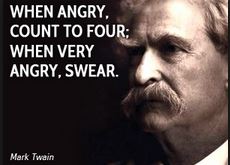
I was mad that cancer had taken the life of a good friend. I was mad at a self-serving state legislature that is pandering to special, extreme interests rather than improving the lives of Mountain State residents. I was mad that years of previous hard work had been torn apart by people who care more about touting their own importance than about doing the right thing. I was even mad that I had spent the day fighting with my work computer, which was eventually diagnosed with having either a bad virus or a bad hard drive.
Most of all, I was mad that not one of those situations was within my control.
And so, I lay awake thinking that, since I couldn’t change the random nature of life or the priorities of other people, I could at expose the selfish nature and behavior of others.
But no matter what scenario I imagined, I was never satisfied.
My friend would still be dead. Constituents would still vote against their own self interest and politicians would still prey upon emotional rather than rational voters. All of my hard work would still lie in ruins at the hands of people who never really tried to understand my efforts, and my computer would still be on a shelf waiting for repair.
And I would still be angry.
My mood hadn’t improved by the time I arrived at work the next morning.
Knowing that I had to put my anger aside, I spent the first few minutes in my office repeating one of my favorite quotes, “Holding on to anger is like drinking poison and expecting the other person to die.”
Saying those words to myself wasn’t sufficient, so I started sharing them with others.
Then something miraculous happened.
The people with whom I shared that quote not only empathized with me, they also shared their own anger.
In doing so, we talked about our values and about not feeling valued. We talked about how difficult people are often doing their best and just don’t know or have the skills to do better. We talked about our own successes and all that we hope to achieve in the future.
And when we spoke, we didn’t use flowery language that made us sound noble. We spoke from the heart with words that are best left behind closed doors (they were) but are sometimes the best way to describe our feelings.
I hadn’t had a complete attitude adjustment by the end of the day, but I did gain something important: perspective.
No one goes through life untouched by anger, and pretending we are above it is ridiculous. Instead, if we share it in the right way with the right people, we can learn more from anger than we ever could from happiness.
With that said, I’m hoping to be much less studious in the next few weeks.
I can only take so much anger management.
Saying Goodbye
I debated writing this post.
These are probably the most personal words I have ever written, yet I feel guilty about writing them.
My friend is dying of cancer. She has been given only hours to live.
Despite the tears making wet trails down my cheeks, I feel guilty about the enormity of my grief. Her husband, children, parents and even other friends are losing someone who occupied a much bigger space in their lives.
I feel guilty because they value their privacy and my friend’s privacy, and I don’t want to violate that.
And yet, as always, I feel the incredible need to write something about the situation. I feel as though putting my thoughts into a concrete form will somehow make sense of an incredibly unfair situation.
If my friend, the lawyer by education and the social worker by heart, could read these words, I know exactly what she’d say.
She’d tilt her head ever so slightly, give me a sidelong glance and say “curious.”
My friend never understood why I wrote.
I remember one particular conversation that occurred while we sat drinking margaritas as we looked out over Pamlico Sound in the Outer Banks of North Carolina.
“You write for pleasure?” she asked in her trademark flat yet completely expressive voice.
We were discussing a possible career change for me, and she was trying to make sense of what she considered a completely ridiculous notion that being creative could actually be a profession.
“But who would read what you wrote?” she asked.
“You already do,” I replied.
“Yeah, but I don’t pay for it,” she said.
That ended the conversation but not our friendship.
Now, on an extremely cold February night, I’m grieving the loss of that friendship while simultaneously trying to remember how it even began.
I remember how we met, but I can’t remember how we grew from being acquaintances to being friends. I can’t remember when she became THE person I texted when I was most pissed off because I knew she would respond with some sardonic comment that would make me feel better.
Just today, despite a final visit to her hospital room yesterday, I found myself picking up my phone to tell her about a completely ridiculous situation.
That was the bittersweet moment when I realized that her diagnosis of cancer had gifted me with a reminder about the value of time, of enjoying completely inane moments and of appreciating the sometimes random events of life that bring people together.
Cancer completely sucks, but it also has the amazing ability to remind us of how beautiful life can be.
As my friend would say, “curious.”
I’ll miss hearing her say those words, but I’ll never forget how they always made me smile.
This final goodbye would be much more difficult if she hadn’t given me so many of those smiles.
Thank you my friend.
Thank you so very, very much.
The Drug Test
 O.K. I get it.
If you don’t know anything about “the welfare system,” then drug testing “people on welfare” makes sense.
After all, your hard-earned taxpayer dollars are being used to support “people on welfare.”
Even on days when you don’t want to go to work, you show up because that is what is required for you to bring home a regular paycheck. Obviously, “people on welfare” are looking for an easier way to get money.
And, because they aren’t working hard like you are, they must spend their time doing whatever they want – including watching television all day and doing drugs. Since they don’t have jobs, the money that “people on welfare” use to buy those drugs is obviously coming from their “welfare check” that we, the hard- working taxpayers, provide them. If they didn’t use the money from their “welfare check” to buy the drugs, then they don’t need a “welfare check” at all.
To ensure that no one “on welfare” is using our money to buy drugs, then we have to drug test them. That way we won’t be wasting taxes, right?
Wrong.
The seemingly ongoing demand and state jumping on the drug testing band wagon isn’t based on facts and statistics but rather on prejudice, stereotypes and misinformation about “the welfare system.”
It’s also a waste money. Requiring drug tests for individuals who receive social services benefits has consistently been shown to increase administrative costs with little else to show for the efforts.
When the State of Tennessee started testing individuals who applied for Temporary Assistance to Needy Families (TANF), only 37 out of more than 16,000 applicants failed drug tests during a six month period. Those results weren’t much different from those in other states, such as Utah and Florida.
I don’t know what the cost of administering those tests was, but I do know there is no way that those results can be spun to indicate cost-effectiveness. But then, the outcry for drug-testing people who receive TANF has never really been about cost-effectiveness or even helping families with drug addiction.
It has always been about pointing fingers at low-income people and blaming them for their circumstances.
Despite public perception that “people on welfare” are lazy and don’t do much to contribute to society, the life of people who receive TANF isn’t all that restful. First they have children to raise.
TANF, which was established during the Clinton administration, is only available to families with children. It also requires recipients to participate in programs that help them learn skills and gain employment. In West Virginia, TANF recipients are required to sign a personal responsibility contract which they have to follow or they will lose benefits.
Even if they do all that is required of them, federal law prohibits them from receiving more than 60 months of assistance during a lifetime.
For a small amount of cash assistance (in West Virginia, a family of four receives an average amount of about $385 each month), TANF recipients must go to classes, do volunteer work and actively seek employment. Studies show that the average time any individual receives TANF is 24 months, and that is usually the result of unfortunate circumstances like the loss of a job or divorce. Much like an insurance policy, TANF was available to these individuals who had been taxpayers but fell in tough times until they could once again be taxpayers.
I have many more friends who never used TANF not because they never had financial difficulties but because they had the resource friends and family to help them through the crisis. Not everyone is surrounded by people who have the resources to help.
But even when we look beyond the stereotypes about who receives TANF, there are even bigger issues.. For example,what happens when someone does test positive for drugs? What will happen to their children (since they must have children to even receive the assistance.) Just as critical, who will be responsible for treatment and recovery services? In my community, those services are usually unavailable and inaccessible to low-income and rural individuals. Advocates have been complaining for years about the lack of treatment programs. Before we focus on drug testing anyone, we must have the community capacity to help those who struggle with addiction.
The call for drug testing “people on welfare” only makes sense to those who either don’t understand the social services system or who don’t want to understand it. It only makes sense to people who don’t mind stereotyping low-income people or who don’t realize that’s what they are doing. And it only makes sense to those who think that subjecting people who are already struggling to additional accusations is more effective than subjecting them to a helping hand.
Conversations with Strangers Part 2 – The Phone Call
 Wallowing in self-pity never results in anything positive, and I’m generally annoyed by people who use it to gain attention.
At the same time, I’ve been told that sometimes the behaviors that annoy us most are the ones we revert to when we are at our worst.
I was at my worst this week.
Nothing horrible or life shattering happened. I just had to deal with some difficult and taxing situations at work. By the time I got home each night, I was too exhausted to do much more than complain about how tired and stressed I was.
I deal with people who struggle to meet their basic needs on a daily basis, so I should recognize how fortunate I am to have a warm and safe home to take shelter in each night. I have friends who are struggling with serious health issues, so I should wake up grateful for a (relatively) strong body and mind. I know people who go to jobs in which their only reward is a paycheck, and I should realize that being passionate about my work is more gratifying than any financial reward.
And yet, I forget.
This week I forgot so much and complained so much about my stress that I was even starting to annoy myself.
Which is why, when my cell phone rang at 6:30 on Friday night, I almost didn’t answer it. The caller i.d. showed that a volunteer from my office was trying to reach me, and I thought I had reached maximum capacity for anything work-related. At the same time, the responsible side of my personality (the stronger one that completing despises my whining and self-pitying side) had to answer the phone.
So I answered it, and the call served as a wonderful reminder of why I should be grateful for feeling overwhelmed at times.
The volunteer actually wanted me to speak with his wife, who was also interested in being a volunteer. The couple recently retired in another state and moved to my town to be nearer to their children and grandchildren.
I’d never met the woman who I spoke with on the phone, but on a cold evening in February, she was the only person who was able put my week in perspective.
I initially tried to hurry her off the phone. After confirming when she would come in to discuss volunteer opportunities, I said, “Have a good weekend.”
She wouldn’t let me go that quickly.
“I’m just hoping you can help me,” she said.
That shut me up.
“My mother is 94 years old,” she said. ” That means I likely have 30 years of retirement ahead of me. Everyone tells you that retirement is great. No one tells you that no one values your skills anymore.”
She went on. “I used to take pride in my work. I liked contributing something. I don’t feel as though I’m doing that now.”
I told her I understood.
And I did.
I may complain about all the stress in my life, but that stress means that I’m overwhelmed by demands on my time and talents. That stress means that others depend on me and need me. That stress means that I’m valued and that others recognize how important my contributions are.
In other words, the type of stress I experienced last week is a reflection of what I value most: the ability to make a difference to others.
The woman I talked to on Friday night may or may not decide to be a volunteer at my office. But whether she does or not, she’s already made a difference in my life.
Sometimes, strangers can do that.
Would Anyone Miss Mrs.?
 My co-worker stood in the doorway of my office with a book in her hand.
“Can I complain for a minute?” she asked.
“Sure,” I answered. And I meant it.
One of the reasons I love my job is that I work in an environment of open doors and open ears. Most of us have ever-growing “to do” lists, are trying to meet multiple demands from multiple people and are always aware that we may have to drop everything in order to meet the needs of the people we serve. Despite that, or maybe because of it, we always make time for each other.
And so it was when the immigration attorney in the office next to mine needed to air her grievances.
And when she did, I understood.
She was recently listed in a professional directory with a Miss in front of her name. “There’s nothing to indicate that I have a law degree or that I passed the bar exam,” she sighed. “Basically, the only thing people know from this publication is what my job title is and that I’m single.”
I glanced through the directory noting that all of the women were listed as either Miss or Mrs. Since I’m neither (I’m married but didn’t take my husband’s last name), I had to question why, in this day and age, the terms are even needed. I’ve been married 21 years, have two children and have never once felt that my life would be better if people called me Mrs.
As we discussed the issue, a male colleague chimed in.
“I understand the need to differentiate between male and female,” he said. “There are women that have my first name, and I want people to know I’m a guy. But my wife and I have had this conversation on numerous occasions, and she thinks Ms. and Mr. are is all we need”
I’m with him (and his wife).
With all the advances women have made, I don’t understand why we often still address them based on marital status (or questionable marital status) while we address all men the same, regardless of marital status.
I know the distinction is probably a result of days when men were in charge and women (supposedly) embraced marriage as the ultimate achievement. But those days are over (except for extremists like the Duggar clan.) Women who want to take the traditional path of changing their last name when they marry can and should.
But women who are listed in a professional directory should have the assurance that people are much more interested in their qualifications than with their marital status.
Besides, I doubt anyone under the age of 50 (other than the Duggars) would even notice if the term Mrs. goes missing.
Patterson’s
 Sometimes, the history that captivates us most isn’t the one that has shaped who we are but instead is the one that has shaped others.
I didn’t grow up in the town where I now live, and no significant life events have occurred here (yet). Despite that, I can’t shake the nostalgia that often hits me at the oddest times.
Take, for example, my daily mail run during the work week.
My office is located two blocks from Patterson’s Pharmacy, where a mailbox sits just outside of the picture windows.
Almost every day, when I am dropping off the office mail, I glance in at the patrons sitting at the old-fashion soda fountain.
For the most part, these individuals are, at a minimum, a couple of decades older than I am. Most are at least 30 years older.
Sometimes they wave at me, but often they don’t because they are too engrossed in conversation. Despite their general camaraderie, there is always at least one person who hides behind the daily newspaper, with his head stuck in so far that I’m not sure he’s reading or using the paper as a shelter from the outside world.
I’ve never noticed what or whether people are eating or drinking, but my guess is they are generally sipping cups of coffee rather than the homemade milkshakes, malts and sodas that interest the younger generation. These are the treats that my children and friends enjoy despite, or maybe because of, the old-fashion counter, historic photos and the general slow pace of the place.
Last Friday, my daughter and her friend asked me to take them to Patterson’s. We took our seats on the soda fountain stools, even though no one was behind counter.
The old woman next to me in the knitted cap didn’t say anything. The two elderly gentleman on the stools at the end of the counter were quiet for about five minutes until I asked the girls if they were willing to wait or wanted to go elsewhere.
“She’s at the bank to get some cash,” the one man told me. “She’ll be back soon.”
No one said who “she” was. Everyone knew it was Ginny, whom I also see daily and has worked at Patterson’s since I moved to town.
No one seemed concern about Ginny’s absence. That’s the slow pace of business at a place like Patterson’s.
No one is worried about following the rules of corporate America in which money is often more important than people. Patterson’s is a local business in a small town. It caters to older people as well as 13 year-old girls who want a genuine root beer float and are more than willing to spend time chatting with each other at a old-fashion soda fountain rather than demand that their drinks are available immediately
At Patterson’s, people are important.
I know this because they are one of very few pharmacies that provide services to the people whom Catholic Charities, where I work, helps. These are people who often can’t even afford the $1.00 co-pay needed for a prescription. But Patterson’s works with us to ensure that people who need help get help.
And sometimes that help doesn’t come in a bottle but instead comes in the form of a safe place.
Last Friday, as my daughter, her friend and I waited for Ginny, the old woman in the knit cap on the stool next to me finally began talking.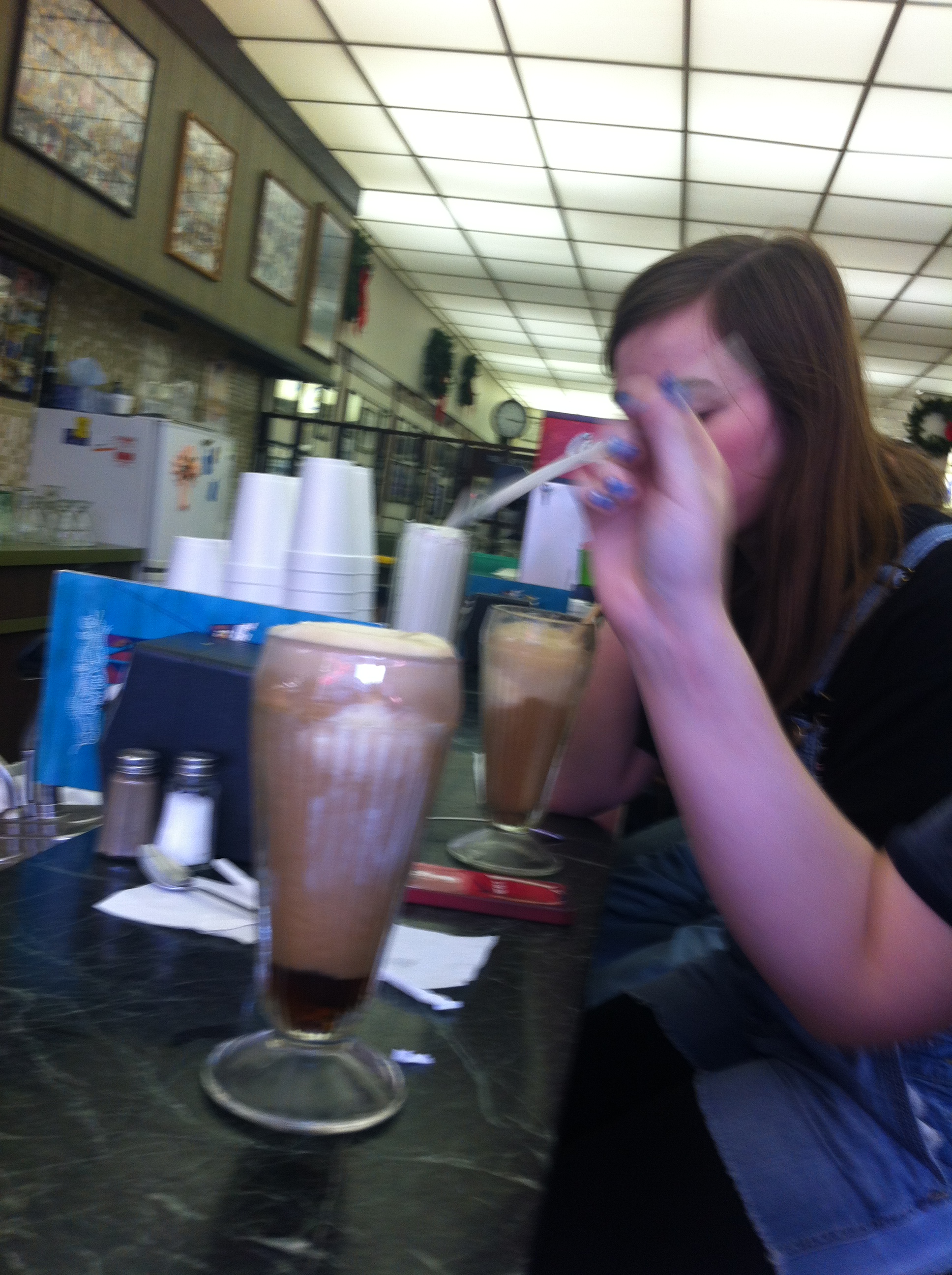
“How old are your girls?” she asked me.
“Thirteen,” I said.
“Thirteen? They are awful big for 13!”
I looked at my daughter and her friend. Neither was wearing makeup and both were wearing t-shirts and Converse tennis shoes. To me, they looked exactly 13.
“In my day, kids were a lot smaller,” she said.
“When was that?” I asked.
“Back in the 1950’s,” she said, “I had kids in the 1950’s when Martinsburg was still Martinsburg.”
“Hmmm,” I responded. Ginny was back, and I ordered the root beer floats.
“I grew up here,” the woman in the knit cap said, “but you wouldn’t know it. I don’t know anyone here now. I don’t even know what happened to the bars. Back in my day, there were bars here but there wasn’t the traffic we have today. There’s too much traffic now.”
“Hmmm,” I said as Ginny filled glasses with root beer and added a scoops of ice cream.
“What is that?” the woman asked looking at a glass with a bit of suspicion.
“A root beer float,” I answered.
“I can’t drink that anymore,” the woman said. “It does something to my stomach.”
“Hmmm,” I said.
“I don’t like this town anymore,” the woman in the knit cap said. “It’s full of people I don’t know doing things they shouldn’t do.”
She shrugged then looked at my daughter and her friend.
“What are they drinking?” she asked.
“Root beer floats,” I answered.
“I can’t drink those anymore,” the woman said again. “It does something to my stomach.”
And so are conversation went. She asked me the same questions and when I answered, she gave me the same responses and the same complaints.
When the root beer floats were gone and the girls were ready to go, the woman said goodbye then struck up a conversation with Ginny behind the counter.
“How are you feeling today, Shirley?” Ginny asked.
“Not good,” said Shirley. “I don’t know anyone in this town anymore.”
“But they know you,” I thought as my daughter and her friend smiled at her and said goodbye as we walked out the door.
“Sometimes, the history that captivates us most isn’t the one that has shaped who we are,” I thought. “Instead is the one that has shaped and is shaping others. And sometimes there is noting more magical than watching it shape very different generations at the same time.”
The Wise Women
 This time of year, wise men get a great deal of attention – as they should.
But as I look back on the past year, I find myself appreciating all of the wise women who were a part of it.
These are the women that may not have made a loud splash in my life but instead helped me quietly navigate both rough waters as well as the still waters of day-to day living.
Their experience, intelligence, kindness, humor and support refilled my toolbox with gems I will treasure for the rest of my life.
And just as the following gems have helped me deal with difficult people and tough circumstances, I have no doubt that the wise women in my life would want me to share them with others.
And so I will:
“The older you get, the less and less you care about what others think. That’s the beauty of getting older and the reason we can take joy in embarrassing our children on a regular basis.”
“Sometimes we just have to sit back and watch other people implode when their desire for importance exceeds their ability to actually be important to anyone else.”
“Men will never laugh so hard they pee their pants. That’s kind of sad.”
“Some people are intimidated by a strong woman, but that doesn’t mean you should stop lifting your intellectual weights. Take pride in the fact that they can’t win an arm wrestling contest with your mental muscles.”
“Keeping your mouth shut is sometimes much more powerful than saying anything at all.”
“We rub elbows with delusional people every day. These are people who think they are leaders but never turn around to see that not only is no one is following them, but many are running as far as possible in the opposite direction.”
“Being honest in a resume is far more important to the soul than getting a job based on half-truths.”
“There’s absolutely nothing wrong with sleeping in a pretty dress if it makes you feel good about yourself.”
“Mean and angry people are actually very sad, broken people who don’t realize how unhappy they are until they are standing by themselves yelling at an empty room or, even worse, standing silent in an empty room because there is no one left to listen.”
“Life is one big choice. Choose to embrace those things you love, forgive the people you don’t love and let go of everything in between. In the end, all that matters is that you weren’t hateful.”
As I review these gems, I can only look forward to yet another year with wise women who can once again fill my tool box.
Getting Real About Giving Thanks
 This Thursday will be my 47th Thanksgiving, which means I’ve had a great deal of experience hearing people give thanks for family and health and God.
I’m not questioning their gratitude.
I too am thankful for those gifts.
I’m also thankful for hot showers, coffee, the internet, my car’s heated seats, wine, Netflix and a husband who sends me roses when he knows he’s made me mad. And I’m not going to feel selfish for saying so.
There is, after all, something to be said for heartfelt thanks, such as that expressed by my fourth grade classmates in November 1976.
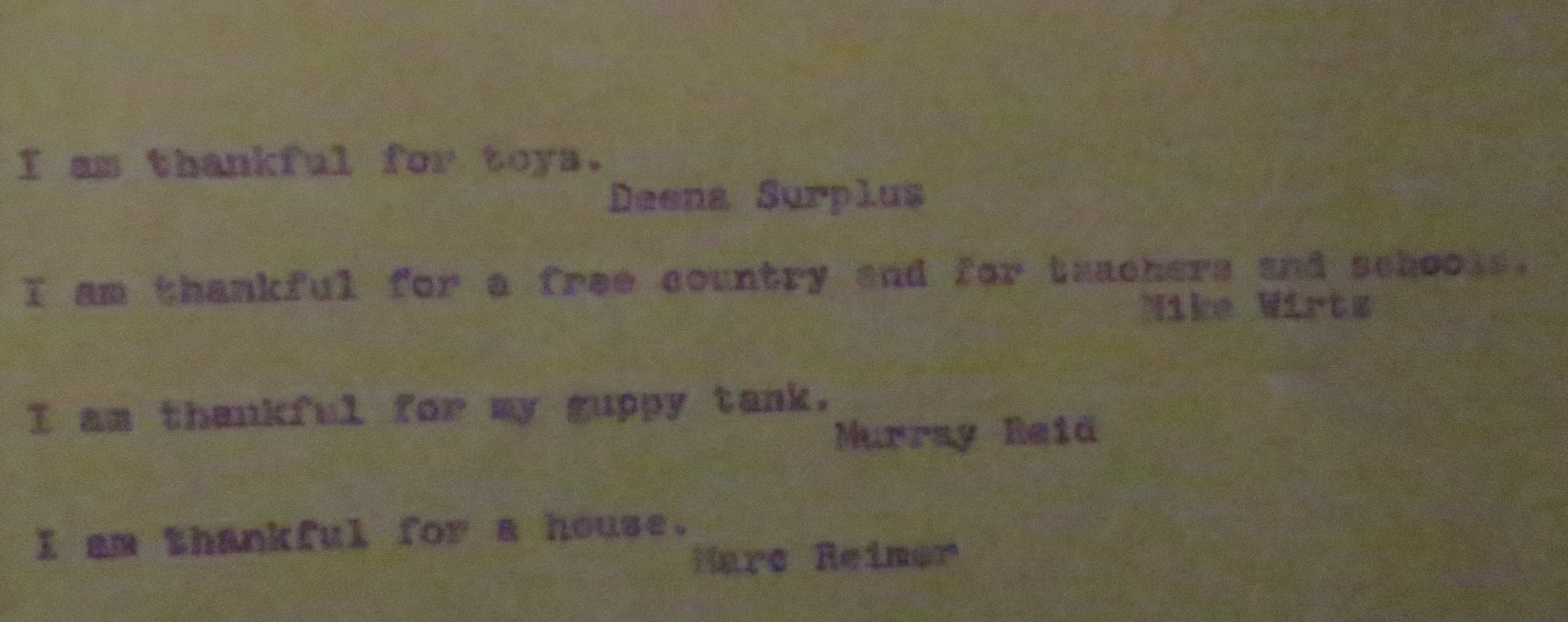 I re-discovered their gratitude recently when I flipped through a childhood scrapbook and found a booklet from that year.
In those days before word processing, personal computers and printers, my teacher typed her students’ responses to the question “What are you grateful for this Thanksgiving?” Later, she gave each of us a mimeographed copy of our responses.
In reviewing the gratitude in that booklet, I am completely in awe of the wisdom of a group of fourth grade students in a rural community in 1976.
We knew to be thankful for our bicycles and birthdays and toys.
We knew to be thankful for teachers and doctors and friends.
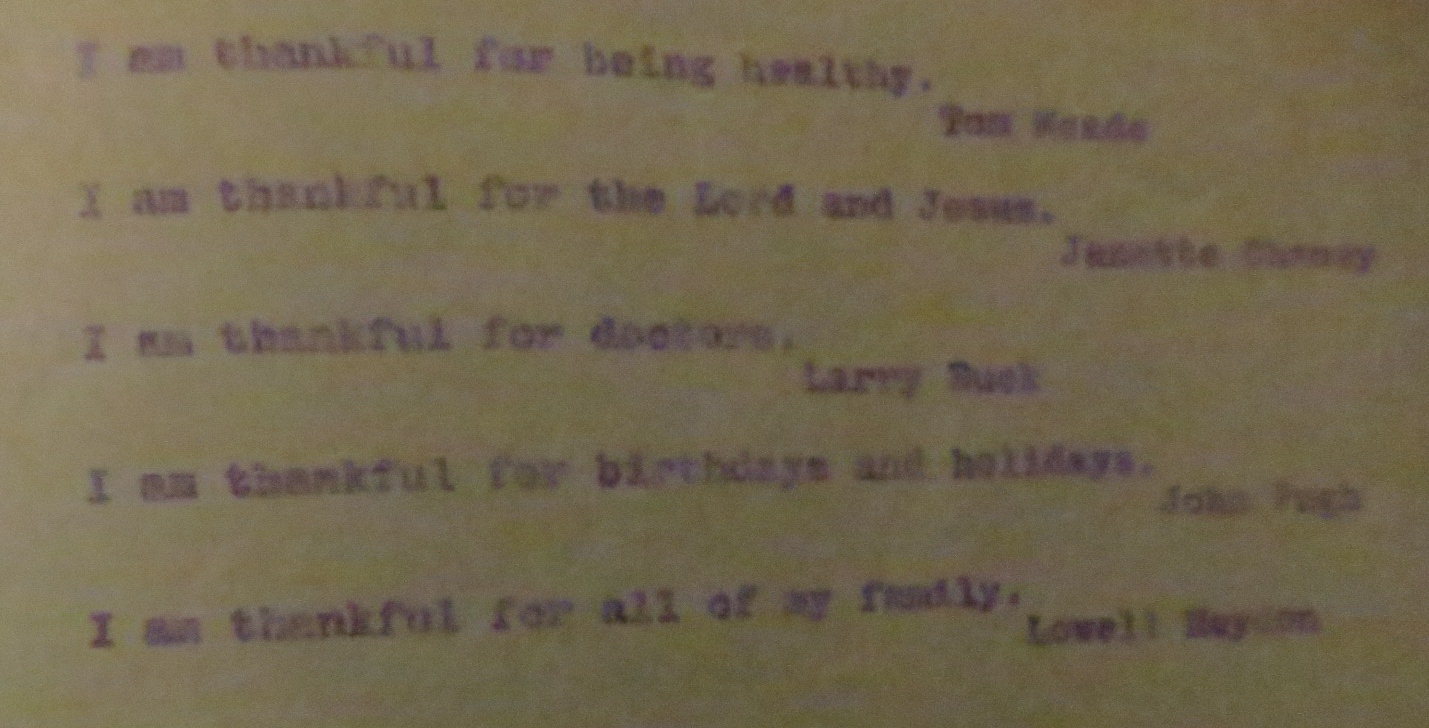 And we even knew to appreciate beauty in the world, the support we gave each other and even ourselves.
Reading the words of a group of children who are now middle-aged adults marked by the scars of experience, I can’t help but smile and recognize something else for which I am extremely grateful.
I will forever be thankful for memories , the people who helped create them and the people who helped preserve them.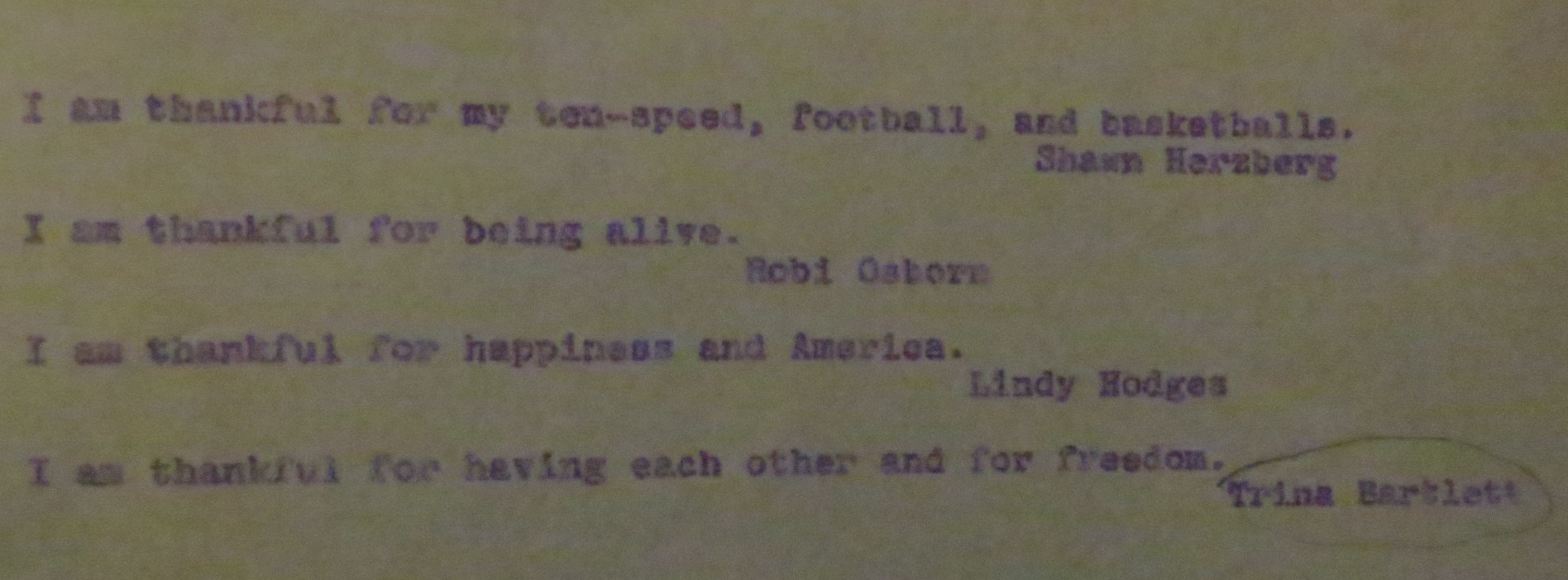
Happy Thanksgiving!

Conversations With Strangers – The NYC Subway
There is something incredibly comforting about conversations with complete stran gers with whom we only share are a few random moments in the same location.
We don’t have to worry about making an impression or searching in vain for something we have in common. We simply accept the fact that connecting with another human, even for just a few minutes, will always be more meaningful than comparing a long list of accomplishments, the size of our house or our connections with what we deem powerful people.
I was reminded of this last Friday on the subway in New York City.
I was lucky enough to have a seat on the crowded train, but that seat was very, very small. My thigh was wedged up against that of the man next to me. Societal rules dictated that I ignore the contact, but apparently he didn’t abide by those rules and immediately engaged in conversation.
In a thick Hispanic accent, he asked if I lived in the city. When I told him no, he told me he didn’t he either. He had grown up in the Bronx, but he now lived in Kellogg, Michigan. He wanted to know where I do live. When I told him, he asked whether I lived near the ocean and if the winters are bad. apparently, he still hasn’t recovered from the one he experienced in Michigan.
He and his wife applauded as my daughter and her friend broke into song, and he told me that his cousin had started the children’s chorus in New York City. He gave me tips about navigating the subway system, and he shared his excitement at being back in “his city.”
At one point during our conversation, his wife urgently grabbed his arm and started speaking rapidly in Spanish.
“She wants to know if you are Polish,” he explained to me.
His wife gave me a brilliant smile, and I felt some sense of guilt asking “why?”
“Because you look like her good friend who is Polish,” he said. “Your features are the same.’
I glanced back at his wife who was still beaming and shook my head. “Not Polish,” I answered.
She nodded in understanding as the train grinded to a stop – our stop.
“Have a good life,” the man said as I stood to leave.
“You too,” I said.
That ended a generally unmemorable conversation, and I know I’ll never recognize the man if I ever see him again. He was just a random person on a train with whom I happened to share a moment in time.
Yet, ironically, I’ll never forget him because he gave me a little piece of himself to me.
He and his wife provided my daughter with an audience and applause in New York City. His wife seemed to think I must be a good person because I reminded her of a dear friend. Most importantly, the man took an interest in me not because society required that of him but because he recognized the importance of humanity. And because of that, I gave a little piece of myself to him.
I couldn’t ask for more.
He, a random stranger on a subway train, taught me how much total strangers can bring into our lives and how much sharing those encounters can bring into the lives of others. I’m looking forward to many more conversations with strangers.


 Just So You Know