Author Archives: Trina Bartlett
For Just One Perfect Moment
 During all of my nearly 50 years, I can recall only one time that I literally stopped to think “This is one of the moments that I need to treasure. I need to store it in my memory right next to my heart so I can pull it out when times are tough. I need to remember how the sun feels on my skin and how I’m surrounded by people who only want the best for me. I need to capture the absolute essence of happiness that is permeating all of my pores so I can remember that life’s most important moments aren’t always big events but sometimes rather uneventful instances that actually mean everything.”
These thoughts came to me on a warm spring afternoon my senior year in college. My friends and I had skipped class to spend time at the lake at Strouds Run, a state park near the campus of Ohio University. My future was a complete unknown, and I had absolutely no idea where any of us would be in just a few short months. I had little if no money and no prospects for a job. And yet, I was completely happy to focus on enjoying an absolutely perfect moment.
It was so perfect that now, nearly 30 years later, I still remember how I wanted to hold on to it forever.
After that, life got more chaotic and often more serious. New people entered and exited my life. Circumstances changed often and significantly. And I changed.
Amid all that, I never again stopped long enough to recognize the importance of pausing to breathe in then hold on to a simply perfect moment.
That’s not to say I didn’t appreciate such moments. I did.
But there is a difference between appreciating something and treasuring it.
And lately, the person I used to be has been sending that reminder to the person I am now.
Maybe that’s because, with my son in college, I’m thinking more and more about that time in my life. Or maybe that’s because in two weeks I’ll be going to my college homecoming and reuniting with friends I haven’t seen in almost 30 years. Or maybe (and this is what I choose to believe), it’s because I’m tired of always worrying about what will happen when those perfect moments end and the complications, heartache and struggles return.
Because they always return.
But I’ve now lived long enough to know that the return of life’s problems provides even more reason to embrace those moments when all seems right with the world.
And I had one of those moments today.
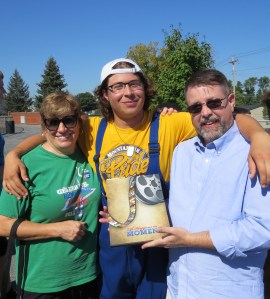
I hadn’t seen my son since the beginning of August when he left for band camp at West Virginia University. With the exception of a few texts and posts on social media, my husband and I haven’t heard much from him. But today, the Pride of West Virginia WVU marching band made a stop in our town in route to a game at Fed Ex Field.
We joined a handful of other local parents and fans as well as students from three schools to watch the band perform. When the show ended, we waited until the musicians had taken their instruments to the buses before coming back into the stadium for bag lunches.
And that’s when I saw my son for the first time in almost two months.
He broke into the same wide grin that he used to give me when I was picking him up at preschool. He doesn’t smile like that much anymore, and I don’t think it’s been captured on camera since he was a toddler. But he was looking right at me, broke into that wide smile and said “Hi Mom!”
And before I walked over to him for a hug and a photo opportunity, the me I used to be started whispering in my ear. She told me to treasure that moment. She told me I needed to store it in my memory and right next my heart so I can pull it out when times are tough. She told me I needed to remember how the sun felt on my skin and how I was fortunate to have people who care about me. And she told me that life’s most important moments aren’t always big events but sometimes rather uneventful instances that are measured by the smile on a child’s face and a love that is greater than any problem we will ever encounter.
And I listened to her.
Too Close For Comfort
 My 15 year-old daughter hates when I write anything without her approval and her editorial input. (For the record, she is an awesome editor.)
But sometimes she’s involved in something so much bigger than her or her editing skills that I am compelled to write without her approval.
This is one of those times.
To fully understand this story, you have to understand my daughter.
She is the girl who cares about every single living being and will always root for the underdog. She is the child who Googled how to provide emergency care for a baby squirrel and made me drive to the drug store to buy Pedialyte and a medicine dropper so she could save the one our cat dragged in.
She makes me buy tofu because it never breathed, can’t enjoy shrimp because they used to swim freely in the ocean and notes that every hamburger was once a cow.
And that same love of every creature is why she saved a cicada that was struggling on the sidewalk.
We were walking our German Shepherd when I heard her gasp and tell me to stop.
“He’s struggling,” she said pointing at the cicada on its back with legs flailing helplessly in the air.”I need to help him.” (Personally, I have absolutely no idea how to tell a male cicada from a female cicada so I went with her assumption that the cicada was a guy.)
Kendall nudged “the guy” with her shoe so he could grab onto it.
And grab on he did.
Once he had flipped himself upright on her canvas shoe, he began to slowly make his way up toward the laces.
And that’s when the screaming started.
“Get him off!” my daughter screamed. “Get him off.”
The piercing quality of her screams gained urgency because I wasn’t acting quickly enough.
By the time the cicada’s tiny, spindly legs had begun to make their way up my daughter’s bare legs, I was convinced that one of the neighbors was calling 911 to report a murder in progress.
When I finally did locate a stick (because I didn’t want to actually touch the bug either), my daughter was almost in a state of panic. Thankfully, I was able to get the cicada onto the stick and then safely onto the grass.
Kendall almost immediately admitted her shame at not wanting to actually touch the bug she was trying to save.
I told her that was natural and she shouldn’t worry, but I couldn’t help but compare that situation to ones I witness almost every day.
I work at a social service organization with a mission of improving the lives of others, particularly those living in poverty.
On a regular basis, I see the generosity of others to help the less fortunate. And not a day goes by when I’m not in awe of individuals who don’t run screaming when they realize that a simple financial donation isn’t enough to raise people out of poverty.
Does the money help? Absolutely!
Is it the answer? Absolutely not!
While there will always be individuals in situational poverty who just need that one financial boost to get them back on the right track, most of the people who walk through my office doors aren’t on any track at all. Instead, they are stumbling through an obstacle course of life designed by people who live in a world that is foreign to them.
Some of them don’t understand the importance of education. Others were taught that arguing and fighting is the only way to get what they want. And some have never even experienced the security of being a priority to parents, caregivers or anyone else who wants nothing in return but their well-being.
Letting such individuals people into our lives can be difficult and frightening. As my daughter stated after the incident with the cicada “My screaming didn’t indicate I didn’t want to help, but I just freaked out when he actually touched me.”
I understand her sentiment, but that doesn’t mean we shouldn’t step outside of our comfort zones.
Saving a life – whether it is that of a bug or that of another human being – often requires us to do just that. It can get messy and dirty and sometimes even scary.
But if we really want to change the world, we have to touch the world we want to change.
The Smell of Guilt and Regret
 When I was about ten years old, I found a starfish lying on the beach and somehow convinced my parents to let me bring it home. I have no idea how I managed that, but I do remember my dad suggesting that we let the starfish “dry out” in his greenhouse.
Dad’s greenhouse was the latest in a series of projects he’d undertaken to pursue his avid love of gardening.
I don’t know why he thought putting the starfish in there was a good idea, but I’m sure he was thrilled with my interest in something involving nature. I’m just as sure that he regretted his decision.
I can’t remember if the starfish ever did “dry out.” What I do remember is the horrible smell that permeated the greenhouse only a few short days after the starfish arrived. I also remember being confused as to why my dad would make such a horrible recommendation.
When the smell was no longer bearable, my dad convinced me that the starfish didn’t belong in the greenhouse, in our yard or even anywhere in Central Oregon. We eventually discarded it, but the stench remained until the greenhouse was torn down. I hadn’t thought of the starfish or the greenhouse for decades until last week when I was out riding my bike and the hot, summer breeze brought with it the whiff of something horrid.
The memory came flooding back.
I shouldn’t have been surprised.
Science has proven that smell is the sense most closely linked to memory and the most likely to elicit strong emotions.
In this case, that emotion was guilt.
I felt guilty about bringing the starfish home. I felt guilty about the horrible stench it created in my father’s greenhouse. And most of all, I felt guilty for questioning my dad’s judgement or good intentions.
But the guilt didn’t last long. I was so very young when the starfish incident occurred. I’ve since made many more and much greater mistakes, all of which have taught me the importance of forgiving myself.
But even more importantly, I’m a mom. I now understand that parenting isn’t necessarily about trying to be perfect in the eyes of our children or about living a life with no regrets. Instead, it’s about teaching our kids that life is one big experiment. And, when things don’t go as planned, we all have to live with and learn from the consequences.
Even when they really stink.
The Note
 There are people who don’t understand what I do for a living or why I do it.
I belong to an underappreciated profession that isn’t well paid and regularly interacts with people who are often discounted by “the establishment.”
But then again, I’ve never been overly concerned about what the establishment thinks.
Great things only happen when we color outside the lines, cheer for the underdog, lift broken spirits, and, most importantly, believe in second chances.
That’s probably why I became a social worker – a profession that is defined by the beliefs that anyone can change and that people, not businesses or corporations, power the world.
The opportunity to harness that potential energy to is what drives me to get up every morning. But listening to the stories of the people I have the privilege of serving each day is what keeps me going.
The power of their stories was never more clear than this past weekend when a friend and I drove by a man who was mumbling to himself as he ambled along the shoulder of the road.
“What’s up with that guy?” my friend asked.
“A lot,” I answered. “He has schizophrenia, he’s been homeless multiple times, his family disowned him, and he knows my name.”
What I didn’t tell her is how much he means to me and all of my co-workers and how we are all relieved when he comes into the office. Nor did I mention that we look through the newspaper and the local jail website when he doesn’t. I didn’t explain how we celebrate when we know he’s taking his medication, can hold a conversation and actually exhibits a great sense of humor.
She doesn’t work in my office and therefore can’t truly understand how being a part of such compassionate workplace is immensely more valuable than a big paycheck.
My friend knows that my fan club is a group of homeless men who hang out downtown during the day. What she doesn’t know is those guys actually have a talent for making me smile on my most difficult days, just as one of our most recent clients did last week.
His name is Joe. When he arrived at our office, he had just released from prison with the clothes on his back, $400 dollars to his name and his prison release letter. A caring landlord was letting him work off the cost of a security deposit, but he was still trying to find money to pay his first month’s rent.
And even though he came to the office looking for help, he was able to offer us more than we could give him. One of our toilets was clogged and overflowing. When Joe recognized the problem, he jumped right in to help.
Trust me, he really did jump and the fix really wasn’t pleasant.
Ironically, the next time he arrived in the office, another toilet was misbehaving.
He fixed that one too.
Since then, he’s weeded our parking lot, emptied our trash and started cleaning or offices on a weekly basis.
The man who grew up in foster care, is functionally illiterate, and is trying his best to stay on the straight and narrow when the odds are again him, has mastered the art of paying it forward.
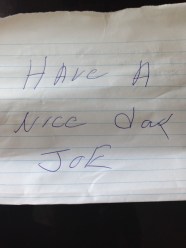
Which is why, when I came into my office on Friday after a morning of meetings, the simple note on my desk meant so much.
The five words “Have a nice day Joe” were more than mere words.
They represented his entire life struggle. I knew that writing that note had been an effort for him but that he believed I was worth the effort.
And I believe he’s worth the effort too.
Words Are the Root of All Violence
There are two national headlines gnawing at my brain right now.
The first is about the murder of three police officers in Baton Rouge.
The second is about WV State Delegate Michael Folk tweeting that Hillary Clinton should be hung on the National Mall.
Both are senseless acts of violence.
Both.
An expression of hate is the ammunition that fuels physical assaults and attacks. It turns the words and actions of someone who looks, thinks, acts, or believes differently into a significant threat to individuals who have been programmed to protect their own closed-minded fortresses of right, wrong, and justice.
Making a statement that any person deserves to be hurt at the hands of another does absolutely nothing to improve anyone’s circumstances. Yet this type of brutality is quickly becoming the norm in the United States.
As a country, we are sinking fast in the rising waters of spiteful words, and no one throwing us a life jacket.
Only we can get ourselves out of this mess, which means we have to hold the haters accountable.
I’m not encouraging censorship. Freedom of speech is a core value, and our nation can only improve when we listen to ideas and thoughts that are different from our own. But freedom of speech must be treated with the same respect that we give to anything that is fragile and prone to break when it is mishandled.
And, as a country, we are being anything but gentle with each other.
Having a right to say what you want and not being held accountable for your words are two entirely different issues.
When I was a child, I lived with the taste of soap in my mouth because I was constantly saying things that provoked my parents. There was no law against the words I used or the tone with which they were said. But my words were disrespectful and inappropriate, and I paid the price by becoming a connoisseur of a wide variety of soap brands.
The soap in the mouth punishment isn’t feasible with politicians, community leaders or others who choose to continue to pollute political events and social media with their hateful and violent words.
But the rest of us can ensure that there are consequences.
We can choose not to vote for them.
We can unfollow them on social media.
We can call other leaders and lawmakers and express our concerns.
We can write letters to the editor.
We can even write blogs about them.
Collectively, when each one of us speaks up, our voices are bound to drown out the nasty ones.
The Lecture
Last month, I was contacted by the Huffington Post about being a contributor after reading one of my previous blogs. Here’s my second post on the HuffPost.
If Only

As a social worker, the most heart-breaking cases always walk through the door on a Friday afternoon when most social service organizations are closing for the weekend, all the organizations are out of funds, and everyone is both mentally and physically drained.
And there is absolutely nothing I can do to help.
So it was a few weeks ago when a woman with three children under the age of four walked through my door. And as the woman told her story, two words ran in a continuous loop in my brain: “if only.”
“If only” I lived in a community with more resources.
“If only” the woman and her children weren’t invisible, irrelevant or deemed undeserving by people who are more concerned about their next vacation or their social status.
But most of all, “if only” our social services system wasn’t so broken that we invest most of our resources into programs that are as effective as putting BAND-AIDS on wounds that need major surgery.
The details of the woman’s story varied only slightly from those I’d heard before.
She had stayed home to raise her three pre-school age children while her husband worked. Everything was fine until, one day, her husband decided he didn’t want to be married anymore. In fact, he didn’t even want to live in the same country she did. And so, he fled – leaving her with no work experience, no support system and three very young children entirely dependent on her.
Unlike me, the woman had never been supported or encouraged to ensure she could be financially independent. No one had even told her that furthering her education or skills was an option.
And so she did the best she could.
She went to the Department of Health and Human Resources and applied for benefits, including Temporary Assistance of Needy Families, or TANF. To receive those TANF benefits, she had to sign a personal responsibility contract that required her to make every effort to find employment. She did just that. The job she found was only part-time, and the limited hours were irregular. As the sole caretaker for three small children who got sick and had other emergencies, she was often late and sometimes missed work.
Unlike me, she hadn’t grown up in a home where steady employment was a top priority. No one taught her the importance of calling in or being on time.
So when her supervisor spoke to her about these issues, she quit.
Unlike me, no one had ever explained to her that the costs of quitting are greater than those of being fired. She just didn’t know. But she soon learned.
Her TANF benefits were sanctioned because she had broken her personal responsibility contract.
Without any income, she got a car title loan to pay the rent.
Unlike me, no one had ever taught her that the interest on such loans quickly grows out of control. And unlike me, she had no support system of individuals who could help her financially. The people she knew were facing similar crises.
Despite her efforts, she couldn’t afford her rent and was evicted. She and her three children went to live in a shelter with strict rules and little privacy. That’s why the apparent kindness of a new acquaintance was so tempting.
The man offered her a free place for her and her children to live.
But, unlike me, she had no role models for healthy relationships. She had no frame of reference that trust, one of the most essential elements of any relationship, takes time to develop. She was in crisis, and people in crisis want one thing: a way out.
And so she accepted the man’s offer even though shelter rules prohibited her from returning for 30 days if she left on her own accord.
Unlike me, she had never been provided with opportunities to reap the rewards of delaying gratification after weighing benefits and consequences. She had only been taught to act on instinct and in the moment.
But less than a week after leaving the shelter, she realized that the promises for a free home didn’t actually come without a cost. She escaped with only her children and a car that was being repossessed because of her failure to pay on the title loan.
And that’s when she landed in my office on a Friday afternoon
I wish I could say I helped her, but all I could do was encourage her to go to another town with a homeless shelter from which she hadn’t been banned for 3o days.
As she was leaving, one of her children asked her if they were finally going home, and her response was “I told you that home is wherever Mommy is.” My heart broke a little.
Her words along with my own words of “if only” have been reverberating in my brain for weeks now.
“If only” echoes every time I listen to representatives from social service organizations report, in an almost congratulatory manner, that they have increased the number of people to whom they have provided emergency assistance. Providing assistance to those in crisis is important, but when the numbers go up, we are reinforcing how little we are doing to improve the long-term circumstances of struggling families.
“If only” echoes every time I hear poverty defined in terms of a lack of money rather than as a lack of resources. We can’t eliminate poverty until we address all the resources people need to succeed – that type of resources that I was so fortunate to have growing up: ongoing support, positive relationships, skills, knowledge, encouragement and role models.
And “if only” echoes every time another desperate individual or family walks into my office on a Friday afternoon and there is nothing I can do to help.
“If only.” “If only.” “If only.”
An Overdose of Reality
 Last Monday night, family and friends celebrated as my son and 255 of his classmates received their high school diplomas
A week later, one of those students died.
My daughter was told about the death at school. My son found out via social media. My husband learned of it from my son. And I received a text message telling me the Spring Mills High School class of 2016 had already lost a member.
Within a few hours, the rumors were swirling through the neighborhood and on the internet. But there was element that never changed: the culprit was heroin
And while many are simply shocked that a kid with so much potential died from a drug overdose, I’m dealing with a range of emotions.
I’m saddened, and my heart breaks for my son’s classmates who are struggling to understand what happened. I’m overwhelmed with how this drug continues to gain strength in my community. And I’m frustrated with the political posturing that’s preventing real solutions to this horrible epidemic.
But, most of all, I’m angry.
I’m angry that so many people are expressing surprise that an athlete with decent grades could die from an overdose. This has been happening for years across the country, and pretending it couldn’t happen at our school was ridiculous.
I’m angry that my community has experienced dozens of overdose deaths since the beginning of 2016 and yet so many people want to blame the victims and their families instead of work toward a solution.
And most of all, I’m angry that drug dealing is yet another example of how money has become more important than human lives.
Nobody in the Class of 2016 can rewind the clock a week and get a do-over, and there is still plenty more heartache to come for everyone involved in this situation.
I can only hope that the members of my son’s graduating class, as well as the underclassmen who will follow in their footsteps, recognize that some of life’s most important lessons don’t happen in the classroom. Even more importantly, I hope they understand that those lessons mean nothing if they don’t use that knowledge in a meaningful way.
In a situation like this, turning those lessons into action is a matter of life and death.
The Graduate

Thirteen years ago,”Pomp and Circumstance” played as my son wore a red cap and gown to accept his diploma.
Because his class was extremely small, the formal ceremony was short. As the post-graduation celebration began, my son led his friends in a unique rendition of the “Chicken Dance.”
Throughout the afternoon, there were several other moments when he grabbed, or attempted to grab, the limelight. At one point, his teacher pulled me aside and whispered “All the world is a stage for Shepherd. Just enjoy it.”
But I couldn’t.
The next 13 years, starting in kindergarten, weren’t easy.
I worried obsessively about my son.
Even though my son was very smart and very funny, I worried that he didn’t have the same interests as his peers.
I worried that he was awkward and uncoordinated and would never find the place where he belonged.
I worried that he often seemed oblivious to what others automatically understood.
I even worried that he didn’t care that I was worried.
But somewhere between kindergarten and twelfth grade, my son taught me more than algebra and English literature classes ever could.
He taught me that going out on a limb will always be more interesting than standing on the ground hugging the trunk.
He taught me that winning a dance contest doesn’t necessarily require the best moves. It simply requires the most guts.
He taught me that more people appreciate the sheep who wonders off to explore new pastures than the ones who stay with the herd.
And he taught me that grabbing a mic and singing in front of the entire student body can never be embarrassing if you get everyone to sing with you.
On Monday, I will listen to “Pomp and Circumstance” while my son wears a red cap and gown to accept his diploma.
I wish I could guarantee he won’t lead his entire graduating class in a rendition of “The Chicken Dance,” but I can’t. Neither can I guarantee he won’t pull off one final, ridiculous high school stunt.
But here’s what I can guarantee: I won’t be worried.
Because I know that my unique, gifted, funny, ridiculous, smart, sarcastic son already has plenty of experience in finding his way in the often rocky terrain of life.
I also know, that his preschool teacher wasn’t entirely right. All the world is not just a stage for my Shepherd. Instead, all the world is HIS stage.
And I can’t wait to see his upcoming performances.
Donald Trump and the Gritters
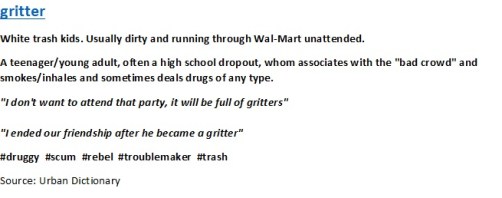
“Gritter.” It was such a completely foreign and wrong word, yet it was also very powerful.
Until I moved to West Virginia as an awkward adolescent, I never knew such words even existed. I was aware that some people used negative words to describe different races, but I didn’t know that there were also words to describe people by their social status. I had certainly witnessed my share of ridicule of the poor and outcast, but I didn’t know there were actual labels for such individuals.
What I did know was that associating with people who wore such labels was social suicide and defending them could be just as dangerous.
I was already teetering on the edge of not belonging, and I was worried that even the slightest mistake would send me hurtling over the edge. I was already considered weird because I had transferred from a state that was thousands of miles away. Then I had made a near fatal error of comparing my old life to my new one. In other words, in the eyes of my peers, I thought I was better than they were.
Nothing was farther from the truth. Maybe, if we hadn’t all been so wrapped up in the complexity of adolescence, my classmates might have recognized how completely alone and alien I felt.
But, they didn’t. Or, if they did, they didn’t care.
And so, I felt a complete urgency to assimilate into a new culture and to adopt a new language, even when it went in the face of everything in which I believed.
I made the mistake of trying out my newly acquired word “gritter” on my family during dinner.
“What does that mean?” my mom asked
I tried my best to explain about the kids on the bus that were gritters and how they wore the same clothes over and over again, lived in the mobile home park and were generally unacceptable.
My parents got really, really angry.
More than 30 years later, I don’t remember much of what my parents said, but I do remember the look on my dad’s face when he said that he would have been a “gritter” in high school. And I remember my ambivalence.
To the depths of my soul, I knew how wrong judging and labeling other people was. But I also knew that I had absolutely no social footing, so standing up against what was a social norm would just further alienate me. My peers had a pecking order, and I wasn’t about to question it.
Until this past week, I’d completely forgotten all about gritters and my parents complete outrage at the ease with which I had used the word.
But then the West Virginia primary election brought it all back.
Donald Trump easily won West Virginia’s nod for President of the United States. While this wasn’t a surprise, the political pundits immediately began analyzing how one of the nation’s poorest states could engage in a love affair with a man who has nothing in common with the people, the culture and, of course, the lack of resources.
And even though I’m personally frustrated by the whole situation, I kind of get it.
West Virginians have been ridiculed for decades. The entire population is often stereotyped as poor, uneducated hillbillies whose culture is defined as being on par with the dueling banjos in the movie Deliverance.
No one wants to be called the equivalent of a gritter. We want people to believe we are better than that, even if that means we point our fingers at other people and blame them, not ourselves, for our problems.
That is Donald Trump’s schtick.
He builds himself up while tearing others down – the poor, the undocumented, women, people with disabilities, people with accents, etc. Basically, he has taken license to belittle anyone who isn’t exactly like him.
No wonder West Virginians are buying it. If elected, they will have a leader who gives them license to call their neighbors gritters and blame others for their problems.
I am only grateful that I am no longer that awkward adolescent that was afraid to speak out or embrace the wisdom of her parents. Now, I’m willing to yell at the top of my lungs “Putting other people down doesn’t make you a leader or a better person. In fact, it does the exact opposite.”
Maybe Donald Trump will never hear me, but at least I know someone will.
And that’s a start.


 Just So You Know