Blog Archives
The Challenge

I was listening to one of my favorite podcasts the other day, and the hosts were bubbling with excitement about having just received their 2022 year in review from Spotify. Since I had just received (and of course shared) my year in review from the language app Duolingo, I realized that these reviews are just another marketing tool to suck us in so we share our results while providing free advertising.
Because they are intended to make us feel good about ourselves, these fluffy, feel good, reports don’t capture a realistic snapshot of what really happened over the course of the past year.
I’m always up for a challenge, so I decided I’d try to create my own (realistic) year in review.
Here’s my best shot with the disclaimer the following may or may not be based on valid data:
Hours I spent listening to true crime podcasts: 836
Hours I spent cleaning my house: 12
Phrase I said the most: “The day I don’t make a mistake is the day I’m dead.”
Phrases I never said, “I’d like to live in Florida.” and “I think Texas would be a good place to live.”
The number of times I went to Google to make a diagnosis based on my symptoms: 18
The number of times I went to a doctor to get a diagnosis based on my symptoms: 0
Pounds I lost trying to get healthier: 8
Pounds I gained from stress eating: 10
The number of times in conversation I said, “I have a story about that:” 422
The number of times in conversation someone said “Trina always has a story:” 421
Minutes I spent doom scrolling the internet: 3,523
Minutes I spent reading serious literature: 0
The number of times I’ve stopped my car in the middle of the street and gotten out just to pet a neighbor’s dog: 43
The number of times I’ve stopped my care in the middle of the street and gotten out to help a neighbor: 0
Tears I shed from dealing with a narcissistic bitch who was gaslighting me: 2,530
Tears I shed from laughing so hard I cried: 3,403
The number of times I’ve said “I feel like I’m a bad mother:” 46
Number of children I have: 2
Number of children who are college graduates: 2
Number of children who have been arrested or gone to jail: 0
Number of children who are gainfully employed: 2
The number of times I’ve fallen down while walking the dog, or going down the stairs, or carrying something heavy: 19
The number of black eyes I had: 1
The number of bruises I had: 1,748
The percentage of words that I uttered that many people would consider inappropriate or swear words: 18%
The percentage of times I regretted not telling someone I loved them: 0.
(If I love you, you will know it – especially if you are a dog.)
This year I’ve learned that sometimes justice isn’t possible, and you just have to walk away from a bad situation even if it means also walking away from unachieved goals and people you care about. I’ve learned that if you are a genuine person who cares about the underdog, you will attract genuine people who care about the underdog. And, most importantly, I continue to learn not to take myself to seriously. I’m the only person who has to spend 100% of their time with me. I might as well enjoy that time.
So here is to 2022 and an even better 2023. Here’s to the people who listened to me cry and rant and to the people who I never want to see again but who have taught me important life lessons. And here is to you. I hope you are your own best friend and that you take care of yourself regardless of what others think. It’s a challenge we can all continue to pursue.
The Cover Up
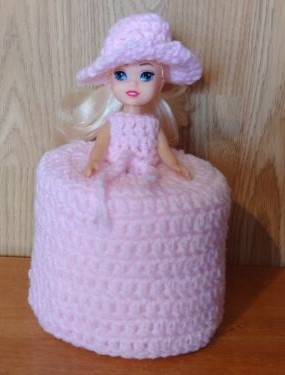
I had an unexplainable flashback to my early childhood the other day.
For some reason, I was thinking about an object that sat on the back of our toilet when I was barely out of diapers. The object looked like a beautiful doll with a large, crocheted skirt, and I thought she was stunning. So stunning, in fact, that I was devastated when my mother told me that I couldn’t play with her because she wasn’t a toy but instead was a toilet paper cover.
She said the skirt was so full because it covered an extra roll of toilet paper.
Her explanation confused me. Why would someone waste a perfectly good doll on toilet paper? But even more curious to me was why we needed to hide the extra roll since there was already a clearly visible one of the holder next to the toilet. If toilet paper was that embarrassing, shouldn’t all of it be covered?
My mom couldn’t answer my questions, and, in hindsight, she probably had the same questions I had. The doll/toilet paper cover thing was definitely not my no-nonsense, practical mother’s style. I’m guessing that it was probably a gift from someone, so Mom felt compelled to use it. My hypothesis is backed up by the fact that the thing never resurfaced when we moved a couple of years later.
I’m not sure why I remembered the mysterious toilet paper cover more than fifty years after I last saw it. But I do know what it represents to me: the tendency for some people to hide what they don’t want others to see by creating distractions. These individuals also shut down anyone who asks questions about what is actually under the full skirt.
Hiding anything is generally problematic, but it can also be particularly traumatic for people like me who question everything and who value transparency.
Over the past few years, I had to deal with a person who wanted to shut down my questions while simultaneously surround herself with people who would swear the object on the back of the toilet was simply a doll with a big skirt and was most certainly not covering up something like toilet paper.
It took its toll on me. I questioned my questions, my self worth, my skills, and my expertise. I could clearly see the toilet paper and wanted to know why it was hidden. But when I asked, I had my hand slapped again, and again, and again and had to deal with a chorus of the hand slapper’s loyal followers who practically chanted “There’s nothing to see here. Just go along to get along.”
I know they probably all saw the toilet paper but were in self preservation mode. I just can’t do that. It’s not who I am. If I don’t call out the hidden toilet paper, I’m fairly certain my brain will explode.
Thankfully, the people I most respect affirmed my questions about the toilet paper and my integrity. They held me up when I would have otherwise crashed. They are what kept me sane.
As I write this, I realize that individuals who don’t know anything about the situation are probably wondering why I am writing something so cryptic, but I have my reasons.
First, a lot of people have asked me why I haven’t been writing. The truth is, when you are beaten down, it’s hard to do anything but survive. For the past three years, I was just trying to survive.
Secondly, I want to emphasize the importance of surrounding yourself with people who build you up instead of tear you down and are willing to look under the big full skirt with you to see what is really there.
And most importantly, I want to publicly state that I have put that entire situation behind me. One of the people who didn’t let me fall actually offered me a path to get away from the toilet paper deniers. I am now walking down it, starting to heal, and starting to write again.
Soon, the situation I left will just be a memory like the weird toilet paper doll cover thing on the back of the toilet, It will continue to fade as more important and current issues occupy my brain. But I know I will still take out the memory from time to time, brush it off, and keep asking questions. One of those questions will always be why so many people denied seeing the toilet paper because, if they had, it could have been used to clean up the load of crap they were also ignoring.
The Place You Belong

I hated feeling like a stranger in my own life.
Thankfully, I rarely experience that feeling anymore, but it used to creep into my psyche like an unwanted encounter with a mean girl from high school. I did my best to present as confident and competent, but I actually felt like a pretender and an invader in the lives of people who really belonged.
I have, after all, spent my entire life living in places where I don’t have a family connection. Or so I thought. Because sometimes, one tiny piece of information can change everything.
For me, that small shift was seeing a headstone at a park where I walk my dog on a regular basis. The last name on the marker is Mowen, which is my great-grandmother’s maiden name. Initially, I just thought this was interesting. After all, I live in the Eastern Panhandle of West Virginia, wedged between Northern Virginia and Maryland. My dad grew up in Massachusetts, my mom grew up in Michigan, and my family moved several times when I was a child. I didn’t grow up around any extended family.
This is probably why I embraced genealogy with a passion and became the family historian. When my grandparents passed away, the treasures I inherited might have had little value for many people, but to me the old photos, ledgers, deeds, and birth certificates are priceless. I’ve done a DNA test, convinced my parents to do a DNA test, and spent hours trying to figure out the puzzle of my family tree. What I never expected was to randomly stumble upon a headstone of a distant relative.
And yet, I did. After logging onto my laptop and doing some simple research, I determined that I was indeed related to the Mr. Earl C. Mowen, who is memorialized by a simple marker on a forest trail in Poor House Farm Park. Granted, the relationship is rather distant as Mr. Mowen and my great-grandmother had the same grandparents.
My great grandmother’s family is actually from Washington County, Maryland, which is only minutes from my house. I have ancestors buried in cemeteries in nearby Hagerstown, and a few geographic locations actually bear the last name of some of my ancestors.
While all of this is fascinating, it shone a light on something even more important: having a family connection to the area where I now live hasn’t affected my feelings about being a stranger in my life. I rarely feel that way anymore not because I have historical ties to this area but because I’ve been able to build my own life. Instead of being a stranger, I’m a main character surrounded by people who accept me, and care about me, and support me even though we don’t share the same DNA or childhood memories. I don’t have to pretend or feel like an invader.
I can create the place where I belong.
Five Questions
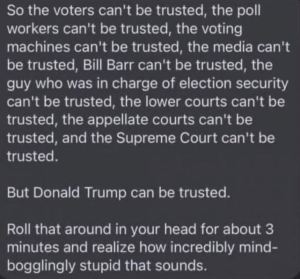 In the weeks leading up to the 2020 presidential election, I noticed a trend on Facebook. Trump supporters were posting false information and then complaining when the Facebook administrators called them out. Apparently, some of these individuals were even getting private messages telling them about the consequences of posting false information. When discussing this, one person said, “everyone is getting that message.”
I wanted to comment, “I haven’t received that warning because I don’t share false information.” I didn’t though, because I was fairly confident I would have been called a lying libtard or told that Facebook was targeting conservatives and protecting progressives.
The irony of all of this is that the people who kept posting false information were the same individuals ranting about “fake news.” While they were definitely projecting (unconsciously taking unwanted emotions, traits, and behaviors they didn’t like about themselves and attributing them to someone else), they were also acting like spoiled children. In their delusional brains, something is only a fact if it justifies their beliefs or meets their needs.
Before the election, I rolled my eyes at their temper tantrums and self-centered posts. After the election, I realized that this twisted thinking, encouraged by President Donald Trump, was dangerous. When Trump and his allies told his minions that the election had been stolen, they believed them. Even when every avenue was pursued to ensure the election results were accurate, including re-counts in Republican-controlled states and court cases, these Trump supporters were convinced, or pretended to be convinced, of some grand conspiracy to steal the election. In an attempt to get their way, they filled busses and airplanes during a global pandemic and went to Washington D.C. to demand that Trump remain president.
The mayhem committed at the capitol building in Washington D.C. on January 6 is unforgivable as are false assertions that members of “Antifa” disguised themselves as Trump supporters and were the actual perpetrators.
Following the events on Wednesday, Trump followers are now complaining that actions taken by social media and technology companies to address hate speech and violence is fascism. Considering the education level of most of the people I’ve witnessed saying this, I’m fairly certain they would be unable to define fascism without being given a computer to Google it. These are, after all, the same people who call any policy with which they don’t agree socialism. The icing on their hateful cake is that many are proclaiming themselves Christians while calling people with different beliefs evil.
Don’t get me wrong. I believe people have the right to different opinions just as they have the right to organize and participate in peaceful protests. What they don’t have the right to do is demand that our country revolve around their belief system. And for those who say that’s not what they want, I have five questions:
- No one disputed that Hillary Clinton won the popular vote in 2016 but that Donald Trump won the electoral college. If Hillary Clinton had proclaimed the election was stolen, filed multiple lawsuits trying to get the results overturned, and tried to convince a secretary of state to find 11,000 votes, what would you have done and said?
- In Italy, the birthplace of fascism, people noted that the scenes at the United States Capitol on Wednesday were reminiscent of events in Italy in the 1930s under Mussolini. You call people who have taken a stand against police violence and for basic human rights as “Antifa,” which is short for Anti-fascists. Does that mean that you are pro-fascism?
- In America, where the economy is rooted in capitalism, the wealthier you are the more access you have to political power. Donald Trump used his wealth and celebrity to win the 2016 presidential election but has yet to publicly share his tax returns. Since taxes are used to pay for public education, public safety, roads, and numerous other services that are equally available to all citizens, the amount he pays in taxes is one mechanism of demonstrating how he much he has or hasn’t contributed to the public good. Taxes are a contentious issue for many conservatives who constantly worry that their taxes might increase (even though they are benefiting from those public services). If the amount people pay in taxes is so important to you, why haven’t you held Donald Trump accountable to ensure he contributes his fair share?
- This week I saw a heartbreaking post from a young woman whose father berated her for not supporting Trump. He told her that college was giving her the wrong ideas. This isn’t unusual. I’ve witnessed numerous Trump supporters complain that colleges are turning young people into liberals. A college education is intended to expand a young person’s knowledge, expose them to different ideas, and teach them critical thinking skills. Are you afraid that people who think for themselves or are better educated than you are a threat who will challenge your belief system or demonstrate that your way of thinking may not be for the greater good?
- A vast number of Evangelical Christians have continued to support President Trump even though he has never been actively engaged with the church or behaved in a Christ-like manner. Among his many behaviors, he has bragged about grabbing women by the genitalia, engaged in name-calling, endorsed policies that separate families, and lied on a daily basis. He cheated on his wives. In order to gain the support of Evangelical Christians, he chose Mike Pence as his vice president, but last week put him in danger when he didn’t “follow orders” to disrupt the electoral process. And he has supported a health care system that operates on the principles of making money rather than on ensuring all Americans have access to it. None of these actions are in the least bit Christian. And yet so-called Christians have supported him in part because of his ability to put in place conservative judges. How do your reconcile the Golden Rule, the beatitudes, and the Ten Commandments with supporting a man who has demonstrated he worships wealth and power more than anything else?
If any of Trump’s supporters read this, they will probably be angry. That’s fine with me. I’ve been angry for four years and during that time the most controversial political action I took was to wear a pink, knitted hat. And, for the record, I didn’t even have to purchase it thus contributing to a politician’s coffers. Someone made it and gave it to me for free because that is what genuinely nice, not evil, people do.
What We Didn’t Say

The conversation with the two strangers started with a puppy. It was an adorable, soft, fluffy, three-month old Husky with bright blue eyes that drew me to it like… well… like any dog draws me to it.
In all honesty, it could have been a mangy mutt, and I would still have stopped my bike ride to say hi. I do, after all, always carry dog treats when I am out riding my bike.
The puppy was trying to catch a quick nap while the person on the other end of its leash was engaged in conversation with a woman working in her yard. I interrupted the conversation to first ask if I could pet the puppy and then to ask all of the important questions about the puppy.
Neither the puppy’s owner nor the woman with whom he was speaking seemed to mind. In fact, their interest turned from the puppy to me.
“How far do you ride?”
“Where do you ride?”
“Don’t you think some of those roads are dangerous?”
The last question prompted a discussion about how some people can be complete jerks.
“Someone once threw a whole cup of iced tea out of their car window at me,” I told them. “It hurt because it was hurtling from a moving car, and I know it was sweetened because it was so sticky.”
“Yeah,” the guy said, “People can be real jerks. I was out jogging once, and someone yelled then through a raw egg at me. It hit me right in the chest.”
We were all silent for a moment before he said, “I had to just turn the other way. There’s no point in confronting people like that. It just makes the situation worse.”
We continued to talk about how confronting angry and rude people isn’t worth the effort. What none of us mentioned, or even acknowledged, was that the stakes were different for the the man.
That’s because the other woman and I were white. The man was black.
If the conversation had been with friends or even acquaintances, we would have addressed the issue of race. But when the man mentioned having the egg thrown at him, I didn’t ask if he thought the perpetrators were racist. When he said he didn’t engage with hateful people because he might land in jail if he got in a fight, I just nodded. And when he said that his wife doesn’t want him to let the dog out at night because the neighbors had threatened to call the police if it barked, I joked that all my neighbors have dogs that bark.
I didn’t raise the issue of racism, but I could feel it hanging in the air like a storm cloud full of rain. And even though it was obviously there – heavy and dark -we acted as though it didn’t exist.
I felt as though raising the issue would be akin to handing each of them a “Black Lives Matter” bumper sticker only to be handed an “all lives matter” one in return. I just didn’t have the emotional fortitude.
The issue of race shouldn’t be political because there should only be one view of it: it shouldn’t exist and when it does, we need to acknowledge and address it.
And yet, just like during my conversation with strangers yesterday, we often dance around racism as if ignoring it will make it go away.
It won’t.
I honestly don’t know that actually raising the issue during that particular conversation with strangers would have been appropriate. What I do know is even though no words were said, it WAS part of the conversation.
And here’s the other thing I know. That puppy? The one that brought us all together for a short period it time? That puppy loved getting attention from all of us and had no concept of race.
Maybe that’s why I like dogs so much.
The Experiment
 When I was about five years old, my mother pulled a chair up to the kitchen counter so I could watch what she was doing.
She got a soup bowl out of one cupboard and a container of cornstarch out of another.
“We are going to do a science experiment,” she explained.
She poured the cornstarch into the bowl then slowly added water. When the mixture was exactly the texture she wanted, she told me “stick your finger in until it touches the bottom of the bowl.”
I tried, but the mixture was solid, and my finger didn’t even dent it.
“I can’t,” I said.
“Yes you can, ” she replied. “Try again.”
I poked at it again with the same results.
“It doesn’t work,” I complained.
“Yes it does. Look.” she said as she put her finger in the bowl. I watch in amazement as what had felt like a rock to me oozed around her finger.
She removed her finger and told me to try again. I did and was once again met with resistance.
“Don’t poke it. Instead just lightly touch it.”
I followed her instructions and was delighted when my finger began to sink into a gooey substance.
I don’t remember if my mom talked about the science behind our experiment, but apparently it had a lasting impact as I’ve been thinking about it recently.
From an early age, my approach to dealing with problems has never been subtle. I’ve been called blunt, forthright and outspoken. I’ve taken in pride in the fact that I always let people know where I stand and, most of the time, exactly what I’m thinking. I’m not good at quietly expressing my thoughts and then letting them soak in while I patiently wait for a response. As my husband knows, when I don’t get a response, I keeping poking until I get one.
Generally, that works, but sometimes it doesn’t. Recently, I’m not only getting resistance when I make a stab at addressing a situation, I feel as though every effort is bouncing back and bruising me. I guess that’s why I’ve been thinking about that experiment at the kitchen counter with my mother more than 45 years ago.
Maybe my mom was attempting to tell me that sometimes you have to stop trying so hard to make something happen and just need to let the situation unfold. In some circumstances, that may be the right approach.
But here is my other take away from that long ago experiment: when you let things rest and happen at their own pace sometimes all you get is covered in muck.
History tells us that change only happens when people are willing to poke their fingers at the problems and keep poking until they make cracks.
I don’t need muck. I need change.
The Racist In Me

My kindergarten school picture
Nearly fifty years later, I don’t clearly remember my first day of kindergarten, but I know I was miserable and complained that I didn’t fit in.
What I really meant was that I was the only white student in my class.
That didn’t last long.
On the second day of kindergarten, Mike Donahue switched classes and joined mine.
I have a few other memories from that year: sitting on the floor at the feet of an elderly tribe member who taught us her native language; participating in the annual root feast; wearing the wing dress my mom had sewn, and being chased and taunted when I was walking home from school. My tormentors, a group of older children, told me I didn’t belong and I needed to move off of the reservation.
The next year I did. I started first grade in a classroom full of white students like me.
When I was younger, I used to tell people that, because of those experiences, I knew what being a minority felt like and that I had experienced discrimination.
I didn’t and I hadn’t.
When I complained about being the only student with my skin color, my white, well-educated parents stepped in to ensure I had a friend in my class. When I lived in a place with a very different heritage than mine, my professional parents bought a house elsewhere among people with similar backgrounds.
In other words, what I actually experienced as a child was white privilege.
I’m still experiencing it.
I guarantee that no one has ever clutched their purse a bit tighter when they’ve seen me in a parking garage. No one has ever called the police because I look suspicious when I’m walking my dog in their neighborhood. I’ve never been patted down or had my car searched when I’ve been stopped for speeding.
But I have been the person who has clutched her purse a bit tighter when she’s seen a black man in a parking garage.
And I absolutely hate that.
My parents raised me better. They taught me not to judge people by the color of their skin. My education specifically addressed prejudice. I am a licensed social worker whose professional ethics are grounded in fairness and equality. My children and friends, who are all strong advocates for diversity, expect more from me.
And yet, I’ve had those moments when my immediate reaction is to clutch my purse tighter.
Living in a racist society has influenced my reactions, but, I am still responsible for them. I am responsible for acknowledging them and I am responsible for changing them.
America should be too.
People Who Don’t Like Dogs (And Other Warning Signs)
My husband told me to write this.
Well, he didn’t tell me to write these exact words.
I was complaining that I can’t relax because I can’t stop thinking, and he told me that I should write. When I said no one wants to read about what is currently going on in my head, he suggested I discuss the weather.
Since today is stormy and perfectly reflects the thoughts cycling around in my brain, his suggestion wasn’t very helpful.
Here’s the thing: the devil on my right shoulder wants me to write about the people who I prefer weren’t in my life right now. The angel on my left shoulder is telling me I can’t always control who is in my life nor can I control their behavior. I can only control my reaction to them.
And right smack dab between my right shoulder and my left shoulder is my head with all those thoughts blowing around like the gusts of wind currently rattling the windows. Since my brain is centrally located in the neutral position, I guess I should feel safe sharing some thoughts about the types of individuals who are currently setting me on edge – people I don’t trust.
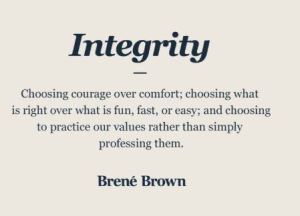 I don’t trust people who never challenge authority. History provides dozens of examples of what happens when people blindly follow the leader rather than do what is right. When people are more concerned about protecting their status than they are about protecting those who are most vulnerable, I will never be able to trust them,
I don’t trust “suck ups” and “brown nosers.” Anyone who uses a significant amount of time and energy trying to impress those in power is doing a disservice to people who actually have integrity. If your words and behaviors don’t provide any evidence of your personal values, I can’t trust you.
I don’t trust people who don’t like dogs. According to my baby book,  one of my first words was “doggy.” When my mom took me to the library as a toddler, I gravitated to the books with pictures of dogs. The worst moments of my life have always improved when I’ve been able to wrap my arms around a nonjudgmental furry friend and sobbed uncontrollably. And yes, I do have human friends who don’t like dogs, but they’ve had to earn that friendship and my trust.
I don’t trust people who have college degrees but still don’t use proper grammar or punctuation. I understand language is learned, but going to college requires a lot of reading and writing. It should also involve professors who demand the use of correct grammar. If you leave college still using mismatched verb tenses and confusing “wonder” and “wander,” you either didn’t truly earn your degree or there is something significantly wrong with your education.
And finally, I don’t trust people who try to buy my friendship or my approval. I don’t need gifts or flowers or disingenuous compliments. If someone has to give me something in order to validate the relationship, it’s not valid at all.
As I was writing these stormy thoughts, I realized my husband’s suggestion was actually a good one. Because as I went through my list of the types of people I can’t trust, I realized something really important.
In all of the aspects of my life over which I have control, I have surrounded myself with people whom I do trust. My friends are social justice advocates who always question authority. They are the people who call me out when I say or do something stupid and allow me to do the same to them. They are the people who give me the gifts of time and understanding. They are people who want to build a better world for others rather than for themselves. And yes, for the most part, they are also people who love dogs.
The Problem
 Every time I think I’ve dealt with the most difficult person I’ve ever met, God laughs. And then another difficult person enters my life.
And every time I’ve struggled with the chaos and hurt that person leaves in his or her wake, I tell myself the same thing: “I’m supposed to learn or gain something from this situation. One day, I will look back and tell myself, ‘Oh that’s why that happened.'”
And up until now, I’ve been right.
But recently, I’ve had a hard time believing myself and in myself. This time, I’m fairly confident that even God isn’t laughing,
You see, I’m dealing with the most narcissistic and manipulative person I have ever met. And no, I’m not talking about Donald Trump (who I’ve never actually met anyway). However, I still respond when people ask if dealing with this person is like dealing with Donald Trump.
My response is, “it’s worse.”
That’s because most people recognize that Donald Trump is a narcissist. Those who support him obviously don’t care, but at least they recognize who and what he is.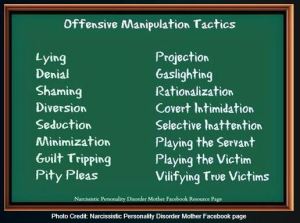
Not so for the individual that I’m currently forced to deal with. In fact, this person is so good at manipulation that I was almost a victim of their false charm and gaslighting.
A part of me wishes I had been.
If so, I wouldn’t be so angry and frustrated, I’ve wasted too much time dealing with the narcissist’s efforts to manipulate. I’ve wasted too much energy being flabbergasted that people in positions to stop the path of destruction actually believe the narcissist instead of those who are complaining. And I’ve lost too much sleep searching the internet for ways to deal with a narcissist.
Unfortunately, all I really learned is that calling out a narcissist only makes the situation worse.
I didn’t have to Google that nugget of information. I learned it the hard way.
That which brings me back to what I’ve always told myself, “Eventually, you will look back on this situation and recognize how much you learned and why you needed to learn it.”
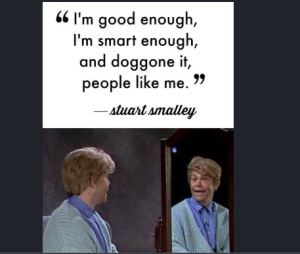 In the meantime, I have to find humor in how ridiculous the situation continues to be and to find solace in the fact that I have a great support system. Just the other day my husband sent me a text message reminding me to channel my inner Stuart Smalley. “You are good enough. Your are smart enough. And doggone it people like you.”
He only forgot one thing, but it didn’t come from the mouth of Stuart Smalley. Instead, it’s from that great philosopher anonymous.
“I’m thankful for all those difficult people in my life. They have shown me exactly who I don’t want to be.”
Horton, Jo Jo, and Dr. Martin Luther King Jr.
 For the past few month’s, I’ve been feeling like Horton the Elephant in Dr. Seuss’ classic children’s book Horton Hears a Who.
If you aren’t familiar with the story, the Whos live on a speck of dust that is floating through the air, which means their entire civilization is at risk of being destroyed.
Because Horton has such big ears, he is the only jungle animal that can hear the Whos. Initially, he saves their community by putting the speck of dust on a clover so he can carry and protect it. His efforts are undermined and ridiculed by the other jungle animals, who try to destroy the clover. Horton rightly believes the only way he can save the Whos is by ensuring their voices are heard by the other jungle animals.
Nothing works until Jo Jo, the tiniest Who of all, joins the effort.
I may not be carrying around a clover, but I am carrying around a lot of concerns. I’m worried that something I’ve cared for and nurtured is going to be destroyed, and the people who could truly protect “my speck’ won’t listen.
Fortunately, unlike Horton who felt all alone in his efforts to protect his clover, I know I’m not alone. Many of us carry clovers. And, like Horton, we persevere because we have to. We are responsible for those who have less power.
Dr. Seuss understood this and passed the message on through his books. Dr. Martin Luther King Jr. understood it and passed the message on through his speeches.
 And they both understood that no voice is ever too small.
Jo Jo had a tiny voice that made all the difference to the survival of the Whos. Members of the Civil Rights movement were the voices that changed the world. And all of us can be a voice for someone who needs our support.
Be a Horton. Or be a Jo Jo. Or be both. But most importantly, be someone who does what you can to make the world a better place for others.


 Just So You Know