Blog Archives
Everything I Need to Know About Valentine’s Day, I learned in First Grade
 I always liked school, but I absolutely hated first grade. That’s because I had a very, very, very mean teacher.
Even forty years later, I’m still traumatized by memories of Mrs. Gladwill.
Normally, I’d feel really guilty calling someone out by name but 1) I’m not the only who has scars inflicted by Mrs. Gladwill and, 2) She’s dead. She died in 2008 at the age of 94. I know this because my mother sent me a link to her obituary. My mother, who is a very wise woman, knew I needed closure.
There’s no need to go into all the details of why first grade was difficult. There are just too many of those details, such as:
Watching fellow students have their ears twisted;
Sitting in class in fear of having “accidents” because, instead of giving permission to use the bathroom, Mrs. Gladwill gave lectures about “not planning accordingly”;
Having my desk put in the corner of the room so others couldn’t cheat from my papers.
But my worst memory, by far, is Valentine’s Day.
Back in the early 1970’s, before there were strict dietary guidelines in schools, Valentine’s Day parties were one of the celebrated days of the school year. Preparation began well before the actual day. By the beginning of February, letters were sent home with both the names of classmates and a list of snacks, such as cookies, cupcakes and candy, that parents were asked to contribute. We used that list of names to painstakingly address a card for every single classmate – whether we liked the person or not. But we did pick out “the best” cards and candy (every card had to have candy) for our friends.
In school, we decorated mailboxes (shoeboxes covered with construction paper) in which our Valentine’s Day cards were to be delivered. The actual celebration was to be a festival of sugar and giggles.
The day before the big Valentine’s Day party, I could no longer hide the fact I couldn’t swallow. I’d begun to worry the day before at school when eating lunch was a painful challenge. At breakfast, while I was trying to somehow swallow a spoonful of Cheerios, my mother took one look at me, told me I looked like a chipmunk and declared I had the mumps.
I wasn’t just devastated. I was horrified.
Mrs. Gladwill simply did not tolerate illness. Every day, after she took attendance, she would take a piece of chalk and scrawl the names of the absent on the blackboard. In the eyes of first graders, having your name on the blackboard was equivalent to the adult version of being forced to wear a scarlet letter. Walking into the classroom and seeing your name on the blackboard was the ultimate walk of shame.
Being diagnosed with mumps was not only a sentence to take that walk of shame, but it also meant I was going to miss the Valentine’s Day party. In the eyes of a six-year-old, life couldn’t have been much worse.
That Valentine’s Day was probably one of the longest days of my life as I spent every minute imagining all I was missing. Finally, sometime after 3:00, I heard the squeal of the school bus’ brakes as it stopped in front of my house. When my brother came into the house, he didn’t call me chipmunk or tease me for missing all the festivities. Instead, he handed me the shoebox I had so painstakingly decorated only a few days earlier. But now, it was full of Valentine’s and candy. I spent hours reading and treasuring all of the cards, even the ones I knew weren’t heartfelt.
A few days later when I returned to class, my name was one of many written in dark chalk on the blackboard. Apparently, some nameless person (me?) had come to school with the mumps and shared the virus with everyone else.
Eventually, attendance went back up and our class returned to the same, miserable status quo. But I didn’t. That Valentine’s Day taught me a lot about love:
1. Love is about the memories we treasure because, even though they sometimes grow out of difficult situations, they remind us of people and challenges we’ve overcome.
2.Love is about finding a song that will mean something to you at any age. For me, the Rolling Stones got it exactly right. “You can’t always get what you want, but if you try sometimes, well you just might find, you get what you need.”
3. Love is about having a family whose support will always make the worst day a little bit brighter.
4. Love is learning to treasure all the small gifts, even ones from people who may not realize that they were giving anything of importance.
5. Love is about taking care yourself, even when others will try to make you feel as though their needs should come first.
Most of all, I learned that Valentine’s Day is much more complicated than cards, or candy or having just one special person in your life. It’s about recognizing and acknowledge everything that makes you happy.
And, over the past 40 years, I’ve been immensely blessed with people, memories and circumstances that make me happy.
Which, is why, even though I may not entirely succumb to the sappiness of Valentine’s Day, I certainly embrace the sentiments, and the lessons, it’s taught me.
The Turmoil of Men, Women, Misery, Illness, Martyrs and Marriage
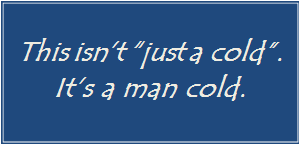 By the end of last week, I was wondering why my husband had married me. Only two days earlier, I’d been wondering why I’d married him.
According to friends, that’s not unusual in a long-term relationship, but I’m not sure my friends truly understand the ugly monster that threatens to wreak havoc on my marriage.
Some call it being sick while others call it having an illness. Personally, I prefer when people say they are feeling “a bit under the weather.” That means they may not be operating at full potential, but at least they are still functioning.
And therein lies the problem.
Whether because of how I was raised or because of my God-given Type A personality, I have an innate belief that when people don’t feel well, they should still try to make some contribution to society.
My husband, on the other hand, believes that the first sniffle or wave of nausea indicates he should lie in bed all day moaning.
O.K., maybe he’s not that quite that bad… anymore. He has, after all, lived with me long enough to know that I’m not the type to provide much comfort when he’s sick. Instead, I am much more likely to tell him to, “suck it up.” At times, I’ve even gone so far as to accuse him of using illness as an excuse to avoid the “honey do” list or to get attention.
I know, that makes me a very bad wife and explains why I’ve questioned that fact he married me. But please note that I’m not a completely bad person.
I DO have empathy for people who are sick, and I DO believe people need to take care of themselves so they recovery quickly and don’t get worse. And I certainly don’t want people coming to work sick. The problem is, I don’t allow myself to take it easy when I’m sick, and therefore set the same expectations for my husband.
Maybe it’s just a man/woman thing. A few years ago, my husband sent me a link to a scene from a British sitcom in which a man believes he’s on his death bed because he has a “man cold.”
I could completely relate, and I think my husband did too.
Last week, he came down with the stomach bug, and I came down with a strong case of irritation. Not only did I have to take on all his household obligations, but he didn’t even offer to try to help. That would have made me feel much better, especially since I always play the martyr when I’m sick. There are many times when I’ve been running a fever or had the stomach virus and insisted that I still had to walk the dog or the world will come to an end.
In hindsight, I was more than just irritated last week, I was also fearful. I didn’t want anyone else in the house to get sick. And while my irritation wasn’t justified, my fear was.
Years ago, when the children were still quite small, the stomach bug caught us all at the same time. Having to take care of small children with the stomach virus is messy, esp when you are suffering the same ailment. At one point, I broke my own rule of silent suffering and proclaimed, “could this possible get any worse?”
It could. As if on cue, one of our two dogs walked into the room and threw up on the carpet. And yes, I was the one who had to clean up that mess too.
So even though my husband thought I was a bit insane last week when I following him around with Lysol and insisting he thoroughly sterilize the bathroom each time he used he, I think he understood just a little.
On the positive side, no one else in the house got sick. At least, not yet.
When Tears Aren’t Enough
I’m rarely at a loss for words, yet I had nothing to say last week when my daughter asked me the simple question “why?”
Instead of answering, I stood silent as a single tear rolled down my cheek.
 We were visiting the United States Holocaust Memorial Museum.
I’d been there previously, but my daughter hadn’t. She’s been studying the Holocaust in school, so I thought she was mature enough to fully appreciate the exhibits and the message.
For the most part, she was, and we took our time going from floor to floor as the timeline of events leading up to the Holocaust unfolded. Then we got to the floor with evidence of the Holocaust and all its atrocities.
We stood inside one of the small, bare and unheated railroad cars that transported up to 100 people to the concentration camps. We stuck our heads into one of the actual bunks from Auschwitz. And we stood next to piles and piles of shoes that were taken from prisoners right before they were gassed.
But nothing affected my daughter more than a photograph of braids in a larger pile of hair the Nazis had collected. (They stuffed mattresses with the hair collected at concentration camps.)
Braids define my daughter. She almost always wears her long hair in one or two braids, and this month, she taught herself to french braid. That made the photo of the braids very personal.
The photo and her reaction struck me too. They reminded me of how incredibly precious my daughter is, and how incredibly precious all the daughters that died in the Holocaust were.
And because of that, I just couldn’t answer her question “why?”
How can you explain to an 11 year-old girl that some people need to point fingers and find someone to blame for difficult times? She lives in a world where that happens on a daily basis. People find it simpler to blame a person or a group of people than they to understand that situations are complicated and are rarely the fault of one person or group.
How can you explain to an 11 year-old girl that some people will simply accept what they read, see or hear when that message justifies their own belief system? She lives in a world where people spew “facts” that are completely inaccurate just because they were presented as the truth.
How can you explain to an 11 year-old girl that some people place their material possessions and personal bank accounts above the health and safety of others? She lives in a world in which people complain that their tax dollars are being used to help those in need.
How can you explain to an 11 year-old girl that some people are comforted by the belief that there is only one legitimate faith. She lives in a world were so-called Christians condemn other religions while claiming ownership of a morality.
How can you explain to an 11 year-old girl that people are comfortable condemning those with different political beliefs and world views? She lives in a world when people use nasty words to define anyone who thinks differently than they do.
And how can explain to an 11 year-old girl that people who loved each other were killed simply for who they loved? She lives in a world where people still claim that some love is an abomination and sinful.
Any explanation I could provide as to why the Holocaust occurred would simply reflect a world in which she lives. And I didn’t want to scare her.
Instead, I scared myself. And no matter how many tears I cry about the Holocaust, I know they aren’t enough to stop the hate that still exists in the world.
The Rapist with the Great Reputation
 During my freshman year of college, female students were on high alert. A predator had taken advantage of unlocked doors to rape at least two co-eds in their own dorm rooms. Flyers with a composite drawing of the suspect along with warnings and safety reminders were hung up all over campus.
I think the guy was eventually caught, but I honestly don’t remember.
What I do remember is that, for a while, most female students were careful about locking their doors and not walking alone after dark. While those precautions should have been and should continue to be common practice, our fears were somewhat misplaced.
Instead of worrying about a stranger jumping out of the shadows to attack us, we should have been alert to those we already knew.
No one ever taught me that, but I learned the lesson anyway. Unfortunately, I learned it too late.
I was already a college graduate when I was invited to a law school party that started like any other. That didn’t last long.
At other parties, I didn’t fall down after one beer. At other parties, male acquaintances with whom I had absolutely no romantic interest didn’t complain, “that’s not how it was supposed to work” when I talked to other male party goers. And at other parties, I didn’t leave with huge chunks of time missing even though very little alcohol was consumed.
I will never know exactly what happened that night. I’ve gotten bits and pieces from friends but, to be honest, I never really wanted to know. For a long time, I was ashamed and believed that I had done something wrong.
Only years later, when I learned about Rohypnol and other date rape drugs, did I piece together what probably happened. And even then, I had no proof that anything happened at all.
Statistics show that such an incident isn’t uncommon. The National Institute of Justice (NIJ) estimates that about 85 to 90 percent of sexual assaults reported by college women are perpetrated by someone the victims knows. Half of all victims do not define the incident as rape because ” there is no obvious physical injury and alcohol was involved.” The NIJ also reports that “approximately 27.5% of college women reported experiences that met the legal criteria for rape.”
What they usually don’t do is report these incidents as crimes.
That’s because rape often doesn’t look like the crime many of us were taught to avoid.
Rape is not just a crime of violent sex offenders who stalk women in dark alleys. It is not just a crime of deranged individuals who can’t control their violent urges and express them through rape. Instead, it is often a crime committed by men or boys with great reputations who, for whatever reason, are seeking to meet their needs by controlling women. And because these men are often respected professionals, athletes or students, they often get away with their behavior.
A former emergency room nurse told me a story about caring for a young woman who had been raped on campus by a student athlete. The university offered to pay the victim’s tuition if she didn’t press charges or go public. She never pursued the crime, but she never went back to school either.
A social worker tells the story of a woman who drank too much and was picked up by a police officer, who, instead of giving her a ticket, chose to rape her instead. She never pressed charges for obvious reasons.
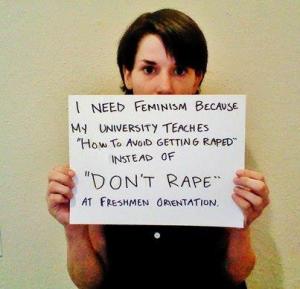
This week, a colleague showed me the photo of a young woman holding a sign that says ” I need feminism because my university teaches how to avoid getting raped rather than don’t rape.” I posted the photo on Facebook, and it immediately got reaction, including those who wanted to emphasize that young women should be taught to take safety precautions.
I couldn’t agree more. But I can’t say that putting all the responsibility on women is fair or appropriate. Universities, and society as a whole, must send a constant and consistent message about the definition of rape and that it is a crime regardless of the circumstances and people involved.
That’s not happening. Instead, the message seems to be that these things sometimes happen when alcohol is involved or when women lead a man on. The message also seems to be that some men are just too important to hold accountable.
And so, I agree with the young woman in the photo.
There will always be individuals who push the limits. The rest of us have the responsibility to push back.
60 Years, 3 Couples, 1 Anniversary and Immeasurable Memories
 From the diary of Letha Bates Smith: “Nov. 29, 1933 Wed. Finished cleaning at the house this morning. Met Sylvia at 3:25. Morden, she & I met Martin in E. Lansing and had the knot tied at 8:30. Home then to Vilas and Evelyn’s for the nite.”
That’s how my grandmother described the day she married my grandfather, Morden, in the chapel at the People’s Church in East Lansing, Michigan with her sister Sylvia and her brothers Martin and Vilas in attendance.
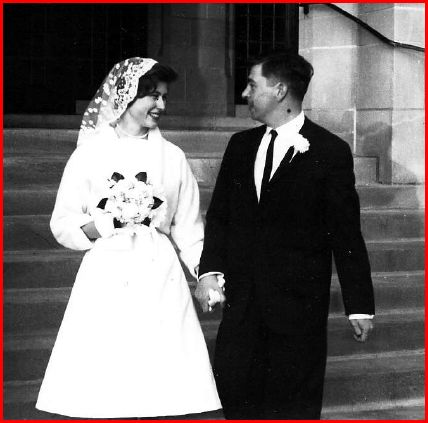
Exactly 30 years later, my mother married my father in the same chapel. Unlike my grandmother, she didn’t keep a diary, but, just like my grandmother, she had a very practical wedding.
Exactly thirty years after that, at age 26, I was a completely different person than both these women. I was definitely less conservative and more reckless. Yet all three of us would be forever connected not just by blood but by our sensibilities and our belief that a strong marriage, just like a strong woman, is defined by substance not glamour.
And so, on November 29, 1993, my grandparents celebrated their 60th anniversary and my parents celebrated their 30th by attending my wedding.
 Letha and Morden
My grandparents met on a blind date while they were both students at Michigan State College (later University) during the Great Depression. My grandmother was one of four children from a farming family in Quincy Michigan who were all determined to go to college. Despite the odds and through their own perseverance, all four obtained college degrees.
My grandfather, the youngest of seven children, grew up in a family that had an uneven financial history – sometimes they had a lot, sometimes they didn’t. My grandfather’s older brother, Carl, had died when he contracted smallpox working in a lab while in medical school. The money from his insurance policy allowed my grandfather to pursue a degree in electrical engineering.
I know little about my grandparents’ college romance. My grandmother wasn’t a talkative or an emotional woman. But for decades, she documented her life in diaries. The one or two sentence entries she diligently recorded provide some insight into the often hidden thoughts of a woman who, on the surface, was practical to the bone. The grandmother I knew had one dress that she wore to every special occasion (including my wedding) for decades. But, that didn’t mean she never cared about a new dress.
“Oct. 30, 1932 Sunday. My sweetheart down today. And what did he bring me – Um does it sparkle? Simply gorgeous delightful! The dear boy.”
“Nov. 1, 1932 Tuesday Met Sylvia downtown this P.M. spent the nite with me. The ring fixed – lovely now – more thrilled than ever. A new dress.”
Even after my grandmother died, we never found picture of her wedding or her wedding dress. At the time of their marriage, my grandfather was a relatively new employee at Citizens Gas Fuel Company. My grandparents chose to get married the evening before Thanksgiving because my grandfather would have a four-day weekend.
My grandparents’ marriage ended when my grandfather died in 1998, just shy of their 65th wedding anniversary. My grandmother would live for another seven years.
The words in her diary will be passed on to future generations.
Evadna and Ken
Following in the footsteps of her parents and her older brother, my mother attended Michigan State University. After graduation, she moved to Manistee, Michigan, but neither her job nor her location were exotic or adventurous enough for her. She wanted to see the world and submitted an application to join the newly established Peace Corps.
After he graduated from Idaho State University, my dad, a Massachusetts native who had already seen a great deal of the world while in the Navy, also applied to join the Peace Corps.
They were among the first individuals ever selected and were in the third group deployed. Before they left for Chile, my parents attended training at Notre Dame University, where they spent days in Spanish class. My father excelled with his ability to speak the words perfectly in his loud, booming voice while my mother shot him dirty looks while she struggled.
Her irritation didn’t last long. Before they returned to the United States, my parents were engaged. Instead of a diamond, my mother wore a simple gold band on her right hand that she would transfer to her left hand when she was married. The only diamond I’ve ever seen my mother wear is her mother’s engagement ring, the one that sparkled so brilliantly in 1932.
After returning to the United States, my father, a forester, got a job in Montana. He hadn’t accumulated any leave, but he was allowed to take a few days for Thanksgiving. And so, a wedding the day after Thanksgiving made sense, and my parents spent their honeymoon driving west to their new home.
They’ve spent the rest of their lives sharing stories of their adventures with their children and grandchildren.
Trina and Giles
Ironically, I met my husband on a November night.
On November 8, 1988, I was a college intern helping cover election results in the newsroom at West Virginia Public Radio. Giles was reporting for his first night of work. He thought I had an attitude, and I thought I had work to do. No sparks flew, and I didn’t give him a second thought.
But after I graduated from Ohio University, our paths continued to cross and our circle of friends became one in the same. Over time and shots of Jagermeister, we eventually ended up together.
Our relationship was nothing like I imagined everlasting love was supposed to be and everything my mother had told me it would be. (She’d told me on multiple occasions that common values and compromise, not romance, were the key to a successful relationship.)
In the beginning, our schedules were very different, and we accommodated. Our schedules are still very different, and we still accommodate. In the beginning, we watched a lot of Star Trek. Giles still watches a lot of Star Trek, and sometimes our kids even watch with him. And in the beginning, we laughed at my intensity and his lack of it. Now, we work around our differences… and we still laugh a lot.
Giles and I didn’t get engaged out of some romantic notion of marriage. We got engaged because his roommate bought a house, and logistically, our moving in together just made sense. And when we realized the significance of the year, we picked a very significant wedding date.
Unlike the two couples before us, we didn’t marry over Thanksgiving weekend nor did we get married in Michigan, Instead, our ceremony took place the Monday after Thanksgiving in Charleston, WV. And yes, our wedding was also simple and practical (my mother made my dress), but it was also a bit quirky. We received gifts of Star Trek dinnerware and had Star Trek action figures on top of our cake.
Our children look at the photographs and simply roll their eyes.
The Present
This Thursday marks my 19th wedding anniversary and my parent’s 49th. If they were still alive, my grandparents would be celebrating their 79th.
Those aren’t generally noteworthy numbers, but they are to me. Life and marriage are both fragile, and every day, month and year of marriage should be treasured.
I am under no illusions that future generations will marry on November 29. But I do hope that the stories from all three couples will serve as a reminder that weddings are not about a fancy show or an exotic honeymoon. They are about two people deciding to move forward together and create memories that can bond families together for generations.
My File Cabinets Full of Men
 I completely appreciate why the internet is buzzing about Governor Romney’s claim during Tuesday’s presidential debate that he had “binders full of women.” But there’s also a part of me that identifies with his statement.
I, after all, have file cabinets full of men.
While Romney said he used the binders to identify qualified candidates for key positions in state government, my file cabinets serve an entirely different purpose.
I use them to store reminders of all the men that are NOT qualified to be in any part of my life.
I started my first file when I was a young girl and a boy told me that men were more important than women because they got to keep their last names when they got married. I was devastated, but I was also angry. As a result, that boy had the honor of being the first male I ever put in a file cabinet.
Over the decades, I’ve filled several file cabinets with men. Some of the most memorable include:
* The minister who insisted my friend keep the word “obey” in her wedding vows.
* The agency director who tried to prevent me from getting a management position because I breastfed my baby during a meeting that I graciously attended while on maternity leave.
* The community leader who always referred to me by using my husband’s last name, even though he knew I had never changed mine.
* The manager who issued a dress code that all female employees must wear pantyhose with skirts or dresses. (For the record, the dress code was issued during the summer when I was eight months pregnant.)
* The nonprofit executive who, with a staff of all women, refused to let mothers take sick leave when a child was ill or had a doctor’s appointment. At that time, we were all granted a set number of days for both vacation and sick leave, but vacation was much more limited. The director’s exact words were, “letting mothers take sick leave for their children isn’t fair to the employees who don’t have children.”
* The supervisor who blatantly promoted young, attractive females over more qualified, middle-aged women.
I’ve recently been considering adding another man to my file cabinets. While this man claims to support women, he’s never demonstrated any real understanding of the often life-long battle many of us have faced. He’s skirted around the issues of equal pay for equal work and reproductive rights. And even when he tries to express his appreciation about the need for equality in the workplace, he falls short by indicating that women don’t want to work long hours because they have to go home and fix dinner.
Yes, this week I’m definitely thinking about adding that man to my file cabinets. I’m just not sure if his binders will fit too.

Lessons in Trees from the View on a Bicycle Seat
 As a child, I always felt at home among the trees and full of exuberance on my bike.
As an adult, not much has changed.
While my father, a forester, no longer teaches me about the secrets hidden in the shape and color of a leaf or in the texture of bark, I am still enamored of trees. And riding a bike is still one of my favorite pastimes. Few things bring me greater joy than taking a lazy bike ride among the beauty and wisdom of the trees.
I had that opportunity this past Sunday when I took advantage of a gorgeous autumn afternoon to ride my bike and attend to the lessons of the trees.

Lesson 1: Sometimes when you blend in, you bring out the best in others. On Sunday, this tree next to the church across from my neighborhood had started to model its fall colors. It was amazingly beautiful, but its splendor didn’t lie simply in its appearance. Even though I drive by that church every day, I’ve never paid much attention to it. But the hue of the red leaves was a perfect match to the color of the bricks, and I was struck by the church’s design.

Lesson 2: Loss and suffering are the best reminders of all that we still have. The past year was a tough one for trees. Almost exactly a year ago, we were hit by a bizarre October snowstorm that knocked down trees still heavy with green leaves, including two in my own yard. In June, we lost even more trees to a land hurricane, also known as a derecho. For weeks, the sound of chainsaws in the morning was as common as the sound of crickets in the evening. I hated that sound. Every time a chainsaw revved up, I knew we were saying goodbye to another tree. But riding my bike on Sunday, I passed hundreds of trees that had never been knocked down, and I felt a deep sense of gratitude for all those still standing.

Lesson 3: Happiness comes from accepting your circumstances and recognizing that, at times, your place might simply be to support someone else. These two trees in an expansive cornfield have always seemed out-of-place to me, yet each year they grow stronger together. From some angles, they are two distinct trees that mirror each other. From other angles they appear to be one. But from all angles, they remind me of two people who hold each other up in a tough environment that could easily defeat someone left all alone.

Lesson 4: The greatest sense of belonging comes from owning your own style and surrounding yourself with people who appreciate differences. Every time I pass these three trees on the edge of a field, I imagine them as a group of women all throwing their arms up in laughter. Each is unique: one is flamboyant, one is plain with a toddler at her knee and one is aging rapidly. Despite their differences, I see them as a united group that delights in life’s simple pleasure of friendship.

Lesson 5: Everyone has scars, but we can choose to let them weigh us down or strengthen us. Several years ago, I fell in love with a magnificent tree that simply owned the landscape. When it was hit by lightning, I was sure it was damaged beyond repair. About half the tree was dead, and several branches hung black and leafless. But this tree didn’t give up and has slowly recovered. It’s now smaller and has a different shape, but in my eyes, this survivor is a giant.
Yesterday, I took the same bike ride that I did on Sunday. The trees had already changed dramatically. Some displayed brighter colors of red, orange and yellow while others were losing their leaves. Most shone in a different light. But these changes gave me one more lesson: savor every beautiful moment, because nothing will ever be exactly the same again.

Will You Sound Bite This?
Being married to a national journalist has its advantages. For example, when I’m feeling completely uninformed or confused about national or international events, I have a readily available source to answer my questions.
There are also disadvantages. The news never takes a vacation, so my husband works weekends and odd hours. He can’t express any public opinions about politics (really, he’s not allowed), and even though he and his co-workers are held to very high standards, when people criticize the media as an industry, they are also criticizing his professional integrity.
Regardless, I credit broadcast journalism for giving me a great life. It’s how I met my husband, it pays the bills and it’s how I started my career.
And while my career in broadcast journalism was extremely short-lived, the lessons it taught me have served me well over the past couple  decades. For example:
1) There will always be people who lie or mislead in order to protect their own self-interest. Being able to separate fact from fiction, determine what’s relevant and ensure the truth prevails requires perseverance and a Teflon shield.
2) Well-known people in the public eye generally aren’t making the biggest difference in the lives of others. There are always exceptions, but many are more intent on advancing their own agenda than they are with furthering the common good. Most often, the people behind the scenes are the ones who do the work and really know what’s happening.
3) There are always two sides to every sound bite.
From most people’s perspective, a sound bite is simply a very short clip of a much larger conversation. But for people on both sides of the microphone, it is much, much more.
A simple statement can inspire, inform or be blown completely out of proportion when taken out of context. A few words are often louder than the most heartfelt speech.
Just ask Mitt Romney or President Obama. During this campaign season, Romney’s comment “I like being able to fire people” wasn’t referring to his record at Bain Capital, but his opponents seized the opportunity to use those words against him. A few months later, President Obama had a similar experience when he said, “You didn’t build that.”
You would think both men would more carefully choose the exact words and phrases that come out of their mouths, but they are human. And a good sound bite is irresistible to a reporter. I should know.
I’ve been on both sides of the microphone many times, and I thought I had the sound bite mastered. And then I fell into the trap myself.
My daughter was just under a year old when I took her and her four-year old brother to a public pool. My mother had joined us, and we were enjoying a sunny, summer Saturday afternoon when a muffled announcement came over the speakers: “We apologize for the inconvenience, but the pool will be closing for the rest of the day. Please exit the pool area immediately.”
Since there wasn’t a cloud in the sky, the announcement made no sense. Fortunately, one of the teenager lifeguards was my neighbor, so I asked her what was happening.
Apparently, there was a dispute between management and the lifeguards. The lifeguards were insisting that the chemical levels in the pool weren’t safe, and they were walking off the job. With no lifeguards, the pool had to close. As other people packed up their towels and exited in mass, my mother and I decided there was no hurry and waited by the baby pool until the crowd cleared.
Just as we were finally leaving, a news van pulled into the parking lot. Since very few swimmers were left and I had a cute baby in my arms, the female reporter immediately zeroed in on me.
“Can I ask you a few questions?” she inquired breathlessly as she shoved a microphone in my face.
I agreed, and she began peppering me with questions about unsafe chemicals in the pool. Since I wasn’t really concerned and saw no reason to panic, I carefully avoided her efforts to bait me into saying anything that blew the situation out of proportion. She was obviously getting frustrated that my answers weren’t heightening the drama. Finally, she asked, “Aren’t you concerned about the health of your baby?”
I stepped into her trap when I answered, “Of course I’m concerned about the health of my baby, I just don’t think this particular situation is going to harm her.”
 A few hours later, I turned on the television news to see a lead story about how panicked parents evacuated a local pool. The story featured a carefully edited clip of me holding my daughter and saying, “I’m concerned about the health of my baby.”
I was mortified.
For the rest of the weekend, the clip played over and over again during news promos and broadcasts. My embarrassment grew when further investigation revealed that the chemical levels were fine, and that the situation had been overblown by a handful of teenage lifeguards.
For days, I was teased, even though I tried to explain that I had NOT panicked.
Years later, this story is rather funny, but it is also a cautionary tale.
Drama and conflict can be used as marketing tools and political weapons. And yes, some reporters take words out of context to create the story they want. This is especially true during an election year. No one should accept a few words at face value. We all need to do our research, determine what message was actually intended and take time to learn all the facts before making judgments and leaping to conclusions.
Take the paragraph above. Someone could easily turn it into a sound bite: Trina Bartlett says “reporters take words out of context to create the story they want.” That would likely stir up trouble with my husband of 19 years as well as my friends in the news industry, who all do their best to maintain journalistic integrity.
The problem is too many people prefer hearing words that support their own beliefs rather than knowing the truth, and many media sources have lost the once distinct line between news and opinion. Unfortunately, many people can’t tell the difference.
Every time someone spreads false information or shares quotes that have been taken out of context, the collective integrity and intelligence of our country drops.
And yes, I would love for someone to sound bite that.
Most of My Heroes Don’t Carry Guns
 It’s Memorial Day.
Which means I’m being inundated with reminders about what the holiday means … a time to remember those we’ve lost, particular those who served in the armed forces.
I understand that. I appreciate that. And I even recognize the importance of supporting those who have served our country — regardless of whether or not we believe in the cause.
But the rebel in me questions if our eagerness to honor members of the armed forces has almost become so cliché that we don’t really consider what being a hero is – and what it’s not.
Being a hero isn’t about a title or a position… it’s about a behavior. It’s about putting your own reputation, sense of comfort or even life on the line for the greater good. It’s about fighting the fight for future generations rather than for ourselves.
And sometimes we forget that there are different types of battles to fight.
My concerns surfaced again when, over the weekend, I was trying to do some “spring is almost over” cleaning.
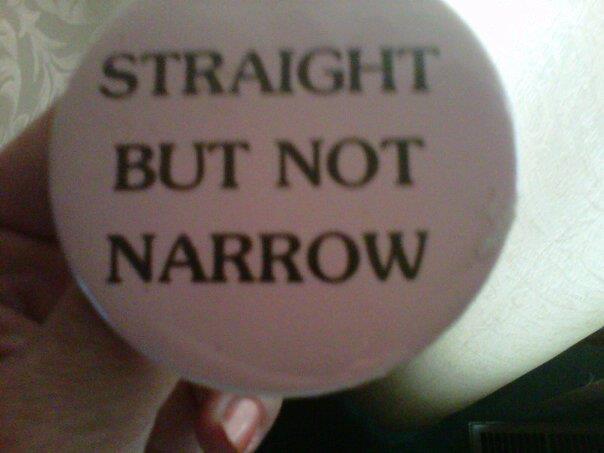
I found a button that said “Straight But Not Narrow.”
Given the recent national debate over gay marriage, I smiled when I realized I had been given the button more than 20 years ago. My smile soon turned to sorrow when 1) I realized that in the past 20 years, our nation really hasn’t come that far and 2) The person who gave me the button died years ago.
His name was Roger, and he died of AIDS.
He, like so many in our armed forces, died in the middle of a battle and with a great deal of honor.
Roger never hid his HIV status. Nor did he hide is sexual orientation.
In fact, Roger was one of the most open people I’ve ever met. If you asked him a question, he never sugar-coated the answer. He sometimes gave you more information than you wanted, but he never pretended the truth was pretty.
Roger will always be one of my heroes: those people who not only stand up for what they believe, but who put their own reputation and livelihood on the line to defend what is right.
Before he was infected with HIV and before his partner died of AIDS, Roger owned a hair salon.
That was his life before AIDS.
His life after AIDS was dedicated to educating West Virginians about the disease.
West Virginians are good people, but they aren’t exactly progressive… just check out their track record in the last few elections.
But Roger didn’t let closed-minded people get in his way. He knew that closed minds are like closed doors… they just need the right key to open or unlock them. And once they are unlocked, options and possibilities greatly increase.
Roger was the key to opening more minds and more doors than he ever knew. And the possibility he was seeking was a country where no one was infected with HIV again.
And so Roger knocked on and sometimes knocked over closed doors so he could share his message. He went to service clubs. He went to other types of clubs. He went to churches. And he went to schools.
He went wherever he could be heard and wherever people would actually listen.
His voice was definitely heard, and people definitely listened. I have no doubt Roger saved lives.
The only life he couldn’t save was his own. The medical battle against HIV was in its infancy, and Roger eventually succumbed.
But like so many other warriors, he left this world a better place than it would have been without him.
To me, that’s a hero. That someone I want to remember. That’s someone who inspires me.
That’s the type of person Memorial Day is all about.
It’s Hard to Get Respect When Your Shoes Are Worn Out

I love shoes.
Unfortunately, I wear out shoes quickly. Very quickly. And, I’ve found that when my shoes are worn out, I have to fight even harder to get respect.
I’m not sure that people who work in the for-profit world will understand, but anyone who works for a community-based nonprofit organization will – especially those who work for social service agencies. Our shoes , just like us, are often worked and worn to the bone.
We are a unique breed that must band together. Our biggest battles aren’t necessarily a result of working directly with the people who need help or of the perception that they are undeserving, lazy or simply crazy.
Sometimes, our biggest battles are with people who support our organization, a cause or a specific project.
I should know.
For almost twenty years, I’ve worked for community-based nonprofit organizations. And while the work is exhausting, it’s also meaningful and educational.
But now, my career path is about to change slightly, so before I leave my comrades, I feel the need to share a few words of wisdom with our board members, our volunteers and our donors:
1. We greatly appreciate you. We know the work we do wouldn’t be possible without you. We know you care, and we know you are compassionate.
2. Your compassion doesn’t mean you are qualified to do our jobs.
3. We do our jobs because we are both compassionate AND skilled.
4. Your bank account doesn’t mean that you know more about the issues than we do. Not only do we have the training and the work experience, many of us work in the trenches because we have ” been there.” Sometimes, because of our salaries, we are still there. Please listen to us.
5. Don’t assume you are more educated than we are. Most nonprofit and social services jobs require, at a minimum, a bachelor’s degree for a position that often doesn’t pay as much as an entry-level, administrative assistant job in the business world.
6. Don’t assume that our ONLY motivation is helping people. That’s a primary motivation, but we still need to pay the bills. Keeping agency administrative costs low is important, but keeping them too low may be hurting the people who are trying to do the most good. It may also limit your pool for people who can fill key leadership positions.
7. Don’t assume that staff doesn’t care about salary and benefits (or lack thereof) because we have spouses/partners who, in your eyes, have”a real job.” The work we do is “ a real job.” Many of our jobs require a license. The helping profession is bound by ethical, legal and professional practices that have been put in place for a reason.
8. Don’t assume that just because we don’t get personally involved with clients that we don’t care. We probably care more than you will ever know. But because we are educated in our field and because we often hold a license, we have to behave in a professional manner that will limit liability while improving outcomes for the client.
9. We know that when you work with our organizations you are volunteering, and we appreciate your time more than you will ever know. But don’t assume we are lazy or not committed to the cause because, at the end of the work day, we don’t have the energy to volunteer to do the same thing we do day in and day out.
10. Disregarding staff in times of key leadership decisions only leads to poor morale. When a key staff person is leaving, other staff members should be consulted as to what skills and leadership style would fit with the team before the selection process even begins. Staff should even be consulted about their interest in a leadership position.
11. The nonprofit and social service sector is composed primarily of females. Falling back on the “good old boys” network for leadership is taking a step backwards, not forwards. It doesn’t sit well with female staff, donors or volunteers.
12. Board members have to play an active role and not simply serve as a rubber stamp for decisions that may have been presented by someone with an agenda. You can always go back to the drawing board – don’t feel like your options are limited to what is presented to you at a board meeting.
These words of advice are based on my long-term work for community nonprofits. That work will end when I walk out the door of my current employer this Friday and into the door of my new employer the following Monday.
As would be expected, my departure has led to an appreciation I never knew existed (see suggestions Number 10 and 11).
So for all the people who, over the past few weeks, have told me that I’m leaving some really big shoes to fill, I apologize if I haven’t accepted the compliment with grace.
It’s not that I don’t appreciate the sentiments. I just know my shoes are really worn out.
Whoever takes my job not only needs to put on their own pair of shoes, they also have the opportunity to point those shoes in their own direction.
And I’m sure that direction will lead to a lot of great accomplishments.


 Just So You Know