Blog Archives
Some People Should Just Shut Up
 Being a parent sometimes means being a hypocrite. If you don’t believe that you are either a) not a parent or b) incredibly (and unbelievably) perfect.
I can provide hundreds of examples of times I’ve behaved in a manner that directly opposes what I’ve told my children. Apparently, my husband is a few steps higher on the parenting evolution ladder than I am. He doesn’t always behave better than I do (although he probably does most of the time), but he’s generally less verbal about certain expectations for our children. That way, his behavior doesn’t seem quite as hypocritical.
I, on the other hand, am constantly setting standards that I can’t even begin to meet myself.
For example, ever since our children started talking, I insisted they use the words “please be quiet” instead of “shut up.”
Yet, I don’t do at all well with that particular language skill.
Recently, I was enduring a painful meeting during which a self-important person was holding forth as though his words were actually meaningful or of interest to anyone but himself. To survive the ordeal, I pretended to take notes while actually scrawling page after page of the words “Shut up. Just shut up.” A few times, I even added a less than flattering description of the person I wanted to be quiet.
But the words “please be quiet” are often inadequate. Quiet means hushed tones and soft voices. Quiet shows a lack of passion or emotion. And quiet doesn’t indicate disagreement when someone else’s words are hurtful or rude or simply pointless.
That’s why I haven’t been thinking “please be quiet” lately when people try to disguise their hate and prejudice with self-righteous statements and stupid jokes. Instead, I want to scream “just shut up” every time someone equates being poor with being lazy. But I haven’t.
I’ve held my tongue as tightly as the man gripping a snow shovel while he rode his bike through my neighborhood on Wednesday.
Wednesday we were supposed to get a blizzard. Schools closed. Government shut down. Businesses even changed their hours of operation. And even though all we got were a few inches of snowy slush, a lot of people with steady jobs and stable employment had a snow day.
The man on the bike didn’t have a day off.
He was looking for work shoveling driveways and sidewalks. He was offering his services to people who most likely judged him on his ragged appearance and his lack of a car. He didn’t have a truck to which he could attach a plow. All he had was a shovel and some muscle.
I’ve seen him selling his shoveling services on other snow days, but this past Wednesday was different.
I was leaving the neighborhood when he rode by me. He didn’t know where I lived or whether I was even a potential customer. I was simply some lady walking a German Shepherd on a cold and windy afternoon.
But, even though I had nothing to offer him, he slowed, gave me a wide smile and told me to enjoy my day. And then, balancing his snow shovel while pedaling his bike, he quickened his pace and was off.
That’s the exact instance I realized that maybe, instead of teaching my children to always say “please be quiet,” I should have been teaching them that sometimes standing up for those without a voice means shutting down those who speak against them. I should have been teaching them that there are times that polite isn’t as important as human rights. And I should have been teaching them that there are times when some people really do need to “just shut up.”
Everything I Need to Know About Valentine’s Day, I learned in First Grade
 I always liked school, but I absolutely hated first grade. That’s because I had a very, very, very mean teacher.
Even forty years later, I’m still traumatized by memories of Mrs. Gladwill.
Normally, I’d feel really guilty calling someone out by name but 1) I’m not the only who has scars inflicted by Mrs. Gladwill and, 2) She’s dead. She died in 2008 at the age of 94. I know this because my mother sent me a link to her obituary. My mother, who is a very wise woman, knew I needed closure.
There’s no need to go into all the details of why first grade was difficult. There are just too many of those details, such as:
Watching fellow students have their ears twisted;
Sitting in class in fear of having “accidents” because, instead of giving permission to use the bathroom, Mrs. Gladwill gave lectures about “not planning accordingly”;
Having my desk put in the corner of the room so others couldn’t cheat from my papers.
But my worst memory, by far, is Valentine’s Day.
Back in the early 1970’s, before there were strict dietary guidelines in schools, Valentine’s Day parties were one of the celebrated days of the school year. Preparation began well before the actual day. By the beginning of February, letters were sent home with both the names of classmates and a list of snacks, such as cookies, cupcakes and candy, that parents were asked to contribute. We used that list of names to painstakingly address a card for every single classmate – whether we liked the person or not. But we did pick out “the best” cards and candy (every card had to have candy) for our friends.
In school, we decorated mailboxes (shoeboxes covered with construction paper) in which our Valentine’s Day cards were to be delivered. The actual celebration was to be a festival of sugar and giggles.
The day before the big Valentine’s Day party, I could no longer hide the fact I couldn’t swallow. I’d begun to worry the day before at school when eating lunch was a painful challenge. At breakfast, while I was trying to somehow swallow a spoonful of Cheerios, my mother took one look at me, told me I looked like a chipmunk and declared I had the mumps.
I wasn’t just devastated. I was horrified.
Mrs. Gladwill simply did not tolerate illness. Every day, after she took attendance, she would take a piece of chalk and scrawl the names of the absent on the blackboard. In the eyes of first graders, having your name on the blackboard was equivalent to the adult version of being forced to wear a scarlet letter. Walking into the classroom and seeing your name on the blackboard was the ultimate walk of shame.
Being diagnosed with mumps was not only a sentence to take that walk of shame, but it also meant I was going to miss the Valentine’s Day party. In the eyes of a six-year-old, life couldn’t have been much worse.
That Valentine’s Day was probably one of the longest days of my life as I spent every minute imagining all I was missing. Finally, sometime after 3:00, I heard the squeal of the school bus’ brakes as it stopped in front of my house. When my brother came into the house, he didn’t call me chipmunk or tease me for missing all the festivities. Instead, he handed me the shoebox I had so painstakingly decorated only a few days earlier. But now, it was full of Valentine’s and candy. I spent hours reading and treasuring all of the cards, even the ones I knew weren’t heartfelt.
A few days later when I returned to class, my name was one of many written in dark chalk on the blackboard. Apparently, some nameless person (me?) had come to school with the mumps and shared the virus with everyone else.
Eventually, attendance went back up and our class returned to the same, miserable status quo. But I didn’t. That Valentine’s Day taught me a lot about love:
1. Love is about the memories we treasure because, even though they sometimes grow out of difficult situations, they remind us of people and challenges we’ve overcome.
2.Love is about finding a song that will mean something to you at any age. For me, the Rolling Stones got it exactly right. “You can’t always get what you want, but if you try sometimes, well you just might find, you get what you need.”
3. Love is about having a family whose support will always make the worst day a little bit brighter.
4. Love is learning to treasure all the small gifts, even ones from people who may not realize that they were giving anything of importance.
5. Love is about taking care yourself, even when others will try to make you feel as though their needs should come first.
Most of all, I learned that Valentine’s Day is much more complicated than cards, or candy or having just one special person in your life. It’s about recognizing and acknowledge everything that makes you happy.
And, over the past 40 years, I’ve been immensely blessed with people, memories and circumstances that make me happy.
Which, is why, even though I may not entirely succumb to the sappiness of Valentine’s Day, I certainly embrace the sentiments, and the lessons, it’s taught me.
The Turmoil of Men, Women, Misery, Illness, Martyrs and Marriage
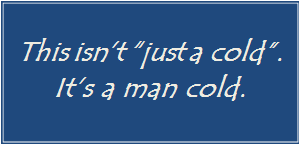 By the end of last week, I was wondering why my husband had married me. Only two days earlier, I’d been wondering why I’d married him.
According to friends, that’s not unusual in a long-term relationship, but I’m not sure my friends truly understand the ugly monster that threatens to wreak havoc on my marriage.
Some call it being sick while others call it having an illness. Personally, I prefer when people say they are feeling “a bit under the weather.” That means they may not be operating at full potential, but at least they are still functioning.
And therein lies the problem.
Whether because of how I was raised or because of my God-given Type A personality, I have an innate belief that when people don’t feel well, they should still try to make some contribution to society.
My husband, on the other hand, believes that the first sniffle or wave of nausea indicates he should lie in bed all day moaning.
O.K., maybe he’s not that quite that bad… anymore. He has, after all, lived with me long enough to know that I’m not the type to provide much comfort when he’s sick. Instead, I am much more likely to tell him to, “suck it up.” At times, I’ve even gone so far as to accuse him of using illness as an excuse to avoid the “honey do” list or to get attention.
I know, that makes me a very bad wife and explains why I’ve questioned that fact he married me. But please note that I’m not a completely bad person.
I DO have empathy for people who are sick, and I DO believe people need to take care of themselves so they recovery quickly and don’t get worse. And I certainly don’t want people coming to work sick. The problem is, I don’t allow myself to take it easy when I’m sick, and therefore set the same expectations for my husband.
Maybe it’s just a man/woman thing. A few years ago, my husband sent me a link to a scene from a British sitcom in which a man believes he’s on his death bed because he has a “man cold.”
I could completely relate, and I think my husband did too.
Last week, he came down with the stomach bug, and I came down with a strong case of irritation. Not only did I have to take on all his household obligations, but he didn’t even offer to try to help. That would have made me feel much better, especially since I always play the martyr when I’m sick. There are many times when I’ve been running a fever or had the stomach virus and insisted that I still had to walk the dog or the world will come to an end.
In hindsight, I was more than just irritated last week, I was also fearful. I didn’t want anyone else in the house to get sick. And while my irritation wasn’t justified, my fear was.
Years ago, when the children were still quite small, the stomach bug caught us all at the same time. Having to take care of small children with the stomach virus is messy, esp when you are suffering the same ailment. At one point, I broke my own rule of silent suffering and proclaimed, “could this possible get any worse?”
It could. As if on cue, one of our two dogs walked into the room and threw up on the carpet. And yes, I was the one who had to clean up that mess too.
So even though my husband thought I was a bit insane last week when I following him around with Lysol and insisting he thoroughly sterilize the bathroom each time he used he, I think he understood just a little.
On the positive side, no one else in the house got sick. At least, not yet.
I Couldn’t Get a Dog so I Got a Gun
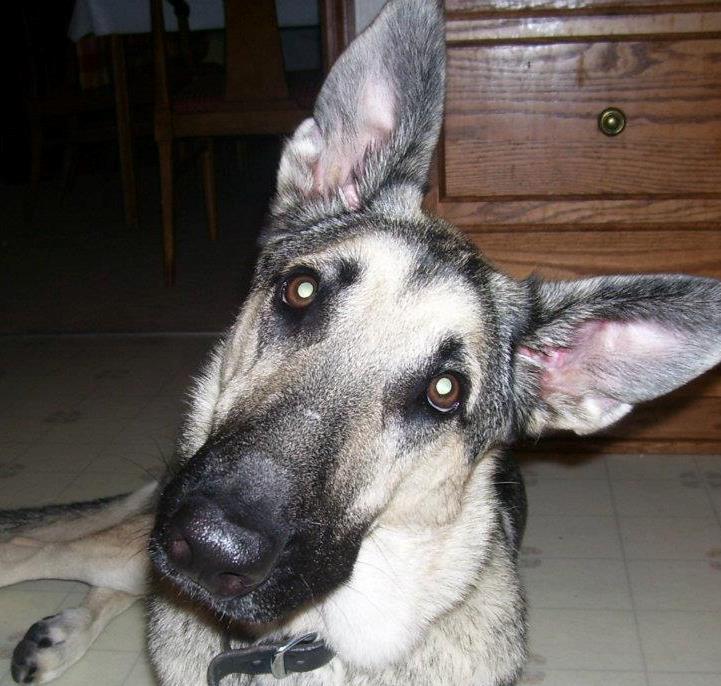 Conflict among people is normal, and most of us accept it as a routine part of life. Conflict within ourselves is just as normal, but something with which we often struggle.
As a licensed social worker, I couldn’t get out of bed every morning if I didn’t believe people can change, that humans have an innate responsibility to support each other and that no good comes from belittling others.
As a rational human, I couldn’t get through life if I simply tolerated and never called out stupid and ridiculous beliefs and behaviors.
As a licensed social worker, I have to ensure that my conduct is appropriate, that I abide by a code of ethics and that I participate in ongoing continuing education.
As a rational human, I am dumbfounded by people who complain when they are required to meet expectations and criteria before they are provided with opportunities and privileges.
As a licensed social worker, I have an obligation to listen, try to understand the perspective of others and validate their feelings.
As a rational human, I simply cannot understand why others choose to ignore facts, scream conspiracy and throw around accusations that are hurtful. I have to call out people who choose to believe and spread all of the vile, ridiculous and illogical propaganda about gun control that I have been witnessing over the past few weeks.
The rabid followers of the NRA propaganda machine remind me of children blindly hitting a piñata at a birthday party. For most people, hitting the piñata is just fun game that results in children scrambling for a few pieces of candy. But the NRA is turning gun control into a piñata that must be destroyed and is putting the blindfolds on people as they swing at it. Those swinging the sticks are convinced that if they don’t break the piñata, they will never have candy again.
In reality, if the piñata doesn’t break, the children won’t be denied candy. They just won’t get the immediate gratification they are seeking.
Most parents allow their children to have candy, but they don’t want them to make a diet of it. Similarly, gun control advocates are not screaming that everyone’s guns should be confiscated. Instead, they are recognizing that too many lives are being broken and destroyed by guns and that something must be done. To counter that, claims are being made that the gun death statistics in the United States aren’t that bad.
Tell that to someone who has lost a loved one to a gun. For them, one death is too many.
Just ask Jackie Barden, whose son Daniel was killed at Sandy Hook Elementary school in December. Jackie recently noted that the process for adopting a kitten is more difficult than getting a gun.
I don’t know much about adopting kittens, but I do know a lot about adopting dogs. As a volunteer for a dog rescue group, my role is to process applications. In other words, I do background checks. I check national “do not adopt” lists. I do a criminal background check. I conduct property checks. I review living arrangements. I talk to animal control and veterinarians about the applicants. And I call references. If I don’t find any red flags, another volunteer conducts a home visit.
Many families who want to adopt a dog are denied for a variety of reasons: they’ve had pets hit by cars; they haven’t spayed or neutered their current or previous pets; they aren’t home enough to spend quality time with an animal; they don’t have the money or space for a dog; they already have too many pets. The list is long and varied, but the bottom line is the same. Rescue groups want to ensure the dogs have a good quality of life and, most of all, that they are safe.
We should want the same for people. And yet, in the United States, people who are denied adopting a dog can walk into a store or a gun show and buy almost any gun they want.
We might be keeping dogs safe, but I have to wonder about the people.
60 Years, 3 Couples, 1 Anniversary and Immeasurable Memories
 From the diary of Letha Bates Smith: “Nov. 29, 1933 Wed. Finished cleaning at the house this morning. Met Sylvia at 3:25. Morden, she & I met Martin in E. Lansing and had the knot tied at 8:30. Home then to Vilas and Evelyn’s for the nite.”
That’s how my grandmother described the day she married my grandfather, Morden, in the chapel at the People’s Church in East Lansing, Michigan with her sister Sylvia and her brothers Martin and Vilas in attendance.
Exactly 30 years later, my mother married my father in the same chapel. Unlike my grandmother, she didn’t keep a diary, but, just like my grandmother, she had a very practical wedding.
Exactly thirty years after that, at age 26, I was a completely different person than both these women. I was definitely less conservative and more reckless. Yet all three of us would be forever connected not just by blood but by our sensibilities and our belief that a strong marriage, just like a strong woman, is defined by substance not glamour.
And so, on November 29, 1993, my grandparents celebrated their 60th anniversary and my parents celebrated their 30th by attending my wedding.
 Letha and Morden
My grandparents met on a blind date while they were both students at Michigan State College (later University) during the Great Depression. My grandmother was one of four children from a farming family in Quincy Michigan who were all determined to go to college. Despite the odds and through their own perseverance, all four obtained college degrees.
My grandfather, the youngest of seven children, grew up in a family that had an uneven financial history – sometimes they had a lot, sometimes they didn’t. My grandfather’s older brother, Carl, had died when he contracted smallpox working in a lab while in medical school. The money from his insurance policy allowed my grandfather to pursue a degree in electrical engineering.
I know little about my grandparents’ college romance. My grandmother wasn’t a talkative or an emotional woman. But for decades, she documented her life in diaries. The one or two sentence entries she diligently recorded provide some insight into the often hidden thoughts of a woman who, on the surface, was practical to the bone. The grandmother I knew had one dress that she wore to every special occasion (including my wedding) for decades. But, that didn’t mean she never cared about a new dress.
“Oct. 30, 1932 Sunday. My sweetheart down today. And what did he bring me – Um does it sparkle? Simply gorgeous delightful! The dear boy.”
“Nov. 1, 1932 Tuesday Met Sylvia downtown this P.M. spent the nite with me. The ring fixed – lovely now – more thrilled than ever. A new dress.”
Even after my grandmother died, we never found picture of her wedding or her wedding dress. At the time of their marriage, my grandfather was a relatively new employee at Citizens Gas Fuel Company. My grandparents chose to get married the evening before Thanksgiving because my grandfather would have a four-day weekend.
My grandparents’ marriage ended when my grandfather died in 1998, just shy of their 65th wedding anniversary. My grandmother would live for another seven years.
The words in her diary will be passed on to future generations.
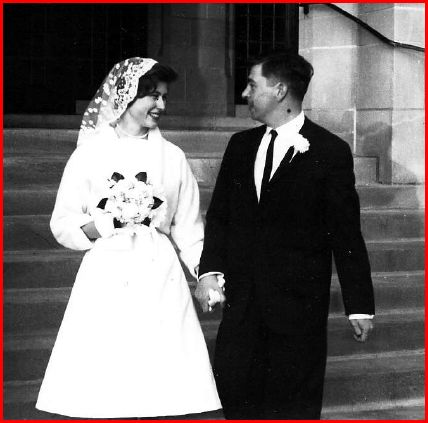
Evadna and Ken
Following in the footsteps of her parents and her older brother, my mother attended Michigan State University. After graduation, she moved to Manistee, Michigan, but neither her job nor her location were exotic or adventurous enough for her. She wanted to see the world and submitted an application to join the newly established Peace Corps.
After he graduated from Idaho State University, my dad, a Massachusetts native who had already seen a great deal of the world while in the Navy, also applied to join the Peace Corps.
They were among the first individuals ever selected and were in the third group deployed. Before they left for Chile, my parents attended training at Notre Dame University, where they spent days in Spanish class. My father excelled with his ability to speak the words perfectly in his loud, booming voice while my mother shot him dirty looks while she struggled.
Her irritation didn’t last long. Before they returned to the United States, my parents were engaged. Instead of a diamond, my mother wore a simple gold band on her right hand that she would transfer to her left hand when she was married. The only diamond I’ve ever seen my mother wear is her mother’s engagement ring, the one that sparkled so brilliantly in 1932.
After returning to the United States, my father, a forester, got a job in Montana. He hadn’t accumulated any leave, but he was allowed to take a few days for Thanksgiving. And so, a wedding the day after Thanksgiving made sense, and my parents spent their honeymoon driving west to their new home.
They’ve spent the rest of their lives sharing stories of their adventures with their children and grandchildren.
Trina and Giles
Ironically, I met my husband on a November night.
On November 8, 1988, I was a college intern helping cover election results in the newsroom at West Virginia Public Radio. Giles was reporting for his first night of work. He thought I had an attitude, and I thought I had work to do. No sparks flew, and I didn’t give him a second thought.
But after I graduated from Ohio University, our paths continued to cross and our circle of friends became one in the same. Over time and shots of Jagermeister, we eventually ended up together.
Our relationship was nothing like I imagined everlasting love was supposed to be and everything my mother had told me it would be. (She’d told me on multiple occasions that common values and compromise, not romance, were the key to a successful relationship.)
In the beginning, our schedules were very different, and we accommodated. Our schedules are still very different, and we still accommodate. In the beginning, we watched a lot of Star Trek. Giles still watches a lot of Star Trek, and sometimes our kids even watch with him. And in the beginning, we laughed at my intensity and his lack of it. Now, we work around our differences… and we still laugh a lot.
Giles and I didn’t get engaged out of some romantic notion of marriage. We got engaged because his roommate bought a house, and logistically, our moving in together just made sense. And when we realized the significance of the year, we picked a very significant wedding date.
Unlike the two couples before us, we didn’t marry over Thanksgiving weekend nor did we get married in Michigan, Instead, our ceremony took place the Monday after Thanksgiving in Charleston, WV. And yes, our wedding was also simple and practical (my mother made my dress), but it was also a bit quirky. We received gifts of Star Trek dinnerware and had Star Trek action figures on top of our cake.
Our children look at the photographs and simply roll their eyes.
The Present
This Thursday marks my 19th wedding anniversary and my parent’s 49th. If they were still alive, my grandparents would be celebrating their 79th.
Those aren’t generally noteworthy numbers, but they are to me. Life and marriage are both fragile, and every day, month and year of marriage should be treasured.
I am under no illusions that future generations will marry on November 29. But I do hope that the stories from all three couples will serve as a reminder that weddings are not about a fancy show or an exotic honeymoon. They are about two people deciding to move forward together and create memories that can bond families together for generations.
The Insanity of All This Violence is Driving Me Crazy
Just over two weeks ago, while families gathered to watch Fourth of July fireworks at a park less than a mile from my home, a gun was fired. In addition to shooting the intended victim, the gunman also shot and injured an eight year-old girl.
Just two days ago, a man opened fire in a crowded movie theater in Aurora, Colorado, He killed 12 people and injured dozens more.
While one incident was right down the street and the other was across the country, my initial reaction to both was the same. I wanted to hug my children and thank God they were safe. And then I wanted to scream about the insanity of it all: “Why does such senseless violence keep occurring and, even worse, why is it creeping into my world?”
In “my world,” the only violence we ever witness is in the form of entertainment: on television, in the movies and in video games. It’s not a place where people have to fear actual violence.
In “my world,” safe neighborhoods are easily defined, and we avoid violence by avoiding unsafe locations. It’s not a place where my daughter’s friends tell her “that shooting at the park was in my backyard.”
In “my world,” guns are used for hunting animals and shooting targets – not for shooting people. It’s not a place where people use violence to resolve a dispute or share their rage with the world.
In “my world,” when a horrible crime does occur, we rally around and pray for the victims and their families. It’s not a place where, only hours after a shooting, we try to turn a tragic event into a political advantage.
But I’ve come to realize that “my world” is a complete fantasy, but it’s a fantasy I also want my children to believe.
On July 5, I was driving by the park where the shooting had occurred only hours before. My daughter, sitting in the passenger seat, noticed all the people picnicking and swimming and asked “why are those people even at that park? Don’t they know it’s dangerous.?”
She was talking about a park that she has walked to and played in hundreds of times: a park where I walk my dog every day: a park that is the gathering place for most community events in my town.
And so, I told her that the shooting was an isolated incident and she shouldn’t worry or avoid the park.
What I didn’t tell her was that if we tried to avoid every place where there’s been gun violence, our options would be very limited. At the time, movie theaters weren’t even on my radar.
But theaters are creeping onto my worry list now.
Just last night, while my daughter was performing in a local production of “The Wizard of Oz,” the alarms in the theater unexpectedly went off.
No one in the audience moved, and the youth on the stage continued to perform. We were probably all hoping the same thing: that the smoke on the stage had tripped a fire alarm. We were also probably all just a little worried about the same thing: that someone with a gun had entered the building.
The alarm was turned off, my concerns ebbed and I went back to the fantasy of “my world.” It’s actually a very nice place, and I like living there. If I didn’t, I’d go crazy with worry.
Sadly, I’m having to leave it more and more often. And until we stop arguing about solutions and actually start working together, “my world” never will be a reality.
Five Words I’d Like to Ban From Any Political Discussion
This week, Michigan State Representative Lisa Brown was banned from the House floor for uttering the name of a body part.
She, unlike her male colleagues, actually has that body part.
Personally, I’ve said the word countless times. I’ve taught my kids that it’s an appropriate word, unlike the slang terms that are often used. I’ve even attended a play that features the word in the title and in the script.
But I don’t want to get banned from writing or labeled an extremist, so I’m not going to actually include it here.
I know that’s sad.
But sadder still is that, in 2012, a woman was reprimanded for saying it.
I shouldn’t be surprised. This has been an especially bad year for women.
Access to birth control has been threatened. Equal pay for equal work is being discounted. Ridiculous and invasive medical procedures (procedures that actually include the banned word) have been considered for legislation.
And women who stand up for their rights have been called sluts (because that is apparently not as offensive as a the name of a body part) on a nationally syndicated radio show.
I’m not just feeling belittled and a bit angry, I’m feeling frustrated.
I thought women were making progress. I thought the country was making progress. I thought individuals were important regardless of how much money they make, where they were born, what their sexual orientation is or, most important to me, what sex organs they were born with.
Silly me.
But since we are now engaged in a debate about what words are and are not appropriate to say during a political debate, I’d like to propose five that shouldn’t be part of any discussion.
1. Socialism. In recent years, this term has been used to perpetuate divisiveness and bitterness. It is being used to suggest that it is not American to believe those who have more resources have a responsibility to help those who are struggling.
2. Obamacare. I don’t believe that access to health care should be the responsibility (or fault) of one particular party or individual. It’s about all of us. Health care reform is complicated and hard to understand. But quality, affordable health care is also critical (and currently not accessible) to too many Americans. I have family and friends who have had cancer, high blood pressure and chronic sinus conditions. These are all pre-existing conditions that can drive personal health-care costs sky high. Most of my professional life I’ve been in jobs that either didn’t offer health insurance or offered it at an incredibly high price. I’m a very hard-working person, and I take extreme offense at being told that I don’t deserve the same access to health care as some one who has a different employer. Let’s be rational and talk about the issue rather than about specific politicians and leaders.
3. Christian. Anyone who knows me, knows that I have the greatest respect for God, religion and faith. But America was established on religious freedom, and we are going backward when we make any one religion the basis for laws. Of course our laws should be based on moral and ethical principles, but most religions are based on strong values. Let’s not marginalize people of different faith by holding up Christians as the only religion that counts.
4. Undeserving. This word makes my heart hurt. By using it to broadly describe any group of people is unfair and incredibly biased. It is also very effective. It allows some people to pat themselves on the back for being deserving while belittling people who are different. People hit hard times for a wide variety of reasons, many of which are beyond their control or rooted in a childhood that never gave them a chance. I’m not saying that we shouldn’t set expectations for people or encourage them to take care of their own needs. But lets provide them with skills and opportunities rather than blame and labels.
5. Penis. If vagina isn’t allowed, then we shouldn’t be allowed to say penis either.
Whoops. Did I just say vagina? There go any hopes of a political career.
Hopefully, I will still be allowed to share my thoughts and opinions. And hopefully this post doesn’t get deleted as a result of actually naming a body part.
The Reason I Never Forgot Eddie Pee Pants
 On a beautiful spring day several weeks ago, my kids and I were heading to lunch a few blocks from my husband’s office on the crowded streets of Washington D.C . Dressed in only shorts and t-shirts, we didn’t really fit in with the men and women in business attire who were walking with a great deal more purpose.
But we had one thing in common: we all pretended we didn’t see the homeless person still wrapped in a blanket and sleeping in a doorway on a busy sidewalk.
I saw both of my kids glance over at him, but neither said anything. I didn’t either. Soon, the homeless person was forgotten.
Almost.
Because somewhere in the back of my mind, he stayed with me.
He’s still there.
It’s not that I’ve never seen homeless people before. I see them every day. I even have a semi-relationship with the guy who hangs out at the park where I walk my dog. If I don’t at least wave at him, he coughs or makes some other noise until I acknowledge him.
But the homeless guy sleeping on the steps was different, because he might as well have been invisible. Everyone, including me, blatantly ignored his existence.
I understand why the business people ignored him: they probably see him everyday. He’s as much a part of their daily landscape as the traffic lights, the street signs and the blur of faces they regularly encounter.
But I didn’t have any excuse, and I couldn’t figure out why I didn’t even talk to my kids about him. That’s just not like me at all. If anything, I usually talk way too much about such things.
The only explanation I could find is one I don’t like: I was going along with the crowd. It was just easier.
It’s not the first time I’ve had to make that admission.
When I was in elementary school, I didn’t even know the full name of the boy who rode the school bus. I just knew everyone called him Eddie Pee Pants. You don’t need to be a genius to figure out how he got the name.
I don’t remember calling him that to his face, but that’s the name I used when my peers and I were discussing how to avoid him. No one wanted to have to sit with Eddie Pee Pants on the bus. If you did, you’d not only have to smell him, but you would get “Eddie Pee Pants germs.”
I knew what we were doing was wrong, but I justified my behavior by telling myself that I was never actually mean to his face. But the guilt got worse when Eddie’s life got worse.
One Saturday morning, I joined my dad at the top of our driveway to watch the drama unfold on a hill about a mile from our house. A dilapidated mobile home was on fire. Flames were shooting out the roof, and smoke was turning the sky black.
“That’s a total loss,” my dad commented.
I didn’t know until Monday that the old, junky trailor everyone said was an eyesore was Eddie’s house.
I have no recollection of what happened to him after his house burned. I just know he never rode the bus again, and I don’t remember ever seeing him at school again. I don’t even remember if there were any injuries or fatalities in that fire.
What I do remember is wondering why I wasn’t nicer to Eddie and feeling horrible that I’d never have an opportunity to undo my misdeeds.
Eddie isn’t the only person I’ve ever discounted or belittled. But he’s the first person who taught me three essential life lessons:
1. Treating someone poorly never makes you feel better about yourself.
2. Sometimes you don’t get a second chance to do the right thing.
3. Issues such as poverty, child abuse and homelessness are actually about individuals — people who, regardless of the reason for their circumstances, still have value.
I’ve taken that third lesson to heart. Eddie, like the homeless person in the doorway, gave me something priceless. They taught me to look beyond the unkempt appearances, poor hygiene or odd behavior. They’ve taught me that sometimes the person who needs to change their attitude or perception is me. And they’ve taught me that speaking up feels a lot better than putting someone down.
They were priceless gifts in my life, and I hope I can pass their lessons on to my children. And that, if nothing else, is what makes their lives so valuable to me.
There’s a Reason This Mom’s Brain is a Hot Mess

There’s no doubt I love my children.
But at times, when I’m completely honest with myself, I wonder what the heck I was thinking when I decided to become a mom.
It’s not because I regret having children. Not for a minute.
And it’s not because I think my life would be more interesting or exciting if motherhood didn’t require I put their needs above mine. Being a parent puts a whole new spin on interesting or exciting.
And it’s certainly not out of guilt that as a girl, teenager and even as a young woman, being a mom wasn’t on my list of life goals. Having children helped me recognize what’s really important in life.
It’s because there are times when I think my kids could have done better with another mother – a mom who isn’t as emotional or head strong or outspoken as the one they got. A mom who never purposefully ignores parenting magazines, workshops or other sources of standard parenting advice. A mom who always enjoys her children’s activities instead of attending out of a sense of obligation.
And just when I’ve convinced myself that my kids would be better off with any mom but me, I come face to face with parents who don’t understand what an incredible gift – and responsibility –being a parent is. I witness moms behaving as though they are still adolescents with all the same drama and self-absorption. I have to listen to parents who always blame someone else when their child behaves poorly, gets a bad grade or is fighting with other children. Worst of all, I know of parents who put their children’s welfare and safety in jeopardy.
I may be imperfect, but those situations make me feel better about my own parenting skills. At least for a little while… until my kids do or say something embarrassing or completely inappropriate. Then I’m back to thinking that if they had a different mother, their behavior would be stellar.
Such thoughts bounce around in my brain on a daily basis… sometimes at such incredible speed that I fear an impending brain explosion.
The requirements of my profession haven’t helped.
Because I have a social work license, I’m required to take continuing education. Usually, I seek work-related education. Because I recently changed jobs, I’ve been seeking education that is more closely aligned with parenting issues, which I usually avoid.
I’m not sure the plan has worked for me.
In a workshop on bullying, the presenter disparaged parents who tell their daughters that, when a boy teases her, he actually likes her. According to the presenter, that’s putting her on the path to domestic violence. Having said those exact words to my daughter, I was convinced that, at worst, I was creating a victim. At a minimum, I was teaching her that abusive behavior is a sign of affection.
I was back to being a horrible mom.
But then, a couple of weeks later I attended a workshop on child abuse. The workshop emphasized the need for children to feel comfortable questioning and saying no to adults. Now that is something my children have NO problem doing. Could it actually be good that my children are following in their mother’s footsteps by requiring more than just a command as a reason to follow orders?
My internal confusion isn’t necessarily a bad thing, but it does highlight the reason I’ve avoided reading all those articles about parenting. Once my children started developing their unique personalities, I had to treat them uniquely. And no expert could tell me how to do that.
So while no parenting magazine will ever put me on its cover, that’s not important to me.
What is important is that someday in the distance future, when I’m not the complete embarrassment or the clueless person that my children currently think I am, I will be featured in their life scrapbook .
I don’t even expect to make the cover, but I do want to be featured.
I’m pretty sure I can fill that role quite well… a long as my brain doesn’t explode in the meantime.
The Misadventures of Mr. Muffet, My Chronically Confused Cat
 Mr. Muffet was never destined for greatness, dignity or even a long life.
Quite the opposite in fact.
The moment he joined our family, his fate was sealed.
I was too young to remember how Mr. Muffet arrived at our house or even when his name changed.
All I know is that Mr. Muffet was Miss Muffet until my cat-loving grandmother from Massachusetts visited our Oregon home. All things considered, my grandmother probably thought my parents were trying to make some kind of statement about gender stereotypes, but she wasn’t going to have any of it. She told them in no uncertain terms that Miss Muffet was just not an appropriate name for a male cat.
My father, who had previously tried unsuccessfully to breed rabbits, (he was unsuccessful because they were all female) heeded her advice, and Mr. Muffet’s name was modified accordingly. But his status as a full-fledged member of the family never changed.
Which, apparently, is why he went with us on a family vacation to the Oregon Coast.
I was recently reminded of the trip during a conversation with a couple of co-workers. Both were discussing the trauma of having to ship their cats overseas.
“I’ve never shipped a cat,” I said. “But I do remember the time my family took our cat to the beach.”
They both looked at me in disbelief.
“Why,” they wanted to know, “would you take your cat to the beach?”
I couldn’t answer their question. But since cats were the topic, curiosity got the best of me. I had to call my mom and ask why.
“I don’t remember,” she told me.
“But we did take the cat to the beach, didn’t we?” I asked.
“Yes, we did,” she answered. “I just don’t remember why. Probably because cats are easy, and we didn’t want to travel an hour to have him boarded.”
I didn’t even ask why a neighbor couldn’t have taken care of Mr. Muffet. Instead, I pressed on with the bigger issue. “And he pooped in the car, right?”
“Yes,” she sighed. “Yes, your memory is correct. He pooped in the car.”
She was obviously done with the conversation, so I didn’t push the issue. But I did tell my co-workers that I wasn’t imagining the trip.
Not only did we take Mr. Muffet on vacation with us, but we didn’t even have a carrier for him. (Were cat carriers even around in the early 1970’s?) Because of that, he was simply free to move around the cabin. But he didn’t. He stayed on the vent behind the back seat where my brother and I were riding.
That was either his favorite spot or he was too terrified to move, even when he had to poop. As a result, he pooped in the vent right behind my head.
There is no way to describe 1) the smell, or 2) how determined my mother was to get the mess cleaned up.
My mom was determined for a long, long time.
The good news for Mr. Muffet was that he soon had a lot more places to poop.
Always an equal member of the Bartlett family, Mr. Muffet accompanied us on our first walk on the beach (a beach comprised mostly of sand dunes.) He probably thought he’d landed in the world’s largest litter box.
He did his best to take advantage of the situation, but after an hour of running through the dunes, scratching in the sand and doing his business, the poor cat was simply exhausted.
Fortunately, our trip home was much less memorable than the one to the coast. Unfortunately, I don’t have many more memories of Mr. Muffet.
He disappeared shortly after the infamous vacation.
For years, I was convinced that a less adventurous family had found and adopted him. I was equally sure that he was quite relieved that he didn’t have to live with my crazy family anymore.
I was well into adulthood before I learned the truth: Mr. Muffet had been hit by a truck on the highway near our home.
I appreciate that my parents tried to protect me from the facts, but I also think they were trying to protect themselves. I’m certain that the adventures with Mr. Muffet had a significant impact on them.
He was, after all, my only cat growing up. After he “disappeared,” we only had dogs. And, I must say, dogs travel a lot better.


 Just So You Know