Blog Archives
Don’t You Dare Tell Me How To Feel
 I admit my emotions are still raw after Donald Trump’s election as President of the United States on Tuesday night. And yes, I’ve cycled through the stages of grief: disbelief to sadness to anger to acceptance then back to anger.
And then more anger.
I’m not angry with people who voted for Trump. Even though they voted for a man who used hate to garner much of his support, I understand they had various reasons for voting for him.
I’m angry because I am forced to accept their vote while most Trump supporters have shown absolutely no interest in understanding why I’m completely heartbroken for an America I thought existed. I truly believed that Americans could value the common good over money, dogma, single issues, self-interest and even the truth. And I was wrong.
I’m even more angry that I’ve been told to “just get over it,” “find something else to occupy your thoughts,” “accept God’s will,” and “stop being a tool of the liberal media,”
During my entire life, I have never, ever told anyone who was grieving to “suck it up and just get over it.”
Grief isn’t just about losing someone you love. It’s about losing something that you value and hold close to your heart. It’s about trying to get through a day in a fog when other people are acting as if nothing has changed. It’s about having to re-wire your brain to live in a different reality. Worst of all, grief harshly rips open old wounds and scars that some of us have spent decades trying to forget.
Which is why I was in tears this week when a friend asked the six women in the room “How many of us have been groped by a man we didn’t want?” Five of the six of us raised our hands. I was not the fortunate woman who didn’t raise her hand. I was the adolescent girl who had never even kissed a boy but was groped by a middle-aged man at church. I was wearing my favorite sweater on the Sunday when he grabbed my breast and told me I was developing nicely. I shoved that sweater to the back of closet and never wore it again.
That old scar tore open the day I heard the now infamous recording of Trump talking about “grabbing pussy.”
But grief isn’t just about the past, it’s also about losing hopes and dreams for the future. On Tuesday night, my hope for the future dimmed the second I received a text that my son, a college freshman, sent to his dad and me.
“Guys,” it read, “I’m terrified.”
And I knew exactly what he meant.
My son is a journalism major following in the footsteps of journalists on both sides of his family tree. His dad is a journalist. My mom was a journalist. His great-grandfather published a newspaper. And yet, my son’s professional aspirations were belittled and threatened by the future president of the United States. My son recognized this threat when, on the day his father and I visited the National Press Club, Donald Trump banned the Washington Post from covering his campaign.
Like me, my son completely understands that some media sources, both liberal and conservative, are truly biased. But he also knows that many journalists have dedicated their lives to uncovering and reporting the truth – whether or not they like or agree with it. All of their hard work is being completely disregarded and even threatened by a significant percentage of the American population. And he is scared.
I completely understand his fear.
A week before the election, I finished reading two books. The first, Lilac Girls, a historical novel by Martha Hall Kelly. Although it’s a work of fiction, the book follows real events, real people and the real tragedy of World War II when too many people were willing to blame, ridicule, persecute and ultimately kill people of a different faith because they believed in a leader who told them to hate.
In the second book, Sarah’s Key by Tatiana de Rosnay, a French Catholic girl is sent to a concentration camp because she has Jewish blood. Despite her prayers, her entire family is killed, and she begins to doubt the power of prayer.
That story is so fresh and so painful that I can’t believe this election is “God’s will” any more than I can believe the rise of Hitler was “God’s will.”
I will never believe that God favors one group of people or one set of beliefs over another. The God I know encourages love and acceptance.
And if you tell me I’m wrong, I’m going to get angry. Just like I’m going to get angry when you tell me that I simply need to “get over” this election.
I won’t hate. I won’t belittle. I won’t even tell people they are misguided or wrong.
But I won’t get over my anger.
And don’t you dare tell me I should.
The Meme I Hate the Most
 I regretfully admit that I was in my forties before I truly understood one of life’s most important tenets: being right will never feel as good as being kind. That’s why I almost didn’t write this.
I don’t want to shame or embarrass anyone who has shared or posted the meme that makes me cringe every time I see it.
I know that it was posted with the best of intentions by great people with good hearts, kind souls and a desire to make the world a better place.
But a statement suggesting that big homeless shelters are somehow better than big churches is, well, just wrong on so many levels.
Let’s start with the fact that we live in America, a nation founded by people seeking a right to worship in the way they wanted. Dismissing how others choose to worship is completely un-American.
Personally, I’m not a fan of churches with memberships larger than the population of the town in which I live. But that’s why I don’t attend one.
I understand concerns that the money used to build, maintain, and equip such large churches could be better used to pay for services to the disadvantaged, but couldn’t the same be said for almost any aspect of our own lives? If we had a smaller house or a less expensive cars, all of us would be able to give more to charity.
We should all spend less time judging and more time actually helping others.
Which brings me to the other reason I hate this meme.
Are there really people who think that building more and bigger homeless shelters is the answer to our homeless problems?
To me, that statement is like waving the white flag in surrender to all of the issues that cause homelessness. We are accepting that we are helpless in the face of the root causes, such as mental illness and social injustice. We are admitting that prevention doesn’t work and that people and systems can’t change.
And I’m not willing to accept that.
I work for a social service organization that fights poverty. Yet every day, I also fight a mentality that providing financial assistance and food to the poor is all we can do to help.
In reality, that’s doing people in poverty a disservice. It’s sending a message that they are not capable of doing more or being more. It’s telling them we’ve given up on the possibility that they are capable of helping themselves and helping others.
Addressing issues of poverty is hard work. It involves developing relationships with people who are often hard to love or don’t understand the manner in which middle class people live and interact. It’s our job to walk with them, teach them, and set expectations for them.
That’s not to say that there isn’t a place for emergency financial, food, and housing. There is. We can’t expect anyone to make big changes in their lives when they are in the middle of a crisis.
But if that’s all we do, then we are selling them, and ourselves, short.
So instead of calling for more homeless shelters, I want to hear a rallying cry for more preventive and support services. I want a united demand for better mental health and drug treatment programs. And, most of all, I want people to stop putting the band-aid of temporary shelter on gaping, life-long wounds created in part by the inference that some people should just accept their place in life.
Beyond Appearances
 Months ago, I swore I wouldn’t get too emotionally or otherwise invested in this year’s presidential election.
In 2012, I wrote and ranted and worried. I wanted to ensure that everyone knew exactly what I thought about the candidates and why my opinion was justified.
In retrospect, I doubt anything I wrote had much, if any, influence on anyone.
People who agreed with me, well, agreed with me.
People who disagreed with me either ignored me, posted negative comments, unfriended me or unfollowed me.
America re-elected Obama, politics continued to divide us, and America has continued to be torn apart by issues of race, equality and social justice.
And this presidential campaign has devolved into a completely horrifying spectacle.
Yet up until now, I’ve refrained from writing about it.
Maybe I’ve just become too cynical and convinced that some people’s brains simply can’t separate facts from propaganda and can only spout ridiculous rhetoric.
But something happened to my self-imposed reticence after watching the first of three scheduled presidential debates on Monday night.
I realized the hypocrisy of my temptation to make light of Donald Trump’s hair, his weird orange complexion, his constant sniffing and his absurd facial expressions.
Because in doing so, I’ve lowered myself to his standards of valuing, or devaluing, someone based solely on appearance. This is, after all, a man who discussed the potential size of his toddler daughter’s breasts https://www.youtube.com/watch?v=1w2T1owSV0U, has used physical attributes as a qualification for employment http://www.latimes.com/projects/la-na-pol-trump-women, and, the night after the debate, defended hurtful comments about a beauty queen’s weight http://www.npr.org/2016/09/27/495611105/in-post-debate-interview-trump-again-criticizes-pageant-winners-weight,
As a country, we have to be better than this.
We must do better than this.
We have to raise our expectations and our standards.
And, most importantly, we have to make the voice of human dignity louder than anything money can buy.
Words Are the Root of All Violence
There are two national headlines gnawing at my brain right now.
The first is about the murder of three police officers in Baton Rouge.
The second is about WV State Delegate Michael Folk tweeting that Hillary Clinton should be hung on the National Mall.
Both are senseless acts of violence.
Both.
An expression of hate is the ammunition that fuels physical assaults and attacks. It turns the words and actions of someone who looks, thinks, acts, or believes differently into a significant threat to individuals who have been programmed to protect their own closed-minded fortresses of right, wrong, and justice.
Making a statement that any person deserves to be hurt at the hands of another does absolutely nothing to improve anyone’s circumstances. Yet this type of brutality is quickly becoming the norm in the United States.
As a country, we are sinking fast in the rising waters of spiteful words, and no one throwing us a life jacket.
Only we can get ourselves out of this mess, which means we have to hold the haters accountable.
I’m not encouraging censorship. Freedom of speech is a core value, and our nation can only improve when we listen to ideas and thoughts that are different from our own. But freedom of speech must be treated with the same respect that we give to anything that is fragile and prone to break when it is mishandled.
And, as a country, we are being anything but gentle with each other.
Having a right to say what you want and not being held accountable for your words are two entirely different issues.
When I was a child, I lived with the taste of soap in my mouth because I was constantly saying things that provoked my parents. There was no law against the words I used or the tone with which they were said. But my words were disrespectful and inappropriate, and I paid the price by becoming a connoisseur of a wide variety of soap brands.
The soap in the mouth punishment isn’t feasible with politicians, community leaders or others who choose to continue to pollute political events and social media with their hateful and violent words.
But the rest of us can ensure that there are consequences.
We can choose not to vote for them.
We can unfollow them on social media.
We can call other leaders and lawmakers and express our concerns.
We can write letters to the editor.
We can even write blogs about them.
Collectively, when each one of us speaks up, our voices are bound to drown out the nasty ones.
An Overdose of Reality
 Last Monday night, family and friends celebrated as my son and 255 of his classmates received their high school diplomas
A week later, one of those students died.
My daughter was told about the death at school. My son found out via social media. My husband learned of it from my son. And I received a text message telling me the Spring Mills High School class of 2016 had already lost a member.
Within a few hours, the rumors were swirling through the neighborhood and on the internet. But there was element that never changed: the culprit was heroin
And while many are simply shocked that a kid with so much potential died from a drug overdose, I’m dealing with a range of emotions.
I’m saddened, and my heart breaks for my son’s classmates who are struggling to understand what happened. I’m overwhelmed with how this drug continues to gain strength in my community. And I’m frustrated with the political posturing that’s preventing real solutions to this horrible epidemic.
But, most of all, I’m angry.
I’m angry that so many people are expressing surprise that an athlete with decent grades could die from an overdose. This has been happening for years across the country, and pretending it couldn’t happen at our school was ridiculous.
I’m angry that my community has experienced dozens of overdose deaths since the beginning of 2016 and yet so many people want to blame the victims and their families instead of work toward a solution.
And most of all, I’m angry that drug dealing is yet another example of how money has become more important than human lives.
Nobody in the Class of 2016 can rewind the clock a week and get a do-over, and there is still plenty more heartache to come for everyone involved in this situation.
I can only hope that the members of my son’s graduating class, as well as the underclassmen who will follow in their footsteps, recognize that some of life’s most important lessons don’t happen in the classroom. Even more importantly, I hope they understand that those lessons mean nothing if they don’t use that knowledge in a meaningful way.
In a situation like this, turning those lessons into action is a matter of life and death.
In the Bathroom
 I am a worrier.
I worry about my kids, the decisions they make and if they are happy.
I worry about having enough money to meet my family budget and having enough money to meet my office budget.
I worry about whom our country will select for our next president.
I worry about drugs and crime in our community, individuals who are homeless and people are being abused by a family member or by the system.
And I worry about people who are too self-centered or narrow-minded to care about anything or anyone but themselves and their own self-righteous and generally misguided opinions.
But I have never once worried about the person in the bathroom stall next to me.
Until this year, I never even considered that a birth certificate could prove or disprove whether that person in the next stall posed a risk to me or my children.
Birth certificates are just pieces of paper that capture information provided during one single moment in time and reflect societal norms of the past.
Heck, my own birth certificate isn’t even accurate. My mother’s name is misspelled. Apparently, in the excitement of my arrival, she didn’t put her professional proof reading skills to use.
Even worse, my birth certificate lists my mother’s profession as a housewife. My mother was never married to a house. Neither did she spend the majority of her adult life staying at home cleaning, cooking and caring for kids. She was an extension agent, a Peace Corps volunteer, a substitute teacher, a journalist, an editor and even a librarian.
But, at that time I was born, she was not an earning an income outside the home. At that ONE point in time. So, even though my birth certificate states my mother was married to a house, which I find a frightening thought, I can’t find any information on my birth certificate that indicates whether or not I pose a danger to others. The information on my birth certificate is so irrelevant that I’ve never even considered carrying it with me.
In the past 30 years, the only time I’ve even taken it out of a safe deposit box was when I needed it for proof of identification. If I ever need it to get into a public restroom, I’m out of luck because it stays locked away in a box that won’t burn.
This whole debate over which sex can use which public bathroom seems as ridiculous as the dress code a former employer tried to implement years ago. The man was getting ready to retire and was trying, for one last time, to impose his prehistoric beliefs on those who would be left behind.
(This is the same man who insisted I should never be put in a position of authority because I breastfed during a work-related meeting. He never considered that I attended the meeting while on maternity leave because I was just that committed to my job.)
To provide some perspective about just how prehistoric his dress code was, it required women wear hose with skirts or dresses. It also required women wear appropriate underwear and noted that thongs were not appropriate undergarments for the workplace.
When I read the dress code (which, by the way, I fought against and eventually had overturned) , my first question was how it would be monitored and enforced.
I feel exactly the same about a law that require people to use the public restroom that corresponds with the sex on their birth certificate.
It is, in two words, absolutely ridiculous.
For All I Do Wrong
I felt like a child on the verge of a temper tantrum. I wanted to put my hands over my ears, stomp my feet and tell  everyone to be quiet.
But, I couldn’t. I was attending a meeting in a professional capacity.
And so, I could only throw an internal temper tantrum during which I raged about how easily people can point fingers.
Maybe, I had just reached my capacity for simplistic thinking. Maybe I was exhausted by all of the people who expend all of their energy finding fault rather than solutions. Maybe I was tired of putting labels on people without taking into consideration all of the external forces that helped shape them. And maybe, just maybe, I was too aware of all of the mistakes I’ve made in my own life.
And so, when I was forced to listen to people make a blanket statement that all homeless people are drug addicts and criminals, I twitched.
Here’s the truth: not all homeless people are criminals or drug addicts and very few drug addicts and criminals are homeless.
Here’s a greater truth: no person arrives at rock bottom on purpose. No one makes decisions with the sole purpose of destroying all of the good things around them. Most important of all, no person can be described by one or two simple adjectives like addict or homeless or loser.
I’m not just saying this because my work involves individuals who struggle with those labels so I have the opportunity to see how complicated people and situations are.
I’m saying this because I make mistakes EVERY SINGLE DAY. Sometimes the mistakes are small and easily forgotten. Sometimes they are significant enough to hurt others, and I carry the guilt and regret with me as though they were an actual physical presence. And, more often than not, I’ve hurt myself with a pattern of wrong decisions that have left scars on both on my body and my soul.
And yet, few, if any people, label me by mistakes. Maybe that’s because I’m able to hide them behind a shield of respectable friends, family and job. Maybe it’s because I am surrounded by people who are not so weighed down by their own mistakes that they still have the energy and ability to help me when I fall. And maybe it’s because I was raised by parents who, even as they reached out a hand to help pick me up, never allowed me to escape the consequences of my mistakes.
But if I ever discovered that, instead of being identified as a unique individual, I was being forced to wear my mistakes as a label, I would not just feel shame. I would also feel less than human. And when I feel bad about myself, I am much more likely to make bad decisions.
Which is why, as I sat in that meeting where blame was being thrown around like baseballs at spring training, I wanted to  remind people of that old saying “when you point a finger at someone, remember there are three pointing back at you.”
In other words, we can’t expect the world to change until each of us changes too. That starts with spending less time finding blame, more time trying to understand the complex issues that cause our biggest community problems, and, most importantly, relying on ourselves rather than others to be part of the solution.
The Thieves
For years, I allowed thieves to steal something precious from me.
They didn’t take any material possessions. The thieves weren’t interested in those.
Instead, they wanted what I treasure most: my individuality and integrity.
I shouldn’t be bothered by people who want to steal something they have so little chance of getting.
But, for whatever reason, some people behave like crows who pick at whatever bright and shiny object they see. The more someone else shines, the more they pick.
And so they picked at me.
They picked at my efforts to change a system that is obviously broken but in which they feel comfortable. They picked at my tendency for being outspoken by claiming I try to be hurtful. Worst of all, they picked at my reputation by twisting, and sometimes completely changing, my words, actions and intentions.
Pick. Pick. Pick.
Thankfully, I have fairly thick skin so my individuality and integrity are still in tact despite their best efforts.
But that doesn’t mean they didn’t steal something, because they did.
They stole my time.
Even worse, they were able to take it because I let them.
I let them take my time when I worried if others would believe their stories.
I allowed them to take more of my time when I complained about them to others.
And I simply handed them my time while I wondered what I’d done to deserve such treatment.
In hindsight, I should not have given them a darn thing, especially something as precious as time.
I should have realized that there will always be people who don’t like me, what I stand for or what I hope to accomplish. And some of those people, like crows, try to find happiness by taking someone else’s.
Ironically, no one can find happiness by taking what doesn’t belong to them any more than we can find happiness worrying about what others think of us.
Life’s too short to worry about what the thieves might attempt to steal.
Instead, I’m going to enjoy all the thieves might covet while offering to share my happiness with anyone who cares to ask.
That’s a much better use of my time.
The Drug Test
 O.K. I get it.
If you don’t know anything about “the welfare system,” then drug testing “people on welfare” makes sense.
After all, your hard-earned taxpayer dollars are being used to support “people on welfare.”
Even on days when you don’t want to go to work, you show up because that is what is required for you to bring home a regular paycheck. Obviously, “people on welfare” are looking for an easier way to get money.
And, because they aren’t working hard like you are, they must spend their time doing whatever they want – including watching television all day and doing drugs. Since they don’t have jobs, the money that “people on welfare” use to buy those drugs is obviously coming from their “welfare check” that we, the hard- working taxpayers, provide them. If they didn’t use the money from their “welfare check” to buy the drugs, then they don’t need a “welfare check” at all.
To ensure that no one “on welfare” is using our money to buy drugs, then we have to drug test them. That way we won’t be wasting taxes, right?
Wrong.
The seemingly ongoing demand and state jumping on the drug testing band wagon isn’t based on facts and statistics but rather on prejudice, stereotypes and misinformation about “the welfare system.”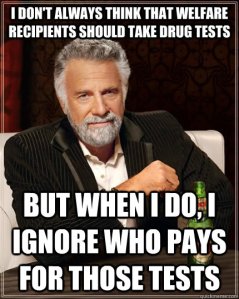
It’s also a waste money. Requiring drug tests for individuals who receive social services benefits has consistently been shown to increase administrative costs with little else to show for the efforts.
When the State of Tennessee started testing individuals who applied for Temporary Assistance to Needy Families (TANF), only 37 out of more than 16,000 applicants failed drug tests during a six month period. Those results weren’t much different from those in other states, such as Utah and Florida.
I don’t know what the cost of administering those tests was, but I do know there is no way that those results can be spun to indicate cost-effectiveness. But then, the outcry for drug-testing people who receive TANF has never really been about cost-effectiveness or even helping families with drug addiction.
It has always been about pointing fingers at low-income people and blaming them for their circumstances.
Despite public perception that “people on welfare” are lazy and don’t do much to contribute to society, the life of people who receive TANF isn’t all that restful. First they have children to raise.
TANF, which was established during the Clinton administration, is only available to families with children. It also requires recipients to participate in programs that help them learn skills and gain employment. In West Virginia, TANF recipients are required to sign a personal responsibility contract which they have to follow or they will lose benefits.
Even if they do all that is required of them, federal law prohibits them from receiving more than 60 months of assistance during a lifetime.
For a small amount of cash assistance (in West Virginia, a family of four receives an average amount of about $385 each month), TANF recipients must go to classes, do volunteer work and actively seek employment. Studies show that the average time any individual receives TANF is 24 months, and that is usually the result of unfortunate circumstances like the loss of a job or divorce. Much like an insurance policy, TANF was available to these individuals who had been taxpayers but fell in tough times until they could once again be taxpayers.
I have many more friends who never used TANF not because they never had financial difficulties but because they had the resource friends and family to help them through the crisis. Not everyone is surrounded by people who have the resources to help.
But even when we look beyond the stereotypes about who receives TANF, there are even bigger issues.. For example,what happens when someone does test positive for drugs? What will happen to their children (since they must have children to even receive the assistance.) Just as critical, who will be responsible for treatment and recovery services? In my community, those services are usually unavailable and inaccessible to low-income and rural individuals. Advocates have been complaining for years about the lack of treatment programs. Before we focus on drug testing anyone, we must have the community capacity to help those who struggle with addiction.
The call for drug testing “people on welfare” only makes sense to those who either don’t understand the social services system or who don’t want to understand it. It only makes sense to people who don’t mind stereotyping low-income people or who don’t realize that’s what they are doing. And it only makes sense to those who think that subjecting people who are already struggling to additional accusations is more effective than subjecting them to a helping hand.
Would Anyone Miss Mrs.?
 My co-worker stood in the doorway of my office with a book in her hand.
“Can I complain for a minute?” she asked.
“Sure,” I answered. And I meant it.
One of the reasons I love my job is that I work in an environment of open doors and open ears. Most of us have ever-growing “to do” lists, are trying to meet multiple demands from multiple people and are always aware that we may have to drop everything in order to meet the needs of the people we serve. Despite that, or maybe because of it, we always make time for each other.
And so it was when the immigration attorney in the office next to mine needed to air her grievances.
And when she did, I understood.
She was recently listed in a professional directory with a Miss in front of her name. “There’s nothing to indicate that I have a law degree or that I passed the bar exam,” she sighed. “Basically, the only thing people know from this publication is what my job title is and that I’m single.”
I glanced through the directory noting that all of the women were listed as either Miss or Mrs. Since I’m neither (I’m married but didn’t take my husband’s last name), I had to question why, in this day and age, the terms are even needed. I’ve been married 21 years, have two children and have never once felt that my life would be better if people called me Mrs.
As we discussed the issue, a male colleague chimed in.
“I understand the need to differentiate between male and female,” he said. “There are women that have my first name, and I want people to know I’m a guy. But my wife and I have had this conversation on numerous occasions, and she thinks Ms. and Mr. are is all we need”
I’m with him (and his wife).
With all the advances women have made, I don’t understand why we often still address them based on marital status (or questionable marital status) while we address all men the same, regardless of marital status.
I know the distinction is probably a result of days when men were in charge and women (supposedly) embraced marriage as the ultimate achievement. But those days are over (except for extremists like the Duggar clan.) Women who want to take the traditional path of changing their last name when they marry can and should.
But women who are listed in a professional directory should have the assurance that people are much more interested in their qualifications than with their marital status.
Besides, I doubt anyone under the age of 50 (other than the Duggars) would even notice if the term Mrs. goes missing.


 Just So You Know