Category Archives: perspective
The Gift in the Dead Man’s Email
 About ten years ago (before social media reconnected me with people who I never thought I’d hear from again), I received an unexpected email at work.
It was from a guy I’d known more than a decade earlier and who had faded into my memory like the vague shadows of a rear view mirror. He and I had once run in similar circles, but I’m fairly certain we never had a conversation that endured more than five-sentences. He’d certainly never occupied much, if any space, in my conscious or subconscious mind.
Which is why, when I’d received a chatty and rather lengthy email from him, I was more than just a little surprised.
He’d contacted me after reading a newspaper article in which I was quoted. He hadn’t known that I lived in the same town where his daughter and ex-wife resided, and seemed genuinely excited to re-connect.
I responded, and we exchanged a few more emails.
And then he died.
I learned about his death in the same way he’d found me – by reading about it in a newspaper article in the local paper. He had been in a head-on collision after apparently falling asleep at the wheel.
At a glance, there’s nothing particularly meaningful about this guy who was a small part of life, then wasn’t, then was again, then exited it completely.
We hadn’t been close nor do I imagine we ever would have been.
And yet, his random appearance after so many years then his abrupt disappearance after only a few days have stayed with me. Perhaps that’s partly because they serve as a reminder of how random and fragile life is. But they also suggest something more essential about how we live our lives.
We never know what the implications of our simplest interactions with others may lead. Acknowledging the presence of the quiet person in a group or sharing a smile don’t seem like grandiose gestures in a world overwhelmed by people who scream for, and often get, attention.
But then again, maybe they are actually bigger and more relevant than any action on a stage, or screen, or political platform can ever be.
Mark’s email all those years ago was a surprise because I never thought there was much worth remembering about me in those early days of my adult life. I certainly didn’t think someone I barely knew would reach out to me more than a decade later.
Yet he did. And even though our interactions were brief, he gave me something in return: a new-found understanding of my relevance in the past, in the present, and in the future.
As the Year 2016 ends and the Year 2017 arrives, the majority of my friends and acquaintances are glad to say goodbye to a year in which so many people died and the future of our democracy began to crack. Because of that, they are fearful of what 2017 may bring.
And yet, in truth, we can’t really live if we spend our energy in a soup of regrets, resentment and concerns about the behavior and actions of others.
All we can do is follow the Golden Rule and treat others in a manner that no one can criticize. And sometimes, when we do that, our actions may stay with others long after our own memories of them have faded.
A guy I once barely knew taught me that.
Rest in peace, Mark.
And rest in peace 2016.
The Car Accident
 I have a confession.
While I am quite happy to have my son home from college for a few weeks during the holidays for the simple pleasure of having him close, I’m also appreciating a side benefit.
I have an additional chauffeur for my very busy, always doing something but not old enough to drive herself 15-year old daughter.
Such was the case on Monday evening when she needed a ride home from school at 5:30.
My husband, who had to get up and go to work shortly after midnight, was getting ready to go to bed, and I was still at my office on a conference call.
Thus, my 18-year old son was dispatched to get his sister, and I was able to get home without any worries.
Or so I thought.
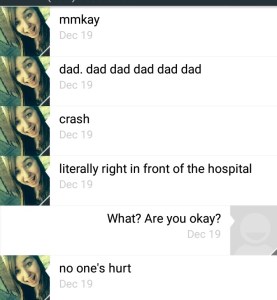
I had just walked in the door and taken off my coat when Giles came running down the hall in a panic. He was wearing only his underwear and waving his phone wildly in one hand while attempting to shove Crocs on his feet with the other.
It was not a pretty sight for so many, many reasons.
“The kids were in a car wreck!” he yelled at me while bouncing unstably on his left foot while trying to shove a Croc on his right.
I am ashamed to admit that, while I did have a flash of concern for my kids, I was primarily focused on one thing: I could not let my husband leave the house looking like that.
And so, I took charge of the situation.
“Where are they?” I asked.
“By the hospital!!!!” he shouted still charging down the hall in all his almost-naked glory.
“I’ll go. You stay,” I said not even bothering to put my coat back on or wait for his response.
Before I continue this story, I must say one thing. Everyone thinks Giles is the calm one in our marriage. While I admit that I am high-strung and have a tendency to worry, I am the proverbial woman who will choke on a flea but swallow a camel. In other words, when I have to deal with a tough situation, I just deal with it. My husband, on the other has, has one extremely irrational fear: he does not trust anyone, except himself, behind the wheel of a motor vehicle.
When we are on a long trip, he practically hyperventilates if I suggest he take a break and let me drive. I don’t think he’s even been in a car when my son is driving. He left the responsibility of driver’s education to me and a paid instructor. That’s why I knew that Giles was in such a state of anxiety that he wouldn’t have thought twice about jumping into my car to drive to the scene of the accident. In his underwear. And his Crocs.
Now back to the story.
Since we live in the neighborhood right behind the hospital, I arrived on the accident scene in less than five minutes. A quick assessment told me several things:
- No one had been hurt
- The accident appeared to be the fault of the other driver
- A hospital security guard was handling the situation until the police arrived
- My husband’s car didn’t seem to be badly damaged – unlike the other car
- I should have worn a coat as the temperature was well below freezing, and
- My daughter was crouched down in the passenger seat talking into her cell phone and looking thoroughly disgusted
After hugging my son, who seemed in complete control (unlike the other driver who was almost in hysterics), I checked on my daughter. She informed me that she was crouched down because the whole situation was extremely embarrassing and she didn’t want anyone to see her. She also told me that she was on the phone with her dad, but the phone battery was almost dead. I told her not to waste any more power and to hang up. I would call her dad to let him know what was happening.
But here’s the thing about me. I like to talk. A lot. And I talk to my husband all of the time. The accident scene provided a whole new set of characters with which to converse. I tried to calm the other driver by talking about her TARDIS hat. I had a lengthy discussion about music with the guy who had been behind my son and stopped to help. I even talked with the security guard about keeping the area safe. Then the police arrived. In other words, despite my promise to call Giles back, I didn’t. Which is why he had again called my daughter, insisting she stay on the phone to keep him informed.
I took the phone from her, tried to ensure my husband that the situation wasn’t that dire, and told him his car wasn’t very damaged.
“It’s mostly superficial,” I said.
“How would you know?” he asked.
“Because I can see it,” I replied. The grill is a bit broken, and there are a few dents. Other than that, it’s fine.” The music-loving guy chimed in.
“Yeah,” he said loudly. “I already checked it over. Nothing is leaking.”
“But is it safe to drive?” my husband asked. At this point, I know I rolled my eyes. After all, the entrance to our neighborhood was only a few yards away, and our house was less than a mile.
“Yes,” I said. “It’s fine.”
When Giles continued to express concern, I handed my daughter’s nearly dead phone to the police officer, who assured Giles that our son could drive the car home – once the other car was pulled out of his way by the tow-truck.
When the officer gave me the phone back, Giles immediately said, “That was embarrassing.”
I almost told him that it was much less embarrassing than if he had actually shown up on the scene, but I restrained myself.
Later, when we had all arrived safely home, I didn’t protest much when he tried to convince the kids that I had been as freaked out as he had when we got the call. They humored him by nodding in agreement.
Because they, like me, didn’t really care who had been freaked out. Everyone was safe, we had another family story to tell, and there was no long-term damage to anyone or anything.
In some ways, that car accident was like a strange Christmas gift wrapped up in torn paper and a wrinkled bow. It might not have been what we would have ever wanted, it certainly wasn’t bright and shiny, and it cost more than we would wanted to spend emotionally or financially. But it reinforced the bond that makes our family unique, special and, most importantly, always ready and willing to support each other… no matter how embarrassing each of us can be.
Since I’m Not Catholic or a Lesbian…
On Sunday morning, I’ll be worshiping at a Catholic mass. I’ll also be briefly speaking about the Catholic  organization for which I work.
The Catholic Church has always been a part of my life during the Christmas season. My parents met on the campus of Notre Dame University back in 1961, and their annual Christmas cards from Father Theodore “Ted” Hesburgh always held a place of honor in their home.
Despite that, my parents aren’t Catholic, and I’m not Catholic.
Just learning to call their church service “mass” was an accomplishment for me. Less than a month after I started my current job, I made the mistake of walking into a Catholic Church on a Sunday morning and asking two women about “the service.” They looked at me blankly until one of them, with a note of disbelief, asked “do you mean the mass?”
I did. Since then, I’ve also discovered that a Catholic priest doesn’t deliver a sermon but instead gives a homily and that Catholics don’t say The Lord’s Prayer. Instead they say a shortened prayer called the Our Father. It has the exact same words as The Lord’s Prayer, but it ends sooner. Which means, if you are a Protestant (like me) in a Catholic Church, you quickly become the center of attention when you are still loudly reciting the end of the prayer you know while everyone around you is silent. That may actually be more embarrassing than loudly saying “Amen” at the end of the Pledge of Allegiance during a school program. Yeah – I did that once too.
But back to my original point: many people assume I’m Catholic because of my job (unless, of course, they get the opportunity to observe me during an actual Catholic mass.)
I had a similar experience back in the early 1990’s when I worked for the statewide AIDS Program. At that time, the popular belief was that AIDS was a gay disease. Therefore, many people assumed that I must be a lesbian, especially since my job required my going to some very interesting events at some very interesting places. Needless to say, I became quite familiar with the gay community.
But here’s the deal: not being Catholic doesn’t prevent me from doing my job or serving people in need any more than not being a lesbian prevented me from addressing the growing AIDS epidemic in the early 1990’s. And I’m fairly confident that the people who know me and have worked with me will agree.
What my work does require is that I accept people for who they are just as I hope they will accept me for who I am. In doing so, we can all work together for the common good.
During the last few months, I’ve witnessed too many individuals make negative comments about people who don’t share the same religion, the same sexual orientation or even the same skin color.
I just don’t get it.
Considering our differences as negative will never, ever allow us to work together. It certainly won’t help us identify and use our various strengths to build a better country. Most of all, it won’t help us eliminate hate, which is an enemy to all of us.
As a small child, one of the first Bible stories I learned was a parable that Jesus told in the Gospel of Luke. It went like this:
“A man was going down from Jerusalem to Jericho, when he was attacked by robbers. They stripped him of his clothes, beat him and went away, leaving him half dead. 31 A priest happened to be going down the same road, and when he saw the man, he passed by on the other side. 32 So too, a Levite, when he came to the place and saw him, passed by on the other side. 33 But a Samaritan, as he traveled, came where the man was; and when he saw him, he took pity on him. 34 He went to him and bandaged his wounds, pouring on oil and wine. Then he put the man on his own donkey, brought him to an inn and took care of him. 35 The next day he took out two denarii[c] and gave them to the innkeeper. ‘Look after him,’ he said, ‘and when I return, I will reimburse you for any extra expense you may have.’
36 “Which of these three do you think was a neighbor to the man who fell into the hands of robbers?”
37 The expert in the law replied, “The one who had mercy on him.”
Jesus told him, “Go and do likewise.” Luke 10:25 -37
I’m not a Biblical expert. Instead, I’m just a lowly social worker trying to do a small bit of good in a world that can be harsh, brutal and often downright cruel. But to make even the slightest difference, I have to work with and be a good neighbor to people who are extremely different to me.
I can only hope that this Christmas, all of you will “go and do likewise” as well.
The Hater
 The phone call came on Friday afternoon because, well, these types of phone calls always seem to come on a Friday afternoon.
The caller was warning me that a self-important person was bad-mouthing me behind my back.
I wasn’t surprised, nor was I worried. In fact, at this point in my life, I didn’t much care.
I’ve had others slamming me for my successes ever since I broke the curve on tests back in junior high school. Heck, I once had another woman spread horrible, untrue rumors about how I treat others just because I got the job she wanted.
So, on Friday afternoon, when I was informed that I was being disparaged for playing well with others to improve a situation, I was only slightly irritated and a little bit sad for the woman who was maligning me.
I wasn’t being criticized for doing anything hurtful, mean-spirited or even self-serving. I was being cut down for succeeding at something that the other woman, for years, has failed to do.
And so, before I hung up on my caller, I told her not to worry. The hater’s words and anger had nothing to do with me and everything to do with her own unresolved issues. For years, she has demonstrated a pattern of trying to undermine strong, accomplished women.
But long after the phone call had ended, I couldn’t stop thinking about all the hate that’s permeating our current social and political environment. I continue to be astonished that so many people feel bad enough about themselves or their own situation that they are compelled to embrace raw hostility toward others.
Despite my initial desire to respond to vitriol with my own harsh words and behavior, I can’t let myself fall into that trap.
Doing so will only contributes to a cycle of negativity.
I speak from experience. At a political forum just this past week I found myself reacting to the ignorance of local politicians with my own derogatory, side comments. And then I immediately felt bad about myself.
Does that mean I should accept bluster, disdain and outright cruelty? No. I refuse to do that.
Something has to change, and being kind in an unkind world seems like a long-shot.
Then again, millions of people have embraced the message of two beloved authors, Charles Dickens and Dr. Seuss, who both wrote stories demonstrating that material possessions can never make a person happy and that kindness can change the hearts of completely selfish individuals.
And if witnessing the compassion of others can turn the souls of Scrooge and the Grinch inside out, then maybe, just maybe, there’s still hope for all the other haters in our country.
Which is why, when I go back to work on Monday, I’m not going to let the hater prevent me from doing what is right, saying what is true, and most importantly, living a life that I know would meet with the approval of Mr. Dickens and Dr. Seuss.
And I challenge any hater to say something negative about those two.
The Immigrant
 If learning from mistakes could actually increase my I.Q., I’d be a genius.
One of my greatest mistakes has been having an opinion on a topic about which I am very emotional but actually know very little.
And so it is with the issue of immigration.
I work for an organization that serves immigrants and refugees. On almost every work day, I overhear conversations in languages other than English, look into the eyes of beautiful children whose parents came to America in hopes of improving their future, and hear stories about families who fear they will never be reunited.
And so, my heart reaches out for these individuals. But being passionate without facts does nothing to help me speak articulately about the issues.
For that, I called upon my co-worker Brittany Young, an immigration attorney who has both the passion and the knowledge. Hopefully, her words enlighten you as much as they enlightened me.
From Brittany:
One of the most common questions I hear about undocumented immigrants, is “If they wanted to come to America so badly, why they didn’t just come legally? “
The question seems straightforward: we have a laws that people should follow, so if you are here without documents, you should just go home.
Many people want an easy solution, like building a wall, but the issue of immigration is too complicated for a simple solution.
Our immigration laws are broken and beyond repair. Limits on the number of available green cards have resulted in backlogs for years, even decades. For example, an unmarried adult child of a U.S. citizen from Mexico will have to wait approximately 11 years before they can gain permanent residency. Additionally, punitive changes in immigration laws passed in the 1990’s prevent many immigrants from seeking green cards. An undocumented spouse of a U.S. citizen who entered the U.S. illegally has to return to their country of origin to pursue a green card. Because they have been present in the U.S. for more than a year without documents, if they leave the U.S. to go to an interview, they trigger a ten-year bar on reentering the United States. They may possibly qualify for a waiver of that bar, but there are no guarantees and not everyone qualifies. So, people get stuck without a viable way to enter the legal immigration system.
As an immigration attorney, I often meet with potential clients only to tell them there is nothing I can do for them despite the fact that they’ve lived in the United States for years and their children are U.S. citizens.
Additionally, many undocumented immigrants are doing are the jobs that, historically, Americans don’t want to do. If you enjoy eating fruits or vegetables, the odds are that undocumented workers picked that tomato or apple or watermelon. Without undocumented immigrants, farms struggle to find the labor to harvest their crops. Undocumented workers not only help do much-needed work, they keep the costs low. Those savings are passed on to the consumers. Many Americans who shame undocumented immigrants publicly are actually enjoying the benefits of their labor.
Also, being undocumented in the United States is not a crime. Violating our immigration laws is not a criminal offense. The act of crossing the border is a crime, but the deportation process is a civil law one. Immigration courts, which are tasked with deciding who to deport, are civil, administrative law courts that operate without many of the due process safe guards present in other parts of our judicial system. Despite the grave consequences, people, even children, represent themselves in immigration court.
Because of that, please stop using the word illegal. It’s is dehumanizing. Immigrants are people. They are moms and dads trying to provide for their family the best they can while giving their children the opportunities they never had. They are young kids terrified to return to their home country because gang violence permeates every layer of society. They are women who have suffered unimaginable abuse and are seeking safety. They are high school graduates who were brought here as children and are now trying to figure out how to pay for college.
I never look at a single one of my clients and think they are illegal, because they aren’t. They are people just like you and me who are I trying to do the best with what they have. Maybe if we move past the labels and actually sit down and talk to some of these individuals, we will discover that our commonalities outweigh our differences.
The Meme I Hate the Most
 I regretfully admit that I was in my forties before I truly understood one of life’s most important tenets: being right will never feel as good as being kind. That’s why I almost didn’t write this.
I don’t want to shame or embarrass anyone who has shared or posted the meme that makes me cringe every time I see it.
I know that it was posted with the best of intentions by great people with good hearts, kind souls and a desire to make the world a better place.
But a statement suggesting that big homeless shelters are somehow better than big churches is, well, just wrong on so many levels.
Let’s start with the fact that we live in America, a nation founded by people seeking a right to worship in the way they wanted. Dismissing how others choose to worship is completely un-American.
Personally, I’m not a fan of churches with memberships larger than the population of the town in which I live. But that’s why I don’t attend one.
I understand concerns that the money used to build, maintain, and equip such large churches could be better used to pay for services to the disadvantaged, but couldn’t the same be said for almost any aspect of our own lives? If we had a smaller house or a less expensive cars, all of us would be able to give more to charity.
We should all spend less time judging and more time actually helping others.
Which brings me to the other reason I hate this meme.
Are there really people who think that building more and bigger homeless shelters is the answer to our homeless problems?
To me, that statement is like waving the white flag in surrender to all of the issues that cause homelessness. We are accepting that we are helpless in the face of the root causes, such as mental illness and social injustice. We are admitting that prevention doesn’t work and that people and systems can’t change.
And I’m not willing to accept that.
I work for a social service organization that fights poverty. Yet every day, I also fight a mentality that providing financial assistance and food to the poor is all we can do to help.
In reality, that’s doing people in poverty a disservice. It’s sending a message that they are not capable of doing more or being more. It’s telling them we’ve given up on the possibility that they are capable of helping themselves and helping others.
Addressing issues of poverty is hard work. It involves developing relationships with people who are often hard to love or don’t understand the manner in which middle class people live and interact. It’s our job to walk with them, teach them, and set expectations for them.
That’s not to say that there isn’t a place for emergency financial, food, and housing. There is. We can’t expect anyone to make big changes in their lives when they are in the middle of a crisis.
But if that’s all we do, then we are selling them, and ourselves, short.
So instead of calling for more homeless shelters, I want to hear a rallying cry for more preventive and support services. I want a united demand for better mental health and drug treatment programs. And, most of all, I want people to stop putting the band-aid of temporary shelter on gaping, life-long wounds created in part by the inference that some people should just accept their place in life.
How to Stay Sane Until November 8
 I’ve felt myself slowly sliding closer and closer to that proverbial deep end.
I made the mistake of reading social media posts from people who, for whatever reason, are incredibly afraid of the truth and therefore ignore facts, denounce credible news sources and cite dubious and/or biased sources to justify their own skewed beliefs. I’ve observed so-called Christians claiming that their version of Christianity is the only legitimate religion in the world. And I saw pictures of women making light of sexual assault.
My disgust hasn’t been limited to social media. My daily perusal of the Washington Post has provided regular reminders of the vitriol, misogyny, xenophobia, racism, disrespect and overall embarrassment of the 2016 presidential campaign.
I’ve wanted to close my eyes, put a finger in each of my ears and loudly yell, “La la la la la la la! Stop it! I’m not listening!” at the top of my lungs.
But I haven’t because I can’t. Of the billions of people on earth, I was lucky enough to be born in the United States and enjoy the rights provided to me in the 19th amendment (even though some avid Trump supporters are now in favor of repealing those rights).
So, despite how incredibly scary this election is or how history will some day portray it, I have a responsibility to use my rights (as they currently exist) to speak out.
But I can’t do that if I lose my sanity, so I must find a way to keep my grasp on it.
And to date, I have thanks to some bright moments as our nation faces such dark times.
For example:
- Staying up to watch Saturday Night Live has once again become worthwhile. Donald Trump can actually make me smile – when he’s played by Alec Baldwin that is.
- I’m rarely the smartest person in the room. I am surrounded by intelligent, well-educated people who amaze me with their breadth of knowledge and keen insights. As a plus, not only are they smart, but they are also very open-minded.
- Even though my man Jon Stewart is no longer on the Daily Show, my favorite acerbic political comedy hits the mark every single time. Each morning, I watch the first ten minutes from the previous night and am filled with appreciation that other people really do “get it.”
- The headlines about sexual assault and sexual harassment are increasing awareness of and support for survivors.
- There are a lot of men who are raising their voices in support of women and against white male privilege. I’ve loved spying on my son’s social media accounts, and, I have to say, I’m so proud of his acceptance of people of all genders, sexual orientation, race, religion and backgrounds (as long as they aren’t bullies and jerks of course.)
- Despite all the hate rhetoric, we ARE making progress toward being a more inclusive nation. On the day I was born, there was only one woman in the U.S. Senate and only eight in the House of Representatives. When I was a year old, Martin Luther King Jr. was slain. Just a year later, the Stonewall riot occurred in New York City, marking the beginning of the gay rights movement. Today, our president is a black man who has spent eight years in the oval office, gay couples have the right to marry, 104 women sit in Congress, and a woman is the Democratic nominee for President of the United States.
- History shows that good ALWAYS rises from the ashes. ALWAYS. No matter how horrible the circumstances, there will always be heroes and people who make history with their ability to not only rise above the fray but to make the world better for others.
And that is what I’m counting on to maintain my sanity after this election too.
Beyond Appearances
 Months ago, I swore I wouldn’t get too emotionally or otherwise invested in this year’s presidential election.
In 2012, I wrote and ranted and worried. I wanted to ensure that everyone knew exactly what I thought about the candidates and why my opinion was justified.
In retrospect, I doubt anything I wrote had much, if any, influence on anyone.
People who agreed with me, well, agreed with me.
People who disagreed with me either ignored me, posted negative comments, unfriended me or unfollowed me.
America re-elected Obama, politics continued to divide us, and America has continued to be torn apart by issues of race, equality and social justice.
And this presidential campaign has devolved into a completely horrifying spectacle.
Yet up until now, I’ve refrained from writing about it.
Maybe I’ve just become too cynical and convinced that some people’s brains simply can’t separate facts from propaganda and can only spout ridiculous rhetoric.
But something happened to my self-imposed reticence after watching the first of three scheduled presidential debates on Monday night.
I realized the hypocrisy of my temptation to make light of Donald Trump’s hair, his weird orange complexion, his constant sniffing and his absurd facial expressions.
Because in doing so, I’ve lowered myself to his standards of valuing, or devaluing, someone based solely on appearance. This is, after all, a man who discussed the potential size of his toddler daughter’s breasts https://www.youtube.com/watch?v=1w2T1owSV0U, has used physical attributes as a qualification for employment http://www.latimes.com/projects/la-na-pol-trump-women, and, the night after the debate, defended hurtful comments about a beauty queen’s weight http://www.npr.org/2016/09/27/495611105/in-post-debate-interview-trump-again-criticizes-pageant-winners-weight,
As a country, we have to be better than this.
We must do better than this.
We have to raise our expectations and our standards.
And, most importantly, we have to make the voice of human dignity louder than anything money can buy.
For Just One Perfect Moment
 During all of my nearly 50 years, I can recall only one time that I literally stopped to think “This is one of the moments that I need to treasure. I need to store it in my memory right next to my heart so I can pull it out when times are tough. I need to remember how the sun feels on my skin and how I’m surrounded by people who only want the best for me. I need to capture the absolute essence of happiness that is permeating all of my pores so I can remember that life’s most important moments aren’t always big events but sometimes rather uneventful instances that actually mean everything.”
These thoughts came to me on a warm spring afternoon my senior year in college. My friends and I had skipped class to spend time at the lake at Strouds Run, a state park near the campus of Ohio University. My future was a complete unknown, and I had absolutely no idea where any of us would be in just a few short months. I had little if no money and no prospects for a job. And yet, I was completely happy to focus on enjoying an absolutely perfect moment.
It was so perfect that now, nearly 30 years later, I still remember how I wanted to hold on to it forever.
After that, life got more chaotic and often more serious. New people entered and exited my life. Circumstances changed often and significantly. And I changed.
Amid all that, I never again stopped long enough to recognize the importance of pausing to breathe in then hold on to a simply perfect moment.
That’s not to say I didn’t appreciate such moments. I did.
But there is a difference between appreciating something and treasuring it.
And lately, the person I used to be has been sending that reminder to the person I am now.
Maybe that’s because, with my son in college, I’m thinking more and more about that time in my life. Or maybe that’s because in two weeks I’ll be going to my college homecoming and reuniting with friends I haven’t seen in almost 30 years. Or maybe (and this is what I choose to believe), it’s because I’m tired of always worrying about what will happen when those perfect moments end and the complications, heartache and struggles return.
Because they always return.
But I’ve now lived long enough to know that the return of life’s problems provides even more reason to embrace those moments when all seems right with the world.
And I had one of those moments today.
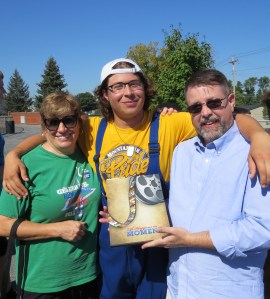
I hadn’t seen my son since the beginning of August when he left for band camp at West Virginia University. With the exception of a few texts and posts on social media, my husband and I haven’t heard much from him. But today, the Pride of West Virginia WVU marching band made a stop in our town in route to a game at Fed Ex Field.
We joined a handful of other local parents and fans as well as students from three schools to watch the band perform. When the show ended, we waited until the musicians had taken their instruments to the buses before coming back into the stadium for bag lunches.
And that’s when I saw my son for the first time in almost two months.
He broke into the same wide grin that he used to give me when I was picking him up at preschool. He doesn’t smile like that much anymore, and I don’t think it’s been captured on camera since he was a toddler. But he was looking right at me, broke into that wide smile and said “Hi Mom!”
And before I walked over to him for a hug and a photo opportunity, the me I used to be started whispering in my ear. She told me to treasure that moment. She told me I needed to store it in my memory and right next my heart so I can pull it out when times are tough. She told me I needed to remember how the sun felt on my skin and how I was fortunate to have people who care about me. And she told me that life’s most important moments aren’t always big events but sometimes rather uneventful instances that are measured by the smile on a child’s face and a love that is greater than any problem we will ever encounter.
And I listened to her.
Too Close For Comfort
 My 15 year-old daughter hates when I write anything without her approval and her editorial input. (For the record, she is an awesome editor.)
But sometimes she’s involved in something so much bigger than her or her editing skills that I am compelled to write without her approval.
This is one of those times.
To fully understand this story, you have to understand my daughter.
She is the girl who cares about every single living being and will always root for the underdog. She is the child who Googled how to provide emergency care for a baby squirrel and made me drive to the drug store to buy Pedialyte and a medicine dropper so she could save the one our cat dragged in.
She makes me buy tofu because it never breathed, can’t enjoy shrimp because they used to swim freely in the ocean and notes that every hamburger was once a cow.
And that same love of every creature is why she saved a cicada that was struggling on the sidewalk.
We were walking our German Shepherd when I heard her gasp and tell me to stop.
“He’s struggling,” she said pointing at the cicada on its back with legs flailing helplessly in the air.”I need to help him.” (Personally, I have absolutely no idea how to tell a male cicada from a female cicada so I went with her assumption that the cicada was a guy.)
Kendall nudged “the guy” with her shoe so he could grab onto it.
And grab on he did.
Once he had flipped himself upright on her canvas shoe, he began to slowly make his way up toward the laces.
And that’s when the screaming started.
“Get him off!” my daughter screamed. “Get him off.”
The piercing quality of her screams gained urgency because I wasn’t acting quickly enough.
By the time the cicada’s tiny, spindly legs had begun to make their way up my daughter’s bare legs, I was convinced that one of the neighbors was calling 911 to report a murder in progress.
When I finally did locate a stick (because I didn’t want to actually touch the bug either), my daughter was almost in a state of panic. Thankfully, I was able to get the cicada onto the stick and then safely onto the grass.
Kendall almost immediately admitted her shame at not wanting to actually touch the bug she was trying to save.
I told her that was natural and she shouldn’t worry, but I couldn’t help but compare that situation to ones I witness almost every day.
I work at a social service organization with a mission of improving the lives of others, particularly those living in poverty.
On a regular basis, I see the generosity of others to help the less fortunate. And not a day goes by when I’m not in awe of individuals who don’t run screaming when they realize that a simple financial donation isn’t enough to raise people out of poverty.
Does the money help? Absolutely!
Is it the answer? Absolutely not!
While there will always be individuals in situational poverty who just need that one financial boost to get them back on the right track, most of the people who walk through my office doors aren’t on any track at all. Instead, they are stumbling through an obstacle course of life designed by people who live in a world that is foreign to them.
Some of them don’t understand the importance of education. Others were taught that arguing and fighting is the only way to get what they want. And some have never even experienced the security of being a priority to parents, caregivers or anyone else who wants nothing in return but their well-being.
Letting such individuals people into our lives can be difficult and frightening. As my daughter stated after the incident with the cicada “My screaming didn’t indicate I didn’t want to help, but I just freaked out when he actually touched me.”
I understand her sentiment, but that doesn’t mean we shouldn’t step outside of our comfort zones.
Saving a life – whether it is that of a bug or that of another human being – often requires us to do just that. It can get messy and dirty and sometimes even scary.
But if we really want to change the world, we have to touch the world we want to change.


 Just So You Know