Category Archives: My life
Revelations from a Former Republican
 During a recent conversation, I shocked a friend when I mentioned that, when I turned 18, I had registered to vote as a Republican.
“You were NOT a Republican,” she stated. “There is just no way.”
“Not just a Republican,” I replied. “I was actually heartbroken that, because of my age, I missed voting for Ronald Reagan by only three months in the 1984 election.”
Since I was talking to my friend on the phone, I can’t confirm that her mouth was actually hanging open, but I’m pretty sure it was.
“What happened?” she finally asked.
“I don’t know exactly,” I replied. “But by the time I graduated from college, I’d changed political parties.”
In all honesty, I do know what happened. I’d identified the core values that would guide the rest of my life, and they simply just didn’t align with the Republican Party.
I don’t think my friend, or anyone else, really cares about how I arrived at my decision. And, until this past week, I didn’t feel any need to explain.
But after witnessing one too many debates about how people who receive SNAP (more commonly known as food stamps) may be eligible for additional benefits if they were affected by the derecho (http://www.catholiccharitieswv.org/index.php?option=com_content&view=article&id=300%3Awv-long-term-disaster-recovery-derecho-storm-a-power-outage-disaster&catid=45%3Aannouncements&limitstart=1), I felt the need to say something.
On the surface, the gist of the conservatives’ argument against the additional benefits was that the government was once again frivolously spending taxpayers dollars.
But, as the arguments continued, a different, more self-centered concern actually emerged. Several people were turning the discussion into a conversation about fairness, or more particularly unfairness, in regards to their own lives: ” I lost all my food when the power went out, and no one is paying me to replace it.” “I have a lot of health care bills, and the government isn’t stepping in to help me.” “Basically, I’m being punished for having a job. ”
Sadly, I could relate to their complaints. That kind of thinking was the reason I had originally registered a Republican.
At the age of 18, I really did believe that everyone had an equal opportunity in this country, and if a person worked hard and persevered, they should be able to meet their own needs. If they couldn’t make ends meet, they needed to work harder or get a better education to get a better job. I believed in responsibility: if people made bad decisions then they, not I, should have to pay for those decisions. And I believed that our leaders had our, not their own, best interests at heart.
I held onto those beliefs because I was surrounded by people who believed the same thing. Then I went to college, and I was surrounded by people who didn’t.
I met too many people who had been denied equal opportunity through no fault of their own. I met too many people who had made poor decision after poor decision only to be bailed out by family while others fell into bad luck and had no one who could help. I learned more and more about greed, inequality and political corruption. And I learned more about myself.
At some point, I was confronted with the ultimate question: is life about what I can do for myself or is it about providing unconditional support for others, even when it sometimes costs me?
I chose the latter.
Don’t get me wrong. I can be very self-centered, and I know a lot of Republicans who are anything but selfish.
I just don’t think the core of my political beliefs should be about what makes my, or my family’s, life better or easier. I think public policy should be about ensuring the safety and well-being of all Americans, particularly those who haven’t had the same privileges that I’ve had: good parents, a good education, a decent I.Q. and a lack of any significant health problems.
When I look back on 18-year-old me, I still understand where I was coming from.
I still think people should do their best and be responsible for their behavior. I also think corporations and millionaires should do the same.
I still believe in hard work and self discipline. I also believe that too many people work very hard and still don’t get paid a fair wage so they can’t make ends meet.
I still wish life were fair. I also realize that making life more fair for everyone requires public policies that provide additional support for those who need it.
The difference between 18 year-old me and 45 year-old me is I don’t think the world owes me anything. Instead, I think I owe the world. The difference is I know some people put their own interests above the interests of others, even when it comes to the environment or safety or health. And I know that the most effective way to ensure such people do minimal damage is to implement and enforce regulation.The difference is that even though I don’t agree with wasteful spending, the wasteful spending I’ve seen isn’t for the programs intended to make the lives of most Americans better.
The difference is that I have enough life experience to know that life isn’t about being fair.
And that’s why I got so frustrated with the debate about additional SNAP/food stamp assistance. The debate wasn’t about whether people needed the assistance. Instead, it was a debate about fairness. I’m pretty sure if you asked the majority of people who were eligible to receive the help, they would be the first to tell you life isn’t fair. If it were, they’d be fortunate enough to afford to replace their own groceries while complaining about those who couldn’t.
The Dog, the Derecho and Me

The fence around the pool where we had been swimming minutes before the derecho hit. It literally looks like a whole section was just lifted up.
Living in West Virginia, I’ve been fortunate to escape dealing with any significant natural disaster. That’s probably because floods are the most common disasters in the Mountain State, and since I’ve never lived in a floodplain, I’ve never had to experience one.
But over the past few years, I’ve had warning signs that my time was up.
In 2010, about four feet of snow fell in four days. I spent that week shoveling snow while my husband spent that week in a hotel in D.C. at the courtesy of his employer.
Last October, we were hit with an abnormal autumn snow that knocked down 2 1/2 trees in my yard. While I was listening to the cracking of limbs and the thump of trees, my husband was in D.C. working.
With these warning signs, you’d think I’d have been preparing to handle a real disaster on my own. Instead, I chose to ignore the signs. That’s probably because I’m a complete wimp when it comes to any kind of danger I can’t control. At such times, I always grab my dog and hold on tight.
Last Friday night, I almost suffocated my poor dog.
My neighbors had gone out for the evening, so I was at their house keeping an eye on our ten year-old daughters and our dogs… my German Shepherd and their Golden Retriever. Since it was extremely hot, all of us spent at least some time in their pool.

My neighbor is worried about letting her dog run in the backyard since there is now a big hole in her fence.
At some point, I commented that the sky had gotten unusually dark. I probably shouldn’t have listened to a ten year-old who told me that was normal, but I hadn’t heard that we were in for any severe weather.
So, when lightning began to flash in the distance, all activities moved to the “pool room.” I worked on my blog, the girls flipped through television channels, the dogs romped and the wind blew. And then the rain came and the wind blew harder… a lot harder. Then it began to howl.
Being a weather geek, I checked the radar and saw a dark red mass moving towards my town. Being a naive weather geek, I didn’t get too concerned since I hadn’t heard any sirens or warnings.
My warning came with a roar when the wind blew open the pool room door and raged around the room. The next few minutes are a blur. I remember telling the girls to move into the hall. I remember trying to shut the door. I remember grabbing my laptop, and I remember grabbing both the dogs.
And then the power flickered and went out.
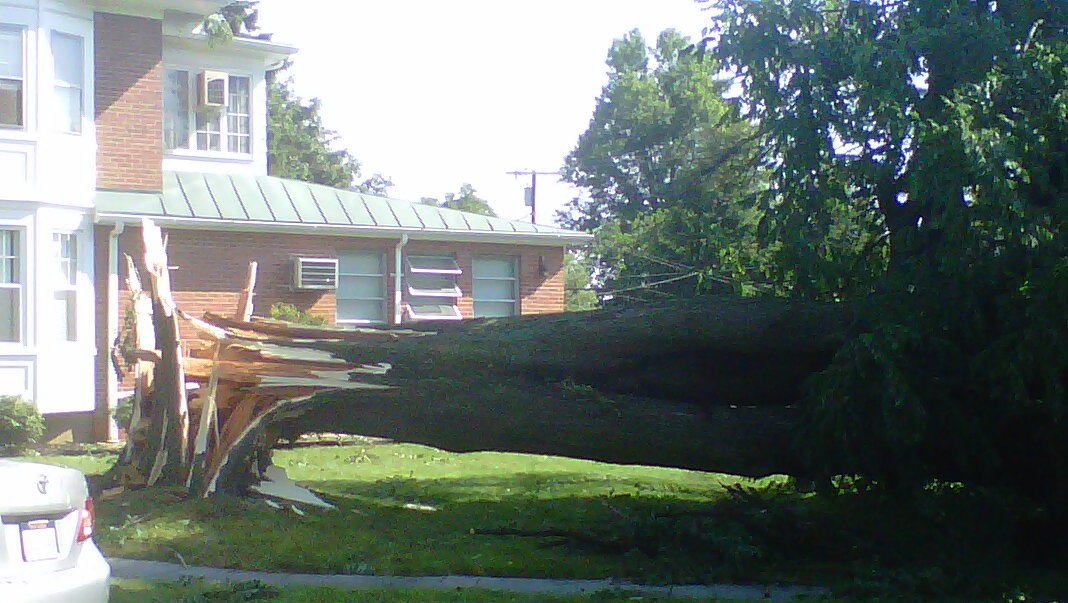
I was surprised at how many trees missed houses and cars… but many landed on roads and utility lines.
We sought refuge in the room of a ten-year old girl. And while I did worry about the girls, I have to say it was the dogs that I held fast. The neighbors’ dog sat in my lap, and my dog stood guard. The girls screamed, lightning flashed and the storm raged. And then, my neighbors’ son and his friend came home. Ever protective, my German Shepherd decided that his barking would be a great addition to Mother Nature’s latest composition.
It wasn’t.
I eventually convinced my daughter that we could dash across the yard to go home, and we spent the remainder of our night in the basement.
By the time my husband went to work shortly after midnight, all the remained of the derecho (also known as a land hurricane) were downed trees, downed power lines and a woman who wouldn’t sleep for days.

This car was entirely covered….
The next morning, my dog and I took our normal walk. Neighbors were already up removing debris from their yards and their roofs.
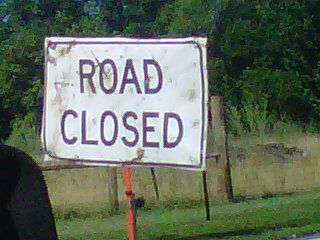
A common site for the first couple days.
Highway workers had already blocked roads, and Potomac Edison crews were already out trying to repair the damage. And the homeless guy at the park was eating his breakfast in his normal spot.
But nothing seemed normal to me except that my favorite dog was on the end of his leash walking happily over broken branches. He was even willing to pause while I used my Blackberry to document the impact of the derecho on my little corner of the world. He obliged for the next couple days as well.
In retrospect, we were lucky. We were only without power for a couple of days. My parents, who live nearly six hours away but experienced the same storm, still don’t have power. And, even with all the damage, what I’ve noted most is how many tall trees are still standing. For every tree that went down, hundreds more didn’t. To me, that’s nature’s way of reminding us all of how resilient we can be.
And, for the most part, I know I am. As long as I have my dog by my side.

My giant German Shepherd, Rodney, looked so small compared to some of the downed trees.
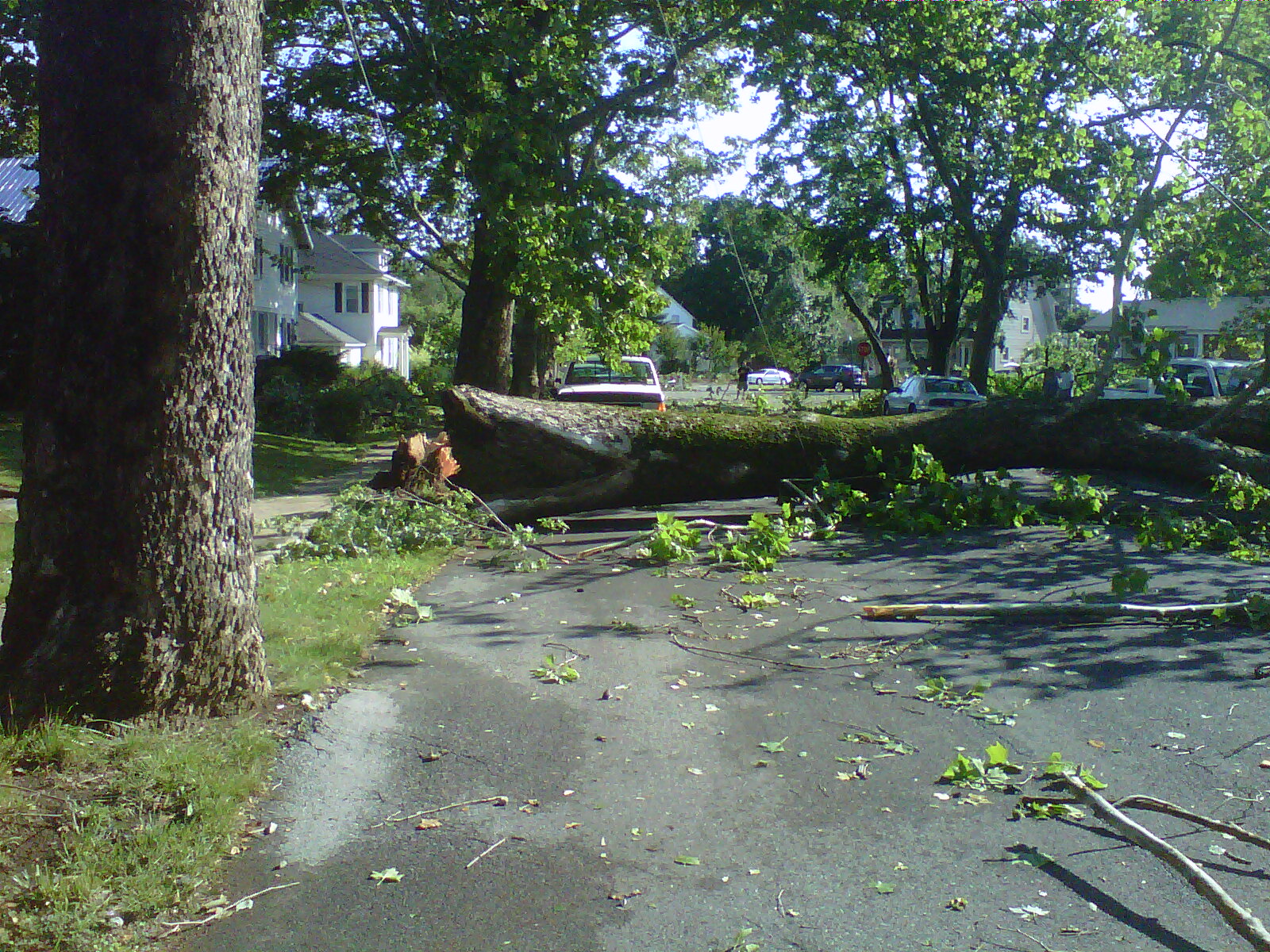
One of many beautiful trees the derecho claimed as victims.
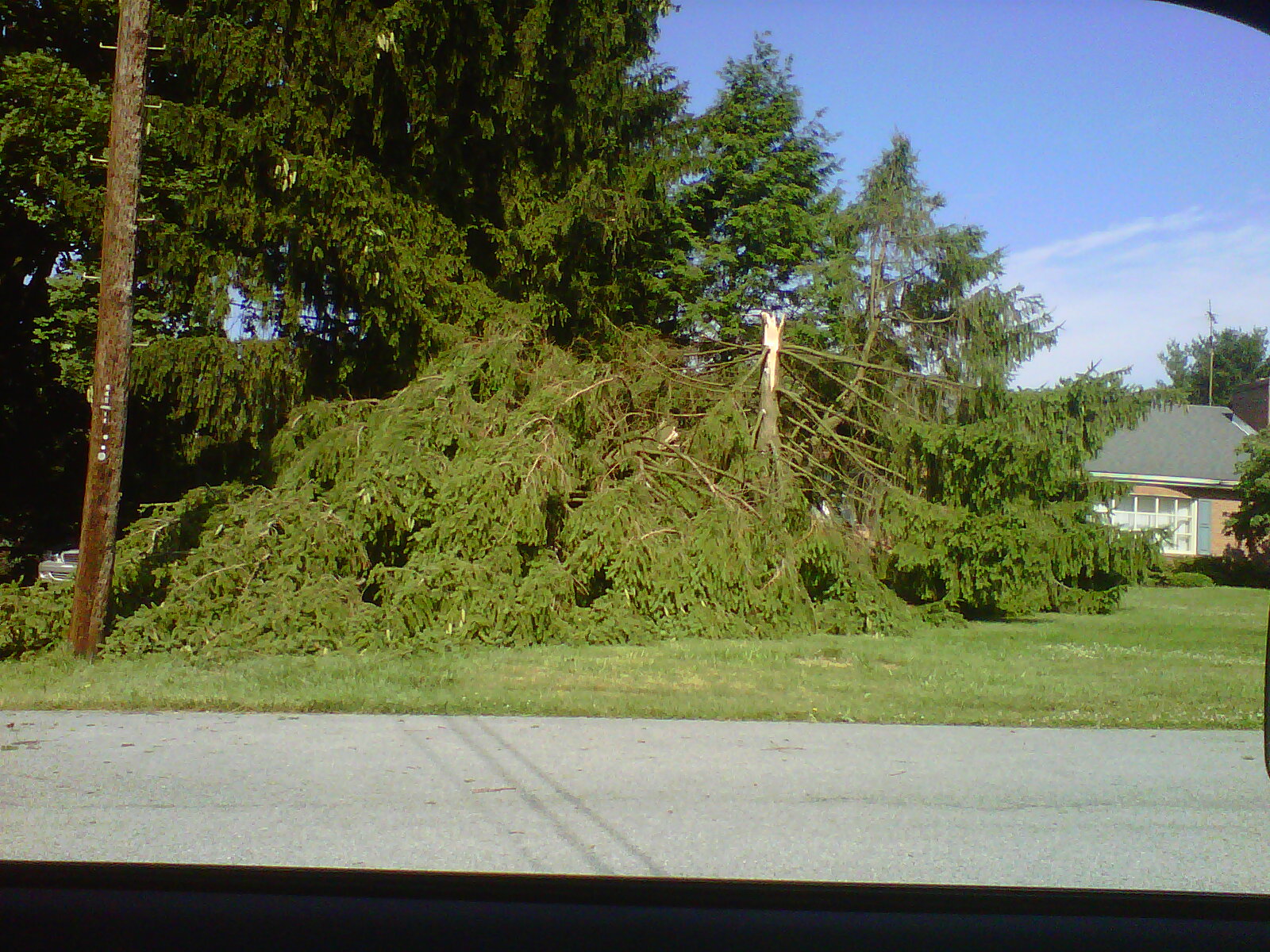
This once beautiful Pine has now been entirely removed from the neighborhood.

The City of Martinsburg is helping out by collecting all the debris residents drag to the curb. Here, Rodney surveys one street in our neighborhood.
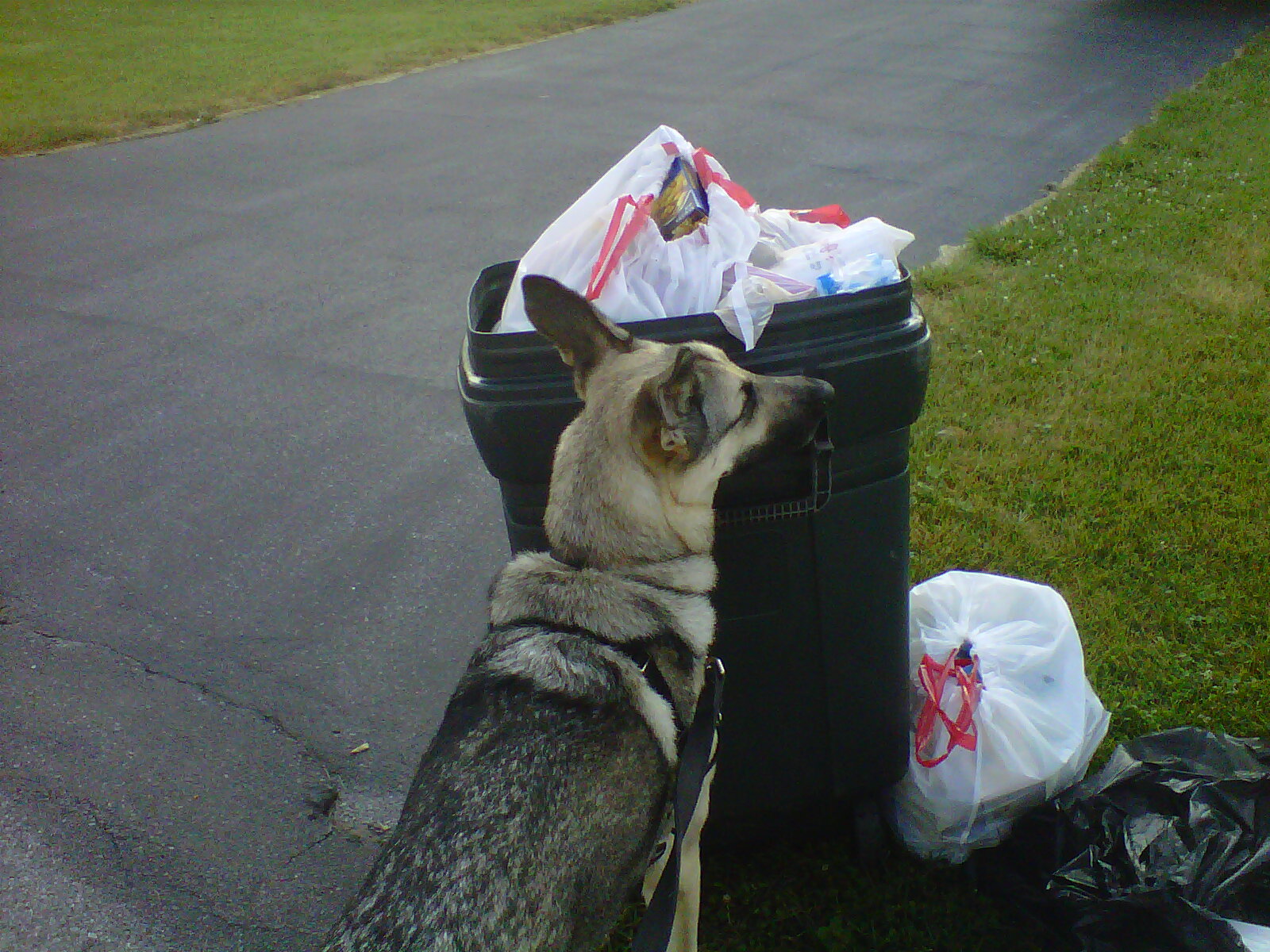
Everyone I know was very appreciative of how hard Potomac Edison worked to restore power. The biggest complaint I heard was how much we all lost when we had to throw away the contents of our freezers and refrigerators.

Rodney was very happy when power and air conditioning were restored. He took a break from all the walking around the neighborhood to sleep on the cool vent.
The Reason I Never Forgot Eddie Pee Pants
 On a beautiful spring day several weeks ago, my kids and I were heading to lunch a few blocks from my husband’s office on the crowded streets of Washington D.C . Dressed in only shorts and t-shirts, we didn’t really fit in with the men and women in business attire who were walking with a great deal more purpose.
But we had one thing in common: we all pretended we didn’t see the homeless person still wrapped in a blanket and sleeping in a doorway on a busy sidewalk.
I saw both of my kids glance over at him, but neither said anything. I didn’t either. Soon, the homeless person was forgotten.
Almost.
Because somewhere in the back of my mind, he stayed with me.
He’s still there.
It’s not that I’ve never seen homeless people before. I see them every day. I even have a semi-relationship with the guy who hangs out at the park where I walk my dog. If I don’t at least wave at him, he coughs or makes some other noise until I acknowledge him.
But the homeless guy sleeping on the steps was different, because he might as well have been invisible. Everyone, including me, blatantly ignored his existence.
I understand why the business people ignored him: they probably see him everyday. He’s as much a part of their daily landscape as the traffic lights, the street signs and the blur of faces they regularly encounter.
But I didn’t have any excuse, and I couldn’t figure out why I didn’t even talk to my kids about him. That’s just not like me at all. If anything, I usually talk way too much about such things.
The only explanation I could find is one I don’t like: I was going along with the crowd. It was just easier.
It’s not the first time I’ve had to make that admission.
When I was in elementary school, I didn’t even know the full name of the boy who rode the school bus. I just knew everyone called him Eddie Pee Pants. You don’t need to be a genius to figure out how he got the name.
I don’t remember calling him that to his face, but that’s the name I used when my peers and I were discussing how to avoid him. No one wanted to have to sit with Eddie Pee Pants on the bus. If you did, you’d not only have to smell him, but you would get “Eddie Pee Pants germs.”
I knew what we were doing was wrong, but I justified my behavior by telling myself that I was never actually mean to his face. But the guilt got worse when Eddie’s life got worse.
One Saturday morning, I joined my dad at the top of our driveway to watch the drama unfold on a hill about a mile from our house. A dilapidated mobile home was on fire. Flames were shooting out the roof, and smoke was turning the sky black.
“That’s a total loss,” my dad commented.
I didn’t know until Monday that the old, junky trailor everyone said was an eyesore was Eddie’s house.
I have no recollection of what happened to him after his house burned. I just know he never rode the bus again, and I don’t remember ever seeing him at school again. I don’t even remember if there were any injuries or fatalities in that fire.
What I do remember is wondering why I wasn’t nicer to Eddie and feeling horrible that I’d never have an opportunity to undo my misdeeds.
Eddie isn’t the only person I’ve ever discounted or belittled. But he’s the first person who taught me three essential life lessons:
1. Treating someone poorly never makes you feel better about yourself.
2. Sometimes you don’t get a second chance to do the right thing.
3. Issues such as poverty, child abuse and homelessness are actually about individuals — people who, regardless of the reason for their circumstances, still have value.
I’ve taken that third lesson to heart. Eddie, like the homeless person in the doorway, gave me something priceless. They taught me to look beyond the unkempt appearances, poor hygiene or odd behavior. They’ve taught me that sometimes the person who needs to change their attitude or perception is me. And they’ve taught me that speaking up feels a lot better than putting someone down.
They were priceless gifts in my life, and I hope I can pass their lessons on to my children. And that, if nothing else, is what makes their lives so valuable to me.
Most of My Heroes Don’t Carry Guns
 It’s Memorial Day.
Which means I’m being inundated with reminders about what the holiday means … a time to remember those we’ve lost, particular those who served in the armed forces.
I understand that. I appreciate that. And I even recognize the importance of supporting those who have served our country — regardless of whether or not we believe in the cause.
But the rebel in me questions if our eagerness to honor members of the armed forces has almost become so cliché that we don’t really consider what being a hero is – and what it’s not.
Being a hero isn’t about a title or a position… it’s about a behavior. It’s about putting your own reputation, sense of comfort or even life on the line for the greater good. It’s about fighting the fight for future generations rather than for ourselves.
And sometimes we forget that there are different types of battles to fight.
My concerns surfaced again when, over the weekend, I was trying to do some “spring is almost over” cleaning.
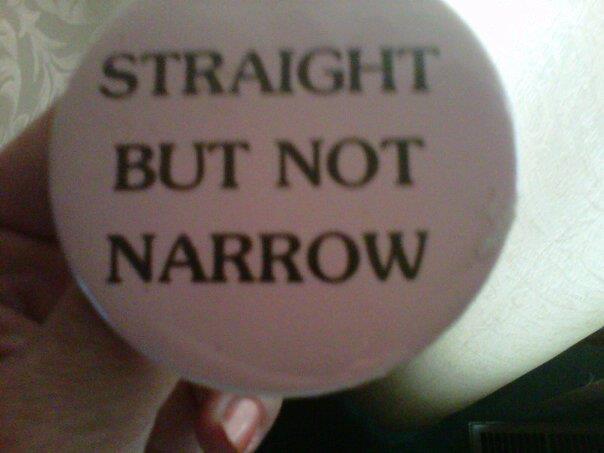
I found a button that said “Straight But Not Narrow.”
Given the recent national debate over gay marriage, I smiled when I realized I had been given the button more than 20 years ago. My smile soon turned to sorrow when 1) I realized that in the past 20 years, our nation really hasn’t come that far and 2) The person who gave me the button died years ago.
His name was Roger, and he died of AIDS.
He, like so many in our armed forces, died in the middle of a battle and with a great deal of honor.
Roger never hid his HIV status. Nor did he hide is sexual orientation.
In fact, Roger was one of the most open people I’ve ever met. If you asked him a question, he never sugar-coated the answer. He sometimes gave you more information than you wanted, but he never pretended the truth was pretty.
Roger will always be one of my heroes: those people who not only stand up for what they believe, but who put their own reputation and livelihood on the line to defend what is right.
Before he was infected with HIV and before his partner died of AIDS, Roger owned a hair salon.
That was his life before AIDS.
His life after AIDS was dedicated to educating West Virginians about the disease.
West Virginians are good people, but they aren’t exactly progressive… just check out their track record in the last few elections.
But Roger didn’t let closed-minded people get in his way. He knew that closed minds are like closed doors… they just need the right key to open or unlock them. And once they are unlocked, options and possibilities greatly increase.
Roger was the key to opening more minds and more doors than he ever knew. And the possibility he was seeking was a country where no one was infected with HIV again.
And so Roger knocked on and sometimes knocked over closed doors so he could share his message. He went to service clubs. He went to other types of clubs. He went to churches. And he went to schools.
He went wherever he could be heard and wherever people would actually listen.
His voice was definitely heard, and people definitely listened. I have no doubt Roger saved lives.
The only life he couldn’t save was his own. The medical battle against HIV was in its infancy, and Roger eventually succumbed.
But like so many other warriors, he left this world a better place than it would have been without him.
To me, that’s a hero. That someone I want to remember. That’s someone who inspires me.
That’s the type of person Memorial Day is all about.
There’s a Reason This Mom’s Brain is a Hot Mess

There’s no doubt I love my children.
But at times, when I’m completely honest with myself, I wonder what the heck I was thinking when I decided to become a mom.
It’s not because I regret having children. Not for a minute.
And it’s not because I think my life would be more interesting or exciting if motherhood didn’t require I put their needs above mine. Being a parent puts a whole new spin on interesting or exciting.
And it’s certainly not out of guilt that as a girl, teenager and even as a young woman, being a mom wasn’t on my list of life goals. Having children helped me recognize what’s really important in life.
It’s because there are times when I think my kids could have done better with another mother – a mom who isn’t as emotional or head strong or outspoken as the one they got. A mom who never purposefully ignores parenting magazines, workshops or other sources of standard parenting advice. A mom who always enjoys her children’s activities instead of attending out of a sense of obligation.
And just when I’ve convinced myself that my kids would be better off with any mom but me, I come face to face with parents who don’t understand what an incredible gift – and responsibility –being a parent is. I witness moms behaving as though they are still adolescents with all the same drama and self-absorption. I have to listen to parents who always blame someone else when their child behaves poorly, gets a bad grade or is fighting with other children. Worst of all, I know of parents who put their children’s welfare and safety in jeopardy.
I may be imperfect, but those situations make me feel better about my own parenting skills. At least for a little while… until my kids do or say something embarrassing or completely inappropriate. Then I’m back to thinking that if they had a different mother, their behavior would be stellar.
Such thoughts bounce around in my brain on a daily basis… sometimes at such incredible speed that I fear an impending brain explosion.
The requirements of my profession haven’t helped.
Because I have a social work license, I’m required to take continuing education. Usually, I seek work-related education. Because I recently changed jobs, I’ve been seeking education that is more closely aligned with parenting issues, which I usually avoid.
I’m not sure the plan has worked for me.
In a workshop on bullying, the presenter disparaged parents who tell their daughters that, when a boy teases her, he actually likes her. According to the presenter, that’s putting her on the path to domestic violence. Having said those exact words to my daughter, I was convinced that, at worst, I was creating a victim. At a minimum, I was teaching her that abusive behavior is a sign of affection.
I was back to being a horrible mom.
But then, a couple of weeks later I attended a workshop on child abuse. The workshop emphasized the need for children to feel comfortable questioning and saying no to adults. Now that is something my children have NO problem doing. Could it actually be good that my children are following in their mother’s footsteps by requiring more than just a command as a reason to follow orders?
My internal confusion isn’t necessarily a bad thing, but it does highlight the reason I’ve avoided reading all those articles about parenting. Once my children started developing their unique personalities, I had to treat them uniquely. And no expert could tell me how to do that.
So while no parenting magazine will ever put me on its cover, that’s not important to me.
What is important is that someday in the distance future, when I’m not the complete embarrassment or the clueless person that my children currently think I am, I will be featured in their life scrapbook .
I don’t even expect to make the cover, but I do want to be featured.
I’m pretty sure I can fill that role quite well… a long as my brain doesn’t explode in the meantime.
It’s Hard to Get Respect When Your Shoes Are Worn Out

I love shoes.
Unfortunately, I wear out shoes quickly. Very quickly. And, I’ve found that when my shoes are worn out, I have to fight even harder to get respect.
I’m not sure that people who work in the for-profit world will understand, but anyone who works for a community-based nonprofit organization will – especially those who work for social service agencies. Our shoes , just like us, are often worked and worn to the bone.
We are a unique breed that must band together. Our biggest battles aren’t necessarily a result of working directly with the people who need help or of the perception that they are undeserving, lazy or simply crazy.
Sometimes, our biggest battles are with people who support our organization, a cause or a specific project.
I should know.
For almost twenty years, I’ve worked for community-based nonprofit organizations. And while the work is exhausting, it’s also meaningful and educational.
But now, my career path is about to change slightly, so before I leave my comrades, I feel the need to share a few words of wisdom with our board members, our volunteers and our donors:
1. We greatly appreciate you. We know the work we do wouldn’t be possible without you. We know you care, and we know you are compassionate.
2. Your compassion doesn’t mean you are qualified to do our jobs.
3. We do our jobs because we are both compassionate AND skilled.
4. Your bank account doesn’t mean that you know more about the issues than we do. Not only do we have the training and the work experience, many of us work in the trenches because we have ” been there.” Sometimes, because of our salaries, we are still there. Please listen to us.
5. Don’t assume you are more educated than we are. Most nonprofit and social services jobs require, at a minimum, a bachelor’s degree for a position that often doesn’t pay as much as an entry-level, administrative assistant job in the business world.
6. Don’t assume that our ONLY motivation is helping people. That’s a primary motivation, but we still need to pay the bills. Keeping agency administrative costs low is important, but keeping them too low may be hurting the people who are trying to do the most good. It may also limit your pool for people who can fill key leadership positions.
7. Don’t assume that staff doesn’t care about salary and benefits (or lack thereof) because we have spouses/partners who, in your eyes, have”a real job.” The work we do is “ a real job.” Many of our jobs require a license. The helping profession is bound by ethical, legal and professional practices that have been put in place for a reason.
8. Don’t assume that just because we don’t get personally involved with clients that we don’t care. We probably care more than you will ever know. But because we are educated in our field and because we often hold a license, we have to behave in a professional manner that will limit liability while improving outcomes for the client.
9. We know that when you work with our organizations you are volunteering, and we appreciate your time more than you will ever know. But don’t assume we are lazy or not committed to the cause because, at the end of the work day, we don’t have the energy to volunteer to do the same thing we do day in and day out.
10. Disregarding staff in times of key leadership decisions only leads to poor morale. When a key staff person is leaving, other staff members should be consulted as to what skills and leadership style would fit with the team before the selection process even begins. Staff should even be consulted about their interest in a leadership position.
11. The nonprofit and social service sector is composed primarily of females. Falling back on the “good old boys” network for leadership is taking a step backwards, not forwards. It doesn’t sit well with female staff, donors or volunteers.
12. Board members have to play an active role and not simply serve as a rubber stamp for decisions that may have been presented by someone with an agenda. You can always go back to the drawing board – don’t feel like your options are limited to what is presented to you at a board meeting.
These words of advice are based on my long-term work for community nonprofits. That work will end when I walk out the door of my current employer this Friday and into the door of my new employer the following Monday.
As would be expected, my departure has led to an appreciation I never knew existed (see suggestions Number 10 and 11).
So for all the people who, over the past few weeks, have told me that I’m leaving some really big shoes to fill, I apologize if I haven’t accepted the compliment with grace.
It’s not that I don’t appreciate the sentiments. I just know my shoes are really worn out.
Whoever takes my job not only needs to put on their own pair of shoes, they also have the opportunity to point those shoes in their own direction.
And I’m sure that direction will lead to a lot of great accomplishments.
Rocks on the Road and Rocks in Our Heads
 Some of life’s toughest lessons are the ones we learn the hard way.
Some of life’s most important lessons are the ones we sometimes never learn at all.
And some of life’s simplest lessons are the ones we often just ignore – like the problem with rocks in the road.
As a bicyclist, I ride an average of at least 10 miles a day. Because of that, I ride over a lot of rocks. For the most part, I don’t even realize the rocks are there. But every once in a while, my tire hits a rock and – due to speed or angle – I get knocked off course and sometimes even knocked down. Getting knocked down hurts, and sometimes the resulting injuries even leave scars.
Because of that, when I do notice a rock, I try to avoid it. And when there are a lot of rocks, I might even change course.
That’s life on my bike.
But I’ve noticed a lot of “rocks on the road” in the rest of my life too.
These rocks are often comments or actions that people believe are completely normal and appropriate. But to the nearby traveler on the road of life, those same words or actions may be slightly offensive or, at worst, hurtful. Sometimes they can also cause people to change course or fall down.
Just the other day, I was having coffee with a colleague who told me that years ago she had come to my office to talk about the possibility of interning with me. When she dropped by for the unscheduled visit, she was told I was in a meeting but that I was just with my intern and could be interrupted.
That one word “just” was enough to make her turn around and walk out the door. She didn’t want to be “just an intern.”
To be honest, I think I might have been the person who told her not to worry, and she changed the story to make me feel better. I don’t remember, but regardless of who said it, the word “just” became a rock in her life’s road.
Fortunately, for my colleague, her change of course is working for her. But she also had the advantage of already having several life successes under her belt. She could handle that rock.
I worry more about people who have so many rocks in their road that they can’t avoid them: people who have been knocked down so many times that they don’t trust that the road ahead gets any easier. Sometimes they’ve fallen so much, they have permanent scars.
Instead of helping clear the road, many of us are busy putting more rocks in their way. Sometimes those rocks are too big to move or go around. 
For the most part, I don’t think we are doing this on purpose. But, at times, I think we are, especially when we make judgments about people whose circumstances we know nothing about. That’s when we become victim of the rocks in our heads.
I’ve noticed a trend of people posting comments online that belittle others who are “on welfare” or “on food stamps” or that make assumptions about people based on appearance. I don’t know which is the bigger rock: those comments or the bitter ones about people with expensive shoes, phones or cars who are receiving some sort of government assistance.
Here’s the deal. I, like most people I know, don’t believe that government assistance should be a permanent way of life. I also don’t believe that government assistance should be used for anything but basic needs. And I don’t believe smart phones and SUV’s are basic needs. I also agree that some people manipulate the system, and that we need to be diligent about stopping such abuse.
However, I also know that most people who receive assistance have fallen on hard times. Some may have previously afforded a lifestyle that included expensive clothes and cars. But then they lost their job or faced another crisis that caused them to deplete all their available resources, including help from friends and family. After that, they were forced to seek public assistance. That expensive car may be all they have left after losing their home, a spouse or a way of life.
Instead of assuming the rocks in their road are their own fault, maybe we should think about how we can pick some up, roll them out of the way or help these individuals navigate a new course.
Doing this follows the simplest life lesson: do unto others as we wish them to do to us. I know if and when I hit tough times, I don’t want to ridiculed and/or blamed.
But this lesson is so simple that a lot of us ignore it when convenient. Or until there’s a rock in our own road. Or until we get the judgmental rocks out of heads.
Unfortunately, sometimes those rocks in our heads are harder to get rid of than the rocks in our roads.
The Misadventures of Mr. Muffet, My Chronically Confused Cat
 Mr. Muffet was never destined for greatness, dignity or even a long life.
Quite the opposite in fact.
The moment he joined our family, his fate was sealed.
I was too young to remember how Mr. Muffet arrived at our house or even when his name changed.
All I know is that Mr. Muffet was Miss Muffet until my cat-loving grandmother from Massachusetts visited our Oregon home. All things considered, my grandmother probably thought my parents were trying to make some kind of statement about gender stereotypes, but she wasn’t going to have any of it. She told them in no uncertain terms that Miss Muffet was just not an appropriate name for a male cat.
My father, who had previously tried unsuccessfully to breed rabbits, (he was unsuccessful because they were all female) heeded her advice, and Mr. Muffet’s name was modified accordingly. But his status as a full-fledged member of the family never changed.
Which, apparently, is why he went with us on a family vacation to the Oregon Coast.
I was recently reminded of the trip during a conversation with a couple of co-workers. Both were discussing the trauma of having to ship their cats overseas.
“I’ve never shipped a cat,” I said. “But I do remember the time my family took our cat to the beach.”
They both looked at me in disbelief.
“Why,” they wanted to know, “would you take your cat to the beach?”
I couldn’t answer their question. But since cats were the topic, curiosity got the best of me. I had to call my mom and ask why.
“I don’t remember,” she told me.
“But we did take the cat to the beach, didn’t we?” I asked.
“Yes, we did,” she answered. “I just don’t remember why. Probably because cats are easy, and we didn’t want to travel an hour to have him boarded.”
I didn’t even ask why a neighbor couldn’t have taken care of Mr. Muffet. Instead, I pressed on with the bigger issue. “And he pooped in the car, right?”
“Yes,” she sighed. “Yes, your memory is correct. He pooped in the car.”
She was obviously done with the conversation, so I didn’t push the issue. But I did tell my co-workers that I wasn’t imagining the trip.
Not only did we take Mr. Muffet on vacation with us, but we didn’t even have a carrier for him. (Were cat carriers even around in the early 1970’s?) Because of that, he was simply free to move around the cabin. But he didn’t. He stayed on the vent behind the back seat where my brother and I were riding.
That was either his favorite spot or he was too terrified to move, even when he had to poop. As a result, he pooped in the vent right behind my head.
There is no way to describe 1) the smell, or 2) how determined my mother was to get the mess cleaned up.
My mom was determined for a long, long time.
The good news for Mr. Muffet was that he soon had a lot more places to poop.
Always an equal member of the Bartlett family, Mr. Muffet accompanied us on our first walk on the beach (a beach comprised mostly of sand dunes.) He probably thought he’d landed in the world’s largest litter box.
He did his best to take advantage of the situation, but after an hour of running through the dunes, scratching in the sand and doing his business, the poor cat was simply exhausted.
Fortunately, our trip home was much less memorable than the one to the coast. Unfortunately, I don’t have many more memories of Mr. Muffet.
He disappeared shortly after the infamous vacation.
For years, I was convinced that a less adventurous family had found and adopted him. I was equally sure that he was quite relieved that he didn’t have to live with my crazy family anymore.
I was well into adulthood before I learned the truth: Mr. Muffet had been hit by a truck on the highway near our home.
I appreciate that my parents tried to protect me from the facts, but I also think they were trying to protect themselves. I’m certain that the adventures with Mr. Muffet had a significant impact on them.
He was, after all, my only cat growing up. After he “disappeared,” we only had dogs. And, I must say, dogs travel a lot better.
Moving On, Missed Opportunities, and Making Memories

My brother and I in the Shaniko Jail in the 1970';s
Apparently, I’ve never been very impressed by men with power. If I had been, my life may have changed forever when I was seven years old.
But I wasn’t, it didn’t and all I have to show for my brush with fame is yet another story about how headstrong I can be.
There are a lot of those stories, but only one about my brief encounter with Hollywood.
A television crew had arrived near the small town where I lived in Central Oregon. At the time, my mother was an enthusiastic newspaper reporter who never missed an opportunity to combine her job with the opportunity to expose her family to a world bigger than the one where we lived.
As I recall, I was already impressed with the world around me. But then, my memory may be a bit biased. One of the advantages of living thousands of miles from your childhood home is that distance enhances the warm fuzzy glow of nostalgia.
And when it comes to my childhood, I am a completely nostalgic for everything that isn’t part of my adult life: sagebrush and juniper trees, cattle drives and rodeos and, most of all, ghost towns.
I loved visiting Shaniko, the ghost town near our home. I loved the stagecoach. I loved the jail. And most of all, I loved the old hotel with the wooden Indian standing guard next to the front door.
Apparently Hollywood felt the same, because Shaniko was the site of an episode of the short-lived television show “Movin On.”
(Thanks to the internet, evidence of that event still exists at http://www.fredmiranda.com/forum/topic/875245. I’m even convinced my dad is

The Shaniko Stagecoach
in the third to last photo standing just to the left of a sign that says ‘Home Style Cafe.)
At first, I was excited about the opportunity to be on the set of a national television show, but my interest was short-lived. Watching the television shoot was tedious and boring. The actors and crew just repeated the same short scene over and over and over again.
And while I was completely bored, my brother sensed opportunity and tried to seize the moment. Every time the cameras started rolling, he started coughing. There was no doubt he was determined to get his voice heard on national television.
The director was just as determined that it would not be heard.
And the battle between the two became epic. At one point, the frustrated director took a break to mingle with the crowd.
But he didn’t do much mingling.
Instead, he headed straight for my family.
I was hoping that he was going to ask us to leave or at least give my brother a muzzle. Instead, he focused all his attention on me and serenaded me with “Raindrops Keep Falling on My Head.” He ended the song by kissing me on the forehead.
I should have been in awe. I should have been gracious. I should have seized the opportunity to suggest that I join Ron Howard’s brother, the kid from “Gentle Ben”, who was a cast member for that episode. Instead, I gave him what, in my adult life, has become known as “the Trina look.”
That look said it all: I didn’t want a song; I didn’t want a kiss; and most of all, I didn’t want to be watching this boring television show.
Our family left shortly after the incident.
Since then, I’ve often wondered if the director had recognized potential in me. I like to think so, although he probably just felt sorry for me because I had such an annoying brother.
Whatever the reason, he singled me out, and I didn’t provide the reaction he was most likely hoping for. Because, even back then, I didn’t like feeding the ego of people in positions of power. I still don’t.
But I’ve also come to recognize all the opportunities I’ve lost because of that.
Acknowledging their power, or perceived power, doesn’t mean I’m giving up mine. When I’ve rushed to judge people who seek the limelight , I’m most likely the person who is losing something. After all, the television director in Shaniko didn’t need to sing to me to build up his ego. He probably just saw a little girl in a crowd and wanted to make her feel important too. And I didn’t give him that chance.
And I’ll never have that chance again.
But other opportunities may arise, and when they do, I’m hoping the memories I make don’t end with “what if.”
Because a life with “what ifs” is similar to a ghost town: a shell of what could have been with few opportunities to make new memories.
I’m planning on making a lot more memories.
Philosophical Thoughts From a Feminist in High Heels

There are times when I wish I could be one of those women content to accept that the world is unfair and that some people are more important than others.
If I could actually believe that, life would be so much simpler.
The problem is that simple bores me and unfairness angers me, especially when it’s perpetuated by people who use inequality to meet their own need for influence, power and/or sense of security.
Even though I hate discrimination of any type, my personal experiences are limited to dealing with sexism. And lately, we seem to be moving backwards on that issue.
Women are facing more sexist attitudes than we did when I was in my twenties. At least it feels that way. Maybe because when I was younger, I attributed personal slights to my being inexperienced. But now, I’ve got a whole lot more experience yet the attitudes and behaviors persist. And women are having to fight battles I thought we’d won years before.
Admittedly, I’ve been more passive than I should be.
Perhaps it’s because protecting myself has sometimes outweighed standing up for what’s right. Or perhaps it’s because sexism can be so subtle that people have made an art form of camouflaging it. Or perhaps it’s because the issues are just too confusing.
Take, for example, shoes.
I recently heard that a woman who wears high heels (but not too high) is taken more seriously in the workplace than a woman who wears flats.
As someone who would sleep in high heels if it were feasible, you’d think I’d find this piece of information encouraging. Not at all.
The whole issue is absurd. The height of a woman’s shoe shouldn’t matter at all as long as she can do her job. But apparently it does. And since women have a lot more choices than men when it comes to footwear, we are also more likely to make decisions that can distract from our skills and abilities.
The same can be said for words we use to describe ourselves. Take, for example, the word feminist.
There are those people who picture a feminist as a woman who hates men, doesn’t shave her legs, dresses like a hippy and has extreme points of view about reproduction.
Umm.. no. As a feminist, that doesn’t describe me at all.
I love men. I shave my legs. I wear make-up. I’m not an extremist on any subject, and I even let my daughter play with Barbie.
Being a feminist has nothing to do with how I dress or who I love.
It’s about taking time to question how women are being treated. It’s about ensuring that, when other factors are equal, women are given the same opportunities as men. It’s about pushing people to think about how fair they are being.
Would the salary be the same if a man had the job? Does a woman really have the same opportunity to break into the “good old boys’ network? Is the spouse’s employment relevant?
Ironically, as I was writing this, my daughter looked over my shoulder and asked, “What exactly is a feminist?”
“It’s someone who believes women should have the same opportunities as men,” I said.
“Duh,” she said in a voice and manner that only 10 year-old girls can get away with.
“Exactly,” I said. “Duh.”
And hearing that one word come out of my daughter’s mouth put the fight right back in me.
Watch out world, this feminist in high heels is on a mission to ensure life is more fair for her daughter.


 Just So You Know