Blog Archives
365 Reasons to Smile – Day 54
One of the best things about being a parent is that dull moments are rare and far between.
My children tend to make them even rarer.
Last weekend while on a Girl Scout camping trip with my daughter, my son still had a strong presence.
One of his friend’s mother is a troop leader, and she was filling me in about Shepherd.
“My son says when he walks in a room everyone yells ‘Shepherd’,” the leader said. “He’s like Norm on Cheers.”
When I got home I repeated the story to my son. His only reaction was “Who is Norm on Cheers?”
After I got over how old I am and showed him some clips on YouTube, he just laughed and shook his head.
“It’s not EXACTLY like that,” he said.
“Why do they do it?” I asked.
“Because, he said, “I’m a character.”
I love the fact that my son has the confidence to be his own person and that his peers enjoy the fact.
That always makes me smile.
Day 54: Being a Unique Individual
Day 53: Children’s Artwork Day 52: Lefties
Day 51: The Neighborhood Deer Day 50: Campfires
Day 49: Childhood Crushes Day 48: The Words “Miss You”
Day 47: Birthday Stories Day 46: Nature’s Hold on Us
Day 45: Play-Doh Day 44: First Day of School Pictures
Day 43: Calvin and Hobbes Day 42: Appreciative Readers
Day 41: : Marilyn Monroe’s Best Quote Day 40: Being Silly
Day 39: Being Happy Exactly Where You Are Day 38: Proud Grandparents
Day 37: Chocolate Chip Cookies Day 36: Challenging Experiences that Make Great Stories
Day 35: You Can’t Always Get What You Want
Day 34: Accepting the Fog Day 33: I See the Moon
Day 32: The Stonehenge Scene from This is Spinal Tap
Day 30: Unlikely Friendships Day 29: Good Samaritans
Day 28: Am I a Man or Am I a Muppet? Day 27: Shadows
Day 26: Bike Riding on Country Roads
Day 24: Hibiscus Day 23: The Ice Cream Truck
Day 22: The Wonderful World of Disney Day 21: Puppy love
Day 20 Personal Theme Songs Day 19: Summer Clouds
Day 18: Bartholomew Cubbin’s Victory Day 17: A Royal Birth Day 16: Creative Kids Day 15: The Scent of Honeysuckle Day 14: Clip of Kevin Kline Exploring His Masculinity Day 13: Random Text Messages from My Daughter Day 12: Round Bales of Hay Day 11: Water Fountains for Dogs Day 10: The Rainier Beer Motorcycle Commercial Day 9: Four-Leaf Clovers Day 8: Great Teachers We Still Remember Day 7: Finding the missing sock Day 6: Children’s books that teach life-long lessons Day 5: The Perfect Photo at the Perfect Moment Day 4: Jumping in Puddles Day 3: The Ride Downhill after the Struggle Uphill Day 2: Old Photographs Day 1: The Martians on Sesame Street
365 Reasons to Smile – Day 6
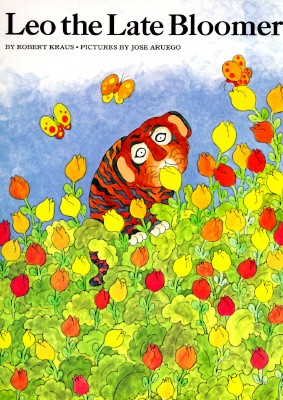 One of the benefits of being a parent is the excuse to read children’s books.
I adore children’s books.
I don’t just love the illustrations or the stories. I love everything about them: the way they feel in my hands, the rhythm of the words and most of all, the optimism they express.
I was picking out books before I was picking out clothes for my unborn son. And I treasured every moment helping both him and his sister discover the joy of books and reminding myself that’s how I discovered some of life’s most important lessons.
Leo the Late Bloomer was one my teachers.
I may not have shared Leo’s issues, but I certainly had my own timetable for learning to be comfortable in my own skin and accepting who I am.
But when I did, I blossomed.
Leo the Late Bloomer, like so many other children’s books, confirms that is absolutely nothing wrong with just being yourself.
And that always makes me smile.
Day 6: Children’s books that teach life-long lessons
Day 5: The Perfect Photo at the Perfect Moment
A Piece of Your Dad

Summer 1998
A message to my 15 year-old son:
The moment you were born, your dad grinned wider than I’ve ever seen. Then he said,”This is the best day of my life.”
And he meant it.
While my mind was spinning with worry, and I wasn’t even sure if I was even cut out to be a mother, your dad knew he had arrived at the place he was always meant to be – fatherhood.
Since then, he’s never left that place. Not even once. And that hasn’t always been an easy thing to do.
Not all men have the fortitude to be a father, and, and as you should well know, it is often a thankless job. It’s even harder when you grow up without much of a role model.
But your father has something a lot of men don’t – the ability to put his ego aside and focus on what he believes is most important – always being available for you and your sister.
From the moment you were born, you have been his priority. He’s never stopped believing in you or being your number one champion. Ever.
At those times when I’ve cried over your behavior or questioned what I did wrong, your dad always spoke up for you. And he was always the voice of reason.
On those days when I worried that you weren’t like other boys – that you weren’t particularly interested in playing sports or being overly social – he always praised you for being comfortable in your own skin and being true to yourself. And he was always right.

Summer 2013
And all those times when you were being the total and complete goof you are, he was proud of you and never hid his face in embarrassment.
Well, almost never.
I know we often joke about your blood line and about your genealogy, but, in all honesty, you should be proud of being your father’s son.
You may not have his brown eyes or his poker straight hair, but you have something much more important.
You have pieces of his heart and pieces of his soul.
Treasure them and make good use of them. Your dad sacrificed a great deal so you could have them.
A Letter to Abercrombie & Fitch CEO Mike Jeffries
Dear Mr. Jeffries,
Congratulations on recently making headlines with your strategy of only selling clothes to those whom you define as cool, pretty and thin: http://www.businessinsider.com/abercrombie-wants-thin-customers-2013-5#ixzz2SoRlwYlN.
You’ve certainly grabbed a lot of attention and clearly made your point.
As you said, “In every school there are the cool and popular kids, and then there are the not-so-cool kids. Candidly, we go after the cool kids. We go after the attractive all-American kid with a great attitude and a lot of friends. A lot of people don’t belong [in our clothes], and they can’t belong. Are we exclusionary? Absolutely.”
You have every right to your opinion and your business strategy. But here’s what you apparently don’t get: most of us (people who will never set foot in your store) don’t really care whom you define as cool, and we don’t care that you won’t sell us your over-priced clothes. We see you in the same light that we saw the “cool kids” in high school.
We didn’t actually think they were all that cool. Instead, we thought they were self-absorbed and incredibly superficial.
You (as they did) base coolness on appearance, access to money and whom you associate with. Ironically, the only people who hang out with your are also people who only care about superficial appearances.
There’s no depth. There’s no empathy or compassion for others. And there’s no understanding that life is so much bigger than your very small and limited materialistic world.
In the real world, where everyone else lives, life is so much more than what size you wear, how much you paid for your clothes or all the places where your wealth will take you.
It’s about knowing that you can never count on your looks for anything and building upon your other strengths instead.
It’s about walking into a room and being appreciated for what you can contribute to the conversation rather than for what clothes you wear.
And it’s about supporting others rather than rubbing disadvantages in their faces.
Enjoy your fortune while it lasts, Mr. Jeffries, but be warned.
I’ve got two children who won’t ever buy clothes in your store.
I know their current buying habits are of no interest to you (because neither fits your definition of cool), but I think you should know who they are.
They are both very smart and don’t care whether you or anyone else thinks they are popular or cool. They just care that they are happy and making the world a better place.
Such aspirations have never required buying and wearing a certain brand of clothes.
So watch out, Mr. Jeffries. My children represent the next generation of consumers, and they have loud voices.
Sincerely,
Trina Bartlett
Some People Should Just Shut Up
 Being a parent sometimes means being a hypocrite. If you don’t believe that you are either a) not a parent or b) incredibly (and unbelievably) perfect.
I can provide hundreds of examples of times I’ve behaved in a manner that directly opposes what I’ve told my children. Apparently, my husband is a few steps higher on the parenting evolution ladder than I am. He doesn’t always behave better than I do (although he probably does most of the time), but he’s generally less verbal about certain expectations for our children. That way, his behavior doesn’t seem quite as hypocritical.
I, on the other hand, am constantly setting standards that I can’t even begin to meet myself.
For example, ever since our children started talking, I insisted they use the words “please be quiet” instead of “shut up.”
Yet, I don’t do at all well with that particular language skill.
Recently, I was enduring a painful meeting during which a self-important person was holding forth as though his words were actually meaningful or of interest to anyone but himself. To survive the ordeal, I pretended to take notes while actually scrawling page after page of the words “Shut up. Just shut up.” A few times, I even added a less than flattering description of the person I wanted to be quiet.
But the words “please be quiet” are often inadequate. Quiet means hushed tones and soft voices. Quiet shows a lack of passion or emotion. And quiet doesn’t indicate disagreement when someone else’s words are hurtful or rude or simply pointless.
That’s why I haven’t been thinking “please be quiet” lately when people try to disguise their hate and prejudice with self-righteous statements and stupid jokes. Instead, I want to scream “just shut up” every time someone equates being poor with being lazy. But I haven’t.
I’ve held my tongue as tightly as the man gripping a snow shovel while he rode his bike through my neighborhood on Wednesday.
Wednesday we were supposed to get a blizzard. Schools closed. Government shut down. Businesses even changed their hours of operation. And even though all we got were a few inches of snowy slush, a lot of people with steady jobs and stable employment had a snow day.
The man on the bike didn’t have a day off.
He was looking for work shoveling driveways and sidewalks. He was offering his services to people who most likely judged him on his ragged appearance and his lack of a car. He didn’t have a truck to which he could attach a plow. All he had was a shovel and some muscle.
I’ve seen him selling his shoveling services on other snow days, but this past Wednesday was different.
I was leaving the neighborhood when he rode by me. He didn’t know where I lived or whether I was even a potential customer. I was simply some lady walking a German Shepherd on a cold and windy afternoon.
But, even though I had nothing to offer him, he slowed, gave me a wide smile and told me to enjoy my day. And then, balancing his snow shovel while pedaling his bike, he quickened his pace and was off.
That’s the exact instance I realized that maybe, instead of teaching my children to always say “please be quiet,” I should have been teaching them that sometimes standing up for those without a voice means shutting down those who speak against them. I should have been teaching them that there are times that polite isn’t as important as human rights. And I should have been teaching them that there are times when some people really do need to “just shut up.”
When Tears Aren’t Enough
I’m rarely at a loss for words, yet I had nothing to say last week when my daughter asked me the simple question “why?”
Instead of answering, I stood silent as a single tear rolled down my cheek.
 We were visiting the United States Holocaust Memorial Museum.
I’d been there previously, but my daughter hadn’t. She’s been studying the Holocaust in school, so I thought she was mature enough to fully appreciate the exhibits and the message.
For the most part, she was, and we took our time going from floor to floor as the timeline of events leading up to the Holocaust unfolded. Then we got to the floor with evidence of the Holocaust and all its atrocities.
We stood inside one of the small, bare and unheated railroad cars that transported up to 100 people to the concentration camps. We stuck our heads into one of the actual bunks from Auschwitz. And we stood next to piles and piles of shoes that were taken from prisoners right before they were gassed.
But nothing affected my daughter more than a photograph of braids in a larger pile of hair the Nazis had collected. (They stuffed mattresses with the hair collected at concentration camps.)
Braids define my daughter. She almost always wears her long hair in one or two braids, and this month, she taught herself to french braid. That made the photo of the braids very personal.
The photo and her reaction struck me too. They reminded me of how incredibly precious my daughter is, and how incredibly precious all the daughters that died in the Holocaust were.
And because of that, I just couldn’t answer her question “why?”
How can you explain to an 11 year-old girl that some people need to point fingers and find someone to blame for difficult times? She lives in a world where that happens on a daily basis. People find it simpler to blame a person or a group of people than they to understand that situations are complicated and are rarely the fault of one person or group.
How can you explain to an 11 year-old girl that some people will simply accept what they read, see or hear when that message justifies their own belief system? She lives in a world where people spew “facts” that are completely inaccurate just because they were presented as the truth.
How can you explain to an 11 year-old girl that some people place their material possessions and personal bank accounts above the health and safety of others? She lives in a world in which people complain that their tax dollars are being used to help those in need.
How can you explain to an 11 year-old girl that some people are comforted by the belief that there is only one legitimate faith. She lives in a world were so-called Christians condemn other religions while claiming ownership of a morality.
How can you explain to an 11 year-old girl that people are comfortable condemning those with different political beliefs and world views? She lives in a world when people use nasty words to define anyone who thinks differently than they do.
And how can explain to an 11 year-old girl that people who loved each other were killed simply for who they loved? She lives in a world where people still claim that some love is an abomination and sinful.
Any explanation I could provide as to why the Holocaust occurred would simply reflect a world in which she lives. And I didn’t want to scare her.
Instead, I scared myself. And no matter how many tears I cry about the Holocaust, I know they aren’t enough to stop the hate that still exists in the world.
2 and 1/2 Foolish Wishes
 If I had a genie that granted three wishes, I would have almost wasted them this past week.
Instead I only hypothetically wasted two and came very close to wasting the third.
My preoccupation with genies and wishes began when my daughter told me about a recent in-class writing assignment. She and her fellow sixth grade students were given the scenario that they’d released a genie from a lamp and had three wishes to use in a week.
“The only rule,” my daughter explained as I was driving to her dance class, “was that we couldn’t wish for more wishes.”
“What about wishing for magical powers?” I asked.
She thought for a minute then said, “It depends on what kind of magic.” She didn’t elaborate, so we sat in silence for a few minutes.
Then I had to ask, “Well, what were your wishes?”
She turned and gave me an exasperated look. “You’re not going to write about this are you?” she asked.
I didn’t think I would, so I didn’t really lie. “Of course not,” I said.
“I wished for a rainbow-colored unicorn, a black Pegasus like Blackjack from the Percy Jackson books and telepathy,” she said.
At the time, I was simply amused by her choices, but then my imagination took hold and I began to pretend that I too had found a magic lamp with a genie who granted three wishes. I was sure my wishes would be much more meaningful and beneficial to society.
I was wrong. Despite what I thought were good intentions, my wishes were probably more foolish than my daughter’s.
My first was for everyone to see the true colors of a person I’m pretty sure has narcissistic personality disorder. Granted, my clinical training is limited to a few classes in graduate school, but he has most of the of the classic characteristics. He not only lies but also he believes his own lies. He manipulates yet does his best to convey that others are the ones being manipulative. He expects everyone else to go along with his plans, doesn’t listen to anyone he doesn’t deem worthy, takes advantage of others and exaggerates his skills and talents. This week, when I realized how many people either don’t recognize or don’t want to recognize this, I’d had enough. I wished everyone else could see through the bravado. But if that happened, I later realized, his gigantic ego would be injured but he’d still carry on with his life. Others could be hurt much more, and then I’d be as selfish as he is. That was an incredibly foolish wish.
My second wish came after looking at a Facebook news feed and witnessing what I deemed some incredibly stupid posts. Some people were sharing inappropriate details about their personal life and health. Others were posting photos of themselves that screamed “pay attention to me.” And then there were the completely inaccurate and misleading political posts. I wished that Facebook had an automatic editor that screened inane and inaccurate posts then provided genuine feedback as to why the edits were made. I smiled at the thought of opening up Facebook to a much more rationale, intelligent and genuinely humorous news feed. But then I realized what a damaging and self-righteous wish that was. What I was really asking for was a limit on free speech. And no matter how inaccurate, hurtful or stupid the information is that people are now putting on the internet, many Americans fought and even lost their lives for their right to do so. I had wasted another wish.
That’s why my third wish came very close to being a wish to get rid of mirrors.
Mirrors generally don’t benefit society. They either encourage vanity or dissatisfaction. After my first two wishes, I didn’t want to look in the mirror anyway. My avoidance of a mirror had nothing to do with my outward appearance and everything to with lifelong aversion to self-absorbed and self-righteous people. If I looked into the mirror after my first two wishes, I would have been face-to-face with just such a person. But maybe that’s why I wanted mirrors eliminated.
I was on the verge of making the mirror wish when I received an email that jerked me back to reality. The son of a friend had been very seriously injured, and all anyone could do is pray. In comparison, all my wishes seemed trivial and ridiculous. I realized we are all on this planet together and finding fault with each other really doesn’t do us any good in the end. Neither does thinking that we know better than others.
I’m still in the process of learning that lesson the hard way, but I also have one imaginary wish left. If it were real, I’d use it to wish we all had just a bit more patience and understanding. No matter how I look at it, I don’t see how this is foolish. It doesn’t break the rule of wanting more wishes, but it could be magical and transform humanity.
A Perspective From the Backseat of a Car
 I spent some very long hours in the backseat of a car when I was a child. That’s how our parents transported kids from place to place when we weren’t riding in the bed of pickup trucks without toppers.
Riding in the backseat of a car was torturous.
Even though we were never confined to car seats, neither did we have electronic games nor videos to keep us preoccupied. Instead, we entertained ourselves by reading books, playing travel games or irritating each other.
When none of those activities interested me, I simply paid attention to the world around me.
I paid attention to the landscape passing by outside, and I paid attention to my parents’ conversations. I just didn’t participate in the conversations very much.
I used to feel quite grown up when I listened to adult discussions about politics or current events or even us children. And I liked feeling grown up. At least I thought I did until one road trip changed me forever.
We were on our way home from somewhere, and we were very hungry. Knowing my parents, they were probably trying to get home before they wasted money at a restaurant when there was plenty of food at home.
But the hour was late, we were irritable and food was necessary.
So they decided to appease us, and we stopped at what I recall was a ski resort. My family walked past a long line of people waiting to get into the restaurant’s bar. But when we reach the dining area, the host gave my brother and me a disgusted look then turned to my parents and said, “It’s after 9:00. Children aren’t allowed.”
Instead of simply turning around and looking for food elsewhere, my parents chose to argue with the host. And I chose to wish I was a million miles away. The host prevailed, and we had to once again walk by the long line of people.
I honestly don’t remember if we got something to eat elsewhere that night. I do remember the discussion that I heard from the backseat of the car. My parents were frustrated they had faced discrimination because of their children.
I also remember feeling guilty that I was a child who apparently didn’t deserve to eat in a real restaurant. And I remember the look on the host’s face when he sneered “Children aren’t allowed.”
That incident haunted me for years.
I balked every time my parents headed into a restaurant that appeared to be more for adults than for children. I didn’t like going somewhere I wasn’t wanted, and I didn’t want to be in a place where people could single me out as someone who didn’t belong. And I certainly didn’t want to be in a place where people thought I wasn’t worthy or capable of dealing with the situation.
So, when someone asks “what do you think about kids in adult-oriented places?” my immediate answer isn’t “as long as they behave, they should be allowed.” Nor is it “they don’t belong.”
My answer has nothing to do with whether parents think their children are mature enough to handle a situation, whether they are trying to expose their children to culture or whether they just want to parade their children as well-trained little people in front of others.
My answer has everything to do with how the children will feel in that situation and whether they will truly miss anything by not being there. In most cases, the children are probably better served by waiting a few years.
That’s a lesson I learned from all the years I spent in the backseat of a car.
When I was there, I wanted nothing more than to move to the front seat. But in retrospect, I learned a lot in the backseat when I was often forced to observe and listen. When I was finally allowed to ride in the passenger seat, I engaged in conversations with my parents. I also had a clearer picture of where we were headed. A few years later, I even moved into the driver’s seat, where I had to make tough choices on my own. But by then, I was prepared.
The learning process was gradual, not sudden. And it all started with the knowledge gained from riding in the backseat of a car.
My Lifetime Battle with the Big, Yellow School Bus
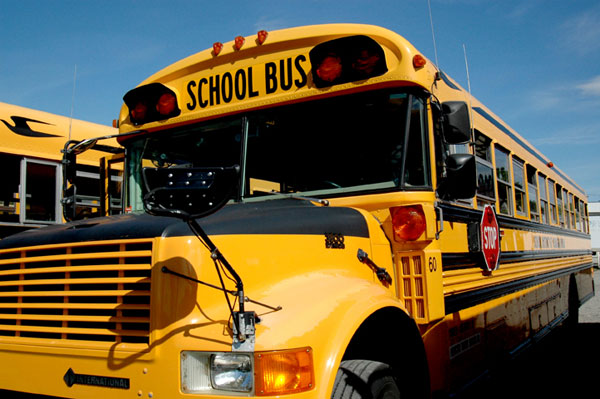 This Monday, my son starts high school and my daughter starts middle school.
I could grieve how quickly the years have flown. I could pull out baby pictures and wallow in nostalgia. I could reminisce about how, just yesterday, my son was starting kindergarten.
Or I could celebrate that, because both of my children are attending school out of district, my epic battle with the big, yellow school bus may just finally be over — permanently.
The battle began when I was in first grade. Having spent kindergarten walking to school, I was ecstatic that we had moved to a house that required riding a school bus.
My enthusiasm didn’t last long.
The problems started on the first day of school when I thought I could handle the bus ride all by myself. And I did. Going to school was simple. The bus picked me up in front of my house and dropped me off at school. My biggest challenge was getting to my classroom.
Going home proved a bit more difficult. I got on bus number 25, rode it to my street and rode it to my house. I then rode it past my house because my timid calls to stop weren’t heard over the din of bus chatter. Even though the bus failed to stop at my house, it did seem to stop at almost every other house in the county. When her route finally ended, the bus driver turned around, gave me a pointed look and asked me where I lived.
I proudly declared my well-memorized address “1910 Bean Drive.”
The bus driver did not look happy. “We went right past there. Why didn’t you get off?”
“Because you didn’t stop,” I replied.
Without a legitimate comeback, the bus driver had to make a decision. She’d take me home on her next run. Surrounded by kids two or three times my age and size, I finally made it home to an almost hysterical mother.
I wasn’t used to my mother being so worried. I was used to my mother being in control of every aspect of my life… including what I ate. And while I pined to have a lunch box with a bologna sandwich on white bread and ding dongs like all the other kids, my mom packed a very different lunch. Ever day I carried a brown bag (that she ask I bring home to be recycled) with a peanut butter (no added sugar) and honey sandwich on home-made wheat bread, carrot sticks, an apple and powdered milk in a square container with a lid (no thermos for me).
I hated that milk. I never drank that milk. But day after day, my mom packed it in a brown paper bag and day after day I carried the brown bag and the container still full of milk home from school.
Then, the inevitable happened, and I dropped the bag onto the floor of the school bus. The milk, which was already at room temperature, spilled everywhere. The bus driver was not at all pleased with me, so I should have known the situation would get even worse. And it did.
Only weeks later, my mother put her car in the shop near my school and needed a ride home. Being practical, she arrived at my school just as classes were ending and climbed onto bus number 25 with the first and second graders. At least she tried to climb on the bus, but the driver wouldn’t let her.
My mother insisted that there was plenty of room and the bus was going right to our house anyway. The driver told her no. After what seemed like the longest argument (and one of the most embarrassing moments of my life), the principal finally came over to settle the matter.
My mother had to find her own way home.
I’m pretty sure that was the day my name was officially added the national school bus “beware of this student” watch list. (That’s the list distributed nationwide to every single school bus driver.)
The list is the only explanation as to why, even after I moved across the country, the new school bus driver didn’t like me either.
In that case, the feeling was mutual. I had no respect for a woman who, instead of looking at the road, was constantly looking in the mirror to see what the kids were doing. After a few very close and dangerous calls on winding, West Virginia roads, my friend and I decided we’d had enough and organized a protest. We told everyone on the bus to duck down below the backs of the seats. The next time the driver looked in the mirror, her bus appeared empty.
We though this was hilarious. Our bus driver didn’t. In fact, she was so angry, she stopped the bus and marched up and down the aisle taking names and phone numbers Once she got mine, she seemed satisfied in learning that the girl on the national watch list was the culprit. What she didn’t expect was that my parents sided with me. They didn’t, however, think the incident warranted a life-time pass from riding the school bus, and I was still forced to ride for a couple more years.
But now, my days on the bus have come to an end, and, except for a few field trips, they have ended for my children as well.
Like so many other parts of childhood, all that is left are the memories and the lessons learned. Now it’s time to make more memories and learn something new. I’m just glad that neither is likely to involve a big, yellow school bus.
Collecting Tiny Pieces of the Soul
 One of the best things about having children is the privilege of serving as a sounding board for the ideas that are constantly bouncing around in their heads.
One of the worst things about having children is being forced to think about the ideas that are constantly bouncing around in their heads.
The other day my daughter said something I simply haven’t been able to shake.
‘Mom,” she said, “I’m worried about the future. What if teleportation actually becomes a reality?”
“Why is that a problem?” I asked.
“In order for teleportation to work, your body gets broken into tiny little pieces that have to be re-assembled perfectly again.” she explained. “If a lot of people are being teleported at the same time, what will prevent the pieces from getting all mixed up?” She sighed, “I don’t want pieces of me mixed up with pieces of someone else!”
Initially, I had visions of my mid-section being swapped with Jennifer Anniston’s. While I’d be delighted, I’m sure Jennifer would be horrified. My daughter interrupted those daydreams. “What if pieces are left behind?”
That was a good question from an almost 11-year old, and it’s come to haunt me over the past week: a week when I know too many people who have lost someone they care about deeply. A week when, for whatever reason, people who should be in the prime of their life are suddenly gone. A week when the power of medicine failed to make all the pieces of a person’s body work correctly. A week when so much has been lost, and yet so much has been left behind.
And some people leave many, many pieces of themselves behind. Those pieces aren’t intended to be re-assembled but to be shared.
I believe that every laugh, every kind thought and every good deed is a tiny piece of our soul that we give away forever with no expectation that it should remain part of us. These are the pieces that shine in our eyes when we smile and that warm our hearts when we hug. These are the pieces we send with our children each time they walk out the door and the pieces we lose when we share a secret.
These are pieces that do get mixed up with the tiny little pieces of others. And then, other people continue to pass them on all mixed up with their own tiny pieces. These are the pieces we collect when we need to paint a picture or compose a song or write a beautiful story. And they are the pieces we collect so we know how to love and embrace all that is beautiful in the world.
I understand why my daughter is worried about her tiny little pieces. I just hope I have collected enough tiny little pieces from others that I have plenty to share with her. And I hope she, in turn, is collecting tiny little pieces that can also pass on.


 Just So You Know