Blog Archives

Will You Sound Bite This?
Being married to a national journalist has its advantages. For example, when I’m feeling completely uninformed or confused about national or international events, I have a readily available source to answer my questions.
There are also disadvantages. The news never takes a vacation, so my husband works weekends and odd hours. He can’t express any public opinions about politics (really, he’s not allowed), and even though he and his co-workers are held to very high standards, when people criticize the media as an industry, they are also criticizing his professional integrity.
Regardless, I credit broadcast journalism for giving me a great life. It’s how I met my husband, it pays the bills and it’s how I started my career.
And while my career in broadcast journalism was extremely short-lived, the lessons it taught me have served me well over the past couple  decades. For example:
1) There will always be people who lie or mislead in order to protect their own self-interest. Being able to separate fact from fiction, determine what’s relevant and ensure the truth prevails requires perseverance and a Teflon shield.
2) Well-known people in the public eye generally aren’t making the biggest difference in the lives of others. There are always exceptions, but many are more intent on advancing their own agenda than they are with furthering the common good. Most often, the people behind the scenes are the ones who do the work and really know what’s happening.
3) There are always two sides to every sound bite.
From most people’s perspective, a sound bite is simply a very short clip of a much larger conversation. But for people on both sides of the microphone, it is much, much more.
A simple statement can inspire, inform or be blown completely out of proportion when taken out of context. A few words are often louder than the most heartfelt speech.
Just ask Mitt Romney or President Obama. During this campaign season, Romney’s comment “I like being able to fire people” wasn’t referring to his record at Bain Capital, but his opponents seized the opportunity to use those words against him. A few months later, President Obama had a similar experience when he said, “You didn’t build that.”
You would think both men would more carefully choose the exact words and phrases that come out of their mouths, but they are human. And a good sound bite is irresistible to a reporter. I should know.
I’ve been on both sides of the microphone many times, and I thought I had the sound bite mastered. And then I fell into the trap myself.
My daughter was just under a year old when I took her and her four-year old brother to a public pool. My mother had joined us, and we were enjoying a sunny, summer Saturday afternoon when a muffled announcement came over the speakers: “We apologize for the inconvenience, but the pool will be closing for the rest of the day. Please exit the pool area immediately.”
Since there wasn’t a cloud in the sky, the announcement made no sense. Fortunately, one of the teenager lifeguards was my neighbor, so I asked her what was happening.
Apparently, there was a dispute between management and the lifeguards. The lifeguards were insisting that the chemical levels in the pool weren’t safe, and they were walking off the job. With no lifeguards, the pool had to close. As other people packed up their towels and exited in mass, my mother and I decided there was no hurry and waited by the baby pool until the crowd cleared.
Just as we were finally leaving, a news van pulled into the parking lot. Since very few swimmers were left and I had a cute baby in my arms, the female reporter immediately zeroed in on me.
“Can I ask you a few questions?” she inquired breathlessly as she shoved a microphone in my face.
I agreed, and she began peppering me with questions about unsafe chemicals in the pool. Since I wasn’t really concerned and saw no reason to panic, I carefully avoided her efforts to bait me into saying anything that blew the situation out of proportion. She was obviously getting frustrated that my answers weren’t heightening the drama. Finally, she asked, “Aren’t you concerned about the health of your baby?”
I stepped into her trap when I answered, “Of course I’m concerned about the health of my baby, I just don’t think this particular situation is going to harm her.”
 A few hours later, I turned on the television news to see a lead story about how panicked parents evacuated a local pool. The story featured a carefully edited clip of me holding my daughter and saying, “I’m concerned about the health of my baby.”
I was mortified.
For the rest of the weekend, the clip played over and over again during news promos and broadcasts. My embarrassment grew when further investigation revealed that the chemical levels were fine, and that the situation had been overblown by a handful of teenage lifeguards.
For days, I was teased, even though I tried to explain that I had NOT panicked.
Years later, this story is rather funny, but it is also a cautionary tale.
Drama and conflict can be used as marketing tools and political weapons. And yes, some reporters take words out of context to create the story they want. This is especially true during an election year. No one should accept a few words at face value. We all need to do our research, determine what message was actually intended and take time to learn all the facts before making judgments and leaping to conclusions.
Take the paragraph above. Someone could easily turn it into a sound bite: Trina Bartlett says “reporters take words out of context to create the story they want.” That would likely stir up trouble with my husband of 19 years as well as my friends in the news industry, who all do their best to maintain journalistic integrity.
The problem is too many people prefer hearing words that support their own beliefs rather than knowing the truth, and many media sources have lost the once distinct line between news and opinion. Unfortunately, many people can’t tell the difference.
Every time someone spreads false information or shares quotes that have been taken out of context, the collective integrity and intelligence of our country drops.
And yes, I would love for someone to sound bite that.
How I’d Shake Up the Presidential Debates
 This Wednesday, when President Barack Obama and former Massachusetts Governor Mitt Romney square off in the first in a series of three debates, I’ll be watching for entertainment purposes only.
Despite all the hype, I have absolutely no expectation that anything either candidate says will sway my opinion. They will both be so scripted, so practiced and so focused on performing that their potential to impact my life will seem irrelevant. And even after they stop talking, the pundits will step in to add their spin.
The debates, like so many other events that used to be newsworthy, have become staged productions with limited genuine content.
What I need is honesty. I don’t need platitudes or great sound bites. I need heartfelt discussion and genuine opinions.
If only I were in charge of the debates.
If I were, both candidates would be injected with truth serum before they could answer even one question. I’d also be asking my own questions. I already have a list:
1. If your household income were $50,502 (the median household income in the United States in 2011), describe how you would budget your money to pay for housing and health care, ensure your children received an excellence education and save for emergencies.
2. Describe a situation when you “pulled yourself up by your bootstraps” when the odds were against you, if anyone helped you and what resources you used.
3. Who really influences your political decisions?
4. Do you think there are deserving and undeserving people? If you think there are undeserving people, who are they?
5. What is the biggest lie you or your party has told about the other candidate?
6. What do you think are the biggest differences between men and women? (The ability to give birth doesn’t count.)
7. How would you ensure that every child in America actually received a comparable education?
8. Describe what’s wrong with Congress and how you would attempt to fix it.
9. Describe your understanding of a typical week for an average American.
10. Why do you really want to be President of the United States?
I realize that my questions aren’t particularly politically savvy or intellectually stimulating, but when answered truthfully, they would definitely shine light on which candidate could best lead America.
The Backside of a Bull and a Garden Full of Rodents
 I had an unexpected epiphany after spending time with a bronze bull and a garden full of rodents in the financial district of New York City last month.
The moment came at the end of a long weekend celebrating my daughter’s upcoming birthday. She, her best friend, her best friend’s mother and I packed a lot into 48 hours. By Sunday morning, when we were exploring Lower Manhattan, we had slowed considerably.
The city, on the other hand, wasn’t slowing down at all. People crowded narrow sidewalks under the watchful eyes of police officers on every corner. While the officers graciously responded to requests for photos with tourists, their ability to give good directions was questionable.
Despite their help, we were finally able to locate the Charging Bull on Wall Street. Since the bull had never been on my list of sites to see, I hadn’t expected the frenzy of people mobbing it for photos. Many were lined up behind the bull to touch its anatomically correct underside for good luck.
The eleven-foot-tall bronze sculpture is supposed to symbolize aggressive financial optimism and prosperity. Last year, when the Occupy Wall Street protests began, metal gates were set up around the bull to prevent it from harm. Now, the public can once again touch it, but judging by the police presence, there’s still concern about the safety of the more than 7,000 pound bull.
Personally, I think the concern about vandalism is a bit misplaced. I’m more worried about the almost worship-like reverence people demonstrate for an icon that represents an industry focused more on the value of money than the value of people.
Don’t get me wrong. I like money. I just think that, as a society, we’re too fixated on who has it and who doesn’t.
To me, the bull represents a culture rooted in money and the immense appeal that has. But when people go to great lengths to touch that lifestyle, they may miss seeing what’s really going on around them.
 For example, just feet from the Charging Bull, there’s a garden full of rodents living off the crumbs of others. The mice live among the vivid red flowers in the circular garden around the fountain in Bowling Green Park where we ate our lunch.
What seemed like a quiet public garden was actually teaming with dozens, if not hundreds, of mice. When bits of bread, meat, tomatoes and even cucumbers dropped, they would scurry out from under the blossoms, grab their feast then rush back for cover.
Many of the people intent on enjoying the beautiful, late morning sunshine didn’t even notice the mice. Others were completely disgusted by them. No one wanted to touch them, and very few people wanted to feed them.
But my daughter and I were fascinated.
Although seemingly dependent on others for their livelihood, the mice certainly weren’t lazy. In fact, the were quite industrious. And even when vying for the same crumbs, they seemed to respect each other’s efforts.
That’s when I had my epiphany.
The mice represent all the low-income people who live and work right alongside those who are more financially secure and influential. They represent all those people on Wall Street who clean bathrooms and pick up trash instead of buying and selling stocks and bonds.
And even though they live in the shadow of a bull that people fondle for good luck, they also represent a great deal of dignity.

People Are Not Measuring Devices
I’ve been feeling rather sorry for Condoleezza Rice lately, and my sympathy has nothing to do with the fact that she will be forever associated with the George W. Bush administration.
I feel sorry for her because so many people want to turn her into a measuring device.
 After her speech this past Wednesday at the Republican National Convention, the rhetoric started:
“How can the Democrats claim there is a war on women? Condoleezza Rice proves that’s just propaganda manufactured by liberals who are pandering for women’s votes.”
“Condoleezza Rice demonstrates that any woman can succeed if, instead of relying on the government, she just applies herself.”
While I take issue with those statements, I have no problem with the woman who inspired them. I admire Condoleezza Rice. She’s a smart, accomplished and successful woman. Even though I may not always agree with her politics, I do believe she is a fantastic role model for young woman across our nation.
I just don’t believe that she’s a yardstick .
 The notion that all women should measure themselves against Condoleezza Rice, or any other woman, is ridiculous and damaging.
I’ve spent most of my life trying to break my innate tendency to compare myself to other women. I’ve compared my looks, my body, my talents, my personality, my lifestyle and my parenting skills to others. Instead of embracing my unique blend of strengths, weaknesses, quirks and experiences, I simply saw my flaws and failures. I don’t want that for my daughter or for any other female. And I don’t want them to judge women who don’t possess the talent, intelligence or opportunities to achieve what others may define as success.
Yet they are hearing that, because some women have reached the top, all others have to do is simply “try harder.”
That was certainly the message from those who opposed the Lilly Ledbetter Fair Pay Act.
If only working hard were a guarantee of an adequate paycheck and the appropriate recognition. In reality, the workplace is a harsh and very unfair place. I’ve worked hard only to watch those who didn’t zoom right by me. I’ve seen pretty women take advantage of their assets and maneuver their way past others into better jobs and higher paychecks. And I’ve seen the “good old boy” network benefit those who already had the advantage.
While great strides have been made for women in the workplace, the dollars still tell the story. In 2010, the U.S. Census American Factfinder indicates that 17.9% of families with children were living below the poverty level. That number jumped to 39.6 for families with a female head of household. Despite the increase in the number of men who are taking on active parenting and caregiving roles, nothing will ever change the fact that women are the ones who get pregnant and give birth. And now, their ability to even make decisions about that has been under fire by people such as Missouri Congressman Todd Akin, who doesn’t even understand the biology of conception.
Condoleezza Rice has never married nor had children. I have no idea–nor is it any of my business– whether this was a conscious decision or just the result of the many choices she made throughout her life. I do know that she never had to make arrangements for child care, leave work early to pick up her child at school or miss important meetings when a child was sick.
And I’ve never heard anyone claim that she was an underachiever or compare her to women who have careers and children.
But maybe that’s because some yardsticks are defective and only measure what the user wants them to show.
Revelations from a Former Republican
 During a recent conversation, I shocked a friend when I mentioned that, when I turned 18, I had registered to vote as a Republican.
“You were NOT a Republican,” she stated. “There is just no way.”
“Not just a Republican,” I replied. “I was actually heartbroken that, because of my age, I missed voting for Ronald Reagan by only three months in the 1984 election.”
Since I was talking to my friend on the phone, I can’t confirm that her mouth was actually hanging open, but I’m pretty sure it was.
“What happened?” she finally asked.
“I don’t know exactly,” I replied. “But by the time I graduated from college, I’d changed political parties.”
In all honesty, I do know what happened. I’d identified the core values that would guide the rest of my life, and they simply just didn’t align with the Republican Party.
I don’t think my friend, or anyone else, really cares about how I arrived at my decision. And, until this past week, I didn’t feel any need to explain.
But after witnessing one too many debates about how people who receive SNAP (more commonly known as food stamps) may be eligible for additional benefits if they were affected by the derecho (http://www.catholiccharitieswv.org/index.php?option=com_content&view=article&id=300%3Awv-long-term-disaster-recovery-derecho-storm-a-power-outage-disaster&catid=45%3Aannouncements&limitstart=1), I felt the need to say something.
On the surface, the gist of the conservatives’ argument against the additional benefits was that the government was once again frivolously spending taxpayers dollars.
But, as the arguments continued, a different, more self-centered concern actually emerged. Several people were turning the discussion into a conversation about fairness, or more particularly unfairness, in regards to their own lives: ” I lost all my food when the power went out, and no one is paying me to replace it.” “I have a lot of health care bills, and the government isn’t stepping in to help me.” “Basically, I’m being punished for having a job. ”
Sadly, I could relate to their complaints. That kind of thinking was the reason I had originally registered a Republican.
At the age of 18, I really did believe that everyone had an equal opportunity in this country, and if a person worked hard and persevered, they should be able to meet their own needs. If they couldn’t make ends meet, they needed to work harder or get a better education to get a better job. I believed in responsibility: if people made bad decisions then they, not I, should have to pay for those decisions. And I believed that our leaders had our, not their own, best interests at heart.
I held onto those beliefs because I was surrounded by people who believed the same thing. Then I went to college, and I was surrounded by people who didn’t.
I met too many people who had been denied equal opportunity through no fault of their own. I met too many people who had made poor decision after poor decision only to be bailed out by family while others fell into bad luck and had no one who could help. I learned more and more about greed, inequality and political corruption. And I learned more about myself.
At some point, I was confronted with the ultimate question: is life about what I can do for myself or is it about providing unconditional support for others, even when it sometimes costs me?
I chose the latter.
Don’t get me wrong. I can be very self-centered, and I know a lot of Republicans who are anything but selfish.
I just don’t think the core of my political beliefs should be about what makes my, or my family’s, life better or easier. I think public policy should be about ensuring the safety and well-being of all Americans, particularly those who haven’t had the same privileges that I’ve had: good parents, a good education, a decent I.Q. and a lack of any significant health problems.
When I look back on 18-year-old me, I still understand where I was coming from.
I still think people should do their best and be responsible for their behavior. I also think corporations and millionaires should do the same.
I still believe in hard work and self discipline. I also believe that too many people work very hard and still don’t get paid a fair wage so they can’t make ends meet.
I still wish life were fair. I also realize that making life more fair for everyone requires public policies that provide additional support for those who need it.
The difference between 18 year-old me and 45 year-old me is I don’t think the world owes me anything. Instead, I think I owe the world. The difference is I know some people put their own interests above the interests of others, even when it comes to the environment or safety or health. And I know that the most effective way to ensure such people do minimal damage is to implement and enforce regulation.The difference is that even though I don’t agree with wasteful spending, the wasteful spending I’ve seen isn’t for the programs intended to make the lives of most Americans better.
The difference is that I have enough life experience to know that life isn’t about being fair.
And that’s why I got so frustrated with the debate about additional SNAP/food stamp assistance. The debate wasn’t about whether people needed the assistance. Instead, it was a debate about fairness. I’m pretty sure if you asked the majority of people who were eligible to receive the help, they would be the first to tell you life isn’t fair. If it were, they’d be fortunate enough to afford to replace their own groceries while complaining about those who couldn’t.
Burning Down Our House With Debates About Health Care
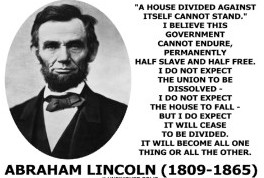 In 1858, Abraham Lincoln made his famous “A house divided cannot stand” speech.
He was debating Stephen Douglas about the issue of slavery. Douglas believed that each new territory or state should be allowed to decide whether it would permit slavery. Lincoln believed that the nation as a whole should take stand. At the time, a lot of people believed whites to be superior to blacks and that owning another person was justified based on skin color and bank account size.
We all know who eventually won that debate. But even after the slaves were free, too many people still believed in a superior race. And, for more than century, too many laws reflected their beliefs.
Now, more than 150 years later, I wonder how history will portray the politics of 2012 when the United States is once again a house divided.
Only this time, instead of being divided over slavery, we are divided about the purpose of government. But there is also an underlying debate very similar to the one being waged during the Civil War.
Too many people still believe that some individuals are superior to others. Only instead of color, they are claiming superiority based on the size of their bank account or their employment status. We have become a country that is debating whether we measure success in terms of dollars or in terms of human rights. We are debating whether accumulating possessions is more important than ensuring access to health care. And we are even debating whether or not poverty is a moral issue.
This has never been more apparent than with the reaction to the Supreme Court’s decision that the Affordable Health Care Act is Constitutional.
The fact that people have different opinions about the decision doesn’t bother me. I expect that. Different opinions are healthy. What bothers me is the judgmental comments and self-righteous outrage that some people expressed.
I was particularly struck by comments from a public school teacher who said the Supreme Court’s decision was immoral. She followed this by saying “I work for a living. I don’t want my hard-earned dollars to support people who depend on the government.”
Since a public school teacher depends on the government (i.e., taxpayer dollars) for her paycheck, I was dumbfounded. I wonder how she would react if the country engaged in a debate about the importance of education and whether we are infringing on taxpayers rights by requiring them to pay for education.
At some point, our country embraced the belief that education is a right that every child deserves. We even took that concept a step further and mandated that children stay in school until a certain age.
If the issue were being debated now, there’s no doubt some people would be screaming that requiring children to go to school is unconstitutional and that hard-working taxpayers shouldn’t be responsible for the education of others.
Thankfully, most people recognize the importance of education, the benefit it has on a person’s future and the positive impact on a community’s economy. The same benefits can be attributed to access to health care, so I’m not really sure why we are so divided about the issue.
But we are.
Instead of debating how to help people, we are debating whether or not we even should. Take, for example, the comments of the previously mentioned public school teacher who claimed the concept of the Affordable Care Act is immoral.
Last time I checked, helping others was the definition of morality, not immorality.
But logic isn’t everyone’s strong suit. Many of the same people advocating for personal responsibility are also outraged that the individual mandate is part of health care reform. As explained to me, the purpose of this mandate is to encourage responsibility by requiring people to either purchase health insurance or pay a penalty to help cover the government’s costs.
Don’t get me wrong. I don’t think the Affordable Care Act is perfect, but at least it’s a statement about what a lot of people think is important. Actually, most people probably think access to health care is important. The dividing issue is about whether it is important for all Americans or only those who have employers or bank accounts that can cover the costs.
The debate isn’t going to end anytime soon. And with the presidential election season getting into full swing, discussions will get even more discordant.
I just hope that whatever the outcome, Americans can look back at the repercussions of this time with pride rather than shame. I hope we can say this is a time we stood up for the rights of all rather than for the benefit of some. And most of all, I hope we don’t divide and even burn down our house with our heated differences.
Five Words I’d Like to Ban From Any Political Discussion
This week, Michigan State Representative Lisa Brown was banned from the House floor for uttering the name of a body part.
She, unlike her male colleagues, actually has that body part.
Personally, I’ve said the word countless times. I’ve taught my kids that it’s an appropriate word, unlike the slang terms that are often used. I’ve even attended a play that features the word in the title and in the script.
But I don’t want to get banned from writing or labeled an extremist, so I’m not going to actually include it here.
I know that’s sad.
But sadder still is that, in 2012, a woman was reprimanded for saying it.
I shouldn’t be surprised. This has been an especially bad year for women.
Access to birth control has been threatened. Equal pay for equal work is being discounted. Ridiculous and invasive medical procedures (procedures that actually include the banned word) have been considered for legislation.
And women who stand up for their rights have been called sluts (because that is apparently not as offensive as a the name of a body part) on a nationally syndicated radio show.
I’m not just feeling belittled and a bit angry, I’m feeling frustrated.
I thought women were making progress. I thought the country was making progress. I thought individuals were important regardless of how much money they make, where they were born, what their sexual orientation is or, most important to me, what sex organs they were born with.
Silly me.
But since we are now engaged in a debate about what words are and are not appropriate to say during a political debate, I’d like to propose five that shouldn’t be part of any discussion.
1. Socialism. In recent years, this term has been used to perpetuate divisiveness and bitterness. It is being used to suggest that it is not American to believe those who have more resources have a responsibility to help those who are struggling.
2. Obamacare. I don’t believe that access to health care should be the responsibility (or fault) of one particular party or individual. It’s about all of us. Health care reform is complicated and hard to understand. But quality, affordable health care is also critical (and currently not accessible) to too many Americans. I have family and friends who have had cancer, high blood pressure and chronic sinus conditions. These are all pre-existing conditions that can drive personal health-care costs sky high. Most of my professional life I’ve been in jobs that either didn’t offer health insurance or offered it at an incredibly high price. I’m a very hard-working person, and I take extreme offense at being told that I don’t deserve the same access to health care as some one who has a different employer. Let’s be rational and talk about the issue rather than about specific politicians and leaders.
3. Christian. Anyone who knows me, knows that I have the greatest respect for God, religion and faith. But America was established on religious freedom, and we are going backward when we make any one religion the basis for laws. Of course our laws should be based on moral and ethical principles, but most religions are based on strong values. Let’s not marginalize people of different faith by holding up Christians as the only religion that counts.
4. Undeserving. This word makes my heart hurt. By using it to broadly describe any group of people is unfair and incredibly biased. It is also very effective. It allows some people to pat themselves on the back for being deserving while belittling people who are different. People hit hard times for a wide variety of reasons, many of which are beyond their control or rooted in a childhood that never gave them a chance. I’m not saying that we shouldn’t set expectations for people or encourage them to take care of their own needs. But lets provide them with skills and opportunities rather than blame and labels.
5. Penis. If vagina isn’t allowed, then we shouldn’t be allowed to say penis either.
Whoops. Did I just say vagina? There go any hopes of a political career.
Hopefully, I will still be allowed to share my thoughts and opinions. And hopefully this post doesn’t get deleted as a result of actually naming a body part.
Philosophical Thoughts From a Feminist in High Heels

There are times when I wish I could be one of those women content to accept that the world is unfair and that some people are more important than others.
If I could actually believe that, life would be so much simpler.
The problem is that simple bores me and unfairness angers me, especially when it’s perpetuated by people who use inequality to meet their own need for influence, power and/or sense of security.
Even though I hate discrimination of any type, my personal experiences are limited to dealing with sexism. And lately, we seem to be moving backwards on that issue.
Women are facing more sexist attitudes than we did when I was in my twenties. At least it feels that way. Maybe because when I was younger, I attributed personal slights to my being inexperienced. But now, I’ve got a whole lot more experience yet the attitudes and behaviors persist. And women are having to fight battles I thought we’d won years before.
Admittedly, I’ve been more passive than I should be.
Perhaps it’s because protecting myself has sometimes outweighed standing up for what’s right. Or perhaps it’s because sexism can be so subtle that people have made an art form of camouflaging it. Or perhaps it’s because the issues are just too confusing.
Take, for example, shoes.
I recently heard that a woman who wears high heels (but not too high) is taken more seriously in the workplace than a woman who wears flats.
As someone who would sleep in high heels if it were feasible, you’d think I’d find this piece of information encouraging. Not at all.
The whole issue is absurd. The height of a woman’s shoe shouldn’t matter at all as long as she can do her job. But apparently it does. And since women have a lot more choices than men when it comes to footwear, we are also more likely to make decisions that can distract from our skills and abilities.
The same can be said for words we use to describe ourselves. Take, for example, the word feminist.
There are those people who picture a feminist as a woman who hates men, doesn’t shave her legs, dresses like a hippy and has extreme points of view about reproduction.
Umm.. no. As a feminist, that doesn’t describe me at all.
I love men. I shave my legs. I wear make-up. I’m not an extremist on any subject, and I even let my daughter play with Barbie.
Being a feminist has nothing to do with how I dress or who I love.
It’s about taking time to question how women are being treated. It’s about ensuring that, when other factors are equal, women are given the same opportunities as men. It’s about pushing people to think about how fair they are being.
Would the salary be the same if a man had the job? Does a woman really have the same opportunity to break into the “good old boys’ network? Is the spouse’s employment relevant?
Ironically, as I was writing this, my daughter looked over my shoulder and asked, “What exactly is a feminist?”
“It’s someone who believes women should have the same opportunities as men,” I said.
“Duh,” she said in a voice and manner that only 10 year-old girls can get away with.
“Exactly,” I said. “Duh.”
And hearing that one word come out of my daughter’s mouth put the fight right back in me.
Watch out world, this feminist in high heels is on a mission to ensure life is more fair for her daughter.
There’s Going to Be Trouble When You Live in a Bubble
 Keeping an eye on politics this week has been as compelling as anything the best Hollywood writers could make up. Mitt Romney, the front-runner for the Republican nomination for President of the United States, actually said that he cares about Americans but that he isn’t concerned about the very poor because they have a safety net.
That’s precisely what he said. In that exact order. What happened next, while predictable, was still extremely entertaining.
Some political pundits latched onto the concept that Romney didn’t care about the poor and (gasp) he didn’t even consider them Americans.
Others suggested that he was supporting the notion that government should help the poor indefinitely without encouraging them improve their situations.
And others, particularly those in the Republican party, despaired that Romney is a bad politician who blunders when he doesn’t have a teleprompter.
I have to agree with the latter. When Romney opens his mouth without a script, his comments seem unsympathetic to the average American. His latest remarks about the poor just add to the growing concern.
The doubts have been building with every questionable statement: his spontaneous offer to bet Rick Perry $10,000 (a very sizable amount of money to the average American); his remark that he is also unemployed (not funny to the millions without a job or a daily income like he has) and his insensitive language about liking to fire people. All of these feed into the perception that Romney has no clue about the daily struggles many Americans face.
And there may be something to that. He has, after all, lived in a bubble his entire life.
He grew up in a bubble and doesn’t appear to have left it. That bubble has protected him from worrying about which bills he could afford to pay or whether his children would be able to go to college. I’m pretty sure that there’s never been any coupon clipping, layaways or bargain hunting in the Romney bubble.
But apparently the barrier between Romney’s bubble and the rest of the world isn’t impenetrable. Rumblings of discontent about the disparity between the very rich and the rest of the country actually seem to be reaching Romney’s ears. But the layers of film between us are distorting the message, and he just isn’t hearing it correctly.
But Romney’s not alone.
Because of religion, socio-economic status and even our appearances, many of us live in a bubble and generally associate with, relate to and hear the opinions of people who are very similar to us. And while some people step outside of their bubbles, others never do.
The problem with staying in your own bubble is that you generally don’t hear or understand the plight of those outside the bubble. I’ve bumped into a lot of those people as they float through life. It’s not that people who stay in their own bubbles are bad people. Bubbles simply distort how they see things, so their view of the world just isn’t accurate.
But who can blame them? Living in a bubble can be deceptively comfortable.
Unfortunately, people who are floating around in their own bubbles are still part of the real world: a world where poverty is not a moral issue, where people still face discrimination and where money is a driving force in determining who has power.
If you are floating around in a bubble, your hands may never get dirty, your heart may never fully empathize and your head may never understand.
And that’s the problem with Mitt Romney. It’s hard to understand something you’ve never felt or experienced. And it’s even worse if you don’t recognize the fact that you’re living in a bubble.
On the bright side, most everyone likes watching bubbles float away and eventually pop. Even as a child, I found the sight highly entertaining. I’m pretty sure I still do.
Paving the Way to a Better Educated America

I’m beginning to think that our country is like a complex highway system that is riddled with potholes.
Very intelligent people designed the system. It has served a great purpose, and a lot of people are better off because of it.
Unfortunately, the potholes are getting bigger, and the damage they’re causing is far reaching.
To address the pothole problems, Americans keep patching them one at a time. It’s not effective and is generally a temporary solution. The potholes might disappear for a while, but the patches usually break up and the potholes get even bigger.
To really address the pothole problem, whole sections of the highway need an overhaul.
But overhauls require significant changes and shifts in how we think. That’s something a lot of people, particularly those who have easy access to planes and who don’t even experience potholes, do their best to avoid.
I’m not one of those people, and I’m tired of dealing with the potholes in politics, social services and education. Especially education.
All you have to do is look at America’s dismal statistics to realize that our education system is not helping those children who need it the most.
Nearly 1 million kids who start high school every year in the United States don’t make it to graduation. The dropout rate of students living in low-income families is about four and one-half times greater than the rate of their peers from high-income families (http://nces.ed.gov/pubs2011/dropout08/findings1.asp). The problem is cyclical: parents with limited education often had poor experiences in school and are less likely to emphasize its importance.
For years, community activists, business leaders and education experts have been discussing the problem and trying to develop solutions. millions of dollars have gone into innovative programs. Some communities have decided charter schools are the answer. Others have provided alternative opportunities for youth who don’t do well in the typical public school. And others have simply been too busy pointing fingers.
Even when rates improve, the problem is still extensive.
That’s because most of the solutions center around patching potholes: pouring resources into programs for children who are already at a disadvantage when it comes to learning.
Extensive research on brain development indicates that what happens between the ages of zero and three affects our ability to learn: (http://www.ag.ndsu.edu/pubs/yf/famsci/fs609w.htm)
Forget about being ready to learn in kindergarten. Children from an environment with little stimulation or interaction are behind before they even enter a Pre-K classroom.
But, as a nation, we are doing very little to address true early education (birth to three.) Right now, we are simply trying to help many kids whose brains were never wired to learn because of what happened during their first three years. If our education system shifted its resources and focus to the very young, children might actually be better prepared for academic learning.
And yes, the cost would be high. But people always think the cost of preventive programs is high until they look at the cost when there is no prevention.
According to a recent series on NPR (http://www.npr.org/2011/07/24/138653393/school-dropout-rates-adds-to-fiscal-burden) a high school drop out will earn $200,000 less than a high school graduate over his or her lifetime, and almost a million dollars less than a college graduate. And the cost to taxpayers? The estimate is anywhere from 320 to 350 billion dollars as a result of lost wages, taxable income, health, welfare and incarceration costs.
Can you imagine the difference if our education system actually began to address the critical link between early childhood brain development and academic success? Not only would we begin cutting the costs attributed to the high school drop out rate, but we’d have a whole generation that would be better prepared to contribute to society.
Making that change would require a significant paradigm shift in how Americans think about public education and who we think should receive it. And it would mean education systems would have to partner with other sectors to work with families, since that’s where much early education is or is not occurring.
This overhaul wouldn’t solve all of our country’s education issues. Like anything else, there’s not one magic bullet.
But it’s certainly a start to paving the way for future generations.


 Just So You Know