Blog Archives
Rockefeller’s Reminder
 Last week, I had the privilege of attending a community meeting hosted by U.S. Senator Jay Rockefeller about the reauthorization of the Violence Against Women Act (VAWA). Since there was little doubt that our soon-to-retire senator was going to vote for VAWA, the event was really an opportunity to raise awareness about the issue of domestic violence.
Invited guests included survivors, social workers and advocates who work tirelessly to address the issue. A local police officer was the only man selected as a designated speaker for the round table discussion, but he received a great deal of Rockefeller’s attention.
While domestic violence survivors told heart-breaking stories, many of Rockefeller’s questions were directed to the police officer. The Senator seemed absolutely fascinated by the officer’s description of our local police department’s ride-along program, which provides an opportunity for community members to literally ride along with police officers during any shift. Those who participate have the opportunity to really understand what police face and learn about some of the biggest issues facing our community.
At the time, Rockefeller’s intense interest in the program seemed a little off topic. But in retrospect, I think the Senator was demonstrating what true wisdom is.
In a world where people are intentionally inflicting harm on others, where relationships are often about power struggles rather than support and where individuals are suffering on a daily basis, true wisdom is knowing that doing the right thing requires more than simply responding to the needs of others. Maybe because I’ve recently been watching too many people who think doing the right thing means doing things their way without considering all that others have or could contribute, Rockefeller’s reminder has stuck with me:
Doing the right thing means ensuring resources and services are available for those in need, but is also means focusing on what is positive and good.
Doing the right thing means reinforcing and promoting positive and healthy relationships among people and organizations.
And doing the right thing means really listening to others and acknowledging the power of what they are saying and all they are contributing.
That’s the wisdom Senator Rockefeller brought to the table. Unfortunately, he won’t be at the table much longer. Last month, he announced he will not be seeking a sixth term as U.S. Senator after his current term ends in 2014. West Virginia lost Senator Robert Byrd in 2010, and now we are losing Senator Jay Rockefeller. Regardless of political affiliation, all West Virginians should recognize the implications.
The cynical among us might say that caring about the poor was easy for Rockefeller, who was born into one of the richest families in America and never had to worry about money.
But I disagree.
Instead of choosing to live a life devoted to money rather than meaning, he chose to work on behalf of people who live in one of the poorest states in the nation. And even though I live closer to Washington D.C., Baltimore, Philadelphia, Pittsburgh and New York City than I do to our state capitol, I still care about what happens to this state.
And I’m hoping whoever steps into his position is someone who understands the importance of asking a local city police officer to explain a simple program that involves reaching out to others to develop stronger partnerships and healthy relationships.
That’s wisdom and a reminder about how we should all live our lives.
Thank you for your service and your wisdom, Senator Rockefeller.
All Good Superheroes Ask Questions, Don’t They?
 According to some people, I suffer from a very bad habit, and, if I knew what was good for me, I’d have given it up for Lent.
But I didn’t and I probably never will, so my friends and family are forced to deal with my habitual need to ask questions. Lots and lots of questions. About anything and everything.
My husband and kids call me “The Interrogator.”
I’d like to think that means they consider me a superhero who unveils misdeeds, liars and unacceptable behavior by eventually asking so many questions the truth is revealed.
Unfortunately, they aren’t paying me a compliment and instead are simply letting me know they find my all questions annoying. I’ve also been told that people who ask a lot of questions are subconsciously trying to take control of a situation.
There’s probably some truth to that, but I’d rather be annoying than to sit back and just allow people and organizations to get away with actions that affect and sometimes hurt others.

(UPI Photo/Roger L. Wollenberg)
I also like to think that, as an inquisitor, I’m in good company.
This week, at her first Banking, Housing and Urban Affairs Committee hearing, Senator Elizabeth Warren questioned bank regulators about why they hadn’t prosecuted a bank since the financial crisis. Her question seemed simple enough, “Tell me,” she requested “about the last few times you’ve taken the biggest financial institutions on Wall Street to trial. Anybody?”
Instead of simply responding “never,” the regulators tried to explain why there was no need to prosecute.
As with anything political, there are those who agree with Senator Warren and those who don’t.
But her actions, to me, were bigger than pointing out the double standard for big corporations versus average citizens or about ensuring that bank executives don’t continue to pass the repercussions of their behaviors onto the general public. Her actions were about her willingness to ask the tough questions and to not back down. Her actions were about repeating the same question over and over again until someone is forced to answer. And, to be honest, her actions were about validating my own behavior.
I’m not even close to being in Elizabeth Warren’s league much the less in the Justice League, but I do believe heroes have to ask the hard questions. If they don’t, silence persists, and nothing ever changes.
So even though my family insists on calling me “The Interrogator” to try to shut me up, it’s not working. Instead, I’m thinking of getting one of those t-shirts with a big question mark on the front. It may not be the fashion statement superheroes make when wearing their capes, but it just might be a start.
Because if no one questions the status quo, then nothing ever changes or improves. So, far all the
The Boy Scouts Are Misinterpreting the Meaning of Moral
Last year, a fourth grade teacher at my daughter’s intermediate school was arrested for soliciting a 13 year-old girl (or so he thought) online.
Also last year, a teacher at my son’s middle school was arrested for child abuse and identity theft. Two weeks ago, she pleaded guilty to the identify theft, but she is still awaiting trial on 11 counts of child abuse.
Other than the fact that both were teachers in Berkeley County Schools and neither is gay, I don’t think the two have much in common. Yet, they were both engaged in immoral activity because their behavior was harmful. They used their power to hurt, control or take advantage of others, which I think most people would agree is anything but moral. The definition isn’t that fuzzy, at least I’ve never thought it was.
Unfortunately, some people are trying to redefine the meaning in order to fit their own narrow and bigoted views.
This week, the Boy Scouts postponed a decision to “sort of” lift its ban on anyone who is openly gay. I say “sort of” because the potential policy change would simply allow local organizations make their own decisions.

Photo/Richard Rodriguez) NYTCREDIT: Richard W. Rodriguez/Associated Press
I was reading about the situation in the New York Times. While the content of the article bothered me, I was even more disturbed by the accompanying photo, which showed scouts and their parents holding signs that proclaimed “Keep Scouts Moral and Straight.”There was so much wrong with that photo, and I felt sorry for the young boys who are obviously being taught that discrimination is appropriate.
My kids are taught that discrimination is immoral:
Moral people don’t exclude but instead include.
Moral people don’t make broad judgments but instead ensure that every individual is given respect.
And moral people don’t define others by who they choose to love but rather by how they treat others.

Rex C. Curry for The New York Times
Just as important, national organizations that demonstrate moral leadership don’t waffle on potentially controversial issues and, instead of taking a stand, cower by relinquishing their decision-making authority to locals.
Even more importantly, they don’t bow to bigots who make unsubstantiated and untrue generalizations about any group of people. Yet, the decision to delay a decision on the ban on gays came after rallies like the one at the Boy Scout headquarters in Irvine, Texas where protesters claimed that prohibiting gay membership equates to protecting their children.
After the incidents last year at my children’s schools, no one rallied with signs asking the school system to protect my children.
But maybe that’s because there’s no organized effort to rally against straight people who commit immoral acts. But maybe there should be. After all, I’m pretty sure statistics would show that’s where the real “danger’ lies.
Did You Just Stick My Jelly Beans Up Your Nose?
 There are those days when I feel as though people are sticking my jelly beans up their noses.
In more innocent times, I never worried about leaving a bowl of jelly beans on my desk. Instead, I was pleased to share with others while regularly snagging a few pieces of candy myself.
I should have known better.
I should have realized that some people will always find a way to sabotage life’s small pleasures because they are so focused on meeting their own needs.
I learned the lessons of jelly beans when I was getting my master’s degree and had classes with someone from high school. I don’t remember ever talking to my fellow student in high school and was honestly surprised he’d even graduated from college.
I had preconceived beliefs about him, and he, in turn had preconceived beliefs about me. I remember the day he told me, “you are actually really funny. In high school, your friends told me you were funny, but I never believed it. I always thought you were just too smart and too serious. You really aren’t that serious at all.”
I couldn’t really fault him for never getting to know me as I’d never made the effort to know him.
Instead, I’d simply thought he was someone who spent a lot of time in the principal’s office.
Turns out, I was wrong.
He rarely spent any time in the principal’s office. Instead, he spent a lot of time with the vice principal, who was in charge of discipline.
“Mr. Tidquist and I,” he said, “were quite familiar with each other. But I really didn’t like him or the jelly beans he always kept on his desk.”
I shouldn’t have asked about the jelly beans, but I couldn’t resist.
“Mr. Tidquist always had a jar of jelly beans on his desk, and sometimes he would grab a handful and eat them while lecturing me,” he told me. “One day, I was sitting in his office alone waiting for him to come in, and I was just so angry. I kept looking at those jelly beans and thinking of Mr. Tidquist eating them. I just couldn’t help myself. I would take few, put them up my nose, put them back in the jar and then stick some more up my nose.”
He smiled.
“I can’t even describe how I felt when Mr. Tidquist came back in his office, sat at his desk, grabbed a handful of jelly beans and ate them.”
After hearing the story, I couldn’t immediately describe how I felt either, other than to say I was relieved that I’d never been in Mr. Tidquist’s office and therefore never been tempted to eat his jelly beans.
But lately, I feel as though my decisions, beliefs and values are like the jelly beans on Mr. Tidquist’s desk. I take pleasure in being a strong and educated woman who can think and act on her own. I like to believe that by sharing and discussing my opinions, I just might help make the world a little bit better.
Instead, when I’m not around, some people choose to express their dislike and misperceptions by judging me, discrediting me or misinterpreting my actions. But they don’t say anything to me directly.
In other words, they are sticking my jelly beans up their noses.
Since I’m human, there’s a part of me that can’t help but be bothered and offended. But there’s another part of me that realizes how their behavior has nothing at all to do with me. Which is why, instead of taking my jelly beans off my desk, I’m thinking of putting a mirror next to them.
That way, when people put my jelly beans up their noses, they are forced to see how their words and behavior only reflect back on them.
In the meantime, I’m going to continue to enjoy sharing my jelly beans with everyone who appreciates them.
I Couldn’t Get a Dog so I Got a Gun
 Conflict among people is normal, and most of us accept it as a routine part of life. Conflict within ourselves is just as normal, but something with which we often struggle.
As a licensed social worker, I couldn’t get out of bed every morning if I didn’t believe people can change, that humans have an innate responsibility to support each other and that no good comes from belittling others.
As a rational human, I couldn’t get through life if I simply tolerated and never called out stupid and ridiculous beliefs and behaviors.
As a licensed social worker, I have to ensure that my conduct is appropriate, that I abide by a code of ethics and that I participate in ongoing continuing education.
As a rational human, I am dumbfounded by people who complain when they are required to meet expectations and criteria before they are provided with opportunities and privileges.
As a licensed social worker, I have an obligation to listen, try to understand the perspective of others and validate their feelings.
As a rational human, I simply cannot understand why others choose to ignore facts, scream conspiracy and throw around accusations that are hurtful. I have to call out people who choose to believe and spread all of the vile, ridiculous and illogical propaganda about gun control that I have been witnessing over the past few weeks.
The rabid followers of the NRA propaganda machine remind me of children blindly hitting a piñata at a birthday party. For most people, hitting the piñata is just fun game that results in children scrambling for a few pieces of candy. But the NRA is turning gun control into a piñata that must be destroyed and is putting the blindfolds on people as they swing at it. Those swinging the sticks are convinced that if they don’t break the piñata, they will never have candy again.
In reality, if the piñata doesn’t break, the children won’t be denied candy. They just won’t get the immediate gratification they are seeking.
Most parents allow their children to have candy, but they don’t want them to make a diet of it. Similarly, gun control advocates are not screaming that everyone’s guns should be confiscated. Instead, they are recognizing that too many lives are being broken and destroyed by guns and that something must be done. To counter that, claims are being made that the gun death statistics in the United States aren’t that bad.
Tell that to someone who has lost a loved one to a gun. For them, one death is too many.
Just ask Jackie Barden, whose son Daniel was killed at Sandy Hook Elementary school in December. Jackie recently noted that the process for adopting a kitten is more difficult than getting a gun.
I don’t know much about adopting kittens, but I do know a lot about adopting dogs. As a volunteer for a dog rescue group, my role is to process applications. In other words, I do background checks. I check national “do not adopt” lists. I do a criminal background check. I conduct property checks. I review living arrangements. I talk to animal control and veterinarians about the applicants. And I call references. If I don’t find any red flags, another volunteer conducts a home visit.
Many families who want to adopt a dog are denied for a variety of reasons: they’ve had pets hit by cars; they haven’t spayed or neutered their current or previous pets; they aren’t home enough to spend quality time with an animal; they don’t have the money or space for a dog; they already have too many pets. The list is long and varied, but the bottom line is the same. Rescue groups want to ensure the dogs have a good quality of life and, most of all, that they are safe.
We should want the same for people. And yet, in the United States, people who are denied adopting a dog can walk into a store or a gun show and buy almost any gun they want.
We might be keeping dogs safe, but I have to wonder about the people.
The Problem With Pretty

(Photo by Matt Cashore, USA TODAY Sports)
Not being much of a football fan, I wasn’t watching when the University of Alabama beat Notre Dame the other night. But being an avid news fan, I couldn’t miss the stories about how sportscaster Brent Musburger raved about Katherine Webb, the beauty queen girlfriend of Alabama quarterback AJ McCarron.
I really didn’t understand all the fuss. Men have been making comments about beautiful women as long as women have been making comments about good looking-men. I may be a feminist, but I also recognize that appreciating beauty is an essential element of human nature.
Initially, I didn’t perceive any problem. At least, I didn’t perceive a problem until I read a story about how Webb and her parents responded to all the fuss.
They weren’t bothered by Musburger’s comments. And why would they have been? Webb is a beauty queen. She struts around in a bikini in front of cameras. She obviously wants to be noticed for her appearance alone, and her subsequent reaction reflected that.
What bothered me was the importance Webb’s parents placed on her being beautiful.
Apparently (according to family), Katherine was once considered an ugly duckling because of a skin condition and her height. Her mother said that being in the Miss USA pageant helped build her daughter’s self-esteem. In other words, her mother believes Katherine’s self-esteem hinges on others’ perceptions of her appearance. And that’s what bothers me about this “news” story.
Self-esteem is complicated. Yet, like so many other issues, people try to simplify it. Several years ago when my children were in elementary school, they attended an assembly about self-esteem.
“What activities did you do? I asked. They looked at me puzzled.
“We didn’t do anything,” my son said. “Some lady just talked to us about how we should have self-esteem.”
We moved on to other subjects, but I was irritated with the school for wasting precious educational hours on some pointless presentation. You can’t teach or preach self-esteem. True and lasting self-esteem is achieved through experiences of success and through overcoming difficult situations. Our responsibility as adults is to provide children with those opportunities.
And self-esteem isn’t an “all or nothing” concept.
People don’t either have or not have self-esteem. Most of us feel confident in one aspect of our life while struggling in others. When I was younger, I had excellent self-esteem about my intelligence and ability to do well in school because I had volumes of success in academics. I had very poor self-esteem in regards to my appearance because I’d been told I looked like a monkey and was a four on a scale of one to ten.
Experience taught me that what others think of my appearance has absolute nothing to do with my value as a human, my capacity to be loved or my ability to be happy.
But those are lessons I learned from decades of life experience. Katherine Webb doesn’t have that yet.
Instead, she is surrounded by people who put an inordinate value on appearance. People who coach her that plastering on makeup to cover a skin condition is essential. People who have convinced her that fitness means being skinny enough to meet society’s standards for wearing a bikini. People who equate being called beautiful with being accepted.
Maybe I’m being a bit judgmental because I was raised to never rely on my appearances for anything. Sometimes that message was delivered in a subtle manner as my mother never bought fashion magazines nor wore makeup. At other times, the message was delivered loud and clear – like the time she told me that I was lucky to be smart rather than pretty. And even though those words hurt at the time, they also held a great deal of wisdom.
When you can’t rely on your appearance open doors for you, you develop other skill sets. And those achievements and successes are what truly build self-esteem.
There is nothing wrong with being beautiful, but there is everything wrong when women allow it to define them.
And that’s the problem with pretty.
When Tears Aren’t Enough
I’m rarely at a loss for words, yet I had nothing to say last week when my daughter asked me the simple question “why?”
Instead of answering, I stood silent as a single tear rolled down my cheek.
 We were visiting the United States Holocaust Memorial Museum.
I’d been there previously, but my daughter hadn’t. She’s been studying the Holocaust in school, so I thought she was mature enough to fully appreciate the exhibits and the message.
For the most part, she was, and we took our time going from floor to floor as the timeline of events leading up to the Holocaust unfolded. Then we got to the floor with evidence of the Holocaust and all its atrocities.
We stood inside one of the small, bare and unheated railroad cars that transported up to 100 people to the concentration camps. We stuck our heads into one of the actual bunks from Auschwitz. And we stood next to piles and piles of shoes that were taken from prisoners right before they were gassed.
But nothing affected my daughter more than a photograph of braids in a larger pile of hair the Nazis had collected. (They stuffed mattresses with the hair collected at concentration camps.)
Braids define my daughter. She almost always wears her long hair in one or two braids, and this month, she taught herself to french braid. That made the photo of the braids very personal.
The photo and her reaction struck me too. They reminded me of how incredibly precious my daughter is, and how incredibly precious all the daughters that died in the Holocaust were.
And because of that, I just couldn’t answer her question “why?”
How can you explain to an 11 year-old girl that some people need to point fingers and find someone to blame for difficult times? She lives in a world where that happens on a daily basis. People find it simpler to blame a person or a group of people than they to understand that situations are complicated and are rarely the fault of one person or group.
How can you explain to an 11 year-old girl that some people will simply accept what they read, see or hear when that message justifies their own belief system? She lives in a world where people spew “facts” that are completely inaccurate just because they were presented as the truth.
How can you explain to an 11 year-old girl that some people place their material possessions and personal bank accounts above the health and safety of others? She lives in a world in which people complain that their tax dollars are being used to help those in need.
How can you explain to an 11 year-old girl that some people are comforted by the belief that there is only one legitimate faith. She lives in a world were so-called Christians condemn other religions while claiming ownership of a morality.
How can you explain to an 11 year-old girl that people are comfortable condemning those with different political beliefs and world views? She lives in a world when people use nasty words to define anyone who thinks differently than they do.
And how can explain to an 11 year-old girl that people who loved each other were killed simply for who they loved? She lives in a world where people still claim that some love is an abomination and sinful.
Any explanation I could provide as to why the Holocaust occurred would simply reflect a world in which she lives. And I didn’t want to scare her.
Instead, I scared myself. And no matter how many tears I cry about the Holocaust, I know they aren’t enough to stop the hate that still exists in the world.
My Gut Reaction to Senseless Tragedy
 On an intellectual level, I have absolutely no idea why I’m writing this particular blog entry.
On an emotional level, I have to write it.
Over the next few weeks, volumes will be written about the shooting that occurred at Sandy Hook Elementary School in Newtown, Connecticut. My own thoughts will be just a mere drop in a sea of ideas and opinions.
And since I usually write to inform, persuade or sometimes to simply vent, having my voice heard should matter.
But there are times when I write just to get my thoughts in order. This is one of those times.
I, like so many Americans, am overcome with grief and frustration about an event that involved no one I know yet affected everyone I know.
I am also filled with guilt because, initially, I didn’t even take notice of the shootings. I was logging into my email account to send a message about my children’s latest accomplishments when I saw a headline that there had been a shooting at a Connecticut school. Absorbed in my own life, my only thought was, “Here we go again.” And then I forgot about headline until later in the day.
How sad is that?
Shootings have become such common events that I, a person who hates violence, wasn’t initially shocked or curious.
There is something fundamentally wrong with a society in which many of us don’t even pay attention to violence until multiple people are shot to death. We should be upset with every violent word, gesture and action. Instead, we are immune to all but the most heinous of events.
And when such events do occur, we turn to each other and ask, “how could this happen?”
In reality, we already know the reasons. We just fear addressing them because anything we say might turn into a political debate rather than a rational discussion.
The time has come for rational discussion.
We know that too many people suffer from undiagnosed, untreated or mismanaged mental illness. Sometimes the families dealing with such an illness don’t know how to cope or where to get help. Sometimes they can’t get the help anyway. Services are expensive, and waiting lists far exceed the need. Often, mental health services aren’t even integrated with other health and social services. And then there are the people complaining about their tax dollars being used to pay for services for people who can’t hold down a job. Guess what? People with mental health issues often have a very difficult time maintaining employment, and, as a society, we lack a comprehensive system to deal with the complicated issues. Time and time again, the warning signs are obvious, but we either don’t know what to do, don’t know where to turn or realize there simply is no place to turn.
We know that too many people who should never have access to guns obtain them anyway. Yes, sometimes people will find ways to access guns even when barriers are in place to prevent it. Sometimes, there is no way of determining who will use guns inappropriately. And sometimes guns can be used to prevent, rather than commit, a crime. But that doesn’t excuse us from identifying more effective ways to better prevent gun violence.
The bottom line is that gun violence involves two things: people and guns.
Guns are material possessions that can be manufactured, sold and replaced.
People can’t be manufactured, shouldn’t be sold and can never be replaced.
Americans need to make a choice about our priorities and how to balance them. Only then can genuine discussion about preventing future tragedies realistically begin.
If we don’t have those discussions, we won’t develop effective solutions and will continue to believe that our only common ground is providing prayer and support for victims, their families and first responders.
If we continue down the path we are on, we might as well start praying right now for all the future victims who could have been protected.
The Rapist with the Great Reputation
 During my freshman year of college, female students were on high alert. A predator had taken advantage of unlocked doors to rape at least two co-eds in their own dorm rooms. Flyers with a composite drawing of the suspect along with warnings and safety reminders were hung up all over campus.
I think the guy was eventually caught, but I honestly don’t remember.
What I do remember is that, for a while, most female students were careful about locking their doors and not walking alone after dark. While those precautions should have been and should continue to be common practice, our fears were somewhat misplaced.
Instead of worrying about a stranger jumping out of the shadows to attack us, we should have been alert to those we already knew.
No one ever taught me that, but I learned the lesson anyway. Unfortunately, I learned it too late.
I was already a college graduate when I was invited to a law school party that started like any other. That didn’t last long.
At other parties, I didn’t fall down after one beer. At other parties, male acquaintances with whom I had absolutely no romantic interest didn’t complain, “that’s not how it was supposed to work” when I talked to other male party goers. And at other parties, I didn’t leave with huge chunks of time missing even though very little alcohol was consumed.
I will never know exactly what happened that night. I’ve gotten bits and pieces from friends but, to be honest, I never really wanted to know. For a long time, I was ashamed and believed that I had done something wrong.
Only years later, when I learned about Rohypnol and other date rape drugs, did I piece together what probably happened. And even then, I had no proof that anything happened at all.
Statistics show that such an incident isn’t uncommon. The National Institute of Justice (NIJ) estimates that about 85 to 90 percent of sexual assaults reported by college women are perpetrated by someone the victims knows. Half of all victims do not define the incident as rape because ” there is no obvious physical injury and alcohol was involved.” The NIJ also reports that “approximately 27.5% of college women reported experiences that met the legal criteria for rape.”
What they usually don’t do is report these incidents as crimes.
That’s because rape often doesn’t look like the crime many of us were taught to avoid.
Rape is not just a crime of violent sex offenders who stalk women in dark alleys. It is not just a crime of deranged individuals who can’t control their violent urges and express them through rape. Instead, it is often a crime committed by men or boys with great reputations who, for whatever reason, are seeking to meet their needs by controlling women. And because these men are often respected professionals, athletes or students, they often get away with their behavior.
A former emergency room nurse told me a story about caring for a young woman who had been raped on campus by a student athlete. The university offered to pay the victim’s tuition if she didn’t press charges or go public. She never pursued the crime, but she never went back to school either.
A social worker tells the story of a woman who drank too much and was picked up by a police officer, who, instead of giving her a ticket, chose to rape her instead. She never pressed charges for obvious reasons.
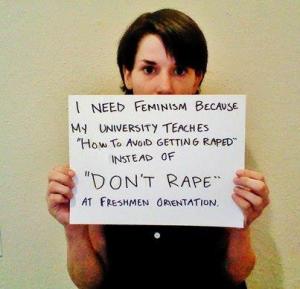
This week, a colleague showed me the photo of a young woman holding a sign that says ” I need feminism because my university teaches how to avoid getting raped rather than don’t rape.” I posted the photo on Facebook, and it immediately got reaction, including those who wanted to emphasize that young women should be taught to take safety precautions.
I couldn’t agree more. But I can’t say that putting all the responsibility on women is fair or appropriate. Universities, and society as a whole, must send a constant and consistent message about the definition of rape and that it is a crime regardless of the circumstances and people involved.
That’s not happening. Instead, the message seems to be that these things sometimes happen when alcohol is involved or when women lead a man on. The message also seems to be that some men are just too important to hold accountable.
And so, I agree with the young woman in the photo.
There will always be individuals who push the limits. The rest of us have the responsibility to push back.
Fear and Self Doubt at the End of a Pointed Finger
 A few months after I moved to West Virginia from Oregon, a girl in my junior high gym class pushed me into a dark corner of an unused shower, got in my face and screamed at me for being too smart. As she pointed her finger into my chest, she told me that I had better stop acting like I was better than everyone else. She was joined by two other girls whose spittle sprayed across my face as they railed at me – screaming that every time I got a high score on a test or assignment, I ruined the curve for everyone else. They also told me that I talked funny, should accept I was in West Virginia and needed to start acting like it.
Even though the incident probably lasted only a few minutes, the repercussions have lasted my entire life. Yet I never told anyone about what happened, and, up until now, it’s been a secret between me and the three others involved.
But this week, with all of the negative comments and finger-pointing after the presidential election, the memory has come flooding back.
After the incident in the shower, I hated myself and believed I was somehow to blame for the situation. While I never purposely got a bad grade, I was still bullied into submission. I spent years locked in the prison of being a follower rather than an individual. Throughout my adolescence, most of the opinions or beliefs I espoused weren’t really my own. Instead, I was simply parroting what I had heard and what I thought would help me fit in.
Even worse, I was full of self-doubt about who I was and what I believed.
Thankfully, I grew up and I grew strong. I grew to be an independent woman who could think for herself, believe in her own intelligence and develop a conscience that extends far beyond her own wants and needs. I also grew into a woman who isn’t tolerant when people make judgments about or reject someone who acts or thinks differently than they do. I know all too well what that feels like.
That’s why some of the harsh comments and reactions to this week’s election took me right back to the shower where I was being bullied.
I understand why some people are angry and frustrated. I felt the same way after the 2000 and 2004 elections. But I didn’t to purposely make others feel bad about their beliefs and opinions. Yet that’s what I’ve been witnessing, and to me, the reactions mirror how the girls in the shower treated me.
People are angry at the election results and are trying to find someone else to blame. The girls were angry about their own grades and had to find a scapegoat, which was me.
Romney supporters are screaming that those who voted for Obama are idiots, morons, traitors and worse. The girls didn’t question my intelligence, but they did question my standards and integrity.
Some extremists are complaining that Obama rallied minorities and people on welfare to vote for him and, in those complaints, they are insinuating that these individuals don’t have the same status as “real” Americans. The girls complained that I, a newcomer to a community where they had lived their entire lives, should be conforming to their definition of normal.
The main difference between now and when I was a teenager is that I am not going to be quiet when I hear or witness such behavior. It’s wrong and people should be told it’s wrong. Neither do I feel bad about myself or my beliefs. I now recognize that anyone who points a finger is simply trying to transfer their own fear and self-doubt to someone else.
Instead of pointing fingers we should be joining hands so together we can tackle some of the tough issues we face. After, all, it’s’ hard to be angry, fearful or full of doubt when your fingers are touching someone else’s.


 Just So You Know