Blog Archives
The Art of the Silent Blog
 The art of silence has always eluded me.
For some people, a lack of words seems profound and noble. For me, a lack of words is simply awkward and frustrating. For the most part, silence has always been just beyond my reach, ability and even my belief system.
Even though I understand that silence is often a sign of respect, I also know that silence can do more damage and cut deeper than the harshest words.
I’m not alone.
Dr. Martin Luther King, Jr. said, “History will have to record that the greatest tragedy of this period of social transition was not the strident clamor of the bad people, but the appalling silence of the good people.” He also said, “In the end, we will remember not the words of our enemies, but the silence of our friends.”
Even the dictionary validates my belief that silence isn’t always golden. While the simple definition is “the absence of sound or noise,” the more complicated definition is “the absence or omission of mention, comment, or expressed concern.”
I’ve straddled and struggled with both definitions my entire life. My battle has less to do with my tendency to talk and more to do with my overwhelming need to call attention to injustice, wrongdoing and inappropriate, self-serving behavior.
I’ve been witnessing a great deal of such behavior recently. Yet, for the most part, I’ve remained silent. Even when people have asked if I’m going to write a blog about certain situations, I’ve said, “No, that’s not my role or responsibility.” Besides, my words could easily be misinterpreted as angry and bitter rather than caring and concerned. So I have decided my silence might be more powerful than words.
And so, the silence continues. This change in tactics is also teaching me a new art form: the silent blog.
I think this one says a lot.
Silence is argument carried out by other means. Che Guevar

A Country Road, a Locked Gate and Barriers to Endless Possibilities
 I can be pretty slow at times, especially when I ride my bike. But that’s not necessarily a bad thing. As the only person actually peddling on a road where others are simply pushing a gas pedal, I notice a lot.
For the past couple years, I’ve been regularly riding on a country road that gives me a great deal to think about:
A plowed cornfield with only one stalk left standing;
A barn with what appears to be an old American flag I can’t identify;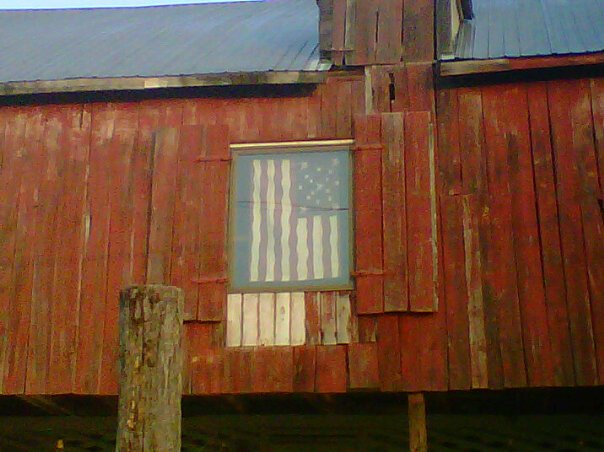
And a gate that, for all I can tell, is completely ineffective.
The gate crosses a gravel road that runs between two fields. Until this week, green stalks of corn filled one of the fields, while the other had no discernible crop. This week, both were plowed. So the road now runs, and eventually dead ends, between two muddy, empty fields.
Other than providing farm workers easy access to the fields, the road doesn’t serve much purpose. It certainly doesn’t lead anywhere interesting or provide enough privacy to be a lovers’ lane. Because of that, the importance of a locked gate with a fading private property sign eludes me. Since there is no fence on either side, the gate isn’t really preventing anyone from simply driving around it.
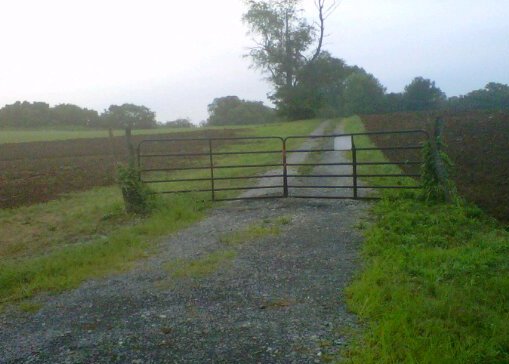 After passing the gate day after day, I finally took a picture and posted it on Facebook with a question about its purpose. I got a variety of responses ranging from people who took the question seriously to those who didn’t.
The general consensus was that there had probably been fences around the fields at some point. When they were torn down, the gate stayed to mark private property.
While this concept still puzzles me, it also reminds me of human behavior in general: we often tear down fences but leave gates standing.
We say we believe in equal rights and demonstrate this by tearing down barriers for others. Yet we still leave up gates to protect what we believe we earned or deserve and fear others may access or take away. Sometimes these gates are words. Sometimes they are the policies we support. And sometimes they are even religious beliefs.
But whatever the reason, the gates are there. And, just liked the locked gate I pass every day on my bike, they provide a false sense of security for some and serve as a challenge for others.
At times, I know I’ve protected my own gates. But the rebel in me also spends a lot of time thinking about how to get around gates. And I admit, there have been many times when riding my bike on the country road, I’ve been tempted to ride around the gate. The silliest thing is I would have no desire to ride on the gravel road if the gate weren’t there. I certainly don’t want to cause any problems or do any damage.
But then, I don’t think people who are seeking greater opportunities have any desire to trample on the achievements of others. They just know the possibilities would be endless if they weren’t constantly slowed down by so many locked gates.
The Insanity of All This Violence is Driving Me Crazy
Just over two weeks ago, while families gathered to watch Fourth of July fireworks at a park less than a mile from my home, a gun was fired. In addition to shooting the intended victim, the gunman also shot and injured an eight year-old girl.
Just two days ago, a man opened fire in a crowded movie theater in Aurora, Colorado, He killed 12 people and injured dozens more.
While one incident was right down the street and the other was across the country, my initial reaction to both was the same. I wanted to hug my children and thank God they were safe. And then I wanted to scream about the insanity of it all: “Why does such senseless violence keep occurring and, even worse, why is it creeping into my world?”
In “my world,” the only violence we ever witness is in the form of entertainment: on television, in the movies and in video games. It’s not a place where people have to fear actual violence.
In “my world,” safe neighborhoods are easily defined, and we avoid violence by avoiding unsafe locations. It’s not a place where my daughter’s friends tell her “that shooting at the park was in my backyard.”
In “my world,” guns are used for hunting animals and shooting targets – not for shooting people. It’s not a place where people use violence to resolve a dispute or share their rage with the world.
In “my world,” when a horrible crime does occur, we rally around and pray for the victims and their families. It’s not a place where, only hours after a shooting, we try to turn a tragic event into a political advantage.
But I’ve come to realize that “my world” is a complete fantasy, but it’s a fantasy I also want my children to believe.
On July 5, I was driving by the park where the shooting had occurred only hours before. My daughter, sitting in the passenger seat, noticed all the people picnicking and swimming and asked “why are those people even at that park? Don’t they know it’s dangerous.?”
She was talking about a park that she has walked to and played in hundreds of times: a park where I walk my dog every day: a park that is the gathering place for most community events in my town.
And so, I told her that the shooting was an isolated incident and she shouldn’t worry or avoid the park.
What I didn’t tell her was that if we tried to avoid every place where there’s been gun violence, our options would be very limited. At the time, movie theaters weren’t even on my radar.
But theaters are creeping onto my worry list now.
Just last night, while my daughter was performing in a local production of “The Wizard of Oz,” the alarms in the theater unexpectedly went off.
No one in the audience moved, and the youth on the stage continued to perform. We were probably all hoping the same thing: that the smoke on the stage had tripped a fire alarm. We were also probably all just a little worried about the same thing: that someone with a gun had entered the building.
The alarm was turned off, my concerns ebbed and I went back to the fantasy of “my world.” It’s actually a very nice place, and I like living there. If I didn’t, I’d go crazy with worry.
Sadly, I’m having to leave it more and more often. And until we stop arguing about solutions and actually start working together, “my world” never will be a reality.
Rocks on the Road and Rocks in Our Heads
 Some of life’s toughest lessons are the ones we learn the hard way.
Some of life’s most important lessons are the ones we sometimes never learn at all.
And some of life’s simplest lessons are the ones we often just ignore – like the problem with rocks in the road.
As a bicyclist, I ride an average of at least 10 miles a day. Because of that, I ride over a lot of rocks. For the most part, I don’t even realize the rocks are there. But every once in a while, my tire hits a rock and – due to speed or angle – I get knocked off course and sometimes even knocked down. Getting knocked down hurts, and sometimes the resulting injuries even leave scars.
Because of that, when I do notice a rock, I try to avoid it. And when there are a lot of rocks, I might even change course.
That’s life on my bike.
But I’ve noticed a lot of “rocks on the road” in the rest of my life too.
These rocks are often comments or actions that people believe are completely normal and appropriate. But to the nearby traveler on the road of life, those same words or actions may be slightly offensive or, at worst, hurtful. Sometimes they can also cause people to change course or fall down.
Just the other day, I was having coffee with a colleague who told me that years ago she had come to my office to talk about the possibility of interning with me. When she dropped by for the unscheduled visit, she was told I was in a meeting but that I was just with my intern and could be interrupted.
That one word “just” was enough to make her turn around and walk out the door. She didn’t want to be “just an intern.”
To be honest, I think I might have been the person who told her not to worry, and she changed the story to make me feel better. I don’t remember, but regardless of who said it, the word “just” became a rock in her life’s road.
Fortunately, for my colleague, her change of course is working for her. But she also had the advantage of already having several life successes under her belt. She could handle that rock.
I worry more about people who have so many rocks in their road that they can’t avoid them: people who have been knocked down so many times that they don’t trust that the road ahead gets any easier. Sometimes they’ve fallen so much, they have permanent scars.
Instead of helping clear the road, many of us are busy putting more rocks in their way. Sometimes those rocks are too big to move or go around. 
For the most part, I don’t think we are doing this on purpose. But, at times, I think we are, especially when we make judgments about people whose circumstances we know nothing about. That’s when we become victim of the rocks in our heads.
I’ve noticed a trend of people posting comments online that belittle others who are “on welfare” or “on food stamps” or that make assumptions about people based on appearance. I don’t know which is the bigger rock: those comments or the bitter ones about people with expensive shoes, phones or cars who are receiving some sort of government assistance.
Here’s the deal. I, like most people I know, don’t believe that government assistance should be a permanent way of life. I also don’t believe that government assistance should be used for anything but basic needs. And I don’t believe smart phones and SUV’s are basic needs. I also agree that some people manipulate the system, and that we need to be diligent about stopping such abuse.
However, I also know that most people who receive assistance have fallen on hard times. Some may have previously afforded a lifestyle that included expensive clothes and cars. But then they lost their job or faced another crisis that caused them to deplete all their available resources, including help from friends and family. After that, they were forced to seek public assistance. That expensive car may be all they have left after losing their home, a spouse or a way of life.
Instead of assuming the rocks in their road are their own fault, maybe we should think about how we can pick some up, roll them out of the way or help these individuals navigate a new course.
Doing this follows the simplest life lesson: do unto others as we wish them to do to us. I know if and when I hit tough times, I don’t want to ridiculed and/or blamed.
But this lesson is so simple that a lot of us ignore it when convenient. Or until there’s a rock in our own road. Or until we get the judgmental rocks out of heads.
Unfortunately, sometimes those rocks in our heads are harder to get rid of than the rocks in our roads.
Philosophical Thoughts From a Feminist in High Heels

There are times when I wish I could be one of those women content to accept that the world is unfair and that some people are more important than others.
If I could actually believe that, life would be so much simpler.
The problem is that simple bores me and unfairness angers me, especially when it’s perpetuated by people who use inequality to meet their own need for influence, power and/or sense of security.
Even though I hate discrimination of any type, my personal experiences are limited to dealing with sexism. And lately, we seem to be moving backwards on that issue.
Women are facing more sexist attitudes than we did when I was in my twenties. At least it feels that way. Maybe because when I was younger, I attributed personal slights to my being inexperienced. But now, I’ve got a whole lot more experience yet the attitudes and behaviors persist. And women are having to fight battles I thought we’d won years before.
Admittedly, I’ve been more passive than I should be.
Perhaps it’s because protecting myself has sometimes outweighed standing up for what’s right. Or perhaps it’s because sexism can be so subtle that people have made an art form of camouflaging it. Or perhaps it’s because the issues are just too confusing.
Take, for example, shoes.
I recently heard that a woman who wears high heels (but not too high) is taken more seriously in the workplace than a woman who wears flats.
As someone who would sleep in high heels if it were feasible, you’d think I’d find this piece of information encouraging. Not at all.
The whole issue is absurd. The height of a woman’s shoe shouldn’t matter at all as long as she can do her job. But apparently it does. And since women have a lot more choices than men when it comes to footwear, we are also more likely to make decisions that can distract from our skills and abilities.
The same can be said for words we use to describe ourselves. Take, for example, the word feminist.
There are those people who picture a feminist as a woman who hates men, doesn’t shave her legs, dresses like a hippy and has extreme points of view about reproduction.
Umm.. no. As a feminist, that doesn’t describe me at all.
I love men. I shave my legs. I wear make-up. I’m not an extremist on any subject, and I even let my daughter play with Barbie.
Being a feminist has nothing to do with how I dress or who I love.
It’s about taking time to question how women are being treated. It’s about ensuring that, when other factors are equal, women are given the same opportunities as men. It’s about pushing people to think about how fair they are being.
Would the salary be the same if a man had the job? Does a woman really have the same opportunity to break into the “good old boys’ network? Is the spouse’s employment relevant?
Ironically, as I was writing this, my daughter looked over my shoulder and asked, “What exactly is a feminist?”
“It’s someone who believes women should have the same opportunities as men,” I said.
“Duh,” she said in a voice and manner that only 10 year-old girls can get away with.
“Exactly,” I said. “Duh.”
And hearing that one word come out of my daughter’s mouth put the fight right back in me.
Watch out world, this feminist in high heels is on a mission to ensure life is more fair for her daughter.
Good Books, Bad Endings, and Why I Never Had a Genuine Relationship with Nancy Drew
 Sometimes, finishing a good book feels similar to ending a tragic love affair. From the beginning, I know it’s going to end, but I dive in anyway believing the pleasure between the covers will be worth all the pain of separation later.
My obsession with a really good book is often like being in the throes of a passionate affair: I think about it all the time, I ignore responsibilities so I can spend time with it, and almost every conversation reminds me of it.
That’s not surprising. My relationships with books have often mirrored my relationships with people.
While I have a lot of acquaintances, I’ve found that when I truly need support I generally fall back on the same trusted few people again and again.Similarly, I fall back on the same book or a favorite author when I just want to escape with a good read.
A good read, to me, isn’t an implausible plot that is moved forward with simple sentences and a lot of action. Just as I prefer complex, yet genuine, people, I prefer complex stories that can make me believe the unbelievable.
In other words, content is more important than showmanship, and flawed characters are more interesting than heroes who always say and do the right thing.
That’s probably why, as a girl, I just could never relate to Nancy Drew. As a lifelong mystery lover, I don’t recall having much issue with the plots of her books, but I definitely remember having issues with Nancy herself. She was too one-dimensional, and I could never relate to a girl who had it all: good looks, a boyfriend, a chic wardrobe, and popularity.
As an awkward kid who struggled with getting through each day without too much turmoil, I don’t know what bothered me more – the ease with which she went through life or that her perfection was incredibly boring.
I still don’t do boring or predictable well. And because of that, I’ve been known to play the field with a lot of books. I’ve even developed a reputation for dumping many before I make it past the fifth chapter.
But at least those books didn’t suck me in before it was too late. There is absolutely nothing worse than a book that gets me all excited throughout only to fail to deliver at the very end. I don’t know if the authors just don’t plan well, get bored with the writing process, or have to meet a deadline, but they seem to be meeting their own needs rather than that of their reader.
I’ve been encountering more and more such books lately. They start off with a well-developed plot and characters that capture me completely through most of the pages. But then, they end quickly by tying up all the loose ends in a neat package that leaves me feeling disappointed and unsatisfied.
Such books used to leave me doubting my own judgement. But not anymore. Just as we grow with both our successful and our failed relationships, I’ve come to believe we can also grow with each book we read no matter how it ends.
At least that’s what I’m telling myself as I find myself completely immersed in my latest book. And just as with the start of any relationship, I have high hopes that it will be both satisfying and leave me wanting more.
The Myth of the Same 24 Hours

I admit that I’m generally a sucker for adages, quotes and platitudes. They often make sense, and sometimes they even speak directly to me. Sometimes.
And then there are sayings that get my blood boiling, because they are simply unfair and obviously perpetuated by people trying to make themselves feel good.
“We all have the same 24 hours” is one of those sayings.
O.K., technically, there are only 24 hours in each day, and as far as I know, no one gets rewarded with extra hours for doing good deeds or has hours subtracted for bad behavior. But the SAME 24 hours? It’s not even close.
For people who want to feel self-righteous, the saying works. After all, they’ve achieved “success” with only 24 hours in a day. If others haven’t, then they obviously haven’t used their 24 hours wisely. This logic is similar to the myth that if low-income people just worked harder, they too could be financially secure. Ironically, some of the hardest working people I know are working two jobs and still can’t make ends meet. And when they aren’t working to earn meager paychecks? They are spending time on tasks that middle and upper class people generally don’t.
In other words, when you don’t have a high income, you just have less time.
You have less time because you spend hours in a laundromat rather than throwing your clothes into a washing machine at home.
You have less time because you can’t simply jump in your car when you need to go to the grocery store, to a child’s school program or to work. You depend, and wait, on public transportation.
You have less time because you don’t have social connections with doctors who can “get you right in” as a favor. Instead, you wait just to get an appointment . . . then you wait in the waiting room.
I first became aware of the “24 hour myth” through my own struggles. I spent hours trying to do things myself that friends with bigger paychecks paid someone else to do.
And sadly, because I bought into the myth that not having extra money meant I wasn’t successful enough or working hard enough, I would pretend that I took satisfaction in “doing it myself.”
Then, at some point, I realized that “doing it myself” was the epitome of hard work. It just didn’t equate to having more money in my pocket, a bigger house or a nicer car. But neither did it equate to being a failure. It did increase my understanding the value of time, and how people who can afford to buy it, do.
They buy it by paying babysitters to watch their children. They buy it by paying people to clean their homes. They buy it by eating at restaurants instead of cooking. And sometimes they can even buy time by working for businesses that allow them to go on golf outings or to participate in charitable events to build their network and their resume (while lower-income people are generally required to stay at the work site while on the job.)
I can’t judge whether people who have higher salaries use their time more or less wisely than people with lower incomes any more than I can judge whether they work harder. Like everything else, individual behaviors run the spectrum. But I do know people with more money have more discretionary time to spend on working more or playing more. And just like discretionary money, it can be wasted or well spent.
As Carl Sandburg said, “Time is the coin of your life. It is the only coin you have, and only you can determine how it will be spent. Be careful lest you let other people spend it for you.”
And that is saying I CAN definitely buy into.
A Tale of Two Teachers and Blank Sheets of Paper
With the current year fading fast and all of the potential of a new year on the horizon, I’d like to suggest a resolution for everyone: don’t write on someone else’s blank sheet of paper.
Whether or not you let someone write on YOUR paper is up to you, but please don’t write on someone else’s.
Personally, I’m resolving to avoid both. For such an outwardly head strong, opinionated person, you might think the first will be more difficult. But, for the unsure, worried and perpetually questioning me inside, the second will be just as challenging.
For years, I’ve let way too many people write on my paper. . . altering my story with their advice, opinions and standards. And the difference between someone who writes on your paper and someone who cheers as you write is long-lasting.
I learned this from two teachers and the blank sheets of paper they expected their students to fill.
I absolutely loved those blank sheets of paper. I loved the smell. I loved the look. And I loved the endless possibilities.
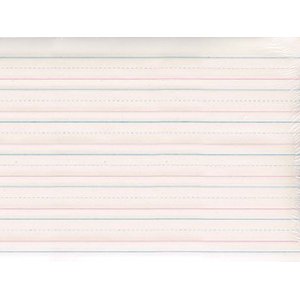
During my grade school years, the paper wasn’t white. It was an indescribable shade of grey and tan with space for a picture above and a combination of dotted and solid lines below. The purpose of the lines was to ensure appropriate hand-writing form.
I never worried about my handwriting (and was generally graded down accordingly). I was much more worried about content. I was fascinated by how I could string words together to say something that nobody else had ever said. I adored the feeling of putting pencil to paper and creating something. And I loved being able to express myself.
What I didn’t love was having parameters placed on me.
And those parameters were set forth quite firmly by my first grade teacher, Mrs. Gladwill. Unfortunately, I can’t really say anything nice about the woman. I could write pages about the horrors of that school year –about the times I was stuck in the corner so other students wouldn’t cheat off me; about how needing to go to the bathroom was a nightmare because it was prohibited during class time (Mrs. Gladwill’s theory was that if you didn’t have the sense to go during recess or lunch, then you should wait); about how Mrs. Gladwill liberally used harsh words and a ruler on knuckles; and, most of all, about how Mrs. Gladwill required conformity.
For a “spirited” child, there’s no wonder that I didn’t thrive in first grade. I simply survived. And was beholden to a series of lessons that led me to believe that sometimes it’s easier to just let others control what goes on your blank sheet of paper.
That became evident when Mrs. Gladwill gave all of her students the assignment of writing (and drawing) an answer to the question “what do you want to be when you grow up?”
At first, I was very excited about the assignment. With Mrs. Gladwill as a teacher, I should have known better.
I wanted to write about becoming a trapeze artist. My father had built and hung a trapeze from a juniper tree in our backyard, and I was already practicing my act.
The problem was, I didn’t know how to spell trapeze.
When I asked Mrs. Gladwill, her only advice was to look it up in the “book of careers” she had provided us.
Needless to say, trapeze artist wasn’t listed.
So I had to ask Mrs. Gladwill again.
Instead of helping me spell out my dream, she advised me to write about something “normal”, like becoming a nurse.
I had no desire to be nurse, but I recognized the authority she had. So, I reluctantly looked up nurse in the career book and wrote about how I wanted to be one. I even remember drawing the picture with particularly harsh strokes: I was angry that Mrs. Gladwill had taken control of MY piece of paper. At the same time, I did not want to be in trouble. So my blank sheet of paper became a full sheet of paper that was a lie.
Turning in that paper marked the end of my dreams of becoming a trapeze artist. Mrs. Gladwill had made it clear: if it wasn’t in the book about careers, there was no sense in pursuing it.
By second grade, my dreams had evolved anyway. My new ambition was to become a writer.
Much to my surprise, my teacher, Mrs. Roth, never told me to look up writer in the “career book.” In fact, she didn’t even have a career book. She simply encouraged me to write stories whenever I had extra time. She even taped my stories on the outside of her classroom door where others could read them. And they did.
I remember swelling with pride when fourth graders stopped by our classroom to read my stories.
Since then, that dream of being a writer has never died. I can’t say I’ve fully achieved that goal, but I never gave it up. It’s hard to give up something when others, particular teachers, believe in you.
So as 2012 approaches, I’m raising a glass to toast the blank sheets of paper everyone will receive in the new year. And I’m toasting the opportunity we all have to continue writing our own unique story without being told what the plot should be. I’m also raising a glass to how we can all cheer each other on. And most of all, I’m raising a glass to the great teachers who lead the way. Not only do they encourage so many of us, but they also serve as examples for other teachers by acknowledging that sometimes the most meaningful lessons aren’t the ones that are taught but are the ones that are observed.
Here’s to that! Cheers!


 Just So You Know