Blog Archives
An Overdose of Reality
 Last Monday night, family and friends celebrated as my son and 255 of his classmates received their high school diplomas
A week later, one of those students died.
My daughter was told about the death at school. My son found out via social media. My husband learned of it from my son. And I received a text message telling me the Spring Mills High School class of 2016 had already lost a member.
Within a few hours, the rumors were swirling through the neighborhood and on the internet. But there was element that never changed: the culprit was heroin
And while many are simply shocked that a kid with so much potential died from a drug overdose, I’m dealing with a range of emotions.
I’m saddened, and my heart breaks for my son’s classmates who are struggling to understand what happened. I’m overwhelmed with how this drug continues to gain strength in my community. And I’m frustrated with the political posturing that’s preventing real solutions to this horrible epidemic.
But, most of all, I’m angry.
I’m angry that so many people are expressing surprise that an athlete with decent grades could die from an overdose. This has been happening for years across the country, and pretending it couldn’t happen at our school was ridiculous.
I’m angry that my community has experienced dozens of overdose deaths since the beginning of 2016 and yet so many people want to blame the victims and their families instead of work toward a solution.
And most of all, I’m angry that drug dealing is yet another example of how money has become more important than human lives.
Nobody in the Class of 2016 can rewind the clock a week and get a do-over, and there is still plenty more heartache to come for everyone involved in this situation.
I can only hope that the members of my son’s graduating class, as well as the underclassmen who will follow in their footsteps, recognize that some of life’s most important lessons don’t happen in the classroom. Even more importantly, I hope they understand that those lessons mean nothing if they don’t use that knowledge in a meaningful way.
In a situation like this, turning those lessons into action is a matter of life and death.
The Graduate

Thirteen years ago,”Pomp and Circumstance” played as my son wore a red cap and gown to accept his diploma.
Because his class was extremely small, the formal ceremony was short. As the post-graduation celebration began, my son led his friends in a unique rendition of the “Chicken Dance.”
Throughout the afternoon, there were several other moments when he grabbed, or attempted to grab, the limelight. At one point, his teacher pulled me aside and whispered “All the world is a stage for Shepherd. Just enjoy it.”
But I couldn’t.
The next 13 years, starting in kindergarten, weren’t easy.
I worried obsessively about my son.
Even though my son was very smart and very funny, I worried that he didn’t have the same interests as his peers.
I worried that he was awkward and uncoordinated and would never find the place where he belonged.
I worried that he often seemed oblivious to what others automatically understood.
I even worried that he didn’t care that I was worried.
But somewhere between kindergarten and twelfth grade, my son taught me more than algebra and English literature classes ever could.
He taught me that going out on a limb will always be more interesting than standing on the ground hugging the trunk.
He taught me that winning a dance contest doesn’t necessarily require the best moves. It simply requires the most guts.
He taught me that more people appreciate the sheep who wonders off to explore new pastures than the ones who stay with the herd.
And he taught me that grabbing a mic and singing in front of the entire student body can never be embarrassing if you get everyone to sing with you.
On Monday, I will listen to “Pomp and Circumstance” while my son wears a red cap and gown to accept his diploma.
I wish I could guarantee he won’t lead his entire graduating class in a rendition of “The Chicken Dance,” but I can’t. Neither can I guarantee he won’t pull off one final, ridiculous high school stunt.
But here’s what I can guarantee: I won’t be worried.
Because I know that my unique, gifted, funny, ridiculous, smart, sarcastic son already has plenty of experience in finding his way in the often rocky terrain of life.
I also know, that his preschool teacher wasn’t entirely right. All the world is not just a stage for my Shepherd. Instead, all the world is HIS stage.
And I can’t wait to see his upcoming performances.
What Mom Never Said
Here ar e three truths that guide my life:
1) Perfection is highly overrated. I’ve never met a perfect person, and I certainly wasn’t raised by anyone who met the criteria.
2) We learn more far more from our mistakes than we will ever learn from accomplishments.
3) The best advice we receive isn’t handed to us wrapped in words of wisdom. Instead, the most meaningful lessons are often hidden in what we observe, what we hear, and, in many cases, what we don’t hear.
My mom has spent more than 51 years trying to impart these nuggets of truth on my brother and me.
When I was young, she sometimes interspersed her acquired wisdom into our conversations, but what went unsaid was always more powerful.
For example, my mom never once told me I deserved anything. NEVER.
I was well into adulthood before I realized that.
No matter what I achieved, she never used the word deserve. Of course she encouraged me and told me that I’d earned my successes, but she implied that earning something is entirely different from deserving it.
She never explained this, and we never discussed the matter.
But by not speaking that one word, deserve, she said volumes.
In matters of every day life, human beings don’t have the right, or the ability, to decide who is deserving of something. Because, in doing so, we imply that others are not deserving.
Life is one big poker game in which the draw sometimes determines everything. Yes, some people are better at playing the game. Yes, some people use their cards to gain an advantage. Yes, some people avoid temptations and are able to improve their chances. And yes, some people are so charming and engaging that they can cloud reality to sway the beliefs of others.
But in the end, some people are simply luckier, and luck has nothing to do with their character, their abilities, their fortitude, their courage, or whether they are more “deserving” than others
So even though Mom never talked about why she threw “deserve” into her junk pile of words that are either misused or meaningless, she said everything through the life she’s led.
And for that, I will always be grateful.
Happy Mother’s Day, Mom.
In the Bathroom
 I am a worrier.
I worry about my kids, the decisions they make and if they are happy.
I worry about having enough money to meet my family budget and having enough money to meet my office budget.
I worry about whom our country will select for our next president.
I worry about drugs and crime in our community, individuals who are homeless and people are being abused by a family member or by the system.
And I worry about people who are too self-centered or narrow-minded to care about anything or anyone but themselves and their own self-righteous and generally misguided opinions.
But I have never once worried about the person in the bathroom stall next to me.
Until this year, I never even considered that a birth certificate could prove or disprove whether that person in the next stall posed a risk to me or my children.
Birth certificates are just pieces of paper that capture information provided during one single moment in time and reflect societal norms of the past.
Heck, my own birth certificate isn’t even accurate. My mother’s name is misspelled. Apparently, in the excitement of my arrival, she didn’t put her professional proof reading skills to use.
Even worse, my birth certificate lists my mother’s profession as a housewife. My mother was never married to a house. Neither did she spend the majority of her adult life staying at home cleaning, cooking and caring for kids. She was an extension agent, a Peace Corps volunteer, a substitute teacher, a journalist, an editor and even a librarian.
But, at that time I was born, she was not an earning an income outside the home. At that ONE point in time. So, even though my birth certificate states my mother was married to a house, which I find a frightening thought, I can’t find any information on my birth certificate that indicates whether or not I pose a danger to others. The information on my birth certificate is so irrelevant that I’ve never even considered carrying it with me.
In the past 30 years, the only time I’ve even taken it out of a safe deposit box was when I needed it for proof of identification. If I ever need it to get into a public restroom, I’m out of luck because it stays locked away in a box that won’t burn.
This whole debate over which sex can use which public bathroom seems as ridiculous as the dress code a former employer tried to implement years ago. The man was getting ready to retire and was trying, for one last time, to impose his prehistoric beliefs on those who would be left behind.
(This is the same man who insisted I should never be put in a position of authority because I breastfed during a work-related meeting. He never considered that I attended the meeting while on maternity leave because I was just that committed to my job.)
To provide some perspective about just how prehistoric his dress code was, it required women wear hose with skirts or dresses. It also required women wear appropriate underwear and noted that thongs were not appropriate undergarments for the workplace.
When I read the dress code (which, by the way, I fought against and eventually had overturned) , my first question was how it would be monitored and enforced.
I feel exactly the same about a law that require people to use the public restroom that corresponds with the sex on their birth certificate.
It is, in two words, absolutely ridiculous.
A Grown Up Question
Shortly before I graduated from college, I sat in a friend’s apartment listening to the song “I’m an Adult Now” by the Pursuit of Happiness and thinking it would soon be included on the soundtrack of my life. (Back in those days, life soundtracks were limited to 60 or 90 minute cassette tapes.)
I was 22 years old, and I had absolutely no idea what being a grown up really meant. But I was convinced that once I had my college diploma in hand, I would quickly learn.
I didn’t.
Now, more than a quarter of a century later, I’m still trying on various hats in hopes of discovering the one that will officially make me feel like a grown up. So far, none have worked.
Yes, I lived on my own and paid my own bills. Yes, I dealt with mortgages and debt and the IRS. Yes, I got married. Yes, I gave birth and became a parent. And yes, I even discovered that I can sound more like my mother than I ever imagined.
But despite all of that, I’ve never felt like an authentic adult. Instead, I feel as though I’m pretending to be an adult when I’m actually more like that 22 year-old still trying to decide which songs should be on my life’s soundtrack.
Maybe that’s because I’ve never been able to answer that one question that so many adults think is incredibly important. It’s a question that was asked of me hundreds of times from the time I was a toddler all the way through high school.
“What do you want to be when you grow up?”
Ironically, the younger I was, the more easily I could answer the question.
When I was five, I wanted to be a trapeze artist. That dream was short-lived when my dad hung a wooden trapeze from a tree in a backyard and I made him lower it because its height five feet off the ground scared me. By the time I was ten, I had my heart set on being a best-selling author which, by the time I was 15, and evolved into a desire to be a journalist. And, at what I considered to be the mature age of 20, I truly believed I was destined to produce documentaries that would change the world.
With the exception of a few months I spent as a radio news reporter, I never achieved any of those goals. I could consider myself a failure, but that would discount all my accomplishments never on my “I want to” list. Nor would it take into account how the experience of living life to its fullest sometimes gets in the way of the expectations we think we are supposed to meet.
I don’t think I could have known, at the age of 22, how life’s river of circumstances has a generally steady and sometimes ferociously rapid current that can easily sweep us away from where we thought we belonged to the places we are needed most.
I was thinking about that river this week when my son celebrated his eighteenth birthday. In only a few months, he’ll be starting college, so he’s regularly being asked what he’ll be studying. To me, that’s the more mature equivalent of the question “what do you want to be when you grow up?”
 And, even though I understand why everyone feels compelled to ask, I think the more meaningful question is “are you keeping your heart and your mind open to making adjustments to your plan with each new opportunity and complication?”
If my son does that, he faces the danger of ending up like his mother – nearly 50 years old and not entirely sure what he wants to be when he grows up. At the same time, he might also learn that being an adult isn’t about reaching a certain age or about achieving a certain status. And he might figure out that making mature decisions doesn’t mean letting go of the child within.
Instead, getting older should be about learning to adjust to the currents of life even when you aren’t confident you are headed in the direction you had originally planned.
For All I Do Wrong
I felt like a child on the verge of a temper tantrum. I wanted to put my hands over my ears, stomp my feet and tell  everyone to be quiet.
But, I couldn’t. I was attending a meeting in a professional capacity.
And so, I could only throw an internal temper tantrum during which I raged about how easily people can point fingers.
Maybe, I had just reached my capacity for simplistic thinking. Maybe I was exhausted by all of the people who expend all of their energy finding fault rather than solutions. Maybe I was tired of putting labels on people without taking into consideration all of the external forces that helped shape them. And maybe, just maybe, I was too aware of all of the mistakes I’ve made in my own life.
And so, when I was forced to listen to people make a blanket statement that all homeless people are drug addicts and criminals, I twitched.
Here’s the truth: not all homeless people are criminals or drug addicts and very few drug addicts and criminals are homeless.
Here’s a greater truth: no person arrives at rock bottom on purpose. No one makes decisions with the sole purpose of destroying all of the good things around them. Most important of all, no person can be described by one or two simple adjectives like addict or homeless or loser.
I’m not just saying this because my work involves individuals who struggle with those labels so I have the opportunity to see how complicated people and situations are.
I’m saying this because I make mistakes EVERY SINGLE DAY. Sometimes the mistakes are small and easily forgotten. Sometimes they are significant enough to hurt others, and I carry the guilt and regret with me as though they were an actual physical presence. And, more often than not, I’ve hurt myself with a pattern of wrong decisions that have left scars on both on my body and my soul.
And yet, few, if any people, label me by mistakes. Maybe that’s because I’m able to hide them behind a shield of respectable friends, family and job. Maybe it’s because I am surrounded by people who are not so weighed down by their own mistakes that they still have the energy and ability to help me when I fall. And maybe it’s because I was raised by parents who, even as they reached out a hand to help pick me up, never allowed me to escape the consequences of my mistakes.
But if I ever discovered that, instead of being identified as a unique individual, I was being forced to wear my mistakes as a label, I would not just feel shame. I would also feel less than human. And when I feel bad about myself, I am much more likely to make bad decisions.
Which is why, as I sat in that meeting where blame was being thrown around like baseballs at spring training, I wanted to  remind people of that old saying “when you point a finger at someone, remember there are three pointing back at you.”
In other words, we can’t expect the world to change until each of us changes too. That starts with spending less time finding blame, more time trying to understand the complex issues that cause our biggest community problems, and, most importantly, relying on ourselves rather than others to be part of the solution.
Touched by an Angel
 For several years, National Public Radio ran a series called This I Believe that encouraged listeners to share short audio essays about core beliefs that defined who they were and how they lived their lives.
I always had a secret desire to submit my own essay, but I never did.
I just couldn’t identify only one belief that defines me.
I believe in karma.
I believe that the worst circumstances in our life are intended to teach us critical lessons that, in the end, will make us better people.
And I believe that angels show up in our lives when we need them most.
So it was last night when I got home from work in a foul mood. I was worn down by trying to do the right thing in a world often controlled by manipulative people. I was so angry that I had an almost physical need for everyone else to know exactly how I felt. I was already writing the words for this blog in my head,
But that was before I saw the package on my front steps.
My curiosity immediately overshadowed my anger. The return address was from my long ago babysitter, Carrie, in Oregon.
Growing up, I adored Carrie just as I had adored her mother, Ruby.
My childhood was spent living thousands of miles away from my own grandparents, and Ruby had stepped up and stepped into the role of foster grandmother.
Since Ruby had several daughters of her own, I never understood how someone as special as she was could possibly think I was special too. Not only was she was kind, gentle and loving, but she had the innate ability to draw into the light all the good in people while ignoring all that was ugly. When spending time with Ruby, you couldn’t be angry at the injustices in the world because you were too busy rejoicing in all its beauty.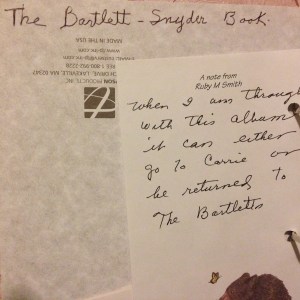
When Ruby died in January 2007 at the age of 92, I never thought I’d hear from her again.
I was wrong.
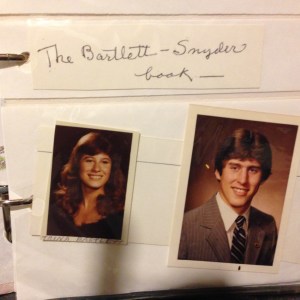
The package on my front steps contained a photo album with the letters, announcements and photographs that my mother and I had sent Ruby over two decades. It also included a note with instructions.
As I read the note from Ruby and flipped through the pages of my life since I’d left Oregon, tears streamed down my face and my anger disappeared.
I had been touched by an angel who was reminding me not to focus on the negative. There is just too much in life to celebrate instead.
And so, thanks to Ruby, that’s exactly what I did.
The Cat Burglar (A Weird Valentine’s Day Love Story)
 When I told the following story to my co-workers, they shook their heads and said, “This would only happen to you.”
When I told my husband the same story, he shook his head and said, “You know, you create these situations.”
I agreed with both statements, although I had to remind everyone that I do attract more than my share of odd people.
Take, for example, the random stranger who stopped me in the greeting card aisle at Target to ask how to get to Dunkin’ Donuts. Since the nearest Dunkin Donuts is on the other end of town, I had to wonder 1) why she was looking for the doughnut store in Target, 2) out of all of the people in Target why she chose to ask me, and 3) if I looked like I eat too many doughnuts. (For the record, I don’t. I may have my weaknesses, but craving doughnuts isn’t one of them.)
As I was giving directions, the woman took out her smartphone, presumably to take notes. Since most people use their smart phones to access maps so they don’t have to ask strangers for directions, I began to wonder if I was being recorded on a hidden camera somewhere.
I wasn’t. The woman happily left Target presumably in search of Dunkin Donuts.
But I digress. This story isn’t about doughnuts or how I have an innate ability to attract odd people. It’s about my crazy, obsessive love of animals and how I make really weird and not always rational decisions because of them.
And so it was on a frigid morning before dawn when my beloved German Shepherd, Rodney, insisted on going for a  walk. He’d been cooped up because of an injury and was going stir crazy. So I layered up. (Winter cap with built in light for walking in the dark: check. Sweatshirt with hoodie: check. Hood to cover my face: check. Winter jacket with hood: check.)
Yes, I was bundled up and had four hats covering my head, but I was visible and I was prepared.
Or so I thought.
I hadn’t planned for Artemis, our tuxedo cat who thinks she’s a dog.
Her inability to understand her that she’s a feline and not a canine isn’t an issue as long as she’s in the house. But when she’s outside, she thinks she’s a dog.
That morning, while I was bundled up with no peripheral vision. Artemis got out of the house and tagged along as Rodney and I set out for a brisk jaunt through the neighborhood. Rodney stopped frequently, smelled often and did his business. Artemis dashed, hid, and pretended to stalk us. Everything was fine until, halfway through the walk, Artemis was no longer happy.
And she let us know.
She began to talk, and talk and talk.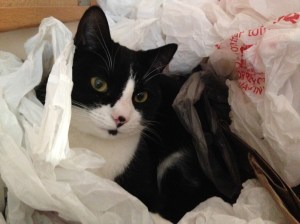
If you aren’t fluent in cat language, you aren’t alone. Neither am I. I thought she was tired or cold and just wanted to be picked up and carried for the rest of the walk.
I was wrong.
What Artemis wanted was for Rodney and me to follow her through a shortcut that involved navigating the neighbors’ backyards rather than taking the long way home via the street.
Apparently, Artemis thought Rodney and I were idiots for opting to take a longer walk in frigid temperatures when we could trespass and get home more quickly.
And, because I love my cat and didn’t want to disappoint her, I followed.
With a cat leading the way, with a German Shepherd in tow, and a bright orange hat and light on my head, I decided to cut through the neighbors’ yards to get home.
That was a mistake.
At the same time I was navigating trees and branches, the city police were investigating a break-in at a house in my neighborhood.
To be more precise, they were investigating a break in at the same house whose yard Artemis decided we should take  as a shortcut.
I can’t imagine the police really thought I was a burglar. What thief wears an orange hat with headlamp, has a large German Shepherd on a leash and takes directions from a cat?
But my neighbors’ house (the one whose yard we had been trampling) had an alarm system. And that alarm had recently gone off prompting the police to arrive. And when the did, they had to stop the only human suspect they had: me.
“Ma’am,” one of the officers asked, “Is this your house?”
I didn’t just say no. I gave him my own address as proof that I belonged in the neighborhood. What I couldn’t easily explain why I was tramping through the neighbor’s yard before dawn in frigid temperatures. Tying to justify trespassing because you are following your cat is always rather difficult.
So I didn’t try. Neither did I stop my trespassing,
Apparently, though, I was suspicious enough to warrant further investigation. The police officer turned on his extra powerful flashlight and shined it directly on Artemis.
“Ma’am?” he asked. “Is that your cat?”
“Um, yes,” I answered.
That seemed to satisfy him, and he starting shining back and forth across the trees.
I don’t know why he expressed interest in Artemis. Maybe he thought she was the cat burglar who had tripped the alarm. Maybe he was looking for a cat of his own to adopt. Or maybe, just maybe, he too is an animal lover and understood that love can sometimes make us behave in crazy and irrational ways.
Whatever his reasons, he let me and my animals go home with yet another story to tell.
Something tells me it’s not the last.
The Curve
 When I was in high school, my fellow students begged our teachers to grade on a curve. Their theory, of course, was that if everyone did poorly, no one would fail. That wasn’t necessarily true, but we were self-absorbed teenagers with little concern for broader implications.
If you’re not familiar with the grading curve, it’s a tool used by some educators to distribute grades on a bell curve. When an assignment or test is scored, the average score becomes the average grade. The scores above and below the average are distributed accordingly. That means, if you get a really high score, you might skew the curve for everyone else. It also means some students are guaranteed to land at the wrong end of the curve.
Back in the 1980’s, my teachers rarely actually graded on a curve. But when they did, I knew two things would happen:
1: I would get grief from all the other students in class warning me not to do so well that I would mess up the curve, and,
2: I had an opportunity to prove that I didn’t need a curve to do well. And that opportunity far exceeded my concern about anyone else’s grade.
At the time, my self-worth was completely wrapped up in academic success. I truly thought that the only thing at which I could excel, and which made my existence matter, was getting good grades. (Yes, I completely related to Brian in the Breakfast Club).
I also believed that getting good grades was simply a matter of working hard, and that anyone could work hard. I had little tolerance for my peers who got mad when I did well. To me, they just needed to try harder.
And so, I shamefully admit, I always tried to burn the curve.
Needless to say, I’m embarrassed that I used to think that way. I now realize that I had so many advantages: educated parents, good nutrition, a safe place to sleep, a home free of violence, a family that embraced education, a mother who believed women didn’t need to depend on men, and a father who expected as much of his daughter as he did of his son. My list of advantages could go on and on and on.
But now, all these years later, I recognize how some children start off at disadvantage simply because of the family they are born into or because of a disability. Some struggle to read. Others struggle to overcome loss of at least one parent in the house. Others were never encouraged or never had an adult who even recognized their potential. And when you are struggling just to get by, studying for test isn’t a priority.
That’s why, more than 30 years later, I may be ashamed at who I once was, but I am also ashamed of some of the former classmates who still embrace the bell curve. Some of the same people who encouraged me not to exceed are now blaming their neighbors for falling at the negative end of the curve. I know this because I see their posts on social media.
They complain about people “on welfare”and how they don’t want their hard-earned money going to support people who are lazy and just don’t try. The want to drug test individuals who receive SNAP (food stamps) because they aren’t deserving. And they have the misguided belief that if people just try, they can find a job that pays more and provides benefits.
When I read such opinions, I can’t help but wonder if my former classmates remember back to the days when I, the person at the top of the bell curve, had similar thoughts about them.
But, over time, I learned that each of us has fought both visible and invisible battles to get where we are, and success looks different for everyone. No one’s achievement shouldn’t be denied or belittled. But neither should we think everyone has the ability to achieve what we have.
Such thinking only accomplishes what the bell curve does: ensures an elite few stay on top while someone will always be struggling to just get by.
Falling Out of Bed
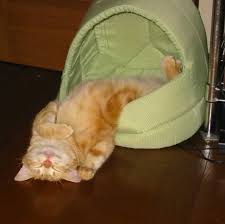 When I was a little girl, I fell out of bed on a regular basis.
Sometimes, I’d pick myself up off the floor and climb back under the covers. Sometimes, my father, who must have heard the thud, would come into my bedroom, scoop me up, and tuck me back into my bed.
I don’t remember being particularly concerned or afraid of falling out of bed, nor do I remember my parents worrying about it.
It was just something I did until, one day, I didn’t do it anymore.
Like so many childhood memories, my habit of falling out of bed was locked away in a part of my brain that only opens with the right key. Sometimes that key is a piece of music, sometimes it’s a smell, and sometimes it’s a conversation. But there are times when I have no idea what key unleashed a memory. It just pops into my mind, and I can’t shake it. Those are the moments when I realize my memories have come out of hiding and dusted themselves off because they are trying to teach me something.
And so it was last week with my memories of falling out of bed.
As I thought back to those nights decades ago, I realized they represent all of life’s struggles. Those times I fell out of bed were only a fraction of all the tumbles I’ve taken. And yet, I only remember a very small percentage of them – the ones that left behind scars and a good story.
But almost every time I stumbled or even completely fell, I had the choice to wallow in the pain and humiliation or to pick myself back up. Those few times when my struggles were so great that I couldn’t just pick myself back up, I was fortunate to have someone nearby who heard the thud and immediately responded with a helping hand.
There are so many individuals with no such people nearby. On almost a daily basis, I watch the stream of people coming through my office doors for financial assistance or other social services. I realize that most of them had very few, if any, people nearby listening for their thuds. And I wonder if it’s harder to pick yourself back up when you know that no one else is paying attention to your struggles.
I also wonder if knowing that you are safe and that someone has your back makes it easier to teach yourself not to fall. When you trust that people care and realize that falls are part of the learning process, it’s easier to have the fortitude and the ability to prevent self-inflicted bruises.
My memories were reminding me that I, like everyone else, needs to pay more attention and react to the thuds when someone nearby, no matter who they are, falls.


 Just So You Know