Category Archives: perspective
Collecting Tiny Pieces of the Soul
 One of the best things about having children is the privilege of serving as a sounding board for the ideas that are constantly bouncing around in their heads.
One of the worst things about having children is being forced to think about the ideas that are constantly bouncing around in their heads.
The other day my daughter said something I simply haven’t been able to shake.
‘Mom,” she said, “I’m worried about the future. What if teleportation actually becomes a reality?”
“Why is that a problem?” I asked.
“In order for teleportation to work, your body gets broken into tiny little pieces that have to be re-assembled perfectly again.” she explained. “If a lot of people are being teleported at the same time, what will prevent the pieces from getting all mixed up?” She sighed, “I don’t want pieces of me mixed up with pieces of someone else!”
Initially, I had visions of my mid-section being swapped with Jennifer Anniston’s. While I’d be delighted, I’m sure Jennifer would be horrified. My daughter interrupted those daydreams. “What if pieces are left behind?”
That was a good question from an almost 11-year old, and it’s come to haunt me over the past week: a week when I know too many people who have lost someone they care about deeply. A week when, for whatever reason, people who should be in the prime of their life are suddenly gone. A week when the power of medicine failed to make all the pieces of a person’s body work correctly. A week when so much has been lost, and yet so much has been left behind.
And some people leave many, many pieces of themselves behind. Those pieces aren’t intended to be re-assembled but to be shared.
I believe that every laugh, every kind thought and every good deed is a tiny piece of our soul that we give away forever with no expectation that it should remain part of us. These are the pieces that shine in our eyes when we smile and that warm our hearts when we hug. These are the pieces we send with our children each time they walk out the door and the pieces we lose when we share a secret.
These are pieces that do get mixed up with the tiny little pieces of others. And then, other people continue to pass them on all mixed up with their own tiny pieces. These are the pieces we collect when we need to paint a picture or compose a song or write a beautiful story. And they are the pieces we collect so we know how to love and embrace all that is beautiful in the world.
I understand why my daughter is worried about her tiny little pieces. I just hope I have collected enough tiny little pieces from others that I have plenty to share with her. And I hope she, in turn, is collecting tiny little pieces that can also pass on.
Fools On An Artificial Ladder
 Even though I like to consider myself an open-minded and fairly accepting individual, I haven’t always behaved in a manner that demonstrates this. In fact, there are times when I’ve acted foolishly and treated people horribly.
One of my worst infractions occurred when I was a teenager in a place that was supposed to promote love and acceptance: church.
At the time, our church was predominantly middle class. Parishioners were well-groomed, nicely dressed and carefully coiffed when they arrived on Sunday morning. Most were neighbors or co-workers who socialized with the same general crowd and who shoveled their dirty laundry into the closet to either hide it or pretend it didn’t exist.
Their equilibrium was disrupted one Sunday when a family from a nearby trailer park came to church and then began attending services on a regular basis. The parents and children were certainly wearing their Sunday finest, but they were anything but well-groomed and carefully coiffed. I remember the other adults at church were a bit patronizing but outwardly nice. The kids weren’t. We did our best to exclude the children, and we made fun of them behind their backs.
Eventually, the family stopped coming to church, and until recently, I had forgotten about them.
But I was reminded of them again a couple of weeks ago when a young woman who works at a local restaurant told me about her Sunday regulars. Her customers’ routine is to go out to eat after Sunday service, but the dish they enjoy most isn’t on the menu. Instead, they loudly and openly share what everyone else did wrong during the church service. They complain about children who misbehaved, and they make fun of the appearance of some of the adults. Apparently, they are too busy judging others to hear the sermon.
What I can’t fathom is why, as older adults, they feel the need to act this way.
As an adolescent, I know my behavior was contrary to the way I was raised. But, I was insecure and believed that I wouldn’t be at the bottom of the social ladder if someone else were there instead. As an adult, I realize how inconsequential, meaningless and ridiculous that social construct is. I also realize that there are a lot of adults who still buy into it. They falsely believe some people are superior to others and that asserting their superiority will ensure their place on their senseless social ladder.
For the most part, their behavior isn’t nearly as blatant as the hypocritical, church-going restaurant patrons, but it is still based on their need to affirm their status. Take, for example, a local non-profit leader who complained about business people being asked to attend community meetings at the local Department of Health and Human Resources office. This individual, who also lays claim to being a good Christian, said that community and business leaders shouldn’t have to be in the waiting room with the people asking for help/welfare.
Not to be presumptuous, but I’m pretty sure Jesus would point out that the people in the waiting room are the same people the community leaders see every day at school functions, churches and grocery stores and that the people on the presumed top of the social ladder are no closer to God than the people on the bottom. That’s assuming he would even acknowledge such a foolish concept to begin with.
The Insanity of All This Violence is Driving Me Crazy
Just over two weeks ago, while families gathered to watch Fourth of July fireworks at a park less than a mile from my home, a gun was fired. In addition to shooting the intended victim, the gunman also shot and injured an eight year-old girl.
Just two days ago, a man opened fire in a crowded movie theater in Aurora, Colorado, He killed 12 people and injured dozens more.
While one incident was right down the street and the other was across the country, my initial reaction to both was the same. I wanted to hug my children and thank God they were safe. And then I wanted to scream about the insanity of it all: “Why does such senseless violence keep occurring and, even worse, why is it creeping into my world?”
In “my world,” the only violence we ever witness is in the form of entertainment: on television, in the movies and in video games. It’s not a place where people have to fear actual violence.
In “my world,” safe neighborhoods are easily defined, and we avoid violence by avoiding unsafe locations. It’s not a place where my daughter’s friends tell her “that shooting at the park was in my backyard.”
In “my world,” guns are used for hunting animals and shooting targets – not for shooting people. It’s not a place where people use violence to resolve a dispute or share their rage with the world.
In “my world,” when a horrible crime does occur, we rally around and pray for the victims and their families. It’s not a place where, only hours after a shooting, we try to turn a tragic event into a political advantage.
But I’ve come to realize that “my world” is a complete fantasy, but it’s a fantasy I also want my children to believe.
On July 5, I was driving by the park where the shooting had occurred only hours before. My daughter, sitting in the passenger seat, noticed all the people picnicking and swimming and asked “why are those people even at that park? Don’t they know it’s dangerous.?”
She was talking about a park that she has walked to and played in hundreds of times: a park where I walk my dog every day: a park that is the gathering place for most community events in my town.
And so, I told her that the shooting was an isolated incident and she shouldn’t worry or avoid the park.
What I didn’t tell her was that if we tried to avoid every place where there’s been gun violence, our options would be very limited. At the time, movie theaters weren’t even on my radar.
But theaters are creeping onto my worry list now.
Just last night, while my daughter was performing in a local production of “The Wizard of Oz,” the alarms in the theater unexpectedly went off.
No one in the audience moved, and the youth on the stage continued to perform. We were probably all hoping the same thing: that the smoke on the stage had tripped a fire alarm. We were also probably all just a little worried about the same thing: that someone with a gun had entered the building.
The alarm was turned off, my concerns ebbed and I went back to the fantasy of “my world.” It’s actually a very nice place, and I like living there. If I didn’t, I’d go crazy with worry.
Sadly, I’m having to leave it more and more often. And until we stop arguing about solutions and actually start working together, “my world” never will be a reality.
Burning Down Our House With Debates About Health Care
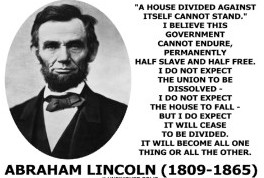 In 1858, Abraham Lincoln made his famous “A house divided cannot stand” speech.
He was debating Stephen Douglas about the issue of slavery. Douglas believed that each new territory or state should be allowed to decide whether it would permit slavery. Lincoln believed that the nation as a whole should take stand. At the time, a lot of people believed whites to be superior to blacks and that owning another person was justified based on skin color and bank account size.
We all know who eventually won that debate. But even after the slaves were free, too many people still believed in a superior race. And, for more than century, too many laws reflected their beliefs.
Now, more than 150 years later, I wonder how history will portray the politics of 2012 when the United States is once again a house divided.
Only this time, instead of being divided over slavery, we are divided about the purpose of government. But there is also an underlying debate very similar to the one being waged during the Civil War.
Too many people still believe that some individuals are superior to others. Only instead of color, they are claiming superiority based on the size of their bank account or their employment status. We have become a country that is debating whether we measure success in terms of dollars or in terms of human rights. We are debating whether accumulating possessions is more important than ensuring access to health care. And we are even debating whether or not poverty is a moral issue.
This has never been more apparent than with the reaction to the Supreme Court’s decision that the Affordable Health Care Act is Constitutional.
The fact that people have different opinions about the decision doesn’t bother me. I expect that. Different opinions are healthy. What bothers me is the judgmental comments and self-righteous outrage that some people expressed.
I was particularly struck by comments from a public school teacher who said the Supreme Court’s decision was immoral. She followed this by saying “I work for a living. I don’t want my hard-earned dollars to support people who depend on the government.”
Since a public school teacher depends on the government (i.e., taxpayer dollars) for her paycheck, I was dumbfounded. I wonder how she would react if the country engaged in a debate about the importance of education and whether we are infringing on taxpayers rights by requiring them to pay for education.
At some point, our country embraced the belief that education is a right that every child deserves. We even took that concept a step further and mandated that children stay in school until a certain age.
If the issue were being debated now, there’s no doubt some people would be screaming that requiring children to go to school is unconstitutional and that hard-working taxpayers shouldn’t be responsible for the education of others.
Thankfully, most people recognize the importance of education, the benefit it has on a person’s future and the positive impact on a community’s economy. The same benefits can be attributed to access to health care, so I’m not really sure why we are so divided about the issue.
But we are.
Instead of debating how to help people, we are debating whether or not we even should. Take, for example, the comments of the previously mentioned public school teacher who claimed the concept of the Affordable Care Act is immoral.
Last time I checked, helping others was the definition of morality, not immorality.
But logic isn’t everyone’s strong suit. Many of the same people advocating for personal responsibility are also outraged that the individual mandate is part of health care reform. As explained to me, the purpose of this mandate is to encourage responsibility by requiring people to either purchase health insurance or pay a penalty to help cover the government’s costs.
Don’t get me wrong. I don’t think the Affordable Care Act is perfect, but at least it’s a statement about what a lot of people think is important. Actually, most people probably think access to health care is important. The dividing issue is about whether it is important for all Americans or only those who have employers or bank accounts that can cover the costs.
The debate isn’t going to end anytime soon. And with the presidential election season getting into full swing, discussions will get even more discordant.
I just hope that whatever the outcome, Americans can look back at the repercussions of this time with pride rather than shame. I hope we can say this is a time we stood up for the rights of all rather than for the benefit of some. And most of all, I hope we don’t divide and even burn down our house with our heated differences.
Jerry Sandusky, Miss America and Good Old-Fashioned Denial
 For the most part, I write my blog because I simply love to write.
I love to string together words in a way no one else ever has. I love to put forth ideas in creative ways that make people think. And I love to feel that maybe, just maybe, what I write makes a difference in the life of someone else.
Today, I’m not feeling that love at all.
In fact, I hate the topic about which I’m writing.
But events over the last few weeks have left me no option.
Friday, after a 20 hour deliberation, a jury found former Penn State defensive coordinator Jerry Sandusky guilty of 45 out of 48 counts of child molestation.
I know people cheered. I know people declared justice. I know people expressed relief that Sandusky is going to be locked in jail for the rest of his life.
Personally, I’m not feeling much elation.
Don’t get me wrong. If Sandusky had been acquitted, I would have been livid. What bothers me is how easily his crimes were swept under the rug for years, even though so many people must have sensed something just wasn’t right.
What bothers me is how easily people were silenced by the job Sandusky held, and how he literally bought more silence by feeding into the growing materialist nature of our society.
What bothers me is that victims didn’t have the knowledge, self-esteem or support to ensure Sandusky was behind bars years ago.
What bothers me most is I’m not at all surprised.
This isn’t an isolated case. Child sexual abuse has been occurring for years, and, for the most part, society has chosen to turn the other way.
I recently read the book Miss America by Day by Marilyn Van Derbur. It’s not a book I would have normally even glanced at, much the less picked up from a shelf. But I’d attended a workshop about how anyone can help prevent child abuse, and Ms. Van Derbur, along with other abuse survivors , was in the training video.
Something about her passion spoke to me, and she’s still speaking to me.
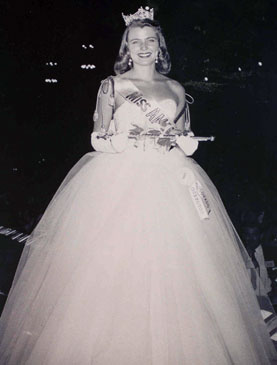 Ms. Van Derbur was Miss America 1958. She was also molested from the age of 5 through age 18 by her father, a wealthy and well-respected member of the Denver community. To the outside world, her family was perfect. To perpetuate this perception, Marilyn’s mother looked the other way. And, for years, Marilyn even repressed the abuse.
But now, she’s an advocate whose message is simple: preventing child sexual abuse isn’t primarily the responsibility of social services agencies, law enforcement or the courts. It’s the responsibility of all of us.
We need to eliminate our preconceived notions that child abusers are easy to identify.
We need to recognize that community leaders, religious leaders and sports leaders are just as likely to be predators as anyone else.
We can’t allow children to be alone with an adult just because that person is trusted by others.
We need to listen to our children and not dismiss their fears, concerns and even silences.
We have to be willing to talk about sensitive issues, such as sex and abuse, so the children feel comfortable talking to us.
We need to look beyond appearances and examine behavior.
Most of all, our outrage needs to be expressed long before an individual has molested multiple children and is on trial.
Our outrage should begin the moment a child communicates they are they least bit uncomfortable with another adult. Period.
Until then, when we see or hear about a conviction, we can cheer and proclaim justice all we want. But if we look away when we think the alleged perpetrator is too well-connected or that no one we know would purposely hurt a child, then all we are really celebrating is good old-fashioned denial.
The Reason I Never Forgot Eddie Pee Pants
 On a beautiful spring day several weeks ago, my kids and I were heading to lunch a few blocks from my husband’s office on the crowded streets of Washington D.C . Dressed in only shorts and t-shirts, we didn’t really fit in with the men and women in business attire who were walking with a great deal more purpose.
But we had one thing in common: we all pretended we didn’t see the homeless person still wrapped in a blanket and sleeping in a doorway on a busy sidewalk.
I saw both of my kids glance over at him, but neither said anything. I didn’t either. Soon, the homeless person was forgotten.
Almost.
Because somewhere in the back of my mind, he stayed with me.
He’s still there.
It’s not that I’ve never seen homeless people before. I see them every day. I even have a semi-relationship with the guy who hangs out at the park where I walk my dog. If I don’t at least wave at him, he coughs or makes some other noise until I acknowledge him.
But the homeless guy sleeping on the steps was different, because he might as well have been invisible. Everyone, including me, blatantly ignored his existence.
I understand why the business people ignored him: they probably see him everyday. He’s as much a part of their daily landscape as the traffic lights, the street signs and the blur of faces they regularly encounter.
But I didn’t have any excuse, and I couldn’t figure out why I didn’t even talk to my kids about him. That’s just not like me at all. If anything, I usually talk way too much about such things.
The only explanation I could find is one I don’t like: I was going along with the crowd. It was just easier.
It’s not the first time I’ve had to make that admission.
When I was in elementary school, I didn’t even know the full name of the boy who rode the school bus. I just knew everyone called him Eddie Pee Pants. You don’t need to be a genius to figure out how he got the name.
I don’t remember calling him that to his face, but that’s the name I used when my peers and I were discussing how to avoid him. No one wanted to have to sit with Eddie Pee Pants on the bus. If you did, you’d not only have to smell him, but you would get “Eddie Pee Pants germs.”
I knew what we were doing was wrong, but I justified my behavior by telling myself that I was never actually mean to his face. But the guilt got worse when Eddie’s life got worse.
One Saturday morning, I joined my dad at the top of our driveway to watch the drama unfold on a hill about a mile from our house. A dilapidated mobile home was on fire. Flames were shooting out the roof, and smoke was turning the sky black.
“That’s a total loss,” my dad commented.
I didn’t know until Monday that the old, junky trailor everyone said was an eyesore was Eddie’s house.
I have no recollection of what happened to him after his house burned. I just know he never rode the bus again, and I don’t remember ever seeing him at school again. I don’t even remember if there were any injuries or fatalities in that fire.
What I do remember is wondering why I wasn’t nicer to Eddie and feeling horrible that I’d never have an opportunity to undo my misdeeds.
Eddie isn’t the only person I’ve ever discounted or belittled. But he’s the first person who taught me three essential life lessons:
1. Treating someone poorly never makes you feel better about yourself.
2. Sometimes you don’t get a second chance to do the right thing.
3. Issues such as poverty, child abuse and homelessness are actually about individuals — people who, regardless of the reason for their circumstances, still have value.
I’ve taken that third lesson to heart. Eddie, like the homeless person in the doorway, gave me something priceless. They taught me to look beyond the unkempt appearances, poor hygiene or odd behavior. They’ve taught me that sometimes the person who needs to change their attitude or perception is me. And they’ve taught me that speaking up feels a lot better than putting someone down.
They were priceless gifts in my life, and I hope I can pass their lessons on to my children. And that, if nothing else, is what makes their lives so valuable to me.
Most of My Heroes Don’t Carry Guns
 It’s Memorial Day.
Which means I’m being inundated with reminders about what the holiday means … a time to remember those we’ve lost, particular those who served in the armed forces.
I understand that. I appreciate that. And I even recognize the importance of supporting those who have served our country — regardless of whether or not we believe in the cause.
But the rebel in me questions if our eagerness to honor members of the armed forces has almost become so cliché that we don’t really consider what being a hero is – and what it’s not.
Being a hero isn’t about a title or a position… it’s about a behavior. It’s about putting your own reputation, sense of comfort or even life on the line for the greater good. It’s about fighting the fight for future generations rather than for ourselves.
And sometimes we forget that there are different types of battles to fight.
My concerns surfaced again when, over the weekend, I was trying to do some “spring is almost over” cleaning.
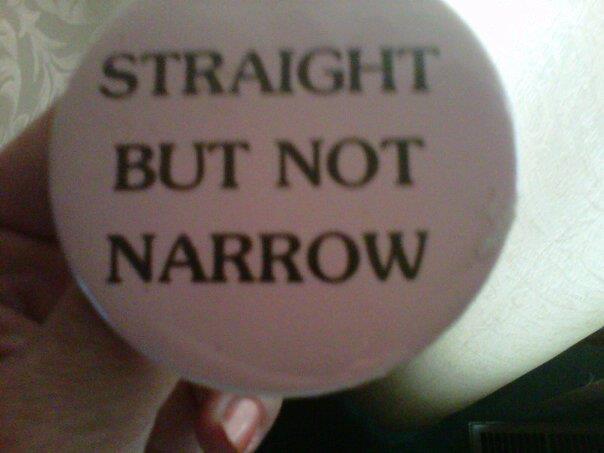
I found a button that said “Straight But Not Narrow.”
Given the recent national debate over gay marriage, I smiled when I realized I had been given the button more than 20 years ago. My smile soon turned to sorrow when 1) I realized that in the past 20 years, our nation really hasn’t come that far and 2) The person who gave me the button died years ago.
His name was Roger, and he died of AIDS.
He, like so many in our armed forces, died in the middle of a battle and with a great deal of honor.
Roger never hid his HIV status. Nor did he hide is sexual orientation.
In fact, Roger was one of the most open people I’ve ever met. If you asked him a question, he never sugar-coated the answer. He sometimes gave you more information than you wanted, but he never pretended the truth was pretty.
Roger will always be one of my heroes: those people who not only stand up for what they believe, but who put their own reputation and livelihood on the line to defend what is right.
Before he was infected with HIV and before his partner died of AIDS, Roger owned a hair salon.
That was his life before AIDS.
His life after AIDS was dedicated to educating West Virginians about the disease.
West Virginians are good people, but they aren’t exactly progressive… just check out their track record in the last few elections.
But Roger didn’t let closed-minded people get in his way. He knew that closed minds are like closed doors… they just need the right key to open or unlock them. And once they are unlocked, options and possibilities greatly increase.
Roger was the key to opening more minds and more doors than he ever knew. And the possibility he was seeking was a country where no one was infected with HIV again.
And so Roger knocked on and sometimes knocked over closed doors so he could share his message. He went to service clubs. He went to other types of clubs. He went to churches. And he went to schools.
He went wherever he could be heard and wherever people would actually listen.
His voice was definitely heard, and people definitely listened. I have no doubt Roger saved lives.
The only life he couldn’t save was his own. The medical battle against HIV was in its infancy, and Roger eventually succumbed.
But like so many other warriors, he left this world a better place than it would have been without him.
To me, that’s a hero. That someone I want to remember. That’s someone who inspires me.
That’s the type of person Memorial Day is all about.
Remember When Mother’s Day Was Considered a “Gay” Holiday? Maybe It Still Is.
 As a child, I adored Mother’s Day. Just like Halloween and Christmas, it held the purposiveness of preparation and the excitement of anticipation.
I was incredibly intent the year I had to make a corsage for my mom out of tissue paper. While my fellow students curled the colorful paper around their pencil erasers then glued it to cardboard to resemble bright flowers, I felt the need to put order to chaos. The result was a smiling face that, in retrospect, bore a striking likeness to the Wal-Mart smiley face.
My mother never hesitated to wear the hideous yellow corsage. In fact, she wore it all day on Mother’s Day, even though it thoroughly clashed with her dress.
I was incredibly proud the year I played Mary Poppins in the Mother’s Day program. Families were required to provide the props, and because my frugal family didn’t have a normal umbrella, I twirled a hideous clear, plastic one shaped like a mushroom as I danced through boxes painted like chimneys. I resembled Mary Poppins about as much as I resembled Grace Kelly.
I was incredibly naive when I bought my mother a card that described Mother’s Day as a “gay” holiday.
I’m a lot older now, and I’m a lot less naive.
But I still don’t have a problem describing Mother’s Day as a gay holiday, especially this year.
That’s because, as I’ve aged, Mother’s Day has come to mean more than simply honoring and thanking my own mom. It’s also become a day to reflect on what being a good mother is.
While my experience is limited to 14 years, I’ve come to recognize three primary truths about being a parent:
1. A mother’s primary responsibility is to ensure that her children grow up to be responsible adults;
2. Every child is different, so there is no “right” way to be a parent;
3. Teaching our children to defend and stand up for those who are different is much more important than teaching them how to be popular or stylish.
This week, our President served as a parent to our entire nation when he publicly declared his support of gay marriage. I know the motivations behind his statements can be disputed, but I choose to believe that he was guided by his sense of morality and his need to set an example for all of us.
I heard his message loud and clear; if we tolerate hate and intolerance wrapped in religion then we are acting in direct opposition to the principles on which our country was established: a country in which all people are supposed to be treated equally.
So, while I seriously doubt my children will ever used their hard-earned allowance to buy a card that describes Mother’s Day as gay, I know that if they do, I would be honored to receive it. After all, it might be describing a holiday that looks beyond stereotypes and bias and unites us with a purpose of increasing tolerance for the next generation.
I can certainly hope.
Rocks on the Road and Rocks in Our Heads
 Some of life’s toughest lessons are the ones we learn the hard way.
Some of life’s most important lessons are the ones we sometimes never learn at all.
And some of life’s simplest lessons are the ones we often just ignore – like the problem with rocks in the road.
As a bicyclist, I ride an average of at least 10 miles a day. Because of that, I ride over a lot of rocks. For the most part, I don’t even realize the rocks are there. But every once in a while, my tire hits a rock and – due to speed or angle – I get knocked off course and sometimes even knocked down. Getting knocked down hurts, and sometimes the resulting injuries even leave scars.
Because of that, when I do notice a rock, I try to avoid it. And when there are a lot of rocks, I might even change course.
That’s life on my bike.
But I’ve noticed a lot of “rocks on the road” in the rest of my life too.
These rocks are often comments or actions that people believe are completely normal and appropriate. But to the nearby traveler on the road of life, those same words or actions may be slightly offensive or, at worst, hurtful. Sometimes they can also cause people to change course or fall down.
Just the other day, I was having coffee with a colleague who told me that years ago she had come to my office to talk about the possibility of interning with me. When she dropped by for the unscheduled visit, she was told I was in a meeting but that I was just with my intern and could be interrupted.
That one word “just” was enough to make her turn around and walk out the door. She didn’t want to be “just an intern.”
To be honest, I think I might have been the person who told her not to worry, and she changed the story to make me feel better. I don’t remember, but regardless of who said it, the word “just” became a rock in her life’s road.
Fortunately, for my colleague, her change of course is working for her. But she also had the advantage of already having several life successes under her belt. She could handle that rock.
I worry more about people who have so many rocks in their road that they can’t avoid them: people who have been knocked down so many times that they don’t trust that the road ahead gets any easier. Sometimes they’ve fallen so much, they have permanent scars.
Instead of helping clear the road, many of us are busy putting more rocks in their way. Sometimes those rocks are too big to move or go around. 
For the most part, I don’t think we are doing this on purpose. But, at times, I think we are, especially when we make judgments about people whose circumstances we know nothing about. That’s when we become victim of the rocks in our heads.
I’ve noticed a trend of people posting comments online that belittle others who are “on welfare” or “on food stamps” or that make assumptions about people based on appearance. I don’t know which is the bigger rock: those comments or the bitter ones about people with expensive shoes, phones or cars who are receiving some sort of government assistance.
Here’s the deal. I, like most people I know, don’t believe that government assistance should be a permanent way of life. I also don’t believe that government assistance should be used for anything but basic needs. And I don’t believe smart phones and SUV’s are basic needs. I also agree that some people manipulate the system, and that we need to be diligent about stopping such abuse.
However, I also know that most people who receive assistance have fallen on hard times. Some may have previously afforded a lifestyle that included expensive clothes and cars. But then they lost their job or faced another crisis that caused them to deplete all their available resources, including help from friends and family. After that, they were forced to seek public assistance. That expensive car may be all they have left after losing their home, a spouse or a way of life.
Instead of assuming the rocks in their road are their own fault, maybe we should think about how we can pick some up, roll them out of the way or help these individuals navigate a new course.
Doing this follows the simplest life lesson: do unto others as we wish them to do to us. I know if and when I hit tough times, I don’t want to ridiculed and/or blamed.
But this lesson is so simple that a lot of us ignore it when convenient. Or until there’s a rock in our own road. Or until we get the judgmental rocks out of heads.
Unfortunately, sometimes those rocks in our heads are harder to get rid of than the rocks in our roads.
Philosophical Thoughts From a Feminist in High Heels

There are times when I wish I could be one of those women content to accept that the world is unfair and that some people are more important than others.
If I could actually believe that, life would be so much simpler.
The problem is that simple bores me and unfairness angers me, especially when it’s perpetuated by people who use inequality to meet their own need for influence, power and/or sense of security.
Even though I hate discrimination of any type, my personal experiences are limited to dealing with sexism. And lately, we seem to be moving backwards on that issue.
Women are facing more sexist attitudes than we did when I was in my twenties. At least it feels that way. Maybe because when I was younger, I attributed personal slights to my being inexperienced. But now, I’ve got a whole lot more experience yet the attitudes and behaviors persist. And women are having to fight battles I thought we’d won years before.
Admittedly, I’ve been more passive than I should be.
Perhaps it’s because protecting myself has sometimes outweighed standing up for what’s right. Or perhaps it’s because sexism can be so subtle that people have made an art form of camouflaging it. Or perhaps it’s because the issues are just too confusing.
Take, for example, shoes.
I recently heard that a woman who wears high heels (but not too high) is taken more seriously in the workplace than a woman who wears flats.
As someone who would sleep in high heels if it were feasible, you’d think I’d find this piece of information encouraging. Not at all.
The whole issue is absurd. The height of a woman’s shoe shouldn’t matter at all as long as she can do her job. But apparently it does. And since women have a lot more choices than men when it comes to footwear, we are also more likely to make decisions that can distract from our skills and abilities.
The same can be said for words we use to describe ourselves. Take, for example, the word feminist.
There are those people who picture a feminist as a woman who hates men, doesn’t shave her legs, dresses like a hippy and has extreme points of view about reproduction.
Umm.. no. As a feminist, that doesn’t describe me at all.
I love men. I shave my legs. I wear make-up. I’m not an extremist on any subject, and I even let my daughter play with Barbie.
Being a feminist has nothing to do with how I dress or who I love.
It’s about taking time to question how women are being treated. It’s about ensuring that, when other factors are equal, women are given the same opportunities as men. It’s about pushing people to think about how fair they are being.
Would the salary be the same if a man had the job? Does a woman really have the same opportunity to break into the “good old boys’ network? Is the spouse’s employment relevant?
Ironically, as I was writing this, my daughter looked over my shoulder and asked, “What exactly is a feminist?”
“It’s someone who believes women should have the same opportunities as men,” I said.
“Duh,” she said in a voice and manner that only 10 year-old girls can get away with.
“Exactly,” I said. “Duh.”
And hearing that one word come out of my daughter’s mouth put the fight right back in me.
Watch out world, this feminist in high heels is on a mission to ensure life is more fair for her daughter.


 Just So You Know