Category Archives: perspective
2 and 1/2 Foolish Wishes
 If I had a genie that granted three wishes, I would have almost wasted them this past week.
Instead I only hypothetically wasted two and came very close to wasting the third.
My preoccupation with genies and wishes began when my daughter told me about a recent in-class writing assignment. She and her fellow sixth grade students were given the scenario that they’d released a genie from a lamp and had three wishes to use in a week.
“The only rule,” my daughter explained as I was driving to her dance class, “was that we couldn’t wish for more wishes.”
“What about wishing for magical powers?” I asked.
She thought for a minute then said, “It depends on what kind of magic.” She didn’t elaborate, so we sat in silence for a few minutes.
Then I had to ask, “Well, what were your wishes?”
She turned and gave me an exasperated look. “You’re not going to write about this are you?” she asked.
I didn’t think I would, so I didn’t really lie. “Of course not,” I said.
“I wished for a rainbow-colored unicorn, a black Pegasus like Blackjack from the Percy Jackson books and telepathy,” she said.
At the time, I was simply amused by her choices, but then my imagination took hold and I began to pretend that I too had found a magic lamp with a genie who granted three wishes. I was sure my wishes would be much more meaningful and beneficial to society.
I was wrong. Despite what I thought were good intentions, my wishes were probably more foolish than my daughter’s.
My first was for everyone to see the true colors of a person I’m pretty sure has narcissistic personality disorder. Granted, my clinical training is limited to a few classes in graduate school, but he has most of the of the classic characteristics. He not only lies but also he believes his own lies. He manipulates yet does his best to convey that others are the ones being manipulative. He expects everyone else to go along with his plans, doesn’t listen to anyone he doesn’t deem worthy, takes advantage of others and exaggerates his skills and talents. This week, when I realized how many people either don’t recognize or don’t want to recognize this, I’d had enough. I wished everyone else could see through the bravado. But if that happened, I later realized, his gigantic ego would be injured but he’d still carry on with his life. Others could be hurt much more, and then I’d be as selfish as he is. That was an incredibly foolish wish.
My second wish came after looking at a Facebook news feed and witnessing what I deemed some incredibly stupid posts. Some people were sharing inappropriate details about their personal life and health. Others were posting photos of themselves that screamed “pay attention to me.” And then there were the completely inaccurate and misleading political posts. I wished that Facebook had an automatic editor that screened inane and inaccurate posts then provided genuine feedback as to why the edits were made. I smiled at the thought of opening up Facebook to a much more rationale, intelligent and genuinely humorous news feed. But then I realized what a damaging and self-righteous wish that was. What I was really asking for was a limit on free speech. And no matter how inaccurate, hurtful or stupid the information is that people are now putting on the internet, many Americans fought and even lost their lives for their right to do so. I had wasted another wish.
That’s why my third wish came very close to being a wish to get rid of mirrors.
Mirrors generally don’t benefit society. They either encourage vanity or dissatisfaction. After my first two wishes, I didn’t want to look in the mirror anyway. My avoidance of a mirror had nothing to do with my outward appearance and everything to with lifelong aversion to self-absorbed and self-righteous people. If I looked into the mirror after my first two wishes, I would have been face-to-face with just such a person. But maybe that’s why I wanted mirrors eliminated.
I was on the verge of making the mirror wish when I received an email that jerked me back to reality. The son of a friend had been very seriously injured, and all anyone could do is pray. In comparison, all my wishes seemed trivial and ridiculous. I realized we are all on this planet together and finding fault with each other really doesn’t do us any good in the end. Neither does thinking that we know better than others.
I’m still in the process of learning that lesson the hard way, but I also have one imaginary wish left. If it were real, I’d use it to wish we all had just a bit more patience and understanding. No matter how I look at it, I don’t see how this is foolish. It doesn’t break the rule of wanting more wishes, but it could be magical and transform humanity.
My File Cabinets Full of Men
 I completely appreciate why the internet is buzzing about Governor Romney’s claim during Tuesday’s presidential debate that he had “binders full of women.” But there’s also a part of me that identifies with his statement.
I, after all, have file cabinets full of men.
While Romney said he used the binders to identify qualified candidates for key positions in state government, my file cabinets serve an entirely different purpose.
I use them to store reminders of all the men that are NOT qualified to be in any part of my life.
I started my first file when I was a young girl and a boy told me that men were more important than women because they got to keep their last names when they got married. I was devastated, but I was also angry. As a result, that boy had the honor of being the first male I ever put in a file cabinet.
Over the decades, I’ve filled several file cabinets with men. Some of the most memorable include:
* The minister who insisted my friend keep the word “obey” in her wedding vows.
* The agency director who tried to prevent me from getting a management position because I breastfed my baby during a meeting that I graciously attended while on maternity leave.
* The community leader who always referred to me by using my husband’s last name, even though he knew I had never changed mine.
* The manager who issued a dress code that all female employees must wear pantyhose with skirts or dresses. (For the record, the dress code was issued during the summer when I was eight months pregnant.)
* The nonprofit executive who, with a staff of all women, refused to let mothers take sick leave when a child was ill or had a doctor’s appointment. At that time, we were all granted a set number of days for both vacation and sick leave, but vacation was much more limited. The director’s exact words were, “letting mothers take sick leave for their children isn’t fair to the employees who don’t have children.”
* The supervisor who blatantly promoted young, attractive females over more qualified, middle-aged women.
I’ve recently been considering adding another man to my file cabinets. While this man claims to support women, he’s never demonstrated any real understanding of the often life-long battle many of us have faced. He’s skirted around the issues of equal pay for equal work and reproductive rights. And even when he tries to express his appreciation about the need for equality in the workplace, he falls short by indicating that women don’t want to work long hours because they have to go home and fix dinner.
Yes, this week I’m definitely thinking about adding that man to my file cabinets. I’m just not sure if his binders will fit too.

Lessons in Trees from the View on a Bicycle Seat
 As a child, I always felt at home among the trees and full of exuberance on my bike.
As an adult, not much has changed.
While my father, a forester, no longer teaches me about the secrets hidden in the shape and color of a leaf or in the texture of bark, I am still enamored of trees. And riding a bike is still one of my favorite pastimes. Few things bring me greater joy than taking a lazy bike ride among the beauty and wisdom of the trees.
I had that opportunity this past Sunday when I took advantage of a gorgeous autumn afternoon to ride my bike and attend to the lessons of the trees.

Lesson 1: Sometimes when you blend in, you bring out the best in others. On Sunday, this tree next to the church across from my neighborhood had started to model its fall colors. It was amazingly beautiful, but its splendor didn’t lie simply in its appearance. Even though I drive by that church every day, I’ve never paid much attention to it. But the hue of the red leaves was a perfect match to the color of the bricks, and I was struck by the church’s design.

Lesson 2: Loss and suffering are the best reminders of all that we still have. The past year was a tough one for trees. Almost exactly a year ago, we were hit by a bizarre October snowstorm that knocked down trees still heavy with green leaves, including two in my own yard. In June, we lost even more trees to a land hurricane, also known as a derecho. For weeks, the sound of chainsaws in the morning was as common as the sound of crickets in the evening. I hated that sound. Every time a chainsaw revved up, I knew we were saying goodbye to another tree. But riding my bike on Sunday, I passed hundreds of trees that had never been knocked down, and I felt a deep sense of gratitude for all those still standing.

Lesson 3: Happiness comes from accepting your circumstances and recognizing that, at times, your place might simply be to support someone else. These two trees in an expansive cornfield have always seemed out-of-place to me, yet each year they grow stronger together. From some angles, they are two distinct trees that mirror each other. From other angles they appear to be one. But from all angles, they remind me of two people who hold each other up in a tough environment that could easily defeat someone left all alone.

Lesson 4: The greatest sense of belonging comes from owning your own style and surrounding yourself with people who appreciate differences. Every time I pass these three trees on the edge of a field, I imagine them as a group of women all throwing their arms up in laughter. Each is unique: one is flamboyant, one is plain with a toddler at her knee and one is aging rapidly. Despite their differences, I see them as a united group that delights in life’s simple pleasure of friendship.

Lesson 5: Everyone has scars, but we can choose to let them weigh us down or strengthen us. Several years ago, I fell in love with a magnificent tree that simply owned the landscape. When it was hit by lightning, I was sure it was damaged beyond repair. About half the tree was dead, and several branches hung black and leafless. But this tree didn’t give up and has slowly recovered. It’s now smaller and has a different shape, but in my eyes, this survivor is a giant.
Yesterday, I took the same bike ride that I did on Sunday. The trees had already changed dramatically. Some displayed brighter colors of red, orange and yellow while others were losing their leaves. Most shone in a different light. But these changes gave me one more lesson: savor every beautiful moment, because nothing will ever be exactly the same again.

Will You Sound Bite This?
Being married to a national journalist has its advantages. For example, when I’m feeling completely uninformed or confused about national or international events, I have a readily available source to answer my questions.
There are also disadvantages. The news never takes a vacation, so my husband works weekends and odd hours. He can’t express any public opinions about politics (really, he’s not allowed), and even though he and his co-workers are held to very high standards, when people criticize the media as an industry, they are also criticizing his professional integrity.
Regardless, I credit broadcast journalism for giving me a great life. It’s how I met my husband, it pays the bills and it’s how I started my career.
And while my career in broadcast journalism was extremely short-lived, the lessons it taught me have served me well over the past couple  decades. For example:
1) There will always be people who lie or mislead in order to protect their own self-interest. Being able to separate fact from fiction, determine what’s relevant and ensure the truth prevails requires perseverance and a Teflon shield.
2) Well-known people in the public eye generally aren’t making the biggest difference in the lives of others. There are always exceptions, but many are more intent on advancing their own agenda than they are with furthering the common good. Most often, the people behind the scenes are the ones who do the work and really know what’s happening.
3) There are always two sides to every sound bite.
From most people’s perspective, a sound bite is simply a very short clip of a much larger conversation. But for people on both sides of the microphone, it is much, much more.
A simple statement can inspire, inform or be blown completely out of proportion when taken out of context. A few words are often louder than the most heartfelt speech.
Just ask Mitt Romney or President Obama. During this campaign season, Romney’s comment “I like being able to fire people” wasn’t referring to his record at Bain Capital, but his opponents seized the opportunity to use those words against him. A few months later, President Obama had a similar experience when he said, “You didn’t build that.”
You would think both men would more carefully choose the exact words and phrases that come out of their mouths, but they are human. And a good sound bite is irresistible to a reporter. I should know.
I’ve been on both sides of the microphone many times, and I thought I had the sound bite mastered. And then I fell into the trap myself.
My daughter was just under a year old when I took her and her four-year old brother to a public pool. My mother had joined us, and we were enjoying a sunny, summer Saturday afternoon when a muffled announcement came over the speakers: “We apologize for the inconvenience, but the pool will be closing for the rest of the day. Please exit the pool area immediately.”
Since there wasn’t a cloud in the sky, the announcement made no sense. Fortunately, one of the teenager lifeguards was my neighbor, so I asked her what was happening.
Apparently, there was a dispute between management and the lifeguards. The lifeguards were insisting that the chemical levels in the pool weren’t safe, and they were walking off the job. With no lifeguards, the pool had to close. As other people packed up their towels and exited in mass, my mother and I decided there was no hurry and waited by the baby pool until the crowd cleared.
Just as we were finally leaving, a news van pulled into the parking lot. Since very few swimmers were left and I had a cute baby in my arms, the female reporter immediately zeroed in on me.
“Can I ask you a few questions?” she inquired breathlessly as she shoved a microphone in my face.
I agreed, and she began peppering me with questions about unsafe chemicals in the pool. Since I wasn’t really concerned and saw no reason to panic, I carefully avoided her efforts to bait me into saying anything that blew the situation out of proportion. She was obviously getting frustrated that my answers weren’t heightening the drama. Finally, she asked, “Aren’t you concerned about the health of your baby?”
I stepped into her trap when I answered, “Of course I’m concerned about the health of my baby, I just don’t think this particular situation is going to harm her.”
 A few hours later, I turned on the television news to see a lead story about how panicked parents evacuated a local pool. The story featured a carefully edited clip of me holding my daughter and saying, “I’m concerned about the health of my baby.”
I was mortified.
For the rest of the weekend, the clip played over and over again during news promos and broadcasts. My embarrassment grew when further investigation revealed that the chemical levels were fine, and that the situation had been overblown by a handful of teenage lifeguards.
For days, I was teased, even though I tried to explain that I had NOT panicked.
Years later, this story is rather funny, but it is also a cautionary tale.
Drama and conflict can be used as marketing tools and political weapons. And yes, some reporters take words out of context to create the story they want. This is especially true during an election year. No one should accept a few words at face value. We all need to do our research, determine what message was actually intended and take time to learn all the facts before making judgments and leaping to conclusions.
Take the paragraph above. Someone could easily turn it into a sound bite: Trina Bartlett says “reporters take words out of context to create the story they want.” That would likely stir up trouble with my husband of 19 years as well as my friends in the news industry, who all do their best to maintain journalistic integrity.
The problem is too many people prefer hearing words that support their own beliefs rather than knowing the truth, and many media sources have lost the once distinct line between news and opinion. Unfortunately, many people can’t tell the difference.
Every time someone spreads false information or shares quotes that have been taken out of context, the collective integrity and intelligence of our country drops.
And yes, I would love for someone to sound bite that.

My Brief Encounter With the Perfect Imperfection of Maya Angelou
I am an incredibly imperfect woman living in a society of people who hide their imperfections much better than I do.
Some are better able to hold their tongues. Others have achieved such brilliant success that it hides any inadequacies. And then there are the people who spend a great deal of time and energy covering up any deficiencies.
Since my tongue often seems to engage before my brain, my successes are nothing out of the ordinary and I choose to spend my time and energy just being me, I don’t mind that people know I’m far from perfect.
Despite that, I’m always striving to become a better person. For that, I need inspiration, which most often comes from other admittedly imperfect women.
These are the women who make me believe.
They make me believe that even those of us who are flawed can accomplish great things. They make me believe that past mistakes and missteps are the fundamental ingredients for a rich life. And they make me believe that, despite injustice and unfair odds, believing in possibilities can only result in magic.
My inspiration comes from women who have overcome barriers and have an honest compassion for those who are still struggling.
And, of course, my inspiration comes from women who can express all this in writing — women like Maya Angelou.
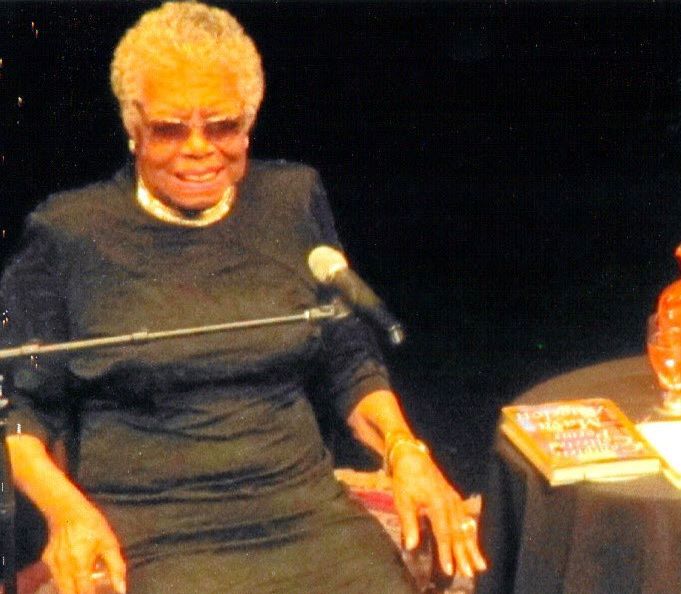
Despite her splendid poetry and prose, her insightful observations of human behavior and the reverence she must encounter everywhere she goes, Maya Angelou doesn’t deny who she is: an imperfect woman who has struggled but, through the support and encouragement of others, done the most she can with the gifts bestowed upon her.
Last week, she shared both her humility and her humor with an audience in Charleston, West Virginia at an event celebrating the 100th anniversary of the YWCA. Thanks to an invitation from a friend, I was fortunate to be in the audience as she poked fun at herself, challenged all of us to empathize with those who are different and encouraged us to think of possibilities.
She talked about her years of silence following the conviction and murder or the man who raped her as a young girl and how poetry freed her. She encouraged us to always find something to make us smile and, when we can’t, to write about something that does. And, she lectured about not blaming others for past injustices but rather thanking those who endured them and taking responsibility for future generations.
In short, she was amazing. I was either laughing or crying the entire time she was speaking.
And then she read her poem “A Brave and Startling Truth,” which she wrote in honor of the 50th anniversary of the United Nations. About halfway into the poem, she lost her place. She faltered, fumbled then regained her composure as she finished.
I know during those moments of silence while she searched for her place, all of us seated at the Clay Center for the Arts and Sciences were holding our breath. She had earlier reminded us that she is 84 years old, and that fact sunk into our brains and into our souls.
The moment was brief, and it passed. But it had still occurred.
Yet, at the end of the evening, Dr. Angelou held her head high, showed appreciation for the applause and ended her talk with dignity.
Some might think she was trying to cover her mistake, but I know she was simply demonstrating why she is so great. Instead of being defined by her mistakes and struggles, she soars through self acceptance and overcoming challenges.
If that’s not inspiration, I don’t know what is.
How I’d Shake Up the Presidential Debates
 This Wednesday, when President Barack Obama and former Massachusetts Governor Mitt Romney square off in the first in a series of three debates, I’ll be watching for entertainment purposes only.
Despite all the hype, I have absolutely no expectation that anything either candidate says will sway my opinion. They will both be so scripted, so practiced and so focused on performing that their potential to impact my life will seem irrelevant. And even after they stop talking, the pundits will step in to add their spin.
The debates, like so many other events that used to be newsworthy, have become staged productions with limited genuine content.
What I need is honesty. I don’t need platitudes or great sound bites. I need heartfelt discussion and genuine opinions.
If only I were in charge of the debates.
If I were, both candidates would be injected with truth serum before they could answer even one question. I’d also be asking my own questions. I already have a list:
1. If your household income were $50,502 (the median household income in the United States in 2011), describe how you would budget your money to pay for housing and health care, ensure your children received an excellence education and save for emergencies.
2. Describe a situation when you “pulled yourself up by your bootstraps” when the odds were against you, if anyone helped you and what resources you used.
3. Who really influences your political decisions?
4. Do you think there are deserving and undeserving people? If you think there are undeserving people, who are they?
5. What is the biggest lie you or your party has told about the other candidate?
6. What do you think are the biggest differences between men and women? (The ability to give birth doesn’t count.)
7. How would you ensure that every child in America actually received a comparable education?
8. Describe what’s wrong with Congress and how you would attempt to fix it.
9. Describe your understanding of a typical week for an average American.
10. Why do you really want to be President of the United States?
I realize that my questions aren’t particularly politically savvy or intellectually stimulating, but when answered truthfully, they would definitely shine light on which candidate could best lead America.
The Backside of a Bull and a Garden Full of Rodents
 I had an unexpected epiphany after spending time with a bronze bull and a garden full of rodents in the financial district of New York City last month.
The moment came at the end of a long weekend celebrating my daughter’s upcoming birthday. She, her best friend, her best friend’s mother and I packed a lot into 48 hours. By Sunday morning, when we were exploring Lower Manhattan, we had slowed considerably.
The city, on the other hand, wasn’t slowing down at all. People crowded narrow sidewalks under the watchful eyes of police officers on every corner. While the officers graciously responded to requests for photos with tourists, their ability to give good directions was questionable.
Despite their help, we were finally able to locate the Charging Bull on Wall Street. Since the bull had never been on my list of sites to see, I hadn’t expected the frenzy of people mobbing it for photos. Many were lined up behind the bull to touch its anatomically correct underside for good luck.
The eleven-foot-tall bronze sculpture is supposed to symbolize aggressive financial optimism and prosperity. Last year, when the Occupy Wall Street protests began, metal gates were set up around the bull to prevent it from harm. Now, the public can once again touch it, but judging by the police presence, there’s still concern about the safety of the more than 7,000 pound bull.
Personally, I think the concern about vandalism is a bit misplaced. I’m more worried about the almost worship-like reverence people demonstrate for an icon that represents an industry focused more on the value of money than the value of people.
Don’t get me wrong. I like money. I just think that, as a society, we’re too fixated on who has it and who doesn’t.
To me, the bull represents a culture rooted in money and the immense appeal that has. But when people go to great lengths to touch that lifestyle, they may miss seeing what’s really going on around them.
 For example, just feet from the Charging Bull, there’s a garden full of rodents living off the crumbs of others. The mice live among the vivid red flowers in the circular garden around the fountain in Bowling Green Park where we ate our lunch.
What seemed like a quiet public garden was actually teaming with dozens, if not hundreds, of mice. When bits of bread, meat, tomatoes and even cucumbers dropped, they would scurry out from under the blossoms, grab their feast then rush back for cover.
Many of the people intent on enjoying the beautiful, late morning sunshine didn’t even notice the mice. Others were completely disgusted by them. No one wanted to touch them, and very few people wanted to feed them.
But my daughter and I were fascinated.
Although seemingly dependent on others for their livelihood, the mice certainly weren’t lazy. In fact, the were quite industrious. And even when vying for the same crumbs, they seemed to respect each other’s efforts.
That’s when I had my epiphany.
The mice represent all the low-income people who live and work right alongside those who are more financially secure and influential. They represent all those people on Wall Street who clean bathrooms and pick up trash instead of buying and selling stocks and bonds.
And even though they live in the shadow of a bull that people fondle for good luck, they also represent a great deal of dignity.

A Leap From The Top Step
On May 14, 1972, I got my first real lesson in fear.
That’s the day my uncle, my mother’s only sibling, was killed in a plane crash.
That’s also the day I stopped leaping from the top step.
Before that day, I loved jumping off the front steps of our small rental house on the Indian Reservation where my father worked. The joy of the  jump was partly due to a sense of flying and partly due to the risk I was taking. More often than not, instead of landing on my feet, I’d land on my hands and knees. But the scraped knees and elbows were a small price to pay for bragging rights.
According to my brother and his friends, walking down the steps was a sign of weakness. Jumping was the only acceptable means of getting off the porch, and the jump had to be from the top step. Even jumping from one step down was considered cheating and a more egregious offense than forgetting to jump at all.
So, every time I walked out the front door, I would hurl my short, five-year old legs over five steps and land in various positions on the sidewalk. Then, I’d brush myself off and walk away with a sense of pride.
That all changed when my uncle crashed his twin-engine plane.
That Mother’s Day started in an ominous way. It began when my dad and mom, a burgeoning journalist, woke up my brother and me before dawn and bundled us into the back of our red, Ford pickup. There had been a train wreck, and we were going to the site. My dad, brother and I stayed in the truck while my mom, notepad in hand and camera around her neck, wandered off to interview people. Sitting in the truck, my imagination ran wild with thoughts of who and what Mom was encountering.
Hours after we had returned, the phone ran, and my mother disappeared for a long, long time, When she finally returned to our living room, she told us “Uncle Lowell was in a plane crash.”
My imagination, already quite stirred up from the morning’s adventure, envisioned all of the injuries he could have sustained. For some reason, I became fixed on the idea that he had, at a minimum, broken his leg. The possibility that he’d died never crossed my mind, and I don’t even remember how or when my mother finally told us. I do know that by the time she did, I’d so worked myself up about the horrors of broken bones that dying seemed like a great alternative.
I’d also decided that, based on my lack of coordination, the next time I jumped off the top step, I would most certainly break my leg.
That fear ate at me, and the next time I had to go down the steps, I couldn’t jump. I was frozen, and the ground seemed to be a long, long, long way down. I eventually jumped from the second step from the top, but I would never leap from that from the top step again.
Now, forty years later, a five year-old’s leap, or lack of a leap, seems insignificant. But it’s not.
That experience taught me about regret and about how inane decisions are made out of fear, limited information or both. It’s also taught me that sometimes we get so wrapped up in an imaginary fear that we are blinded from seeing the genuine and more critical facts.
I still fall into the trap of letting unfounded fear affect my decisions. But more often than not, I remind myself of the joy that comes from leaping off the top step and the pride that comes from going outside my comfort zone.
And then I jump.

People Are Not Measuring Devices
I’ve been feeling rather sorry for Condoleezza Rice lately, and my sympathy has nothing to do with the fact that she will be forever associated with the George W. Bush administration.
I feel sorry for her because so many people want to turn her into a measuring device.
 After her speech this past Wednesday at the Republican National Convention, the rhetoric started:
“How can the Democrats claim there is a war on women? Condoleezza Rice proves that’s just propaganda manufactured by liberals who are pandering for women’s votes.”
“Condoleezza Rice demonstrates that any woman can succeed if, instead of relying on the government, she just applies herself.”
While I take issue with those statements, I have no problem with the woman who inspired them. I admire Condoleezza Rice. She’s a smart, accomplished and successful woman. Even though I may not always agree with her politics, I do believe she is a fantastic role model for young woman across our nation.
I just don’t believe that she’s a yardstick .
 The notion that all women should measure themselves against Condoleezza Rice, or any other woman, is ridiculous and damaging.
I’ve spent most of my life trying to break my innate tendency to compare myself to other women. I’ve compared my looks, my body, my talents, my personality, my lifestyle and my parenting skills to others. Instead of embracing my unique blend of strengths, weaknesses, quirks and experiences, I simply saw my flaws and failures. I don’t want that for my daughter or for any other female. And I don’t want them to judge women who don’t possess the talent, intelligence or opportunities to achieve what others may define as success.
Yet they are hearing that, because some women have reached the top, all others have to do is simply “try harder.”
That was certainly the message from those who opposed the Lilly Ledbetter Fair Pay Act.
If only working hard were a guarantee of an adequate paycheck and the appropriate recognition. In reality, the workplace is a harsh and very unfair place. I’ve worked hard only to watch those who didn’t zoom right by me. I’ve seen pretty women take advantage of their assets and maneuver their way past others into better jobs and higher paychecks. And I’ve seen the “good old boy” network benefit those who already had the advantage.
While great strides have been made for women in the workplace, the dollars still tell the story. In 2010, the U.S. Census American Factfinder indicates that 17.9% of families with children were living below the poverty level. That number jumped to 39.6 for families with a female head of household. Despite the increase in the number of men who are taking on active parenting and caregiving roles, nothing will ever change the fact that women are the ones who get pregnant and give birth. And now, their ability to even make decisions about that has been under fire by people such as Missouri Congressman Todd Akin, who doesn’t even understand the biology of conception.
Condoleezza Rice has never married nor had children. I have no idea–nor is it any of my business– whether this was a conscious decision or just the result of the many choices she made throughout her life. I do know that she never had to make arrangements for child care, leave work early to pick up her child at school or miss important meetings when a child was sick.
And I’ve never heard anyone claim that she was an underachiever or compare her to women who have careers and children.
But maybe that’s because some yardsticks are defective and only measure what the user wants them to show.
The Art of the Silent Blog
 The art of silence has always eluded me.
For some people, a lack of words seems profound and noble. For me, a lack of words is simply awkward and frustrating. For the most part, silence has always been just beyond my reach, ability and even my belief system.
Even though I understand that silence is often a sign of respect, I also know that silence can do more damage and cut deeper than the harshest words.
I’m not alone.
Dr. Martin Luther King, Jr. said, “History will have to record that the greatest tragedy of this period of social transition was not the strident clamor of the bad people, but the appalling silence of the good people.” He also said, “In the end, we will remember not the words of our enemies, but the silence of our friends.”
Even the dictionary validates my belief that silence isn’t always golden. While the simple definition is “the absence of sound or noise,” the more complicated definition is “the absence or omission of mention, comment, or expressed concern.”
I’ve straddled and struggled with both definitions my entire life. My battle has less to do with my tendency to talk and more to do with my overwhelming need to call attention to injustice, wrongdoing and inappropriate, self-serving behavior.
I’ve been witnessing a great deal of such behavior recently. Yet, for the most part, I’ve remained silent. Even when people have asked if I’m going to write a blog about certain situations, I’ve said, “No, that’s not my role or responsibility.” Besides, my words could easily be misinterpreted as angry and bitter rather than caring and concerned. So I have decided my silence might be more powerful than words.
And so, the silence continues. This change in tactics is also teaching me a new art form: the silent blog.
I think this one says a lot.
Silence is argument carried out by other means. Che Guevar


 Just So You Know