Category Archives: My life
Buck Wild in a Beauty Salon
 If you’ve ever lived in West Virginia, you know all about MTV’s newest “reality show” premiering this Thursday night in the spot previously filled by Jersey Shore.
If you’ve never lived in West Virginia, all the drama surrounding Buckwild has probably either escaped you and/or seemed relatively unimportant. But here in the Mountain State, there is a great deal of concern about how the show will perpetuate negative stereotypes about those of us who live here.
When the first promos began airing last month, there were newspaper articles, editorials and online petitions criticizing Buckwild. Even our junior U.S. Senator and former Governor, Joe Manchin, wrote a letter to MTV asking that the show not be aired. Many argued that his subsequent appearances on national news and talk shows simply provided unpaid advertising.
To me, the show just looks stupid. I never watched Jersey Shore, and I have no plans to watch Buckwild. And yes, I even signed one of the online petitions asking that it not to be aired. But my reasons have nothing to do with how people might perceive West Virginians. There will always be those who believe stereotypes regardless of what they watch, hear or read.
To me, the show is actually more of a reflection on the entire nation than it is of West Virginia anyway. And while I deplore the concept of encouraging young people to do really stupid (and yes, mostly scripted) things for others’ entertainment, what I deplore even more is that there is obviously a large market for such shows. And yes, I know there are many who will tune it to watch Buckwild out of initial curiosity, but that’s not my issue. My issue is with people who watch this type of show for entertainment and for more people to ridicule. This includes television viewers such as the guy who was having his hair cut during my last hair appointment.
Until a few years ago, I never understood why any man would go to a beauty shop, but that was before I discovered the salon where I now go.
The place is more entertaining than anything on television because the people, the conversations and the emotions are genuine. I never complain that my appointments usually last more than two hours, because that time is more compelling than any reality show, particularly those featuring half-dressed young women and cocky young men whose vocabulary is rooted in George Carlin’s monologue about seven dirty words. And, when I think about it, I don’t recall hearing much, if any, cussing in the beauty salon.
Instead, I hear and participate in conversations about real people and real struggles that somehow turn into laughter and hope. The conversations range from cancer, to drug addiction to cross-country motorcycle rides. Everyone in town seems to know the owner and her husband, so there is a constant stream of local characters who come through her doors with their own dramas and issues. Discussions can turn from politics to childhood memories in a matter of seconds. And all of this occurs to some music soundtrack that almost always becomes part of the conversation.
The owner, and my stylist, strives to play just the right music, but she also always has technological difficulties. During my last appointment, she finally gave up when her latest gadget stopped working, and she was forced to turn on the radio to a classic rock station. Of course, the music brought back more memories and more stories.
And then, Manfred Mann’s Earth Band’s “Blinded by the Light” came on, and we all sang along. Sort of. The lyrics have always been unclear, so we all sang a different variations of “revved up like a deuce another runner in the night.” Some bordered on completely inappropriate. In order to resolve the debate, I took out my phone to search for accurate lyrics.
By the time I’d found them, the conversation had already moved on to Buckwild, and everyone was expressing an opinion. That’s when the clean-cut gentleman who had been sitting quietly while his hair was being trimmed said, “I think it looks entertaining, and I’m looking forward to watching it.”
For the first time, the shop went quiet except for Led Zeppelin playing in the background. Everything just seemed to stop. And then, just as quickly, the conversation resumed. Only no one said anything about Buckwild, instead the owner started telling a story about the recent Eddie Money concert.
No one acknowledged the man’s comment, and I don’t know whether he was oblivious to the slight or if he even cared. What I do know that everyone else’s reaction spoke volumes. And I don’t think the silence was so much an indictment on his opinion as it reflected a deep sadness that someone, surrounded by real characters, real conversation and an ongoing celebration of the reality of day-to-day life, would admit he wanted to simply observe the exact opposite.
Hours later, when I was thinking about the incident, I realized how we often lose sight of all that is meaningful around us because the media is trying to sell us a completely different definition of what makes life interesting.
I’m just glad there are people who still don’t buy that, and instead enjoy the simple pleasures of going a bit crazy, or buck wild, in a beauty salon.
Happiness Should Be Like a Dog With a Snowball
 The year 2012 ended with a white Christmas, which is fairly unusual here in the Eastern Panhandle of West Virginia. But then, Mother Nature hasn’t been very predictable, or even very kind, over the past twelve months. Her random and sometimes disruptive behavior was fitting for a year when too many people experienced upheaval and loss. But just like Mother Nature, 2012 also brought bright and sunny moments along with the storms. All serve as reminders of the lessons we need to learn and/or remember.
Lesson 1: We Should Experience Happiness Like a Dog with A Snowball My German Shepherd, Rodney, adores the snow. He loves bounding through it. He loves smelling it. He loves eating it. And most of all, he loves playing in it. As a true fanatic for all things that can be thrown and caught, when the white stuff is on the ground, he begs for someone to pack and throw a snowball.
This Christmas, I noted how thrilled he was with every snowball he caught, even though each fell apart or dissolved in his mouth. Instead of being disappointed when a snowball was gone, he was just as eager for another, which he enjoyed with no concern that it too would disappear.
We should all appreciate our happy moments just like my dog appreciates snowballs. They may be fleeting, but instead of worrying that they may not last, we should enjoy each moment and remain steadfast in our belief that there will always be more.
 Lesson 2: We Can’t Always Control Our Circumstances or Protect Those We Love, but Any Attempts To Do So Are Always Good for a Laugh At the end of June, the Eastern Panhandle, like the rest of West Virginia, was hit unexpectedly by a derecho, or a land hurricane. Most of us had never heard of such a storm prior to the event, and since there were no warnings, we didn’t initially realize the severity of what had happened. We discovered the extent of damage the next day when we saw the downed trees and power lines and when many people experienced a loss of electricity for weeks.
The event left its mark, so in October, when meteorologists called for the Eastern Panhandle to be in the path of Hurricane Sandy, most of us wanted to be prepared. Some of us over-prepared. And some of us even freaked out… a bit.
For my part, I decided my family should ride out Sandy in our basement to avoid the hazards of trees crashing through our roof. We were all safely downstairs when I realized that Skitty, our cat, wasn’t with us. Since Skitty has a tendency to hide in unusual and hard-to-find places, I immediately assigned all family members to search for her. As the wind howled and the trees creaked, we took turns calling her name and shaking a bag of cat food, which is usually the best way to get our over-weight feline out of hiding. This time it didn’t work, and I began to worry that my cat, who is generally too lazy to go outside, was battling the elements.
Just as my anxiety got the worst of me, my son, in his usual dry and sarcastic way, told me that the cat was safe. As it turns out, the only thing she was battling was her disdain for a family who didn’t realize that she’d taken shelter in the basement long before the rest of us. My cat had the sense to do what she needed to do and not be bothered by the drama that surrounded her. I should have done the same.
I hadn’t had enough warning to worry about the derecho, and we managed through the storm and the aftermath just fine. I had way too much warning about Sandy, and even though we also managed through that storm and aftermath just fine, my stress level had gotten so high that even my cat chose to ignore me.
Sometimes, we get so wrapped up in either avoiding a situation or in worrying about what might happen, we simply forget that we can only do so much, we must accept that some things are beyond our control and we should believe in the sound judgment and appropriate actions of others. The results won’t always be what we hope for, but too much worry is only good for providing memories that allow us to laugh at ourselves later. 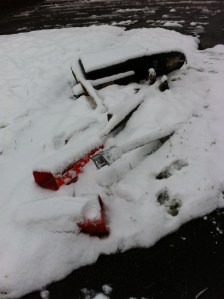
Lesson 3: Life Rarely Goes According to Plan, but When Bad Things Happen, We All Have a Great Capacity for Resiliency and Recovery No one in my family expected the snow that arrived on Christmas Eve, and, even after it began to fall, none of us expected it to last long. But last it did. And in the midst of final preparations for our Christmas celebration, the snow covered the grass and then it covered the roads.
When we realized we were going to have a white Christmas, we celebrated by taking a family walk with Rodney. Unfortunately, Rodney was more excited than all of us, and the jumping, the barking and the lunging, drove my husband crazy to the point he just wanted to go home. Instead of enjoying the beauty of the untouched snow, we were trying to control an overly enthusiastic dog. I worried that our Christmas Eve would become a battle over the dog.
As Rodney began to calm down, we began the climb up the hill on the far side of our neighborhood. When a truck came speeding down the snow-covered hill, we immediately jumped off the road and into a neighbor’s lawn. And then we heard loud thumps and bangs. We turned to see that the truck had gone off the road and taken out two mailboxes and multiple newspaper boxes. Packages littered the ground, and I was relieved that Rodney’s behavior was all but forgotten.
We empathized with the driver and the home owners that such an incident happened on Christmas Eve. But when put in perspective with the loss some families faced this Christmas, the event was far from tragic. For many, Christmas isn’t always just a reminder of family traditions and family warmth. It can also be a reminder of could-have-beens, might-have-beens and regrets. And yet, most of us still believe in the magic of the holidays.
Yesterday, as I was walking up that same hill with Rodney during yet another unexpected snow storm, I noticed the mailboxes were already back up. As is true with human nature, the owners were trying to get everything back to normal. Seeing the mailboxes standing so quickly after witnessing their near demise less than 36 hours earlier was a reminder that no holiday is ever perfect. But planning for perfection only leaves room for disappointment, and planning for disappointment only leaves room for anxiety. But planning to enjoy life’s imperfections only leaves room for joy.
I plan to carry that lesson with me forever and to look forward to whatever the weather, and life, have in store for 2013.
The Rapist with the Great Reputation
 During my freshman year of college, female students were on high alert. A predator had taken advantage of unlocked doors to rape at least two co-eds in their own dorm rooms. Flyers with a composite drawing of the suspect along with warnings and safety reminders were hung up all over campus.
I think the guy was eventually caught, but I honestly don’t remember.
What I do remember is that, for a while, most female students were careful about locking their doors and not walking alone after dark. While those precautions should have been and should continue to be common practice, our fears were somewhat misplaced.
Instead of worrying about a stranger jumping out of the shadows to attack us, we should have been alert to those we already knew.
No one ever taught me that, but I learned the lesson anyway. Unfortunately, I learned it too late.
I was already a college graduate when I was invited to a law school party that started like any other. That didn’t last long.
At other parties, I didn’t fall down after one beer. At other parties, male acquaintances with whom I had absolutely no romantic interest didn’t complain, “that’s not how it was supposed to work” when I talked to other male party goers. And at other parties, I didn’t leave with huge chunks of time missing even though very little alcohol was consumed.
I will never know exactly what happened that night. I’ve gotten bits and pieces from friends but, to be honest, I never really wanted to know. For a long time, I was ashamed and believed that I had done something wrong.
Only years later, when I learned about Rohypnol and other date rape drugs, did I piece together what probably happened. And even then, I had no proof that anything happened at all.
Statistics show that such an incident isn’t uncommon. The National Institute of Justice (NIJ) estimates that about 85 to 90 percent of sexual assaults reported by college women are perpetrated by someone the victims knows. Half of all victims do not define the incident as rape because ” there is no obvious physical injury and alcohol was involved.” The NIJ also reports that “approximately 27.5% of college women reported experiences that met the legal criteria for rape.”
What they usually don’t do is report these incidents as crimes.
That’s because rape often doesn’t look like the crime many of us were taught to avoid.
Rape is not just a crime of violent sex offenders who stalk women in dark alleys. It is not just a crime of deranged individuals who can’t control their violent urges and express them through rape. Instead, it is often a crime committed by men or boys with great reputations who, for whatever reason, are seeking to meet their needs by controlling women. And because these men are often respected professionals, athletes or students, they often get away with their behavior.
A former emergency room nurse told me a story about caring for a young woman who had been raped on campus by a student athlete. The university offered to pay the victim’s tuition if she didn’t press charges or go public. She never pursued the crime, but she never went back to school either.
A social worker tells the story of a woman who drank too much and was picked up by a police officer, who, instead of giving her a ticket, chose to rape her instead. She never pressed charges for obvious reasons.
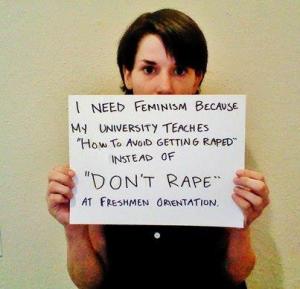
This week, a colleague showed me the photo of a young woman holding a sign that says ” I need feminism because my university teaches how to avoid getting raped rather than don’t rape.” I posted the photo on Facebook, and it immediately got reaction, including those who wanted to emphasize that young women should be taught to take safety precautions.
I couldn’t agree more. But I can’t say that putting all the responsibility on women is fair or appropriate. Universities, and society as a whole, must send a constant and consistent message about the definition of rape and that it is a crime regardless of the circumstances and people involved.
That’s not happening. Instead, the message seems to be that these things sometimes happen when alcohol is involved or when women lead a man on. The message also seems to be that some men are just too important to hold accountable.
And so, I agree with the young woman in the photo.
There will always be individuals who push the limits. The rest of us have the responsibility to push back.
60 Years, 3 Couples, 1 Anniversary and Immeasurable Memories
 From the diary of Letha Bates Smith: “Nov. 29, 1933 Wed. Finished cleaning at the house this morning. Met Sylvia at 3:25. Morden, she & I met Martin in E. Lansing and had the knot tied at 8:30. Home then to Vilas and Evelyn’s for the nite.”
That’s how my grandmother described the day she married my grandfather, Morden, in the chapel at the People’s Church in East Lansing, Michigan with her sister Sylvia and her brothers Martin and Vilas in attendance.
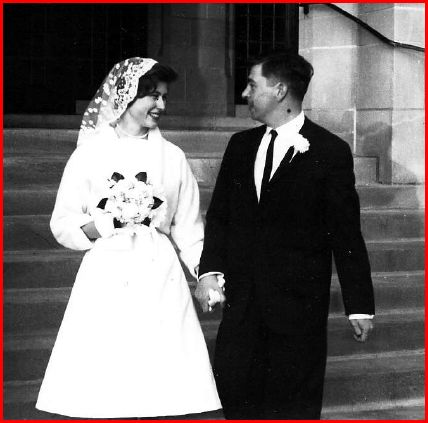
Exactly 30 years later, my mother married my father in the same chapel. Unlike my grandmother, she didn’t keep a diary, but, just like my grandmother, she had a very practical wedding.
Exactly thirty years after that, at age 26, I was a completely different person than both these women. I was definitely less conservative and more reckless. Yet all three of us would be forever connected not just by blood but by our sensibilities and our belief that a strong marriage, just like a strong woman, is defined by substance not glamour.
And so, on November 29, 1993, my grandparents celebrated their 60th anniversary and my parents celebrated their 30th by attending my wedding.
 Letha and Morden
My grandparents met on a blind date while they were both students at Michigan State College (later University) during the Great Depression. My grandmother was one of four children from a farming family in Quincy Michigan who were all determined to go to college. Despite the odds and through their own perseverance, all four obtained college degrees.
My grandfather, the youngest of seven children, grew up in a family that had an uneven financial history – sometimes they had a lot, sometimes they didn’t. My grandfather’s older brother, Carl, had died when he contracted smallpox working in a lab while in medical school. The money from his insurance policy allowed my grandfather to pursue a degree in electrical engineering.
I know little about my grandparents’ college romance. My grandmother wasn’t a talkative or an emotional woman. But for decades, she documented her life in diaries. The one or two sentence entries she diligently recorded provide some insight into the often hidden thoughts of a woman who, on the surface, was practical to the bone. The grandmother I knew had one dress that she wore to every special occasion (including my wedding) for decades. But, that didn’t mean she never cared about a new dress.
“Oct. 30, 1932 Sunday. My sweetheart down today. And what did he bring me – Um does it sparkle? Simply gorgeous delightful! The dear boy.”
“Nov. 1, 1932 Tuesday Met Sylvia downtown this P.M. spent the nite with me. The ring fixed – lovely now – more thrilled than ever. A new dress.”
Even after my grandmother died, we never found picture of her wedding or her wedding dress. At the time of their marriage, my grandfather was a relatively new employee at Citizens Gas Fuel Company. My grandparents chose to get married the evening before Thanksgiving because my grandfather would have a four-day weekend.
My grandparents’ marriage ended when my grandfather died in 1998, just shy of their 65th wedding anniversary. My grandmother would live for another seven years.
The words in her diary will be passed on to future generations.
Evadna and Ken
Following in the footsteps of her parents and her older brother, my mother attended Michigan State University. After graduation, she moved to Manistee, Michigan, but neither her job nor her location were exotic or adventurous enough for her. She wanted to see the world and submitted an application to join the newly established Peace Corps.
After he graduated from Idaho State University, my dad, a Massachusetts native who had already seen a great deal of the world while in the Navy, also applied to join the Peace Corps.
They were among the first individuals ever selected and were in the third group deployed. Before they left for Chile, my parents attended training at Notre Dame University, where they spent days in Spanish class. My father excelled with his ability to speak the words perfectly in his loud, booming voice while my mother shot him dirty looks while she struggled.
Her irritation didn’t last long. Before they returned to the United States, my parents were engaged. Instead of a diamond, my mother wore a simple gold band on her right hand that she would transfer to her left hand when she was married. The only diamond I’ve ever seen my mother wear is her mother’s engagement ring, the one that sparkled so brilliantly in 1932.
After returning to the United States, my father, a forester, got a job in Montana. He hadn’t accumulated any leave, but he was allowed to take a few days for Thanksgiving. And so, a wedding the day after Thanksgiving made sense, and my parents spent their honeymoon driving west to their new home.
They’ve spent the rest of their lives sharing stories of their adventures with their children and grandchildren.
Trina and Giles
Ironically, I met my husband on a November night.
On November 8, 1988, I was a college intern helping cover election results in the newsroom at West Virginia Public Radio. Giles was reporting for his first night of work. He thought I had an attitude, and I thought I had work to do. No sparks flew, and I didn’t give him a second thought.
But after I graduated from Ohio University, our paths continued to cross and our circle of friends became one in the same. Over time and shots of Jagermeister, we eventually ended up together.
Our relationship was nothing like I imagined everlasting love was supposed to be and everything my mother had told me it would be. (She’d told me on multiple occasions that common values and compromise, not romance, were the key to a successful relationship.)
In the beginning, our schedules were very different, and we accommodated. Our schedules are still very different, and we still accommodate. In the beginning, we watched a lot of Star Trek. Giles still watches a lot of Star Trek, and sometimes our kids even watch with him. And in the beginning, we laughed at my intensity and his lack of it. Now, we work around our differences… and we still laugh a lot.
Giles and I didn’t get engaged out of some romantic notion of marriage. We got engaged because his roommate bought a house, and logistically, our moving in together just made sense. And when we realized the significance of the year, we picked a very significant wedding date.
Unlike the two couples before us, we didn’t marry over Thanksgiving weekend nor did we get married in Michigan, Instead, our ceremony took place the Monday after Thanksgiving in Charleston, WV. And yes, our wedding was also simple and practical (my mother made my dress), but it was also a bit quirky. We received gifts of Star Trek dinnerware and had Star Trek action figures on top of our cake.
Our children look at the photographs and simply roll their eyes.
The Present
This Thursday marks my 19th wedding anniversary and my parent’s 49th. If they were still alive, my grandparents would be celebrating their 79th.
Those aren’t generally noteworthy numbers, but they are to me. Life and marriage are both fragile, and every day, month and year of marriage should be treasured.
I am under no illusions that future generations will marry on November 29. But I do hope that the stories from all three couples will serve as a reminder that weddings are not about a fancy show or an exotic honeymoon. They are about two people deciding to move forward together and create memories that can bond families together for generations.
Fear and Self Doubt at the End of a Pointed Finger
 A few months after I moved to West Virginia from Oregon, a girl in my junior high gym class pushed me into a dark corner of an unused shower, got in my face and screamed at me for being too smart. As she pointed her finger into my chest, she told me that I had better stop acting like I was better than everyone else. She was joined by two other girls whose spittle sprayed across my face as they railed at me – screaming that every time I got a high score on a test or assignment, I ruined the curve for everyone else. They also told me that I talked funny, should accept I was in West Virginia and needed to start acting like it.
Even though the incident probably lasted only a few minutes, the repercussions have lasted my entire life. Yet I never told anyone about what happened, and, up until now, it’s been a secret between me and the three others involved.
But this week, with all of the negative comments and finger-pointing after the presidential election, the memory has come flooding back.
After the incident in the shower, I hated myself and believed I was somehow to blame for the situation. While I never purposely got a bad grade, I was still bullied into submission. I spent years locked in the prison of being a follower rather than an individual. Throughout my adolescence, most of the opinions or beliefs I espoused weren’t really my own. Instead, I was simply parroting what I had heard and what I thought would help me fit in.
Even worse, I was full of self-doubt about who I was and what I believed.
Thankfully, I grew up and I grew strong. I grew to be an independent woman who could think for herself, believe in her own intelligence and develop a conscience that extends far beyond her own wants and needs. I also grew into a woman who isn’t tolerant when people make judgments about or reject someone who acts or thinks differently than they do. I know all too well what that feels like.
That’s why some of the harsh comments and reactions to this week’s election took me right back to the shower where I was being bullied.
I understand why some people are angry and frustrated. I felt the same way after the 2000 and 2004 elections. But I didn’t to purposely make others feel bad about their beliefs and opinions. Yet that’s what I’ve been witnessing, and to me, the reactions mirror how the girls in the shower treated me.
People are angry at the election results and are trying to find someone else to blame. The girls were angry about their own grades and had to find a scapegoat, which was me.
Romney supporters are screaming that those who voted for Obama are idiots, morons, traitors and worse. The girls didn’t question my intelligence, but they did question my standards and integrity.
Some extremists are complaining that Obama rallied minorities and people on welfare to vote for him and, in those complaints, they are insinuating that these individuals don’t have the same status as “real” Americans. The girls complained that I, a newcomer to a community where they had lived their entire lives, should be conforming to their definition of normal.
The main difference between now and when I was a teenager is that I am not going to be quiet when I hear or witness such behavior. It’s wrong and people should be told it’s wrong. Neither do I feel bad about myself or my beliefs. I now recognize that anyone who points a finger is simply trying to transfer their own fear and self-doubt to someone else.
Instead of pointing fingers we should be joining hands so together we can tackle some of the tough issues we face. After, all, it’s’ hard to be angry, fearful or full of doubt when your fingers are touching someone else’s.
2 and 1/2 Foolish Wishes
 If I had a genie that granted three wishes, I would have almost wasted them this past week.
Instead I only hypothetically wasted two and came very close to wasting the third.
My preoccupation with genies and wishes began when my daughter told me about a recent in-class writing assignment. She and her fellow sixth grade students were given the scenario that they’d released a genie from a lamp and had three wishes to use in a week.
“The only rule,” my daughter explained as I was driving to her dance class, “was that we couldn’t wish for more wishes.”
“What about wishing for magical powers?” I asked.
She thought for a minute then said, “It depends on what kind of magic.” She didn’t elaborate, so we sat in silence for a few minutes.
Then I had to ask, “Well, what were your wishes?”
She turned and gave me an exasperated look. “You’re not going to write about this are you?” she asked.
I didn’t think I would, so I didn’t really lie. “Of course not,” I said.
“I wished for a rainbow-colored unicorn, a black Pegasus like Blackjack from the Percy Jackson books and telepathy,” she said.
At the time, I was simply amused by her choices, but then my imagination took hold and I began to pretend that I too had found a magic lamp with a genie who granted three wishes. I was sure my wishes would be much more meaningful and beneficial to society.
I was wrong. Despite what I thought were good intentions, my wishes were probably more foolish than my daughter’s.
My first was for everyone to see the true colors of a person I’m pretty sure has narcissistic personality disorder. Granted, my clinical training is limited to a few classes in graduate school, but he has most of the of the classic characteristics. He not only lies but also he believes his own lies. He manipulates yet does his best to convey that others are the ones being manipulative. He expects everyone else to go along with his plans, doesn’t listen to anyone he doesn’t deem worthy, takes advantage of others and exaggerates his skills and talents. This week, when I realized how many people either don’t recognize or don’t want to recognize this, I’d had enough. I wished everyone else could see through the bravado. But if that happened, I later realized, his gigantic ego would be injured but he’d still carry on with his life. Others could be hurt much more, and then I’d be as selfish as he is. That was an incredibly foolish wish.
My second wish came after looking at a Facebook news feed and witnessing what I deemed some incredibly stupid posts. Some people were sharing inappropriate details about their personal life and health. Others were posting photos of themselves that screamed “pay attention to me.” And then there were the completely inaccurate and misleading political posts. I wished that Facebook had an automatic editor that screened inane and inaccurate posts then provided genuine feedback as to why the edits were made. I smiled at the thought of opening up Facebook to a much more rationale, intelligent and genuinely humorous news feed. But then I realized what a damaging and self-righteous wish that was. What I was really asking for was a limit on free speech. And no matter how inaccurate, hurtful or stupid the information is that people are now putting on the internet, many Americans fought and even lost their lives for their right to do so. I had wasted another wish.
That’s why my third wish came very close to being a wish to get rid of mirrors.
Mirrors generally don’t benefit society. They either encourage vanity or dissatisfaction. After my first two wishes, I didn’t want to look in the mirror anyway. My avoidance of a mirror had nothing to do with my outward appearance and everything to with lifelong aversion to self-absorbed and self-righteous people. If I looked into the mirror after my first two wishes, I would have been face-to-face with just such a person. But maybe that’s why I wanted mirrors eliminated.
I was on the verge of making the mirror wish when I received an email that jerked me back to reality. The son of a friend had been very seriously injured, and all anyone could do is pray. In comparison, all my wishes seemed trivial and ridiculous. I realized we are all on this planet together and finding fault with each other really doesn’t do us any good in the end. Neither does thinking that we know better than others.
I’m still in the process of learning that lesson the hard way, but I also have one imaginary wish left. If it were real, I’d use it to wish we all had just a bit more patience and understanding. No matter how I look at it, I don’t see how this is foolish. It doesn’t break the rule of wanting more wishes, but it could be magical and transform humanity.
A Perspective From the Backseat of a Car
 I spent some very long hours in the backseat of a car when I was a child. That’s how our parents transported kids from place to place when we weren’t riding in the bed of pickup trucks without toppers.
Riding in the backseat of a car was torturous.
Even though we were never confined to car seats, neither did we have electronic games nor videos to keep us preoccupied. Instead, we entertained ourselves by reading books, playing travel games or irritating each other.
When none of those activities interested me, I simply paid attention to the world around me.
I paid attention to the landscape passing by outside, and I paid attention to my parents’ conversations. I just didn’t participate in the conversations very much.
I used to feel quite grown up when I listened to adult discussions about politics or current events or even us children. And I liked feeling grown up. At least I thought I did until one road trip changed me forever.
We were on our way home from somewhere, and we were very hungry. Knowing my parents, they were probably trying to get home before they wasted money at a restaurant when there was plenty of food at home.
But the hour was late, we were irritable and food was necessary.
So they decided to appease us, and we stopped at what I recall was a ski resort. My family walked past a long line of people waiting to get into the restaurant’s bar. But when we reach the dining area, the host gave my brother and me a disgusted look then turned to my parents and said, “It’s after 9:00. Children aren’t allowed.”
Instead of simply turning around and looking for food elsewhere, my parents chose to argue with the host. And I chose to wish I was a million miles away. The host prevailed, and we had to once again walk by the long line of people.
I honestly don’t remember if we got something to eat elsewhere that night. I do remember the discussion that I heard from the backseat of the car. My parents were frustrated they had faced discrimination because of their children.
I also remember feeling guilty that I was a child who apparently didn’t deserve to eat in a real restaurant. And I remember the look on the host’s face when he sneered “Children aren’t allowed.”
That incident haunted me for years.
I balked every time my parents headed into a restaurant that appeared to be more for adults than for children. I didn’t like going somewhere I wasn’t wanted, and I didn’t want to be in a place where people could single me out as someone who didn’t belong. And I certainly didn’t want to be in a place where people thought I wasn’t worthy or capable of dealing with the situation.
So, when someone asks “what do you think about kids in adult-oriented places?” my immediate answer isn’t “as long as they behave, they should be allowed.” Nor is it “they don’t belong.”
My answer has nothing to do with whether parents think their children are mature enough to handle a situation, whether they are trying to expose their children to culture or whether they just want to parade their children as well-trained little people in front of others.
My answer has everything to do with how the children will feel in that situation and whether they will truly miss anything by not being there. In most cases, the children are probably better served by waiting a few years.
That’s a lesson I learned from all the years I spent in the backseat of a car.
When I was there, I wanted nothing more than to move to the front seat. But in retrospect, I learned a lot in the backseat when I was often forced to observe and listen. When I was finally allowed to ride in the passenger seat, I engaged in conversations with my parents. I also had a clearer picture of where we were headed. A few years later, I even moved into the driver’s seat, where I had to make tough choices on my own. But by then, I was prepared.
The learning process was gradual, not sudden. And it all started with the knowledge gained from riding in the backseat of a car.
My File Cabinets Full of Men
 I completely appreciate why the internet is buzzing about Governor Romney’s claim during Tuesday’s presidential debate that he had “binders full of women.” But there’s also a part of me that identifies with his statement.
I, after all, have file cabinets full of men.
While Romney said he used the binders to identify qualified candidates for key positions in state government, my file cabinets serve an entirely different purpose.
I use them to store reminders of all the men that are NOT qualified to be in any part of my life.
I started my first file when I was a young girl and a boy told me that men were more important than women because they got to keep their last names when they got married. I was devastated, but I was also angry. As a result, that boy had the honor of being the first male I ever put in a file cabinet.
Over the decades, I’ve filled several file cabinets with men. Some of the most memorable include:
* The minister who insisted my friend keep the word “obey” in her wedding vows.
* The agency director who tried to prevent me from getting a management position because I breastfed my baby during a meeting that I graciously attended while on maternity leave.
* The community leader who always referred to me by using my husband’s last name, even though he knew I had never changed mine.
* The manager who issued a dress code that all female employees must wear pantyhose with skirts or dresses. (For the record, the dress code was issued during the summer when I was eight months pregnant.)
* The nonprofit executive who, with a staff of all women, refused to let mothers take sick leave when a child was ill or had a doctor’s appointment. At that time, we were all granted a set number of days for both vacation and sick leave, but vacation was much more limited. The director’s exact words were, “letting mothers take sick leave for their children isn’t fair to the employees who don’t have children.”
* The supervisor who blatantly promoted young, attractive females over more qualified, middle-aged women.
I’ve recently been considering adding another man to my file cabinets. While this man claims to support women, he’s never demonstrated any real understanding of the often life-long battle many of us have faced. He’s skirted around the issues of equal pay for equal work and reproductive rights. And even when he tries to express his appreciation about the need for equality in the workplace, he falls short by indicating that women don’t want to work long hours because they have to go home and fix dinner.
Yes, this week I’m definitely thinking about adding that man to my file cabinets. I’m just not sure if his binders will fit too.

Lessons in Trees from the View on a Bicycle Seat
 As a child, I always felt at home among the trees and full of exuberance on my bike.
As an adult, not much has changed.
While my father, a forester, no longer teaches me about the secrets hidden in the shape and color of a leaf or in the texture of bark, I am still enamored of trees. And riding a bike is still one of my favorite pastimes. Few things bring me greater joy than taking a lazy bike ride among the beauty and wisdom of the trees.
I had that opportunity this past Sunday when I took advantage of a gorgeous autumn afternoon to ride my bike and attend to the lessons of the trees.

Lesson 1: Sometimes when you blend in, you bring out the best in others. On Sunday, this tree next to the church across from my neighborhood had started to model its fall colors. It was amazingly beautiful, but its splendor didn’t lie simply in its appearance. Even though I drive by that church every day, I’ve never paid much attention to it. But the hue of the red leaves was a perfect match to the color of the bricks, and I was struck by the church’s design.

Lesson 2: Loss and suffering are the best reminders of all that we still have. The past year was a tough one for trees. Almost exactly a year ago, we were hit by a bizarre October snowstorm that knocked down trees still heavy with green leaves, including two in my own yard. In June, we lost even more trees to a land hurricane, also known as a derecho. For weeks, the sound of chainsaws in the morning was as common as the sound of crickets in the evening. I hated that sound. Every time a chainsaw revved up, I knew we were saying goodbye to another tree. But riding my bike on Sunday, I passed hundreds of trees that had never been knocked down, and I felt a deep sense of gratitude for all those still standing.

Lesson 3: Happiness comes from accepting your circumstances and recognizing that, at times, your place might simply be to support someone else. These two trees in an expansive cornfield have always seemed out-of-place to me, yet each year they grow stronger together. From some angles, they are two distinct trees that mirror each other. From other angles they appear to be one. But from all angles, they remind me of two people who hold each other up in a tough environment that could easily defeat someone left all alone.

Lesson 4: The greatest sense of belonging comes from owning your own style and surrounding yourself with people who appreciate differences. Every time I pass these three trees on the edge of a field, I imagine them as a group of women all throwing their arms up in laughter. Each is unique: one is flamboyant, one is plain with a toddler at her knee and one is aging rapidly. Despite their differences, I see them as a united group that delights in life’s simple pleasure of friendship.

Lesson 5: Everyone has scars, but we can choose to let them weigh us down or strengthen us. Several years ago, I fell in love with a magnificent tree that simply owned the landscape. When it was hit by lightning, I was sure it was damaged beyond repair. About half the tree was dead, and several branches hung black and leafless. But this tree didn’t give up and has slowly recovered. It’s now smaller and has a different shape, but in my eyes, this survivor is a giant.
Yesterday, I took the same bike ride that I did on Sunday. The trees had already changed dramatically. Some displayed brighter colors of red, orange and yellow while others were losing their leaves. Most shone in a different light. But these changes gave me one more lesson: savor every beautiful moment, because nothing will ever be exactly the same again.
There Is No Fear in My Anger
Today, I am stepping out of my comfort zone and attempting a different type of blog.
Since I recently saw Maya Angelou, I’m writing poetry for the first time since adolescence (for the record, that’s about 30 years ago).
This challenge requires taking a deep breath and jumping in.
Here… I… go…

There Is No Fear in My Anger
The workshop leader told us
That anger is always rooted in fear.
That helping people address their anger
Always requires helping them confront their fears.
I, the student, told myself
That my anger is never rooted in fear.
That dealing with my anger
Always requires confronting the source.
There is no fear in my anger.
My anger is rooted in a sense of fairness.
When people are treated differently because of the way they look or because of their perceived social status
Then I am red, hot angry.
But I am not fearful.
My anger is rooted in a desire for benevolence.
When a person with money or connections is regarded more highly than a knowledgeable person
Then I am rebelliously angry.
But I am not fearful.
My anger is rooted in a hard-earned sense of self-worth.
When I am ignored because someone wants to build his own ego on a false sense of self-importance
Then I am howling with anger.
But I am not fearful.
My anger is rooted in a cry for compassion.
When I hear people ridicule those who have less
Then I am sadly angry.
But I am not fearful.
My anger is rooted in respect.
When people spend years building a strong foundation and it is destroyed by those who want to build an empire
Then I am frustrated with anger.
But I am not fearful.
And when I am told that I am fearful rather than angry
I am full of fighting words and the need to persevere and speak the truth.
But I am not fearful.
For there is simply no fear in my anger.
(Wow.. that WAS like jumping into a cold pool and enjoying a great swim… invigorating. I had forgotten why I wrote poetry as a teen. I may now write more!)


 Just So You Know