Category Archives: Politics
Revelations from a Former Republican
 During a recent conversation, I shocked a friend when I mentioned that, when I turned 18, I had registered to vote as a Republican.
“You were NOT a Republican,” she stated. “There is just no way.”
“Not just a Republican,” I replied. “I was actually heartbroken that, because of my age, I missed voting for Ronald Reagan by only three months in the 1984 election.”
Since I was talking to my friend on the phone, I can’t confirm that her mouth was actually hanging open, but I’m pretty sure it was.
“What happened?” she finally asked.
“I don’t know exactly,” I replied. “But by the time I graduated from college, I’d changed political parties.”
In all honesty, I do know what happened. I’d identified the core values that would guide the rest of my life, and they simply just didn’t align with the Republican Party.
I don’t think my friend, or anyone else, really cares about how I arrived at my decision. And, until this past week, I didn’t feel any need to explain.
But after witnessing one too many debates about how people who receive SNAP (more commonly known as food stamps) may be eligible for additional benefits if they were affected by the derecho (http://www.catholiccharitieswv.org/index.php?option=com_content&view=article&id=300%3Awv-long-term-disaster-recovery-derecho-storm-a-power-outage-disaster&catid=45%3Aannouncements&limitstart=1), I felt the need to say something.
On the surface, the gist of the conservatives’ argument against the additional benefits was that the government was once again frivolously spending taxpayers dollars.
But, as the arguments continued, a different, more self-centered concern actually emerged. Several people were turning the discussion into a conversation about fairness, or more particularly unfairness, in regards to their own lives: ” I lost all my food when the power went out, and no one is paying me to replace it.” “I have a lot of health care bills, and the government isn’t stepping in to help me.” “Basically, I’m being punished for having a job. ”
Sadly, I could relate to their complaints. That kind of thinking was the reason I had originally registered a Republican.
At the age of 18, I really did believe that everyone had an equal opportunity in this country, and if a person worked hard and persevered, they should be able to meet their own needs. If they couldn’t make ends meet, they needed to work harder or get a better education to get a better job. I believed in responsibility: if people made bad decisions then they, not I, should have to pay for those decisions. And I believed that our leaders had our, not their own, best interests at heart.
I held onto those beliefs because I was surrounded by people who believed the same thing. Then I went to college, and I was surrounded by people who didn’t.
I met too many people who had been denied equal opportunity through no fault of their own. I met too many people who had made poor decision after poor decision only to be bailed out by family while others fell into bad luck and had no one who could help. I learned more and more about greed, inequality and political corruption. And I learned more about myself.
At some point, I was confronted with the ultimate question: is life about what I can do for myself or is it about providing unconditional support for others, even when it sometimes costs me?
I chose the latter.
Don’t get me wrong. I can be very self-centered, and I know a lot of Republicans who are anything but selfish.
I just don’t think the core of my political beliefs should be about what makes my, or my family’s, life better or easier. I think public policy should be about ensuring the safety and well-being of all Americans, particularly those who haven’t had the same privileges that I’ve had: good parents, a good education, a decent I.Q. and a lack of any significant health problems.
When I look back on 18-year-old me, I still understand where I was coming from.
I still think people should do their best and be responsible for their behavior. I also think corporations and millionaires should do the same.
I still believe in hard work and self discipline. I also believe that too many people work very hard and still don’t get paid a fair wage so they can’t make ends meet.
I still wish life were fair. I also realize that making life more fair for everyone requires public policies that provide additional support for those who need it.
The difference between 18 year-old me and 45 year-old me is I don’t think the world owes me anything. Instead, I think I owe the world. The difference is I know some people put their own interests above the interests of others, even when it comes to the environment or safety or health. And I know that the most effective way to ensure such people do minimal damage is to implement and enforce regulation.The difference is that even though I don’t agree with wasteful spending, the wasteful spending I’ve seen isn’t for the programs intended to make the lives of most Americans better.
The difference is that I have enough life experience to know that life isn’t about being fair.
And that’s why I got so frustrated with the debate about additional SNAP/food stamp assistance. The debate wasn’t about whether people needed the assistance. Instead, it was a debate about fairness. I’m pretty sure if you asked the majority of people who were eligible to receive the help, they would be the first to tell you life isn’t fair. If it were, they’d be fortunate enough to afford to replace their own groceries while complaining about those who couldn’t.
Burning Down Our House With Debates About Health Care
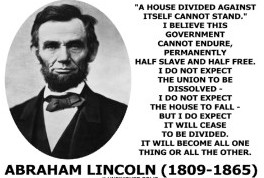 In 1858, Abraham Lincoln made his famous “A house divided cannot stand” speech.
He was debating Stephen Douglas about the issue of slavery. Douglas believed that each new territory or state should be allowed to decide whether it would permit slavery. Lincoln believed that the nation as a whole should take stand. At the time, a lot of people believed whites to be superior to blacks and that owning another person was justified based on skin color and bank account size.
We all know who eventually won that debate. But even after the slaves were free, too many people still believed in a superior race. And, for more than century, too many laws reflected their beliefs.
Now, more than 150 years later, I wonder how history will portray the politics of 2012 when the United States is once again a house divided.
Only this time, instead of being divided over slavery, we are divided about the purpose of government. But there is also an underlying debate very similar to the one being waged during the Civil War.
Too many people still believe that some individuals are superior to others. Only instead of color, they are claiming superiority based on the size of their bank account or their employment status. We have become a country that is debating whether we measure success in terms of dollars or in terms of human rights. We are debating whether accumulating possessions is more important than ensuring access to health care. And we are even debating whether or not poverty is a moral issue.
This has never been more apparent than with the reaction to the Supreme Court’s decision that the Affordable Health Care Act is Constitutional.
The fact that people have different opinions about the decision doesn’t bother me. I expect that. Different opinions are healthy. What bothers me is the judgmental comments and self-righteous outrage that some people expressed.
I was particularly struck by comments from a public school teacher who said the Supreme Court’s decision was immoral. She followed this by saying “I work for a living. I don’t want my hard-earned dollars to support people who depend on the government.”
Since a public school teacher depends on the government (i.e., taxpayer dollars) for her paycheck, I was dumbfounded. I wonder how she would react if the country engaged in a debate about the importance of education and whether we are infringing on taxpayers rights by requiring them to pay for education.
At some point, our country embraced the belief that education is a right that every child deserves. We even took that concept a step further and mandated that children stay in school until a certain age.
If the issue were being debated now, there’s no doubt some people would be screaming that requiring children to go to school is unconstitutional and that hard-working taxpayers shouldn’t be responsible for the education of others.
Thankfully, most people recognize the importance of education, the benefit it has on a person’s future and the positive impact on a community’s economy. The same benefits can be attributed to access to health care, so I’m not really sure why we are so divided about the issue.
But we are.
Instead of debating how to help people, we are debating whether or not we even should. Take, for example, the comments of the previously mentioned public school teacher who claimed the concept of the Affordable Care Act is immoral.
Last time I checked, helping others was the definition of morality, not immorality.
But logic isn’t everyone’s strong suit. Many of the same people advocating for personal responsibility are also outraged that the individual mandate is part of health care reform. As explained to me, the purpose of this mandate is to encourage responsibility by requiring people to either purchase health insurance or pay a penalty to help cover the government’s costs.
Don’t get me wrong. I don’t think the Affordable Care Act is perfect, but at least it’s a statement about what a lot of people think is important. Actually, most people probably think access to health care is important. The dividing issue is about whether it is important for all Americans or only those who have employers or bank accounts that can cover the costs.
The debate isn’t going to end anytime soon. And with the presidential election season getting into full swing, discussions will get even more discordant.
I just hope that whatever the outcome, Americans can look back at the repercussions of this time with pride rather than shame. I hope we can say this is a time we stood up for the rights of all rather than for the benefit of some. And most of all, I hope we don’t divide and even burn down our house with our heated differences.
Five Words I’d Like to Ban From Any Political Discussion
This week, Michigan State Representative Lisa Brown was banned from the House floor for uttering the name of a body part.
She, unlike her male colleagues, actually has that body part.
Personally, I’ve said the word countless times. I’ve taught my kids that it’s an appropriate word, unlike the slang terms that are often used. I’ve even attended a play that features the word in the title and in the script.
But I don’t want to get banned from writing or labeled an extremist, so I’m not going to actually include it here.
I know that’s sad.
But sadder still is that, in 2012, a woman was reprimanded for saying it.
I shouldn’t be surprised. This has been an especially bad year for women.
Access to birth control has been threatened. Equal pay for equal work is being discounted. Ridiculous and invasive medical procedures (procedures that actually include the banned word) have been considered for legislation.
And women who stand up for their rights have been called sluts (because that is apparently not as offensive as a the name of a body part) on a nationally syndicated radio show.
I’m not just feeling belittled and a bit angry, I’m feeling frustrated.
I thought women were making progress. I thought the country was making progress. I thought individuals were important regardless of how much money they make, where they were born, what their sexual orientation is or, most important to me, what sex organs they were born with.
Silly me.
But since we are now engaged in a debate about what words are and are not appropriate to say during a political debate, I’d like to propose five that shouldn’t be part of any discussion.
1. Socialism. In recent years, this term has been used to perpetuate divisiveness and bitterness. It is being used to suggest that it is not American to believe those who have more resources have a responsibility to help those who are struggling.
2. Obamacare. I don’t believe that access to health care should be the responsibility (or fault) of one particular party or individual. It’s about all of us. Health care reform is complicated and hard to understand. But quality, affordable health care is also critical (and currently not accessible) to too many Americans. I have family and friends who have had cancer, high blood pressure and chronic sinus conditions. These are all pre-existing conditions that can drive personal health-care costs sky high. Most of my professional life I’ve been in jobs that either didn’t offer health insurance or offered it at an incredibly high price. I’m a very hard-working person, and I take extreme offense at being told that I don’t deserve the same access to health care as some one who has a different employer. Let’s be rational and talk about the issue rather than about specific politicians and leaders.
3. Christian. Anyone who knows me, knows that I have the greatest respect for God, religion and faith. But America was established on religious freedom, and we are going backward when we make any one religion the basis for laws. Of course our laws should be based on moral and ethical principles, but most religions are based on strong values. Let’s not marginalize people of different faith by holding up Christians as the only religion that counts.
4. Undeserving. This word makes my heart hurt. By using it to broadly describe any group of people is unfair and incredibly biased. It is also very effective. It allows some people to pat themselves on the back for being deserving while belittling people who are different. People hit hard times for a wide variety of reasons, many of which are beyond their control or rooted in a childhood that never gave them a chance. I’m not saying that we shouldn’t set expectations for people or encourage them to take care of their own needs. But lets provide them with skills and opportunities rather than blame and labels.
5. Penis. If vagina isn’t allowed, then we shouldn’t be allowed to say penis either.
Whoops. Did I just say vagina? There go any hopes of a political career.
Hopefully, I will still be allowed to share my thoughts and opinions. And hopefully this post doesn’t get deleted as a result of actually naming a body part.
A Letter to Rush Limbaugh (Even Though I Know He Won’t Read It)
“Our purpose in this life is to help others. And if you can’t help them, at least don’t hurt them.” Dalai Lama |
Monday, March 5, 2012
Mr. Limbaugh
Like many Americans (and I hope most Americans), I was appalled when you turned a national debate on religious-affiliated institutions and contraception coverage into a personal attack on Sandra Fluke. Not only did you call the Georgetown law student a slut, but you went so far as to request sex tapes and claim that she was basically asking the government to pay for her to have sex.
Umm, no, Mr. Limbaugh, government coverage of birth control was not being discussed. The topic was actually about what can, or should, be required health-care coverage by religious institutions… not the government.
But that didn’t matter to you, did it?
And why should it?
Your job isn’t to provide accurate information or to engage the public in genuine debate about how to make life better for most Americans.
Instead, your job is to do the exact opposite. You don’t care about helping anyone but yourself. Your primary concern is about getting higher ratings and more money. And every time you say something controversial, you get more attention, which is all you really want.
You figured out the formula years ago and have been perfecting it ever since. You divide people by ridiculing others, tearing down anyone who thinks differently than your audience and twisting what liberals believe, think and do.
The problem is, your attitude and behavior are contagious, and other news media and internet sites have followed your lead. Attacking people has now become more common than engaging in real, intellectual debate about tough issues that have no easy, and sometimes no right, answer.
Because of this, a lot of people now find it acceptable to demonize others because of religious beliefs. Those who have fallen on hard times and need financial assistance are defined as lazy and undeserving. And lately, our country seems to be going backwards when it comes to women’s issues.
The American public now views politics as a matter of us-versus-them and is more interested in which side can score the most points than what will benefit our country. Attacking others is more important than considering possible solutions and compromise.
Worst of all, we’ve become a country where many think only of their own personal gain rather than about the greater good.
But like I said before, that’s not your concern. Your concern is about getting ratings, and you’ve accomplished that by making every political issue about personal behaviors and beliefs.
But I’m not going to call you out on your own personal behaviors, because that would be stooping to your level.
Instead, I simply want you to think about the real purpose of life. Is it to make as much money as possible while hurting a lot of people in the process? Or is it to make the lives of others better while building people up in the process.
I believe in the latter. I hope someday, you do too.
Sincerely,
Trina Bartlett
There’s Going to Be Trouble When You Live in a Bubble
 Keeping an eye on politics this week has been as compelling as anything the best Hollywood writers could make up. Mitt Romney, the front-runner for the Republican nomination for President of the United States, actually said that he cares about Americans but that he isn’t concerned about the very poor because they have a safety net.
That’s precisely what he said. In that exact order. What happened next, while predictable, was still extremely entertaining.
Some political pundits latched onto the concept that Romney didn’t care about the poor and (gasp) he didn’t even consider them Americans.
Others suggested that he was supporting the notion that government should help the poor indefinitely without encouraging them improve their situations.
And others, particularly those in the Republican party, despaired that Romney is a bad politician who blunders when he doesn’t have a teleprompter.
I have to agree with the latter. When Romney opens his mouth without a script, his comments seem unsympathetic to the average American. His latest remarks about the poor just add to the growing concern.
The doubts have been building with every questionable statement: his spontaneous offer to bet Rick Perry $10,000 (a very sizable amount of money to the average American); his remark that he is also unemployed (not funny to the millions without a job or a daily income like he has) and his insensitive language about liking to fire people. All of these feed into the perception that Romney has no clue about the daily struggles many Americans face.
And there may be something to that. He has, after all, lived in a bubble his entire life.
He grew up in a bubble and doesn’t appear to have left it. That bubble has protected him from worrying about which bills he could afford to pay or whether his children would be able to go to college. I’m pretty sure that there’s never been any coupon clipping, layaways or bargain hunting in the Romney bubble.
But apparently the barrier between Romney’s bubble and the rest of the world isn’t impenetrable. Rumblings of discontent about the disparity between the very rich and the rest of the country actually seem to be reaching Romney’s ears. But the layers of film between us are distorting the message, and he just isn’t hearing it correctly.
But Romney’s not alone.
Because of religion, socio-economic status and even our appearances, many of us live in a bubble and generally associate with, relate to and hear the opinions of people who are very similar to us. And while some people step outside of their bubbles, others never do.
The problem with staying in your own bubble is that you generally don’t hear or understand the plight of those outside the bubble. I’ve bumped into a lot of those people as they float through life. It’s not that people who stay in their own bubbles are bad people. Bubbles simply distort how they see things, so their view of the world just isn’t accurate.
But who can blame them? Living in a bubble can be deceptively comfortable.
Unfortunately, people who are floating around in their own bubbles are still part of the real world: a world where poverty is not a moral issue, where people still face discrimination and where money is a driving force in determining who has power.
If you are floating around in a bubble, your hands may never get dirty, your heart may never fully empathize and your head may never understand.
And that’s the problem with Mitt Romney. It’s hard to understand something you’ve never felt or experienced. And it’s even worse if you don’t recognize the fact that you’re living in a bubble.
On the bright side, most everyone likes watching bubbles float away and eventually pop. Even as a child, I found the sight highly entertaining. I’m pretty sure I still do.
My “Liberal” Brain May Not Believe What You Think It Does

I’m getting very tired of being told what I think. Partly because I already know, and partly because what other people say is often not accurate.
But that doesn’t seem to matter to a lot of people, especially in today’s political environment. Sound bites, snarky comments and misinformation appear to be the norm when it comes to influencing opinion.
And sadly, many people prefer to make generalizations rather than to look at the complexities of almost every issue.
In other words, clarifying what my “liberal” beliefs are won’t matter to those who prefer spoon-fed ideology that paints everything in black and white terms.
Despite the fact that people who should hear what I really believe won’t bother to read this, I’m sharing anyway:
1. I believe in personal responsibility and hard work. I can’t stand laziness and I don’t think it’s the taxpayers responsibility to support people who abuse the system. I also know that the majority of people seeking help have fallen on hard times, are not lazy and/or have a legitimate need. Most have children, who will suffer if their needs aren’t met. I also know that only about 10% of those receiving help also attempt to abuse the system. I know that charitable giving doesn’t begin to cover the need, that the implications of not helping those in need are severe and that funding social services is an essential use of taxpayer dollars.
2. I believe that people who receive assistance from social services should be held accountable for what they receive by taking steps to help themselves. Apparently, a lot of other “liberals” believe the same thing, which is why most social workers and social service providers spend most of their time helping people build skills to improve their circumstances … not “handing out” money. I also believe that people can change, which is why they need others to support and encourage them rather than to criticize and judge. And I believe that people who complain about lazy people on welfare don’t know the basic facts about eligibility requirements, what people actually receive and what is required of them. I know the majority of people who point fingers really don’t want to learn more anyway, because if they did, they wouldn’t be so judgmental in the first place.
3. I believe in the Constitution and its Amendments, particularly the First Amendment and Freedom of Speech. I also believe that these rights should equally apply to all Americans, not just those who have more money or connections. When you have more resources, you have greater opportunity to use and abuse these rights. Ensuring equal access is important. I don’t believe that microphones only belong in the hands of the elected, and I don’t believe Constitution was written with the concept that corporations are people.
4. I believe in freedom of religion and the power of prayer. I also believe that religion is personal and shouldn’t be used to further a political or any other agenda. Historically, people have abused religion to gain power and influence and to promote their own causes. The results can be extremely harmful.
5. I believe in one nation under God, but I don’t believe in a nation of only one religion. I don’t believe that people of one faith are any more moral than people of any other faith or even people of no faith.
6. I believe that people who want to own a gun should have the right to do so. I also believe that the use of guns should be regulated and monitored, just like the use and operation of a motor vehicle. The primary purpose of a gun is to harm another living being, and I believe everyone who picks one up should fully understand and consider that potential. I don’t understand why any private citizen needs to own a semi-automatic weapon, and I know when that happens, there is always the potential that a criminal will steal or gain access to it. I also know the gun industry wants to sell as many guns as they can because their goal is to make a big profit, not to protect anyone. That’s why it spends spend big bucks on propaganda to make the issue black and white.
7. I believe in fairness, just as one of the most revered Republicans ever, Abraham Lincoln, did when he proclaimed, “These men ask for just the same thing, fairness, and fairness only. This, so far as in my power, they, and all others, shall have” I also realize, that since his time, we recognize that inequality exists beyond just race. I believe that love is love, and if you want to commit your life to someone else, the sex of that other person shouldn’t matter. I believe that race, income and religion shouldn’t predict your outcomes in life. And I believe that people who discriminate, judge or make harsh comments on the basis of race, religion, socio-economic status or sexual orientation are either fearful or selfish.
8. I believe that having money is a good thing, but I also believe that there is something wrong with a country when the distribution of wealth and power is so unequal. I know that this unequal distribution is NOT a result of some people working harder than others. I also know that raising this issue threatens people who are happy with the status quo, with their bank accounts and with the power that gives them. And I know that people who are threatened tend to point fingers and find fault with others so they deflect attention from the real issues. Whenever issues of inequality become part of the political landscape, people who have nothing to lose may not fight for the rights of those who have everything to gain. But when they do? The country benefits.
9. I believe that people CAN “pull them up from the bootstraps,” and I’m privileged to know people who have accomplished just that. I also know that the odds are against this. When your parent abuse drugs, when they don’t value education and when they don’t encourage hard work, you already have three strikes against you. And when you’re low-income, the chances are that you aren’t attending the best schools. Low-income children should have the best teachers and the best schools. But they can’t pay for them, so middle and upper class children get the educational benefits and the advantage in life instead. Children are our future, and we have to invest in them… all of them. Early education provided through Head Start and other programs is essential.
10. I believe people are more important than money. There’s no other way to say it. I believe that worshiping money and power more than God violates the First Commandment. I believe that our current political system allows people, and corporations, to buy politicians and policies that in turn allows them to buy more power and money. I believe something has to change, and if it doesn’t, the majority of Americans will suffer.
I also believe that everyone has the right to his/her own opinion, and I’m grateful to have the opportunity to express mine on Martin Luther King Jr. Day. As the great man said, “Our lives begin to end the day we become silent about things that matter.”


 Just So You Know