Author Archives: Trina Bartlett
Superficial

I absolutely love when a fictional character says something that completely resonates with me to the extent that I’m still thinking about it days, or even years, later. For example, I don’t even remember which Scott Turow novel I was reading or which of his characters made the observation that teenage relationships teach you how to break up not how to stay together. The concept rang so true to me that I still reference it.
More recently, my husband and I were watching Three Pines, the television series based on Louise Penny’s books featuring Chief Inspector Armand Gamache. During one episode, the detective tells another character, “Grief is love that has nowhere to go.” That simple statement captured the essence of grief in such a meaningful way that I know I will remember it forever.
But no quote has ever rang as true as one in the most recent Peter Robinson novel when his character Detective Chief Inspector Alan Banks makes the observation that “Superficial people have superficial morals.”
(I’m going to make a brief side note here: Peter Robinson is one of my favorite authors, and I actually got to meet him at the National Book Festival in 2008. Unfortunately, he passed away just a few months ago, and his final novel will be released this spring.)
The statement about superficial people having superficial morals was a reaction to how some people are quick to judge other people’s relationships based on some shallow moral code. No truer statement could have ever been made. Shallow morality is a moral code rooted not in love and compassion but in judgement and fear. Ironically, most people who spout shallow morality don’t think they are superficial. Many think they are spouting a gospel that can not be questioned.
It can, and should, be. In fact, I suggest that everyone ask the following questions before dropping a judgement bomb:
- Do you believe that a relationship can be immoral even if both partners are of age and are not hurting each other? If so, you might have superficial morals.
- Do you use fear and scare tactics as a justification for judging others. For example, do you tell others that trans individuals are stalking potential prey in bathrooms or that gay men are more likely to be pedophiles. If so, you might have superficial morals.
- Do you spout passages from the Bible out of context or without considering that some passages even contradict each other. If so, you might have superficial morals.
- Do you think that you have to be a Christian to be a moral person? If so, you might have superficial morals.
- Do you blindly follow your brand of Christianity, its rituals and its dogma without question or challenge. If so, you might have superficial morals.
- Do you protect your own and circle the wagons to protect others who think like you even if you know they are hurting others? If so, you might have superficial morals.
- Do you make sweeping judgements about other people’s difficult decisions, such as whether to terminate a pregnancy, with no understanding why the decision was made or the consequences of other options. If so you might have superficial morals.
- And finally, do you believe that whole groups of people are less moral than you are and therefore need to be treated differently – whether it’s Muslims or Mexicans or African Americans or refugees or immigrants? If so, you definitely have superficial morals.
The bottom line is that morals should never be used to make us feel superior to other people. In fact, they should instead be used as an opportunity to learn about, care about and love people who are completely different than us. They should make our world and experiences bigger not smaller. They should be based on inclusivity not exclusivity. And most of all, we should recognize that they are subject to change as we have new experiences, meet new people and learn more about the science behind human behavior. To me, superficial morality isn’t moral at all.
I know not everyone will agree with me. I don’t care. As the late, great Leslie Jordan (who like Peter Robinson passed away in 2022) said, “What other people think about me is none of my business.” Thank you Leslie and thank you Peter for your moral guidance.
The Chair

The chair on the side of the road gave me pause. From what I could see, it was in great condition, but the logical side of my brain told me that no one could possibly throw out a perfectly good chair. So I didn’t seriously consider stopping, checking it out, and, if it seemed ok, throwing it in the back of my car because one of my kids might be able to use it. Yet, something about the abandoned chair niggled at the back of my mind.
I couldn’t help but wonder if it actually was a perfectly good chair that someone just didn’t want. Maybe it was the wrong color, or the wrong shape, or the owner had just gotten bored with it. People do that with pets, so they would have no problem abandoning inanimate objects for the same reason.
Regardless, I felt an unexplained empathy with the chair. Yes, I have probably seen Beauty and the Beast too many times and automatically personify inanimate objects, but I have also developed a deeper relationship with chairs after spending a significant amount of time with them a couple of months ago. The organization where I work had an online auction, and a donation of new furniture, including chairs, provided numerous items to offer up for bid. I had the responsibility of photographing and researching each chair to determine its retail value. Of course, I did this as part of a team, and I quickly realized people can have really strong feelings about chairs.
Everyone loved the rockers and recliners, which were mostly in neutral tones. But the accent chairs were quite controversial. Some people loved the bright, floral ones. Others thought they were obnoxious. I was particularly fond of a paisley chair that my co-worker deemed “absolutely ugly.”
It was simply a matter of taste, and no one tried to convince any of us that we were right or wrong. Because of course, no one was right or wrong. We just liked different chairs. Yet, I felt oddly hurt that someone thought a chair I liked was ugly, and I momentarily questioned if maybe I was wrong. We live in a society that tries to define beauty for us and reminds us on an annual basis what is “in” and what is “out.”
I will be 56 years old next month, and, when I’m honest, I admit that I still worry that my wardrobe isn’t cool enough and that there is something wrong with me because I have nothing to contribute to a conversation about the latest trends in interior paint colors. I tell myself that I don’t care, but a part of me does care. I tell others “you do you,” and “the only person you have to make happy is yourself,” but I worry that they may be putting themselves in a position of ridicule. I feel the constant hum in the background of daily living is telling me what I should look like, how to decorate my house, what music I should enjoy, and even whether or not my kids choices are normal.
The constant pull between being true to myself and true to the dictates of society is a struggle. A part of me will always be that kid whose peers made fun of what she wore when she started a new school in a community very different from the one she had left. I will always be that young woman who downplayed her intelligence and pretended she liked music she didn’t because she thought that’s what she had to do if people were going to like her.
Over the decades, the part of me that needs to fit in has grown smaller with every year while my allegiance to my true self has strengthened and grown. I may still worry about what others think of me, but I rarely make decisions based on that. And every day, I strive to be a champion for individuals who don’t feel they can be true to themselves without being discarded and isolated.
Maybe that’s why the chair on the side of the road made me so sad. It was a reminder of how easily anything – or anyone- can be discarded when they no longer meet someone else’s wants, needs, or sense of what is right and wrong.
I didn’t go back for that chair, but I hope someone else did. I hope they saw its beauty, and purpose and uniqueness and that it’s now sitting in a place of honor in someone’s house or apartment.
Everything and everyone belongs somewhere.
The Challenge

I was listening to one of my favorite podcasts the other day, and the hosts were bubbling with excitement about having just received their 2022 year in review from Spotify. Since I had just received (and of course shared) my year in review from the language app Duolingo, I realized that these reviews are just another marketing tool to suck us in so we share our results while providing free advertising.
Because they are intended to make us feel good about ourselves, these fluffy, feel good, reports don’t capture a realistic snapshot of what really happened over the course of the past year.
I’m always up for a challenge, so I decided I’d try to create my own (realistic) year in review.
Here’s my best shot with the disclaimer the following may or may not be based on valid data:
Hours I spent listening to true crime podcasts: 836
Hours I spent cleaning my house: 12
Phrase I said the most: “The day I don’t make a mistake is the day I’m dead.”
Phrases I never said, “I’d like to live in Florida.” and “I think Texas would be a good place to live.”
The number of times I went to Google to make a diagnosis based on my symptoms: 18
The number of times I went to a doctor to get a diagnosis based on my symptoms: 0
Pounds I lost trying to get healthier: 8
Pounds I gained from stress eating: 10
The number of times in conversation I said, “I have a story about that:” 422
The number of times in conversation someone said “Trina always has a story:” 421
Minutes I spent doom scrolling the internet: 3,523
Minutes I spent reading serious literature: 0
The number of times I’ve stopped my car in the middle of the street and gotten out just to pet a neighbor’s dog: 43
The number of times I’ve stopped my care in the middle of the street and gotten out to help a neighbor: 0
Tears I shed from dealing with a narcissistic bitch who was gaslighting me: 2,530
Tears I shed from laughing so hard I cried: 3,403
The number of times I’ve said “I feel like I’m a bad mother:” 46
Number of children I have: 2
Number of children who are college graduates: 2
Number of children who have been arrested or gone to jail: 0
Number of children who are gainfully employed: 2
The number of times I’ve fallen down while walking the dog, or going down the stairs, or carrying something heavy: 19
The number of black eyes I had: 1
The number of bruises I had: 1,748
The percentage of words that I uttered that many people would consider inappropriate or swear words: 18%
The percentage of times I regretted not telling someone I loved them: 0.
(If I love you, you will know it – especially if you are a dog.)
This year I’ve learned that sometimes justice isn’t possible, and you just have to walk away from a bad situation even if it means also walking away from unachieved goals and people you care about. I’ve learned that if you are a genuine person who cares about the underdog, you will attract genuine people who care about the underdog. And, most importantly, I continue to learn not to take myself to seriously. I’m the only person who has to spend 100% of their time with me. I might as well enjoy that time.
So here is to 2022 and an even better 2023. Here’s to the people who listened to me cry and rant and to the people who I never want to see again but who have taught me important life lessons. And here is to you. I hope you are your own best friend and that you take care of yourself regardless of what others think. It’s a challenge we can all continue to pursue.
The Cover Up
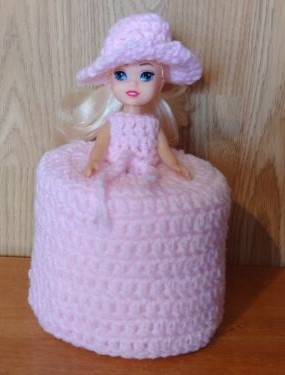
I had an unexplainable flashback to my early childhood the other day.
For some reason, I was thinking about an object that sat on the back of our toilet when I was barely out of diapers. The object looked like a beautiful doll with a large, crocheted skirt, and I thought she was stunning. So stunning, in fact, that I was devastated when my mother told me that I couldn’t play with her because she wasn’t a toy but instead was a toilet paper cover.
She said the skirt was so full because it covered an extra roll of toilet paper.
Her explanation confused me. Why would someone waste a perfectly good doll on toilet paper? But even more curious to me was why we needed to hide the extra roll since there was already a clearly visible one of the holder next to the toilet. If toilet paper was that embarrassing, shouldn’t all of it be covered?
My mom couldn’t answer my questions, and, in hindsight, she probably had the same questions I had. The doll/toilet paper cover thing was definitely not my no-nonsense, practical mother’s style. I’m guessing that it was probably a gift from someone, so Mom felt compelled to use it. My hypothesis is backed up by the fact that the thing never resurfaced when we moved a couple of years later.
I’m not sure why I remembered the mysterious toilet paper cover more than fifty years after I last saw it. But I do know what it represents to me: the tendency for some people to hide what they don’t want others to see by creating distractions. These individuals also shut down anyone who asks questions about what is actually under the full skirt.
Hiding anything is generally problematic, but it can also be particularly traumatic for people like me who question everything and who value transparency.
Over the past few years, I had to deal with a person who wanted to shut down my questions while simultaneously surround herself with people who would swear the object on the back of the toilet was simply a doll with a big skirt and was most certainly not covering up something like toilet paper.
It took its toll on me. I questioned my questions, my self worth, my skills, and my expertise. I could clearly see the toilet paper and wanted to know why it was hidden. But when I asked, I had my hand slapped again, and again, and again and had to deal with a chorus of the hand slapper’s loyal followers who practically chanted “There’s nothing to see here. Just go along to get along.”
I know they probably all saw the toilet paper but were in self preservation mode. I just can’t do that. It’s not who I am. If I don’t call out the hidden toilet paper, I’m fairly certain my brain will explode.
Thankfully, the people I most respect affirmed my questions about the toilet paper and my integrity. They held me up when I would have otherwise crashed. They are what kept me sane.
As I write this, I realize that individuals who don’t know anything about the situation are probably wondering why I am writing something so cryptic, but I have my reasons.
First, a lot of people have asked me why I haven’t been writing. The truth is, when you are beaten down, it’s hard to do anything but survive. For the past three years, I was just trying to survive.
Secondly, I want to emphasize the importance of surrounding yourself with people who build you up instead of tear you down and are willing to look under the big full skirt with you to see what is really there.
And most importantly, I want to publicly state that I have put that entire situation behind me. One of the people who didn’t let me fall actually offered me a path to get away from the toilet paper deniers. I am now walking down it, starting to heal, and starting to write again.
Soon, the situation I left will just be a memory like the weird toilet paper doll cover thing on the back of the toilet, It will continue to fade as more important and current issues occupy my brain. But I know I will still take out the memory from time to time, brush it off, and keep asking questions. One of those questions will always be why so many people denied seeing the toilet paper because, if they had, it could have been used to clean up the load of crap they were also ignoring.
The Place You Belong

I hated feeling like a stranger in my own life.
Thankfully, I rarely experience that feeling anymore, but it used to creep into my psyche like an unwanted encounter with a mean girl from high school. I did my best to present as confident and competent, but I actually felt like a pretender and an invader in the lives of people who really belonged.
I have, after all, spent my entire life living in places where I don’t have a family connection. Or so I thought. Because sometimes, one tiny piece of information can change everything.
For me, that small shift was seeing a headstone at a park where I walk my dog on a regular basis. The last name on the marker is Mowen, which is my great-grandmother’s maiden name. Initially, I just thought this was interesting. After all, I live in the Eastern Panhandle of West Virginia, wedged between Northern Virginia and Maryland. My dad grew up in Massachusetts, my mom grew up in Michigan, and my family moved several times when I was a child. I didn’t grow up around any extended family.
This is probably why I embraced genealogy with a passion and became the family historian. When my grandparents passed away, the treasures I inherited might have had little value for many people, but to me the old photos, ledgers, deeds, and birth certificates are priceless. I’ve done a DNA test, convinced my parents to do a DNA test, and spent hours trying to figure out the puzzle of my family tree. What I never expected was to randomly stumble upon a headstone of a distant relative.
And yet, I did. After logging onto my laptop and doing some simple research, I determined that I was indeed related to the Mr. Earl C. Mowen, who is memorialized by a simple marker on a forest trail in Poor House Farm Park. Granted, the relationship is rather distant as Mr. Mowen and my great-grandmother had the same grandparents.
My great grandmother’s family is actually from Washington County, Maryland, which is only minutes from my house. I have ancestors buried in cemeteries in nearby Hagerstown, and a few geographic locations actually bear the last name of some of my ancestors.
While all of this is fascinating, it shone a light on something even more important: having a family connection to the area where I now live hasn’t affected my feelings about being a stranger in my life. I rarely feel that way anymore not because I have historical ties to this area but because I’ve been able to build my own life. Instead of being a stranger, I’m a main character surrounded by people who accept me, and care about me, and support me even though we don’t share the same DNA or childhood memories. I don’t have to pretend or feel like an invader.
I can create the place where I belong.
Getting Back Up
There is an anecdote in my baby book that explains so much. The brief notation is written in my mother’s perfect handwriting.
Christmas 1969 Trina was in the Sunday School program but kept falling backward.
That is all it says.
As a teenager, I remember asking my mom to elaborate. There really wasn’t much to tell. Apparently, nearly three-year-old me was one of several children singing Away In the Manger, but I could only get through a few lyrics before I’d fall backwards. Then I’d pick myself up, resume singing, and fall over again. And then I’d pick myself up again. And again. And again.
I hadn’t thought about that story in decades until this week when I was clinging to the root of a wild Rhododendron bush on the side of a cliff.
How could I have let myself get into this situation? I am the person who was once too uncoordinated to sing and stand up at the same time.
Being uncoordinated has shaped the person I am. I am the little girl who could never do a cartwheel and failed gymnastics. I am the kid who never once hit the ball during softball. I am the teenager who could run fast during a track meet but tripped at the finish line. I am the college student who sprained her ankle walking down the stairs of her dorm. I am the friend who got left behind on a ski trip because I just couldn’t get my feet to work correctly. I am the woman who shattered her wrist while walking her dog. I am the person who constantly has bruises and who everyone at work worries about every time they hear a crash or a loud bang.
My lack of grace generated a sense of fear in me at an early age. I wasn’t afraid of heights. I was afraid of what I might do to myself if I tried to do anything from a height: jumping downstairs, going off a diving board; springing off a swing in mid flight. I’d watch in awe as other kids did those things, but I avoided doing any of those them myself. And those decisions came with regrets. I once stood at the top of a fire pole willing myself to go down, but my feet refused. They felt as though they each weighed a thousand pounds.
My journalist mother was writing a feature story about a family that had installed the pole in their house as a fun way for their children to get from the second floor to the first floor. All of the kids in the house, their friends, and even my mother had gone down the pole. And yet, I stood in fear at the top unable to grab and go. The shame I felt from having to take the stairs stayed with me and inspired me to push through the fear.
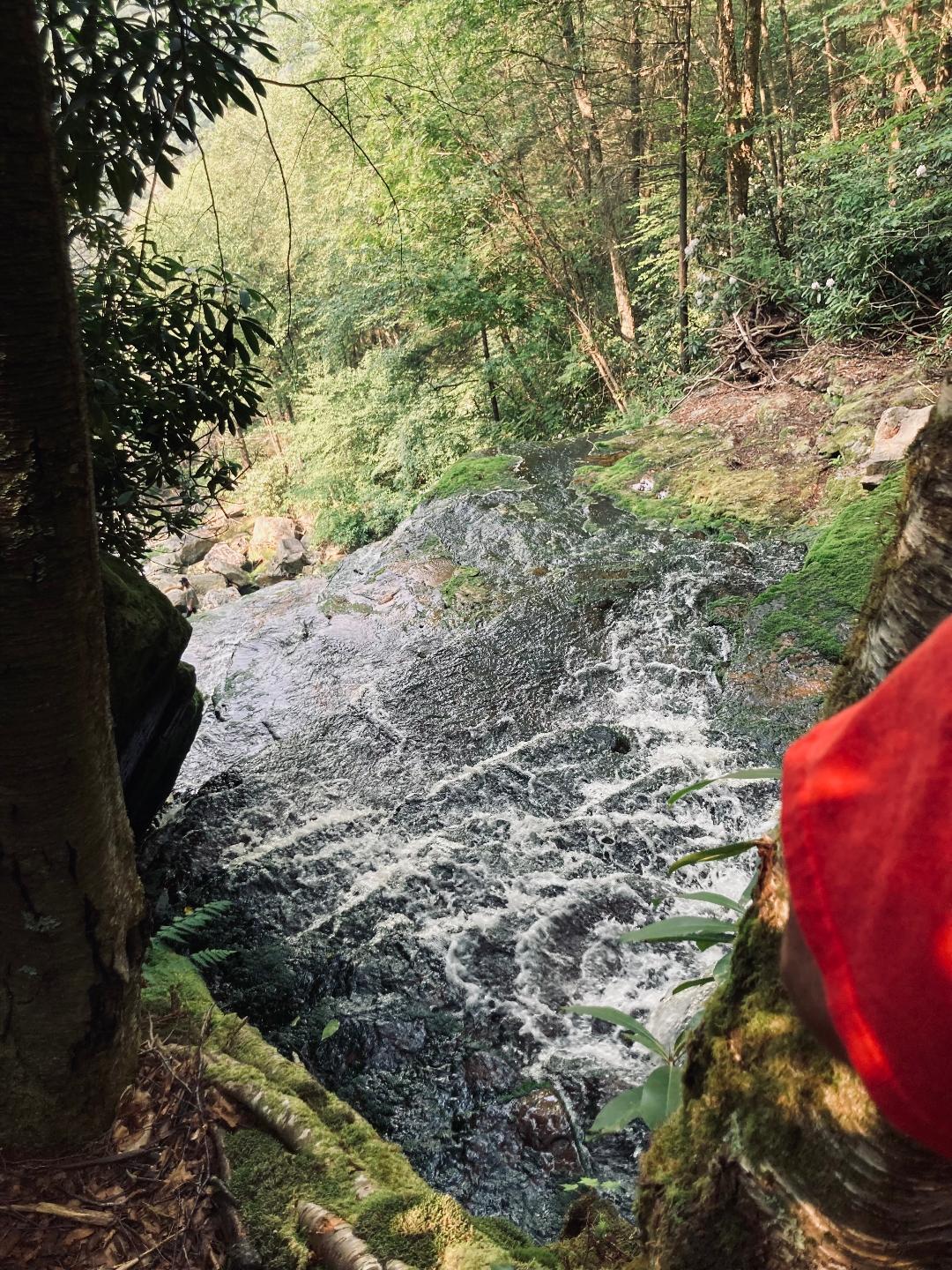
Which is why, earlier this week, I found myself desperately hanging onto the side of the cliff.
My husband and I had taken the week off to spend time hiking and exploring state parks. He was on a mission to find a certain waterfall from a historical illustration, and his search took us to a series of falls that could only be accessed off the beaten path.
Off the beaten path turned out to be what I can only describe as an almost completely vertical cliff.
Getting to the first falls was fairly easy, but I took one look at the steep descent to the next one and said, “I can’t do it.” But then I did it anyway. The descent to the third waterfall, the one that plunges forty feet, was basically a forty foot vertical drop with vegetation and a few foot holes. “I can’t do this,” I said. And then I did it anyway. My forehead and back were dripping in sweat, but I did it anyway.
As my husband and I stood on a rock taking photos of the falls and basking in our success, he turned to me and said, “Now we have to do the hard part and go back up.”

“I’m not worried about that,” I replied. “Getting back up has always been the easy part for me.”
I wasn’t just referring to the fact that, to me, climbing uphill really is much easier than going down a hill, when I often feel unbalanced.
I was referring to the fact that life has demanded that I learn to turn my weaknesses into strengths. When I was almost three years old, I had a problem simultaneously singing and standing. But when I fell, I always got back up. And I eventually learned to sing and stand. And to ride a bike. And to climb trees. And to climb down cliffs. And to trust myself to take risks.
The secret to enjoying life isn’t just about finding those things at which we are innately good and pursuing them. It’s about finding joy in overcoming those things at which we sometimes fail.
It’s about getting back up.
The Obituary I Never Wrote
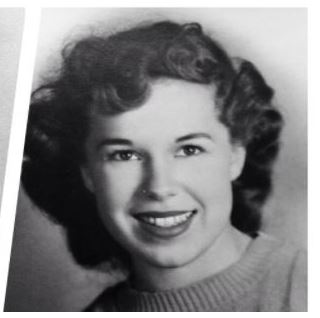
Last October, as the pandemic dragged on, my mother-in-law passed away.
She was 87 years-old and had been in poor health for a while, so I wasn’t surprised. At the same time, I was very surprised. Maggie was larger than life to me. She was unique, quirky, and completely different than my own mother. She was also the best mother-in-law I could have ever asked for.
Because of the circumstances, and because my husband and his siblings are private about such matters, only our family and friends were informed. There wasn’t even an obituary.
But today is our first Mother’s Day without her, and I couldn’t let it pass without paying tribute to the feisty woman who I credit for raising the man I married.
If this were an actual obituary, I’d be expected to provide the basic facts about Maggie that anyone could find on a genealogy site. I might even sprinkle in a few of her significant accomplishments. But a traditional obituary isn’t fitting for a woman like Maggie. Besides, the only interesting nugget from her early life, which I find incredibly entertaining, is the fact that, according to my husband, she once won a beauty pageant. She’ll probably start haunting me now for even making that public knowledge.
My husband tells me that his mom changed quite a bit from when he was a child to the time when I first met her. She wasn’t even called Maggie until all of her children were grown. My brother-in-law, Keith, started calling her that, and the name stuck. Growing up, she was called Marge, and, at some point, was dubbed Muff after Little Miss Muffet, apparently because she was so tiny. I don’t get the connection, but I wasn’t around back in the 1950’s either.
She never told me she was called Muff. I found out when I was attending a large meeting when we still lived in Charleston. I was sitting next to another Grand Dame, Helaine Rotgin. Maggie had worked on Helaine’s campaign for the WV State Legislature in the 1970’s, and Helaine was quite fond of her. As we waited for the meeting to start, Helaine turned to me and loudly yelled (yes, she yelled as she was getting hard of hearing)”How is Muff?” Everyone stopped and stared at me. All I could say was, “fine?” Only later did I get an explanation.
I shouldn’t have been surprised that Maggie had supported Helaine, who was a die-hard democrat, and to my knowledge, the first Jewish woman in the WV Legislature. Maggie herself was a die-hard Democrat. Shortly after Trump was elected and Maggie was still living on her own, I stopped by to visit while on a business trip in Charleston. She proudly showed me the Obama button she still wore every day “just to piss people off.” She was addicted to MSNBC and spent the last few years of her life raging against Trump. Unfortunately, she died when he was still president. I can only imagine how joyful she would have been about the Biden inauguration.
But Maggie, didn’t just watch television. Up until the last couple of years of her life, she was a voracious reader. I actually met her at the bookstore where she worked for years, and I didn’t leave the store empty handed. She picked out several books that, according to her, I “had to read.” That pattern continued for decades, and I spent many hours on the phone talking to Maggie about books. Her recommendations were always stellar.
Other than reading, Maggie’s favorite hobby was going to thrift stores before thrifting was cool. She had a talent for finding the coolest clothes and jewelry then gifting them to just the right person. Generally, her gifts were random as she wasn’t one for dedicating time and energy to celebrating holidays, with the exception of Halloween. I’ll never forget taking my then three- year-old son to her house for Halloween to find her dressed up as Eminem. No that’s not a mistake. She wasn’t dressed as M&M candies. She was dressed as Eminem the rapper.
That wasn’t the only time Maggie left me speechless. My husband and I had just started dating when Maggie struck up a friendship with her neighbor, a flaming gay guy at least thirty years her junior. I adored their friendship, but I became worried when he convinced her to start breaking into empty houses that were for sale just to “have a look around.” Thankfully, they were never caught and arrested.
Don’t get me wrong. Maggie was far from a criminal. In fact, she spent a good part of her life caring for her others. In addition to raising three children, she took care of her sister for years. She also cared for both of my children after they were born. In fact, she and my son had a bond that I never experienced with my own grandparents. Of course, the fact that he could cuss around her and she would cuss right back probably helped cement their relationship,
My children were her only grandchildren, and she adored them. My husband and I must have been arguing one of the only times I witnessed her get angry with him. “Trina will always be right,” she said. “She gave birth to my grandchildren, so I will always side with her.”
Oh how, I loved that woman.
As I as writing this, my husband walked in and asked what I was doing.
“I’m writing about your mom,” I said. “You know she’d hate that,” he replied.
He was right. Maggie would hate it. But she also deserves it.
Five Questions
 In the weeks leading up to the 2020 presidential election, I noticed a trend on Facebook. Trump supporters were posting false information and then complaining when the Facebook administrators called them out. Apparently, some of these individuals were even getting private messages telling them about the consequences of posting false information. When discussing this, one person said, “everyone is getting that message.”
I wanted to comment, “I haven’t received that warning because I don’t share false information.” I didn’t though, because I was fairly confident I would have been called a lying libtard or told that Facebook was targeting conservatives and protecting progressives.
The irony of all of this is that the people who kept posting false information were the same individuals ranting about “fake news.” While they were definitely projecting (unconsciously taking unwanted emotions, traits, and behaviors they didn’t like about themselves and attributing them to someone else), they were also acting like spoiled children. In their delusional brains, something is only a fact if it justifies their beliefs or meets their needs.
Before the election, I rolled my eyes at their temper tantrums and self-centered posts. After the election, I realized that this twisted thinking, encouraged by President Donald Trump, was dangerous. When Trump and his allies told his minions that the election had been stolen, they believed them. Even when every avenue was pursued to ensure the election results were accurate, including re-counts in Republican-controlled states and court cases, these Trump supporters were convinced, or pretended to be convinced, of some grand conspiracy to steal the election. In an attempt to get their way, they filled busses and airplanes during a global pandemic and went to Washington D.C. to demand that Trump remain president.
The mayhem committed at the capitol building in Washington D.C. on January 6 is unforgivable as are false assertions that members of “Antifa” disguised themselves as Trump supporters and were the actual perpetrators.
Following the events on Wednesday, Trump followers are now complaining that actions taken by social media and technology companies to address hate speech and violence is fascism. Considering the education level of most of the people I’ve witnessed saying this, I’m fairly certain they would be unable to define fascism without being given a computer to Google it. These are, after all, the same people who call any policy with which they don’t agree socialism. The icing on their hateful cake is that many are proclaiming themselves Christians while calling people with different beliefs evil.
Don’t get me wrong. I believe people have the right to different opinions just as they have the right to organize and participate in peaceful protests. What they don’t have the right to do is demand that our country revolve around their belief system. And for those who say that’s not what they want, I have five questions:
- No one disputed that Hillary Clinton won the popular vote in 2016 but that Donald Trump won the electoral college. If Hillary Clinton had proclaimed the election was stolen, filed multiple lawsuits trying to get the results overturned, and tried to convince a secretary of state to find 11,000 votes, what would you have done and said?
- In Italy, the birthplace of fascism, people noted that the scenes at the United States Capitol on Wednesday were reminiscent of events in Italy in the 1930s under Mussolini. You call people who have taken a stand against police violence and for basic human rights as “Antifa,” which is short for Anti-fascists. Does that mean that you are pro-fascism?
- In America, where the economy is rooted in capitalism, the wealthier you are the more access you have to political power. Donald Trump used his wealth and celebrity to win the 2016 presidential election but has yet to publicly share his tax returns. Since taxes are used to pay for public education, public safety, roads, and numerous other services that are equally available to all citizens, the amount he pays in taxes is one mechanism of demonstrating how he much he has or hasn’t contributed to the public good. Taxes are a contentious issue for many conservatives who constantly worry that their taxes might increase (even though they are benefiting from those public services). If the amount people pay in taxes is so important to you, why haven’t you held Donald Trump accountable to ensure he contributes his fair share?
- This week I saw a heartbreaking post from a young woman whose father berated her for not supporting Trump. He told her that college was giving her the wrong ideas. This isn’t unusual. I’ve witnessed numerous Trump supporters complain that colleges are turning young people into liberals. A college education is intended to expand a young person’s knowledge, expose them to different ideas, and teach them critical thinking skills. Are you afraid that people who think for themselves or are better educated than you are a threat who will challenge your belief system or demonstrate that your way of thinking may not be for the greater good?
- A vast number of Evangelical Christians have continued to support President Trump even though he has never been actively engaged with the church or behaved in a Christ-like manner. Among his many behaviors, he has bragged about grabbing women by the genitalia, engaged in name-calling, endorsed policies that separate families, and lied on a daily basis. He cheated on his wives. In order to gain the support of Evangelical Christians, he chose Mike Pence as his vice president, but last week put him in danger when he didn’t “follow orders” to disrupt the electoral process. And he has supported a health care system that operates on the principles of making money rather than on ensuring all Americans have access to it. None of these actions are in the least bit Christian. And yet so-called Christians have supported him in part because of his ability to put in place conservative judges. How do your reconcile the Golden Rule, the beatitudes, and the Ten Commandments with supporting a man who has demonstrated he worships wealth and power more than anything else?
If any of Trump’s supporters read this, they will probably be angry. That’s fine with me. I’ve been angry for four years and during that time the most controversial political action I took was to wear a pink, knitted hat. And, for the record, I didn’t even have to purchase it thus contributing to a politician’s coffers. Someone made it and gave it to me for free because that is what genuinely nice, not evil, people do.
What We Didn’t Say

The conversation with the two strangers started with a puppy. It was an adorable, soft, fluffy, three-month old Husky with bright blue eyes that drew me to it like… well… like any dog draws me to it.
In all honesty, it could have been a mangy mutt, and I would still have stopped my bike ride to say hi. I do, after all, always carry dog treats when I am out riding my bike.
The puppy was trying to catch a quick nap while the person on the other end of its leash was engaged in conversation with a woman working in her yard. I interrupted the conversation to first ask if I could pet the puppy and then to ask all of the important questions about the puppy.
Neither the puppy’s owner nor the woman with whom he was speaking seemed to mind. In fact, their interest turned from the puppy to me.
“How far do you ride?”
“Where do you ride?”
“Don’t you think some of those roads are dangerous?”
The last question prompted a discussion about how some people can be complete jerks.
“Someone once threw a whole cup of iced tea out of their car window at me,” I told them. “It hurt because it was hurtling from a moving car, and I know it was sweetened because it was so sticky.”
“Yeah,” the guy said, “People can be real jerks. I was out jogging once, and someone yelled then through a raw egg at me. It hit me right in the chest.”
We were all silent for a moment before he said, “I had to just turn the other way. There’s no point in confronting people like that. It just makes the situation worse.”
We continued to talk about how confronting angry and rude people isn’t worth the effort. What none of us mentioned, or even acknowledged, was that the stakes were different for the the man.
That’s because the other woman and I were white. The man was black.
If the conversation had been with friends or even acquaintances, we would have addressed the issue of race. But when the man mentioned having the egg thrown at him, I didn’t ask if he thought the perpetrators were racist. When he said he didn’t engage with hateful people because he might land in jail if he got in a fight, I just nodded. And when he said that his wife doesn’t want him to let the dog out at night because the neighbors had threatened to call the police if it barked, I joked that all my neighbors have dogs that bark.
I didn’t raise the issue of racism, but I could feel it hanging in the air like a storm cloud full of rain. And even though it was obviously there – heavy and dark -we acted as though it didn’t exist.
I felt as though raising the issue would be akin to handing each of them a “Black Lives Matter” bumper sticker only to be handed an “all lives matter” one in return. I just didn’t have the emotional fortitude.
The issue of race shouldn’t be political because there should only be one view of it: it shouldn’t exist and when it does, we need to acknowledge and address it.
And yet, just like during my conversation with strangers yesterday, we often dance around racism as if ignoring it will make it go away.
It won’t.
I honestly don’t know that actually raising the issue during that particular conversation with strangers would have been appropriate. What I do know is even though no words were said, it WAS part of the conversation.
And here’s the other thing I know. That puppy? The one that brought us all together for a short period it time? That puppy loved getting attention from all of us and had no concept of race.
Maybe that’s why I like dogs so much.
The Difference Between Like and Respect
 I was having dinner on a friend’s deck with a group of like-minded women when we got the news: Ruth Bader Ginsburg had died.
We all reacted differently even though I’m certain we were all feeling the same way. One of us burst into tears. Another just sat silent while a third stood up and started clearing dishes. Me? I cussed. I cussed because Notorious RBG was a role model and a heroine. I cussed because I know what is at stake. And I cussed because some people I know will see her death more as an opportunity than a reason to mourn.
The following words are for those people: I may like you, but I can’t respect you.
I like you because we might laugh together or share common interests or talk about our children.
But I can’t respect you because your vision of what our country’s future holds for those children isn’t one of diversity and inclusion and equality.
I can’t respect you because you believe your narrow definition of Christianity is the only legitimate religion.
I can’t respect you because you can’t discern the difference between journalism, opinion pieces and fake news.
I can’t respect you because you share information on social media that validates your opinion even if when the information is a complete lie.
I can’t respect you because you support political candidates and listen to pundits who claim that liberals aren’t real Christians.
I can’t respect you because you are a one-or two-issue voter who makes decisions at the ballot box based on dogma rather than on the scope and impact of a variety of policies on people’s day-to-day lives.
I can’t respect you because no matter how many times someone has tried to explain the difference between “gun control” and “taking away your guns,” you choose to listen to propaganda from the NRA,
I can’t respect you because you are voting for politicians who care about money more than they care about the well-being of people.
I can’t respect you because you think patriotism is marked by saluting a flag rather than by honoring the first amendment.
I can’t respect you because you throw around the word socialism when what you are really saying is that you don’t want your tax dollars being used to provide services for people you have decided are “undeserving.”
And most of all, I can’t respect you because you are supporting politicians who have shown general disrespect and even criminal behavior toward women.
I know these words will offend some of you, and now you probably won’t respect me. I don’t care.
I’m 53 years old, and I’ve fought hard to become a strong, opinionated woman who cares about minorities and immigrants and the poor and people of different faiths.
I’m writing this because even though there are a lot of people I don’t respect right now, I couldn’t respect myself if I left these words unsaid.
Also, I’m fairly confident that Ruth Bader Ginsburg would approve.


 Just So You Know