Blog Archives
Swimming in a Dress

Victoria swim wear – http://www.fashion-era.com/images/SocialHistory/swimpad500.jpg
This week, I had two conversations that morphed into one question about how we live our lives.
The first conversation was with a friend who told me about home-schooled children who were on a field trip at the Shepherd University pool. They were affiliated with a religious group that prohibits females from wearing pants, and, apparently prohibits swimming suits as well. My friend’s son watched astounded as the girls jumped into the pool still in their dresses.
The second conversation occurred on the phone with my mother, who wanted to know if my son had received his birthday check. After telling her yes, I added, “I know, he hasn’t sent a thank you note to acknowledge it. I’m a bad mom.”
My mother disagreed. “No, you aren’t. You are a much better mom than I was.”
Her comment shocked me, because I’m not even close to the type of mother she was.
My mom always made sure we sent thank you notes immediately. She planned menus that met every dietary guideline. And she ensured we did our Saturday chores, our beds were always made and that our laundry was always put away.
Not only do I fail to do all of those things on a regular basis. but my life is a chaotic mess compared to the structure in which I grew up. I told this to my mother in fewer words, but she responded, “You have fun with your kids. You know how to relax and just enjoy them. I never did.”
Not to belabor the point, but she WAS always wound quite tightly, and I’m generally not wound nearly that tight.
But getting unwound wasn’t easy. As I recently told a friend, “I spent the first 15 years of my life being a nerd trying to follow all the rules, and I spent the next 15 years trying to prove I was a rebel. Then I became a mom and had to find a happy medium.”

swimsuits in 1919 – http://old-photos.blogspot.com/2008_01_01_archive.html
In short, I had to break free of restrictive expectations and learn balance so I could enjoy life.
Which brings me back to the girls who jumped into the swimming pool in their dresses and to my question.
“Can anyone really enjoy life fully when they are restricted by a rigid belief system?”
Being in a pool with a dress is probably more fun than not being the pool at all, but I can’t imagine it was all that enjoyable. The water-logged clothing had to make movement difficult and exhausting.
I have absolutely no right to question or judge the beliefs and choices of the girls or their families. If they choose to swim in a dress, they have every right to do so.
But I have every right to question my own choices and the self-imposed restraints I’ve often put on myself – those that prohibit me from enjoying life. Sometimes these have been thinking a work deadline is more important than a few hours with my children. Sometimes they have been my obsession with gaining weight. And sometimes they’ve been my concerns that I will fail when I try something new.
I’ve definitely done my share of swimming in a dress.
But both times and people evolve, and as I’ve aged, I’ve become better and better at shedding my dress. That doesn’t mean I’m going out in public in a string bikini, but it does mean I can enjoy a good swim in a modest tankini.
Shame is Not a Form of Birth Control
I had to double-check my calendar this morning to assure myself that it was actually 2013 and I hadn’t been sucked into a time warp.
I hadn’t been.
Instead, I was sucked into reading news articles about a school assembly featuring an abstinence-only proponent whose only educational credential is a Psychology Degree from Jerry Falwell’s Liberty University.
See: http://www.dailymail.com/News/201304110267 and http://www.wvgazette.com/News/201304110229 .
I can’t emphasize enough how inappropriate the assembly was.
Almost 20 years ago, when I was working in the field of sex education, experts had already proven that abstinence-only and shame-based tactics don’t work. And promoting a particular religious philosophy in a public school is simply prohibited.
But self-righteous people, who believe they actually know what God is thinking, seem to find a way around these issues.
The speaker, Pam Stenzel, and her sponsors, a religious group called Believe in West Virginia, say her speech wasn’t faith-based. Instead they say it was just a warning about the dangers of sex before marriage.
Those few words should have been enough to keep this woman out of the public schools.
A real sex educator doesn’t pretend that a wedding ring can protect people from a sexually transmitted disease, an unplanned pregnancy or heartache.
A real sex educator doesn’t outright dismiss homosexuals, who are still fighting for the right to even be married.
And a real sex educator doesn’t condemn, judge or shame.
Instead, a real sex educator gives facts – not statistics that have been manipulated to fit a certain dogma.
A real sex educator will agree that sex is the only human behavior that has the potential to create life or to threaten a life. The educator’s job is to help individuals make decisions to prevent unwanted consequences.
And a real sex educator will spend time talking about healthy relationships and about treating others with respect – not condemnation.
Years ago, I was that person, and I will never forget making a presentation about AIDS and HIV in a middle school classroom. As I interacted with the students, the teacher, who was obviously not happy I was there, took out his Bible and placed it open on his desk. He pretended to read, and I pretended to ignore him.
A year later, I had the same assignment and found myself in the same classroom. But instead of taking out his Bible, the teacher made a point of welcoming me and telling his students they should listen. He then privately told me that “a really good person” from his church had been diagnosed with AIDS. Instead of noting that a lot of “really good people” had been diagnosed with AIDS, I was just grateful that he had become a bit more open and less judgmental.
Now, I am hoping the same for all those involved in permitting the recent school assembly at George Washington High School.
Slaying the Lizard of Oz
 When my daughter was in preschool, she discovered The Wizard of Oz, and even though she absolutely loved the story, she just couldn’t get the title quite right. She called the classic story “The Lizard of Oz.”
Initially, my husband and I tried to correct her, but nothing worked.
My son, on other hand, never even attempted to point out that a lizard is very different from a wizard. He simply chose to make fun of his sister, and since she didn’t understand his ridicule, she wasn’t really bothered.
Trying to teach my daughter the difference seemed futile. Instead, we decided that allowing her to happily promote the concept of a giant lizard ruling over the Land of Oz made our lives more peaceful.
At least, it was more peaceful until that day she came home dismayed that her parents made her look foolish by allowing her to publicly talk about “The Lizard of Oz.”
I can’t tell this story without thinking of all the adults who also believe in the Lizard of Oz.
These are people who make up their minds about something and only listen to those who validate their beliefs: the politicians who believe that they speak for “all Americans” or the old white guys with money who only listen to other old white guys with money (or to those who pander to them). They, like the Scarecrow in the Wizard of Oz, could easily gain wisdom. All they’d have to do is listen to people who better understand the real issues.
These are the people who only make decisions based on their own paradigm. They ignore that the world is changing, which means their way of doing things should change too. Instead, they, like the Tin Man, appear heartless because of their refusal to adapt with little regard for others.
These are the people who are self-absorbed. Like the Wicked Witch of the East, they believe those seeking help are the problem, and they care more about feeding their own egos than feeding the hungry.
But no matter how hurtful or destructive these people are, they get away with their behavior because there are even more of us who enable it. We act like the Cowardly Lion, who is afraid of everything. We fear calling out those who are wrong. We fear making ourselves look bad. We fear causing too many problems. We fear repercussions. And we fear failure.
But being the Cowardly Lion is outside of my comfort zone. I’m not the type to sit back because trying to change misperceptions and outright mistakes is too difficult.
I’m off to slay the lizard, the problematic Lizard of Oz.
Some People Should Just Shut Up
 Being a parent sometimes means being a hypocrite. If you don’t believe that you are either a) not a parent or b) incredibly (and unbelievably) perfect.
I can provide hundreds of examples of times I’ve behaved in a manner that directly opposes what I’ve told my children. Apparently, my husband is a few steps higher on the parenting evolution ladder than I am. He doesn’t always behave better than I do (although he probably does most of the time), but he’s generally less verbal about certain expectations for our children. That way, his behavior doesn’t seem quite as hypocritical.
I, on the other hand, am constantly setting standards that I can’t even begin to meet myself.
For example, ever since our children started talking, I insisted they use the words “please be quiet” instead of “shut up.”
Yet, I don’t do at all well with that particular language skill.
Recently, I was enduring a painful meeting during which a self-important person was holding forth as though his words were actually meaningful or of interest to anyone but himself. To survive the ordeal, I pretended to take notes while actually scrawling page after page of the words “Shut up. Just shut up.” A few times, I even added a less than flattering description of the person I wanted to be quiet.
But the words “please be quiet” are often inadequate. Quiet means hushed tones and soft voices. Quiet shows a lack of passion or emotion. And quiet doesn’t indicate disagreement when someone else’s words are hurtful or rude or simply pointless.
That’s why I haven’t been thinking “please be quiet” lately when people try to disguise their hate and prejudice with self-righteous statements and stupid jokes. Instead, I want to scream “just shut up” every time someone equates being poor with being lazy. But I haven’t.
I’ve held my tongue as tightly as the man gripping a snow shovel while he rode his bike through my neighborhood on Wednesday.
Wednesday we were supposed to get a blizzard. Schools closed. Government shut down. Businesses even changed their hours of operation. And even though all we got were a few inches of snowy slush, a lot of people with steady jobs and stable employment had a snow day.
The man on the bike didn’t have a day off.
He was looking for work shoveling driveways and sidewalks. He was offering his services to people who most likely judged him on his ragged appearance and his lack of a car. He didn’t have a truck to which he could attach a plow. All he had was a shovel and some muscle.
I’ve seen him selling his shoveling services on other snow days, but this past Wednesday was different.
I was leaving the neighborhood when he rode by me. He didn’t know where I lived or whether I was even a potential customer. I was simply some lady walking a German Shepherd on a cold and windy afternoon.
But, even though I had nothing to offer him, he slowed, gave me a wide smile and told me to enjoy my day. And then, balancing his snow shovel while pedaling his bike, he quickened his pace and was off.
That’s the exact instance I realized that maybe, instead of teaching my children to always say “please be quiet,” I should have been teaching them that sometimes standing up for those without a voice means shutting down those who speak against them. I should have been teaching them that there are times that polite isn’t as important as human rights. And I should have been teaching them that there are times when some people really do need to “just shut up.”
Did You Just Stick My Jelly Beans Up Your Nose?
 There are those days when I feel as though people are sticking my jelly beans up their noses.
In more innocent times, I never worried about leaving a bowl of jelly beans on my desk. Instead, I was pleased to share with others while regularly snagging a few pieces of candy myself.
I should have known better.
I should have realized that some people will always find a way to sabotage life’s small pleasures because they are so focused on meeting their own needs.
I learned the lessons of jelly beans when I was getting my master’s degree and had classes with someone from high school. I don’t remember ever talking to my fellow student in high school and was honestly surprised he’d even graduated from college.
I had preconceived beliefs about him, and he, in turn had preconceived beliefs about me. I remember the day he told me, “you are actually really funny. In high school, your friends told me you were funny, but I never believed it. I always thought you were just too smart and too serious. You really aren’t that serious at all.”
I couldn’t really fault him for never getting to know me as I’d never made the effort to know him.
Instead, I’d simply thought he was someone who spent a lot of time in the principal’s office.
Turns out, I was wrong.
He rarely spent any time in the principal’s office. Instead, he spent a lot of time with the vice principal, who was in charge of discipline.
“Mr. Tidquist and I,” he said, “were quite familiar with each other. But I really didn’t like him or the jelly beans he always kept on his desk.”
I shouldn’t have asked about the jelly beans, but I couldn’t resist.
“Mr. Tidquist always had a jar of jelly beans on his desk, and sometimes he would grab a handful and eat them while lecturing me,” he told me. “One day, I was sitting in his office alone waiting for him to come in, and I was just so angry. I kept looking at those jelly beans and thinking of Mr. Tidquist eating them. I just couldn’t help myself. I would take few, put them up my nose, put them back in the jar and then stick some more up my nose.”
He smiled.
“I can’t even describe how I felt when Mr. Tidquist came back in his office, sat at his desk, grabbed a handful of jelly beans and ate them.”
After hearing the story, I couldn’t immediately describe how I felt either, other than to say I was relieved that I’d never been in Mr. Tidquist’s office and therefore never been tempted to eat his jelly beans.
But lately, I feel as though my decisions, beliefs and values are like the jelly beans on Mr. Tidquist’s desk. I take pleasure in being a strong and educated woman who can think and act on her own. I like to believe that by sharing and discussing my opinions, I just might help make the world a little bit better.
Instead, when I’m not around, some people choose to express their dislike and misperceptions by judging me, discrediting me or misinterpreting my actions. But they don’t say anything to me directly.
In other words, they are sticking my jelly beans up their noses.
Since I’m human, there’s a part of me that can’t help but be bothered and offended. But there’s another part of me that realizes how their behavior has nothing at all to do with me. Which is why, instead of taking my jelly beans off my desk, I’m thinking of putting a mirror next to them.
That way, when people put my jelly beans up their noses, they are forced to see how their words and behavior only reflect back on them.
In the meantime, I’m going to continue to enjoy sharing my jelly beans with everyone who appreciates them.
Buck Wild in a Beauty Salon
 If you’ve ever lived in West Virginia, you know all about MTV’s newest “reality show” premiering this Thursday night in the spot previously filled by Jersey Shore.
If you’ve never lived in West Virginia, all the drama surrounding Buckwild has probably either escaped you and/or seemed relatively unimportant. But here in the Mountain State, there is a great deal of concern about how the show will perpetuate negative stereotypes about those of us who live here.
When the first promos began airing last month, there were newspaper articles, editorials and online petitions criticizing Buckwild. Even our junior U.S. Senator and former Governor, Joe Manchin, wrote a letter to MTV asking that the show not be aired. Many argued that his subsequent appearances on national news and talk shows simply provided unpaid advertising.
To me, the show just looks stupid. I never watched Jersey Shore, and I have no plans to watch Buckwild. And yes, I even signed one of the online petitions asking that it not to be aired. But my reasons have nothing to do with how people might perceive West Virginians. There will always be those who believe stereotypes regardless of what they watch, hear or read.
To me, the show is actually more of a reflection on the entire nation than it is of West Virginia anyway. And while I deplore the concept of encouraging young people to do really stupid (and yes, mostly scripted) things for others’ entertainment, what I deplore even more is that there is obviously a large market for such shows. And yes, I know there are many who will tune it to watch Buckwild out of initial curiosity, but that’s not my issue. My issue is with people who watch this type of show for entertainment and for more people to ridicule. This includes television viewers such as the guy who was having his hair cut during my last hair appointment.
Until a few years ago, I never understood why any man would go to a beauty shop, but that was before I discovered the salon where I now go.
The place is more entertaining than anything on television because the people, the conversations and the emotions are genuine. I never complain that my appointments usually last more than two hours, because that time is more compelling than any reality show, particularly those featuring half-dressed young women and cocky young men whose vocabulary is rooted in George Carlin’s monologue about seven dirty words. And, when I think about it, I don’t recall hearing much, if any, cussing in the beauty salon.
Instead, I hear and participate in conversations about real people and real struggles that somehow turn into laughter and hope. The conversations range from cancer, to drug addiction to cross-country motorcycle rides. Everyone in town seems to know the owner and her husband, so there is a constant stream of local characters who come through her doors with their own dramas and issues. Discussions can turn from politics to childhood memories in a matter of seconds. And all of this occurs to some music soundtrack that almost always becomes part of the conversation.
The owner, and my stylist, strives to play just the right music, but she also always has technological difficulties. During my last appointment, she finally gave up when her latest gadget stopped working, and she was forced to turn on the radio to a classic rock station. Of course, the music brought back more memories and more stories.
And then, Manfred Mann’s Earth Band’s “Blinded by the Light” came on, and we all sang along. Sort of. The lyrics have always been unclear, so we all sang a different variations of “revved up like a deuce another runner in the night.” Some bordered on completely inappropriate. In order to resolve the debate, I took out my phone to search for accurate lyrics.
By the time I’d found them, the conversation had already moved on to Buckwild, and everyone was expressing an opinion. That’s when the clean-cut gentleman who had been sitting quietly while his hair was being trimmed said, “I think it looks entertaining, and I’m looking forward to watching it.”
For the first time, the shop went quiet except for Led Zeppelin playing in the background. Everything just seemed to stop. And then, just as quickly, the conversation resumed. Only no one said anything about Buckwild, instead the owner started telling a story about the recent Eddie Money concert.
No one acknowledged the man’s comment, and I don’t know whether he was oblivious to the slight or if he even cared. What I do know that everyone else’s reaction spoke volumes. And I don’t think the silence was so much an indictment on his opinion as it reflected a deep sadness that someone, surrounded by real characters, real conversation and an ongoing celebration of the reality of day-to-day life, would admit he wanted to simply observe the exact opposite.
Hours later, when I was thinking about the incident, I realized how we often lose sight of all that is meaningful around us because the media is trying to sell us a completely different definition of what makes life interesting.
I’m just glad there are people who still don’t buy that, and instead enjoy the simple pleasures of going a bit crazy, or buck wild, in a beauty salon.
Happiness Should Be Like a Dog With a Snowball
 The year 2012 ended with a white Christmas, which is fairly unusual here in the Eastern Panhandle of West Virginia. But then, Mother Nature hasn’t been very predictable, or even very kind, over the past twelve months. Her random and sometimes disruptive behavior was fitting for a year when too many people experienced upheaval and loss. But just like Mother Nature, 2012 also brought bright and sunny moments along with the storms. All serve as reminders of the lessons we need to learn and/or remember.
Lesson 1: We Should Experience Happiness Like a Dog with A Snowball My German Shepherd, Rodney, adores the snow. He loves bounding through it. He loves smelling it. He loves eating it. And most of all, he loves playing in it. As a true fanatic for all things that can be thrown and caught, when the white stuff is on the ground, he begs for someone to pack and throw a snowball.
This Christmas, I noted how thrilled he was with every snowball he caught, even though each fell apart or dissolved in his mouth. Instead of being disappointed when a snowball was gone, he was just as eager for another, which he enjoyed with no concern that it too would disappear.
We should all appreciate our happy moments just like my dog appreciates snowballs. They may be fleeting, but instead of worrying that they may not last, we should enjoy each moment and remain steadfast in our belief that there will always be more.
 Lesson 2: We Can’t Always Control Our Circumstances or Protect Those We Love, but Any Attempts To Do So Are Always Good for a Laugh At the end of June, the Eastern Panhandle, like the rest of West Virginia, was hit unexpectedly by a derecho, or a land hurricane. Most of us had never heard of such a storm prior to the event, and since there were no warnings, we didn’t initially realize the severity of what had happened. We discovered the extent of damage the next day when we saw the downed trees and power lines and when many people experienced a loss of electricity for weeks.
The event left its mark, so in October, when meteorologists called for the Eastern Panhandle to be in the path of Hurricane Sandy, most of us wanted to be prepared. Some of us over-prepared. And some of us even freaked out… a bit.
For my part, I decided my family should ride out Sandy in our basement to avoid the hazards of trees crashing through our roof. We were all safely downstairs when I realized that Skitty, our cat, wasn’t with us. Since Skitty has a tendency to hide in unusual and hard-to-find places, I immediately assigned all family members to search for her. As the wind howled and the trees creaked, we took turns calling her name and shaking a bag of cat food, which is usually the best way to get our over-weight feline out of hiding. This time it didn’t work, and I began to worry that my cat, who is generally too lazy to go outside, was battling the elements.
Just as my anxiety got the worst of me, my son, in his usual dry and sarcastic way, told me that the cat was safe. As it turns out, the only thing she was battling was her disdain for a family who didn’t realize that she’d taken shelter in the basement long before the rest of us. My cat had the sense to do what she needed to do and not be bothered by the drama that surrounded her. I should have done the same.
I hadn’t had enough warning to worry about the derecho, and we managed through the storm and the aftermath just fine. I had way too much warning about Sandy, and even though we also managed through that storm and aftermath just fine, my stress level had gotten so high that even my cat chose to ignore me.
Sometimes, we get so wrapped up in either avoiding a situation or in worrying about what might happen, we simply forget that we can only do so much, we must accept that some things are beyond our control and we should believe in the sound judgment and appropriate actions of others. The results won’t always be what we hope for, but too much worry is only good for providing memories that allow us to laugh at ourselves later. 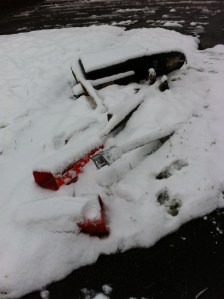
Lesson 3: Life Rarely Goes According to Plan, but When Bad Things Happen, We All Have a Great Capacity for Resiliency and Recovery No one in my family expected the snow that arrived on Christmas Eve, and, even after it began to fall, none of us expected it to last long. But last it did. And in the midst of final preparations for our Christmas celebration, the snow covered the grass and then it covered the roads.
When we realized we were going to have a white Christmas, we celebrated by taking a family walk with Rodney. Unfortunately, Rodney was more excited than all of us, and the jumping, the barking and the lunging, drove my husband crazy to the point he just wanted to go home. Instead of enjoying the beauty of the untouched snow, we were trying to control an overly enthusiastic dog. I worried that our Christmas Eve would become a battle over the dog.
As Rodney began to calm down, we began the climb up the hill on the far side of our neighborhood. When a truck came speeding down the snow-covered hill, we immediately jumped off the road and into a neighbor’s lawn. And then we heard loud thumps and bangs. We turned to see that the truck had gone off the road and taken out two mailboxes and multiple newspaper boxes. Packages littered the ground, and I was relieved that Rodney’s behavior was all but forgotten.
We empathized with the driver and the home owners that such an incident happened on Christmas Eve. But when put in perspective with the loss some families faced this Christmas, the event was far from tragic. For many, Christmas isn’t always just a reminder of family traditions and family warmth. It can also be a reminder of could-have-beens, might-have-beens and regrets. And yet, most of us still believe in the magic of the holidays.
Yesterday, as I was walking up that same hill with Rodney during yet another unexpected snow storm, I noticed the mailboxes were already back up. As is true with human nature, the owners were trying to get everything back to normal. Seeing the mailboxes standing so quickly after witnessing their near demise less than 36 hours earlier was a reminder that no holiday is ever perfect. But planning for perfection only leaves room for disappointment, and planning for disappointment only leaves room for anxiety. But planning to enjoy life’s imperfections only leaves room for joy.
I plan to carry that lesson with me forever and to look forward to whatever the weather, and life, have in store for 2013.
My Gut Reaction to Senseless Tragedy
 On an intellectual level, I have absolutely no idea why I’m writing this particular blog entry.
On an emotional level, I have to write it.
Over the next few weeks, volumes will be written about the shooting that occurred at Sandy Hook Elementary School in Newtown, Connecticut. My own thoughts will be just a mere drop in a sea of ideas and opinions.
And since I usually write to inform, persuade or sometimes to simply vent, having my voice heard should matter.
But there are times when I write just to get my thoughts in order. This is one of those times.
I, like so many Americans, am overcome with grief and frustration about an event that involved no one I know yet affected everyone I know.
I am also filled with guilt because, initially, I didn’t even take notice of the shootings. I was logging into my email account to send a message about my children’s latest accomplishments when I saw a headline that there had been a shooting at a Connecticut school. Absorbed in my own life, my only thought was, “Here we go again.” And then I forgot about headline until later in the day.
How sad is that?
Shootings have become such common events that I, a person who hates violence, wasn’t initially shocked or curious.
There is something fundamentally wrong with a society in which many of us don’t even pay attention to violence until multiple people are shot to death. We should be upset with every violent word, gesture and action. Instead, we are immune to all but the most heinous of events.
And when such events do occur, we turn to each other and ask, “how could this happen?”
In reality, we already know the reasons. We just fear addressing them because anything we say might turn into a political debate rather than a rational discussion.
The time has come for rational discussion.
We know that too many people suffer from undiagnosed, untreated or mismanaged mental illness. Sometimes the families dealing with such an illness don’t know how to cope or where to get help. Sometimes they can’t get the help anyway. Services are expensive, and waiting lists far exceed the need. Often, mental health services aren’t even integrated with other health and social services. And then there are the people complaining about their tax dollars being used to pay for services for people who can’t hold down a job. Guess what? People with mental health issues often have a very difficult time maintaining employment, and, as a society, we lack a comprehensive system to deal with the complicated issues. Time and time again, the warning signs are obvious, but we either don’t know what to do, don’t know where to turn or realize there simply is no place to turn.
We know that too many people who should never have access to guns obtain them anyway. Yes, sometimes people will find ways to access guns even when barriers are in place to prevent it. Sometimes, there is no way of determining who will use guns inappropriately. And sometimes guns can be used to prevent, rather than commit, a crime. But that doesn’t excuse us from identifying more effective ways to better prevent gun violence.
The bottom line is that gun violence involves two things: people and guns.
Guns are material possessions that can be manufactured, sold and replaced.
People can’t be manufactured, shouldn’t be sold and can never be replaced.
Americans need to make a choice about our priorities and how to balance them. Only then can genuine discussion about preventing future tragedies realistically begin.
If we don’t have those discussions, we won’t develop effective solutions and will continue to believe that our only common ground is providing prayer and support for victims, their families and first responders.
If we continue down the path we are on, we might as well start praying right now for all the future victims who could have been protected.
The Rapist with the Great Reputation
 During my freshman year of college, female students were on high alert. A predator had taken advantage of unlocked doors to rape at least two co-eds in their own dorm rooms. Flyers with a composite drawing of the suspect along with warnings and safety reminders were hung up all over campus.
I think the guy was eventually caught, but I honestly don’t remember.
What I do remember is that, for a while, most female students were careful about locking their doors and not walking alone after dark. While those precautions should have been and should continue to be common practice, our fears were somewhat misplaced.
Instead of worrying about a stranger jumping out of the shadows to attack us, we should have been alert to those we already knew.
No one ever taught me that, but I learned the lesson anyway. Unfortunately, I learned it too late.
I was already a college graduate when I was invited to a law school party that started like any other. That didn’t last long.
At other parties, I didn’t fall down after one beer. At other parties, male acquaintances with whom I had absolutely no romantic interest didn’t complain, “that’s not how it was supposed to work” when I talked to other male party goers. And at other parties, I didn’t leave with huge chunks of time missing even though very little alcohol was consumed.
I will never know exactly what happened that night. I’ve gotten bits and pieces from friends but, to be honest, I never really wanted to know. For a long time, I was ashamed and believed that I had done something wrong.
Only years later, when I learned about Rohypnol and other date rape drugs, did I piece together what probably happened. And even then, I had no proof that anything happened at all.
Statistics show that such an incident isn’t uncommon. The National Institute of Justice (NIJ) estimates that about 85 to 90 percent of sexual assaults reported by college women are perpetrated by someone the victims knows. Half of all victims do not define the incident as rape because ” there is no obvious physical injury and alcohol was involved.” The NIJ also reports that “approximately 27.5% of college women reported experiences that met the legal criteria for rape.”
What they usually don’t do is report these incidents as crimes.
That’s because rape often doesn’t look like the crime many of us were taught to avoid.
Rape is not just a crime of violent sex offenders who stalk women in dark alleys. It is not just a crime of deranged individuals who can’t control their violent urges and express them through rape. Instead, it is often a crime committed by men or boys with great reputations who, for whatever reason, are seeking to meet their needs by controlling women. And because these men are often respected professionals, athletes or students, they often get away with their behavior.
A former emergency room nurse told me a story about caring for a young woman who had been raped on campus by a student athlete. The university offered to pay the victim’s tuition if she didn’t press charges or go public. She never pursued the crime, but she never went back to school either.
A social worker tells the story of a woman who drank too much and was picked up by a police officer, who, instead of giving her a ticket, chose to rape her instead. She never pressed charges for obvious reasons.
This week, a colleague showed me the photo of a young woman holding a sign that says ” I need feminism because my university teaches how to avoid getting raped rather than don’t rape.” I posted the photo on Facebook, and it immediately got reaction, including those who wanted to emphasize that young women should be taught to take safety precautions.
I couldn’t agree more. But I can’t say that putting all the responsibility on women is fair or appropriate. Universities, and society as a whole, must send a constant and consistent message about the definition of rape and that it is a crime regardless of the circumstances and people involved.
That’s not happening. Instead, the message seems to be that these things sometimes happen when alcohol is involved or when women lead a man on. The message also seems to be that some men are just too important to hold accountable.
And so, I agree with the young woman in the photo.
There will always be individuals who push the limits. The rest of us have the responsibility to push back.
60 Years, 3 Couples, 1 Anniversary and Immeasurable Memories
 From the diary of Letha Bates Smith: “Nov. 29, 1933 Wed. Finished cleaning at the house this morning. Met Sylvia at 3:25. Morden, she & I met Martin in E. Lansing and had the knot tied at 8:30. Home then to Vilas and Evelyn’s for the nite.”
That’s how my grandmother described the day she married my grandfather, Morden, in the chapel at the People’s Church in East Lansing, Michigan with her sister Sylvia and her brothers Martin and Vilas in attendance.
Exactly 30 years later, my mother married my father in the same chapel. Unlike my grandmother, she didn’t keep a diary, but, just like my grandmother, she had a very practical wedding.
Exactly thirty years after that, at age 26, I was a completely different person than both these women. I was definitely less conservative and more reckless. Yet all three of us would be forever connected not just by blood but by our sensibilities and our belief that a strong marriage, just like a strong woman, is defined by substance not glamour.
And so, on November 29, 1993, my grandparents celebrated their 60th anniversary and my parents celebrated their 30th by attending my wedding.
 Letha and Morden
My grandparents met on a blind date while they were both students at Michigan State College (later University) during the Great Depression. My grandmother was one of four children from a farming family in Quincy Michigan who were all determined to go to college. Despite the odds and through their own perseverance, all four obtained college degrees.
My grandfather, the youngest of seven children, grew up in a family that had an uneven financial history – sometimes they had a lot, sometimes they didn’t. My grandfather’s older brother, Carl, had died when he contracted smallpox working in a lab while in medical school. The money from his insurance policy allowed my grandfather to pursue a degree in electrical engineering.
I know little about my grandparents’ college romance. My grandmother wasn’t a talkative or an emotional woman. But for decades, she documented her life in diaries. The one or two sentence entries she diligently recorded provide some insight into the often hidden thoughts of a woman who, on the surface, was practical to the bone. The grandmother I knew had one dress that she wore to every special occasion (including my wedding) for decades. But, that didn’t mean she never cared about a new dress.
“Oct. 30, 1932 Sunday. My sweetheart down today. And what did he bring me – Um does it sparkle? Simply gorgeous delightful! The dear boy.”
“Nov. 1, 1932 Tuesday Met Sylvia downtown this P.M. spent the nite with me. The ring fixed – lovely now – more thrilled than ever. A new dress.”
Even after my grandmother died, we never found picture of her wedding or her wedding dress. At the time of their marriage, my grandfather was a relatively new employee at Citizens Gas Fuel Company. My grandparents chose to get married the evening before Thanksgiving because my grandfather would have a four-day weekend.
My grandparents’ marriage ended when my grandfather died in 1998, just shy of their 65th wedding anniversary. My grandmother would live for another seven years.
The words in her diary will be passed on to future generations.

Evadna and Ken
Following in the footsteps of her parents and her older brother, my mother attended Michigan State University. After graduation, she moved to Manistee, Michigan, but neither her job nor her location were exotic or adventurous enough for her. She wanted to see the world and submitted an application to join the newly established Peace Corps.
After he graduated from Idaho State University, my dad, a Massachusetts native who had already seen a great deal of the world while in the Navy, also applied to join the Peace Corps.
They were among the first individuals ever selected and were in the third group deployed. Before they left for Chile, my parents attended training at Notre Dame University, where they spent days in Spanish class. My father excelled with his ability to speak the words perfectly in his loud, booming voice while my mother shot him dirty looks while she struggled.
Her irritation didn’t last long. Before they returned to the United States, my parents were engaged. Instead of a diamond, my mother wore a simple gold band on her right hand that she would transfer to her left hand when she was married. The only diamond I’ve ever seen my mother wear is her mother’s engagement ring, the one that sparkled so brilliantly in 1932.
After returning to the United States, my father, a forester, got a job in Montana. He hadn’t accumulated any leave, but he was allowed to take a few days for Thanksgiving. And so, a wedding the day after Thanksgiving made sense, and my parents spent their honeymoon driving west to their new home.
They’ve spent the rest of their lives sharing stories of their adventures with their children and grandchildren.
Trina and Giles
Ironically, I met my husband on a November night.
On November 8, 1988, I was a college intern helping cover election results in the newsroom at West Virginia Public Radio. Giles was reporting for his first night of work. He thought I had an attitude, and I thought I had work to do. No sparks flew, and I didn’t give him a second thought.
But after I graduated from Ohio University, our paths continued to cross and our circle of friends became one in the same. Over time and shots of Jagermeister, we eventually ended up together.
Our relationship was nothing like I imagined everlasting love was supposed to be and everything my mother had told me it would be. (She’d told me on multiple occasions that common values and compromise, not romance, were the key to a successful relationship.)
In the beginning, our schedules were very different, and we accommodated. Our schedules are still very different, and we still accommodate. In the beginning, we watched a lot of Star Trek. Giles still watches a lot of Star Trek, and sometimes our kids even watch with him. And in the beginning, we laughed at my intensity and his lack of it. Now, we work around our differences… and we still laugh a lot.
Giles and I didn’t get engaged out of some romantic notion of marriage. We got engaged because his roommate bought a house, and logistically, our moving in together just made sense. And when we realized the significance of the year, we picked a very significant wedding date.
Unlike the two couples before us, we didn’t marry over Thanksgiving weekend nor did we get married in Michigan, Instead, our ceremony took place the Monday after Thanksgiving in Charleston, WV. And yes, our wedding was also simple and practical (my mother made my dress), but it was also a bit quirky. We received gifts of Star Trek dinnerware and had Star Trek action figures on top of our cake.
Our children look at the photographs and simply roll their eyes.
The Present
This Thursday marks my 19th wedding anniversary and my parent’s 49th. If they were still alive, my grandparents would be celebrating their 79th.
Those aren’t generally noteworthy numbers, but they are to me. Life and marriage are both fragile, and every day, month and year of marriage should be treasured.
I am under no illusions that future generations will marry on November 29. But I do hope that the stories from all three couples will serve as a reminder that weddings are not about a fancy show or an exotic honeymoon. They are about two people deciding to move forward together and create memories that can bond families together for generations.


 Just So You Know