Blog Archives
The Reason I Never Forgot Eddie Pee Pants
 On a beautiful spring day several weeks ago, my kids and I were heading to lunch a few blocks from my husband’s office on the crowded streets of Washington D.C . Dressed in only shorts and t-shirts, we didn’t really fit in with the men and women in business attire who were walking with a great deal more purpose.
But we had one thing in common: we all pretended we didn’t see the homeless person still wrapped in a blanket and sleeping in a doorway on a busy sidewalk.
I saw both of my kids glance over at him, but neither said anything. I didn’t either. Soon, the homeless person was forgotten.
Almost.
Because somewhere in the back of my mind, he stayed with me.
He’s still there.
It’s not that I’ve never seen homeless people before. I see them every day. I even have a semi-relationship with the guy who hangs out at the park where I walk my dog. If I don’t at least wave at him, he coughs or makes some other noise until I acknowledge him.
But the homeless guy sleeping on the steps was different, because he might as well have been invisible. Everyone, including me, blatantly ignored his existence.
I understand why the business people ignored him: they probably see him everyday. He’s as much a part of their daily landscape as the traffic lights, the street signs and the blur of faces they regularly encounter.
But I didn’t have any excuse, and I couldn’t figure out why I didn’t even talk to my kids about him. That’s just not like me at all. If anything, I usually talk way too much about such things.
The only explanation I could find is one I don’t like: I was going along with the crowd. It was just easier.
It’s not the first time I’ve had to make that admission.
When I was in elementary school, I didn’t even know the full name of the boy who rode the school bus. I just knew everyone called him Eddie Pee Pants. You don’t need to be a genius to figure out how he got the name.
I don’t remember calling him that to his face, but that’s the name I used when my peers and I were discussing how to avoid him. No one wanted to have to sit with Eddie Pee Pants on the bus. If you did, you’d not only have to smell him, but you would get “Eddie Pee Pants germs.”
I knew what we were doing was wrong, but I justified my behavior by telling myself that I was never actually mean to his face. But the guilt got worse when Eddie’s life got worse.
One Saturday morning, I joined my dad at the top of our driveway to watch the drama unfold on a hill about a mile from our house. A dilapidated mobile home was on fire. Flames were shooting out the roof, and smoke was turning the sky black.
“That’s a total loss,” my dad commented.
I didn’t know until Monday that the old, junky trailor everyone said was an eyesore was Eddie’s house.
I have no recollection of what happened to him after his house burned. I just know he never rode the bus again, and I don’t remember ever seeing him at school again. I don’t even remember if there were any injuries or fatalities in that fire.
What I do remember is wondering why I wasn’t nicer to Eddie and feeling horrible that I’d never have an opportunity to undo my misdeeds.
Eddie isn’t the only person I’ve ever discounted or belittled. But he’s the first person who taught me three essential life lessons:
1. Treating someone poorly never makes you feel better about yourself.
2. Sometimes you don’t get a second chance to do the right thing.
3. Issues such as poverty, child abuse and homelessness are actually about individuals — people who, regardless of the reason for their circumstances, still have value.
I’ve taken that third lesson to heart. Eddie, like the homeless person in the doorway, gave me something priceless. They taught me to look beyond the unkempt appearances, poor hygiene or odd behavior. They’ve taught me that sometimes the person who needs to change their attitude or perception is me. And they’ve taught me that speaking up feels a lot better than putting someone down.
They were priceless gifts in my life, and I hope I can pass their lessons on to my children. And that, if nothing else, is what makes their lives so valuable to me.
Most of My Heroes Don’t Carry Guns
 It’s Memorial Day.
Which means I’m being inundated with reminders about what the holiday means … a time to remember those we’ve lost, particular those who served in the armed forces.
I understand that. I appreciate that. And I even recognize the importance of supporting those who have served our country — regardless of whether or not we believe in the cause.
But the rebel in me questions if our eagerness to honor members of the armed forces has almost become so cliché that we don’t really consider what being a hero is – and what it’s not.
Being a hero isn’t about a title or a position… it’s about a behavior. It’s about putting your own reputation, sense of comfort or even life on the line for the greater good. It’s about fighting the fight for future generations rather than for ourselves.
And sometimes we forget that there are different types of battles to fight.
My concerns surfaced again when, over the weekend, I was trying to do some “spring is almost over” cleaning.
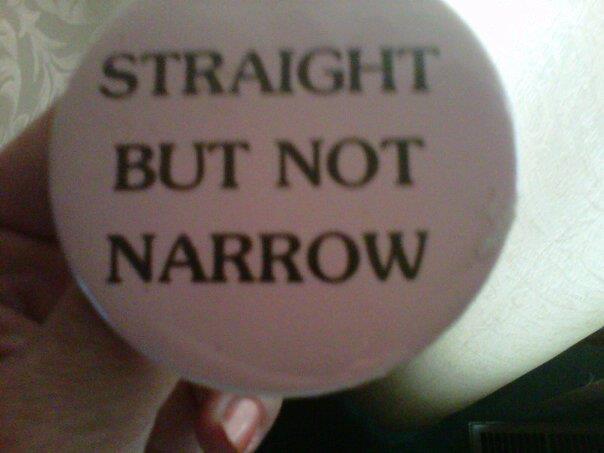
I found a button that said “Straight But Not Narrow.”
Given the recent national debate over gay marriage, I smiled when I realized I had been given the button more than 20 years ago. My smile soon turned to sorrow when 1) I realized that in the past 20 years, our nation really hasn’t come that far and 2) The person who gave me the button died years ago.
His name was Roger, and he died of AIDS.
He, like so many in our armed forces, died in the middle of a battle and with a great deal of honor.
Roger never hid his HIV status. Nor did he hide is sexual orientation.
In fact, Roger was one of the most open people I’ve ever met. If you asked him a question, he never sugar-coated the answer. He sometimes gave you more information than you wanted, but he never pretended the truth was pretty.
Roger will always be one of my heroes: those people who not only stand up for what they believe, but who put their own reputation and livelihood on the line to defend what is right.
Before he was infected with HIV and before his partner died of AIDS, Roger owned a hair salon.
That was his life before AIDS.
His life after AIDS was dedicated to educating West Virginians about the disease.
West Virginians are good people, but they aren’t exactly progressive… just check out their track record in the last few elections.
But Roger didn’t let closed-minded people get in his way. He knew that closed minds are like closed doors… they just need the right key to open or unlock them. And once they are unlocked, options and possibilities greatly increase.
Roger was the key to opening more minds and more doors than he ever knew. And the possibility he was seeking was a country where no one was infected with HIV again.
And so Roger knocked on and sometimes knocked over closed doors so he could share his message. He went to service clubs. He went to other types of clubs. He went to churches. And he went to schools.
He went wherever he could be heard and wherever people would actually listen.
His voice was definitely heard, and people definitely listened. I have no doubt Roger saved lives.
The only life he couldn’t save was his own. The medical battle against HIV was in its infancy, and Roger eventually succumbed.
But like so many other warriors, he left this world a better place than it would have been without him.
To me, that’s a hero. That someone I want to remember. That’s someone who inspires me.
That’s the type of person Memorial Day is all about.
Rocks on the Road and Rocks in Our Heads
 Some of life’s toughest lessons are the ones we learn the hard way.
Some of life’s most important lessons are the ones we sometimes never learn at all.
And some of life’s simplest lessons are the ones we often just ignore – like the problem with rocks in the road.
As a bicyclist, I ride an average of at least 10 miles a day. Because of that, I ride over a lot of rocks. For the most part, I don’t even realize the rocks are there. But every once in a while, my tire hits a rock and – due to speed or angle – I get knocked off course and sometimes even knocked down. Getting knocked down hurts, and sometimes the resulting injuries even leave scars.
Because of that, when I do notice a rock, I try to avoid it. And when there are a lot of rocks, I might even change course.
That’s life on my bike.
But I’ve noticed a lot of “rocks on the road” in the rest of my life too.
These rocks are often comments or actions that people believe are completely normal and appropriate. But to the nearby traveler on the road of life, those same words or actions may be slightly offensive or, at worst, hurtful. Sometimes they can also cause people to change course or fall down.
Just the other day, I was having coffee with a colleague who told me that years ago she had come to my office to talk about the possibility of interning with me. When she dropped by for the unscheduled visit, she was told I was in a meeting but that I was just with my intern and could be interrupted.
That one word “just” was enough to make her turn around and walk out the door. She didn’t want to be “just an intern.”
To be honest, I think I might have been the person who told her not to worry, and she changed the story to make me feel better. I don’t remember, but regardless of who said it, the word “just” became a rock in her life’s road.
Fortunately, for my colleague, her change of course is working for her. But she also had the advantage of already having several life successes under her belt. She could handle that rock.
I worry more about people who have so many rocks in their road that they can’t avoid them: people who have been knocked down so many times that they don’t trust that the road ahead gets any easier. Sometimes they’ve fallen so much, they have permanent scars.
Instead of helping clear the road, many of us are busy putting more rocks in their way. Sometimes those rocks are too big to move or go around. 
For the most part, I don’t think we are doing this on purpose. But, at times, I think we are, especially when we make judgments about people whose circumstances we know nothing about. That’s when we become victim of the rocks in our heads.
I’ve noticed a trend of people posting comments online that belittle others who are “on welfare” or “on food stamps” or that make assumptions about people based on appearance. I don’t know which is the bigger rock: those comments or the bitter ones about people with expensive shoes, phones or cars who are receiving some sort of government assistance.
Here’s the deal. I, like most people I know, don’t believe that government assistance should be a permanent way of life. I also don’t believe that government assistance should be used for anything but basic needs. And I don’t believe smart phones and SUV’s are basic needs. I also agree that some people manipulate the system, and that we need to be diligent about stopping such abuse.
However, I also know that most people who receive assistance have fallen on hard times. Some may have previously afforded a lifestyle that included expensive clothes and cars. But then they lost their job or faced another crisis that caused them to deplete all their available resources, including help from friends and family. After that, they were forced to seek public assistance. That expensive car may be all they have left after losing their home, a spouse or a way of life.
Instead of assuming the rocks in their road are their own fault, maybe we should think about how we can pick some up, roll them out of the way or help these individuals navigate a new course.
Doing this follows the simplest life lesson: do unto others as we wish them to do to us. I know if and when I hit tough times, I don’t want to ridiculed and/or blamed.
But this lesson is so simple that a lot of us ignore it when convenient. Or until there’s a rock in our own road. Or until we get the judgmental rocks out of heads.
Unfortunately, sometimes those rocks in our heads are harder to get rid of than the rocks in our roads.
The Misadventures of Mr. Muffet, My Chronically Confused Cat
 Mr. Muffet was never destined for greatness, dignity or even a long life.
Quite the opposite in fact.
The moment he joined our family, his fate was sealed.
I was too young to remember how Mr. Muffet arrived at our house or even when his name changed.
All I know is that Mr. Muffet was Miss Muffet until my cat-loving grandmother from Massachusetts visited our Oregon home. All things considered, my grandmother probably thought my parents were trying to make some kind of statement about gender stereotypes, but she wasn’t going to have any of it. She told them in no uncertain terms that Miss Muffet was just not an appropriate name for a male cat.
My father, who had previously tried unsuccessfully to breed rabbits, (he was unsuccessful because they were all female) heeded her advice, and Mr. Muffet’s name was modified accordingly. But his status as a full-fledged member of the family never changed.
Which, apparently, is why he went with us on a family vacation to the Oregon Coast.
I was recently reminded of the trip during a conversation with a couple of co-workers. Both were discussing the trauma of having to ship their cats overseas.
“I’ve never shipped a cat,” I said. “But I do remember the time my family took our cat to the beach.”
They both looked at me in disbelief.
“Why,” they wanted to know, “would you take your cat to the beach?”
I couldn’t answer their question. But since cats were the topic, curiosity got the best of me. I had to call my mom and ask why.
“I don’t remember,” she told me.
“But we did take the cat to the beach, didn’t we?” I asked.
“Yes, we did,” she answered. “I just don’t remember why. Probably because cats are easy, and we didn’t want to travel an hour to have him boarded.”
I didn’t even ask why a neighbor couldn’t have taken care of Mr. Muffet. Instead, I pressed on with the bigger issue. “And he pooped in the car, right?”
“Yes,” she sighed. “Yes, your memory is correct. He pooped in the car.”
She was obviously done with the conversation, so I didn’t push the issue. But I did tell my co-workers that I wasn’t imagining the trip.
Not only did we take Mr. Muffet on vacation with us, but we didn’t even have a carrier for him. (Were cat carriers even around in the early 1970’s?) Because of that, he was simply free to move around the cabin. But he didn’t. He stayed on the vent behind the back seat where my brother and I were riding.
That was either his favorite spot or he was too terrified to move, even when he had to poop. As a result, he pooped in the vent right behind my head.
There is no way to describe 1) the smell, or 2) how determined my mother was to get the mess cleaned up.
My mom was determined for a long, long time.
The good news for Mr. Muffet was that he soon had a lot more places to poop.
Always an equal member of the Bartlett family, Mr. Muffet accompanied us on our first walk on the beach (a beach comprised mostly of sand dunes.) He probably thought he’d landed in the world’s largest litter box.
He did his best to take advantage of the situation, but after an hour of running through the dunes, scratching in the sand and doing his business, the poor cat was simply exhausted.
Fortunately, our trip home was much less memorable than the one to the coast. Unfortunately, I don’t have many more memories of Mr. Muffet.
He disappeared shortly after the infamous vacation.
For years, I was convinced that a less adventurous family had found and adopted him. I was equally sure that he was quite relieved that he didn’t have to live with my crazy family anymore.
I was well into adulthood before I learned the truth: Mr. Muffet had been hit by a truck on the highway near our home.
I appreciate that my parents tried to protect me from the facts, but I also think they were trying to protect themselves. I’m certain that the adventures with Mr. Muffet had a significant impact on them.
He was, after all, my only cat growing up. After he “disappeared,” we only had dogs. And, I must say, dogs travel a lot better.
Philosophical Thoughts From a Feminist in High Heels

There are times when I wish I could be one of those women content to accept that the world is unfair and that some people are more important than others.
If I could actually believe that, life would be so much simpler.
The problem is that simple bores me and unfairness angers me, especially when it’s perpetuated by people who use inequality to meet their own need for influence, power and/or sense of security.
Even though I hate discrimination of any type, my personal experiences are limited to dealing with sexism. And lately, we seem to be moving backwards on that issue.
Women are facing more sexist attitudes than we did when I was in my twenties. At least it feels that way. Maybe because when I was younger, I attributed personal slights to my being inexperienced. But now, I’ve got a whole lot more experience yet the attitudes and behaviors persist. And women are having to fight battles I thought we’d won years before.
Admittedly, I’ve been more passive than I should be.
Perhaps it’s because protecting myself has sometimes outweighed standing up for what’s right. Or perhaps it’s because sexism can be so subtle that people have made an art form of camouflaging it. Or perhaps it’s because the issues are just too confusing.
Take, for example, shoes.
I recently heard that a woman who wears high heels (but not too high) is taken more seriously in the workplace than a woman who wears flats.
As someone who would sleep in high heels if it were feasible, you’d think I’d find this piece of information encouraging. Not at all.
The whole issue is absurd. The height of a woman’s shoe shouldn’t matter at all as long as she can do her job. But apparently it does. And since women have a lot more choices than men when it comes to footwear, we are also more likely to make decisions that can distract from our skills and abilities.
The same can be said for words we use to describe ourselves. Take, for example, the word feminist.
There are those people who picture a feminist as a woman who hates men, doesn’t shave her legs, dresses like a hippy and has extreme points of view about reproduction.
Umm.. no. As a feminist, that doesn’t describe me at all.
I love men. I shave my legs. I wear make-up. I’m not an extremist on any subject, and I even let my daughter play with Barbie.
Being a feminist has nothing to do with how I dress or who I love.
It’s about taking time to question how women are being treated. It’s about ensuring that, when other factors are equal, women are given the same opportunities as men. It’s about pushing people to think about how fair they are being.
Would the salary be the same if a man had the job? Does a woman really have the same opportunity to break into the “good old boys’ network? Is the spouse’s employment relevant?
Ironically, as I was writing this, my daughter looked over my shoulder and asked, “What exactly is a feminist?”
“It’s someone who believes women should have the same opportunities as men,” I said.
“Duh,” she said in a voice and manner that only 10 year-old girls can get away with.
“Exactly,” I said. “Duh.”
And hearing that one word come out of my daughter’s mouth put the fight right back in me.
Watch out world, this feminist in high heels is on a mission to ensure life is more fair for her daughter.
The Myth of the Same 24 Hours

I admit that I’m generally a sucker for adages, quotes and platitudes. They often make sense, and sometimes they even speak directly to me. Sometimes.
And then there are sayings that get my blood boiling, because they are simply unfair and obviously perpetuated by people trying to make themselves feel good.
“We all have the same 24 hours” is one of those sayings.
O.K., technically, there are only 24 hours in each day, and as far as I know, no one gets rewarded with extra hours for doing good deeds or has hours subtracted for bad behavior. But the SAME 24 hours? It’s not even close.
For people who want to feel self-righteous, the saying works. After all, they’ve achieved “success” with only 24 hours in a day. If others haven’t, then they obviously haven’t used their 24 hours wisely. This logic is similar to the myth that if low-income people just worked harder, they too could be financially secure. Ironically, some of the hardest working people I know are working two jobs and still can’t make ends meet. And when they aren’t working to earn meager paychecks? They are spending time on tasks that middle and upper class people generally don’t.
In other words, when you don’t have a high income, you just have less time.
You have less time because you spend hours in a laundromat rather than throwing your clothes into a washing machine at home.
You have less time because you can’t simply jump in your car when you need to go to the grocery store, to a child’s school program or to work. You depend, and wait, on public transportation.
You have less time because you don’t have social connections with doctors who can “get you right in” as a favor. Instead, you wait just to get an appointment . . . then you wait in the waiting room.
I first became aware of the “24 hour myth” through my own struggles. I spent hours trying to do things myself that friends with bigger paychecks paid someone else to do.
And sadly, because I bought into the myth that not having extra money meant I wasn’t successful enough or working hard enough, I would pretend that I took satisfaction in “doing it myself.”
Then, at some point, I realized that “doing it myself” was the epitome of hard work. It just didn’t equate to having more money in my pocket, a bigger house or a nicer car. But neither did it equate to being a failure. It did increase my understanding the value of time, and how people who can afford to buy it, do.
They buy it by paying babysitters to watch their children. They buy it by paying people to clean their homes. They buy it by eating at restaurants instead of cooking. And sometimes they can even buy time by working for businesses that allow them to go on golf outings or to participate in charitable events to build their network and their resume (while lower-income people are generally required to stay at the work site while on the job.)
I can’t judge whether people who have higher salaries use their time more or less wisely than people with lower incomes any more than I can judge whether they work harder. Like everything else, individual behaviors run the spectrum. But I do know people with more money have more discretionary time to spend on working more or playing more. And just like discretionary money, it can be wasted or well spent.
As Carl Sandburg said, “Time is the coin of your life. It is the only coin you have, and only you can determine how it will be spent. Be careful lest you let other people spend it for you.”
And that is saying I CAN definitely buy into.
The Addams Family Has Nothing On My Family
One of the stories that gets told and re-told every time my family is together is how I was switched at birth.
Truth be told, the story really isn’t all that interesting. I never actually got sent home with the wrong family. There were only two babies born in the rural Montana hospital that day, and I was over eight pounds while the other baby girl was much smaller. So in reality, there was never any significant confusion. The hospital was just so small and births were so infrequent that wristbands weren’t used. As a result, my parents were handed the wrong baby when they were getting ready to leave.
But even though the circumstances weren’t all that dramatic, there were times growing up when I was convinced that I was living with the wrong family. I was sure my dad made a mistake when he told hospital staff that they had given him the wrong baby. At least, I really, really wished this, and I fantasized that someday my real family, the ranchers in Montana, would come rescue me from my plight.
Putting aside the obvious family resemblances, I was convinced that there was no way I could actually be related to the people I was being forced to live with. They were just too weird, and even worse, they were making me weird. I knew this because I spent a lot of time comparing our family to other families.
There was simply no doubt. We were abnormal: my parents didn’t care about the things other parents cared about; they had different expectations and priorities for my brother and me; they didn’t listen to popular music; they rarely watched any television other than PBS; they didn’t care about pop culture and they would express opinions that were outside the norm of suburbia. Even the food we ate was weird.
There were times when the hopelessness of my situation got so bad that I would secretly watch an episode of the Addams Family just because it made me feel a little bit better. But only a little bit, because I knew the Addams Family was fictional, while my family was real. Besides, my mother never approved of such frivolous shows.
But, like so many other situations in life, I grew up and got some perspective.
I’m not saying I completely overcame my compulsive need to compare myself to others and to worry that I was a bit off kilter (I always have been and always will be), but I did realize that there really is no such thing as normal. Most people spend a lot of time and energy putting up appearances rather than truly engaging in the world. I was raised in a family that just didn’t worry about what other people thought and lived accordingly. Because of that, it took me a long time to figure out how much other people were trying to cover up.
I’ll never forget an incident that occurred when my children were small. They had been invited to a birthday party at the home of someone who I thought had it all together. Not only did she have a career, but she was always talking about the amazing meals she cooked, how she was decorating her home and how her children were exceeding at a variety of activities. At that point in my life, I was feeling accomplished if I arrived at work with matching shoes and if my children were fed before I collapsed in the evening.
Needless to say, I didn’t want to go to the party. But I did.
I don’t remember much about the actual event. What I do remember is trying to find the bathroom and opening a door to a bedroom instead. At least, I think it was a bedroom. I couldn’t tell from all the junk that had been thrown in and piled up to get it out of view. This was obviously the mother’s attempt to make her home and her life appear perfect.
At that moment, staring at all that junk piled to the ceiling, I realized how many people spend too much time and energy trying to create an image of who they think they should be rather than simply being who they really are.
My family may have been weird, but at least they taught me the importance of embracing and accepting differences and imperfections, especially our own. They also taught me that no great discoveries or great works of art were the result of simply following the crowd or doing what everyone else was doing. Great advances come from thinking outside the box and having the conviction to do things differently.
My parents innate ability to do this may have skipped me, but it went right to my children. Neither of them seems to care about doing what is considered to be popular or the “in” thing. They are simply happy pursuing their own interests and are comfortable in their own skin. I admit that I sometimes forget what I’ve learned and start comparing them to other kids.
Then I remember the Addams Family. Their neighbors and community members may have thought them strange, but not only were they oblivious to what other people thought, they were also incredibly happy.
I like to think my family is too.
On this Thanksgiving, I’m Thankful for All the Handouts I’ve Received
There are times when I just want to scream out loud. But that doesn’t necessarily solve any problems, so sometimes I choose to scream through writing.
Now is one of those times.
While I can’t emphasize enough that I believe in the First Amendment, that everyone is entitled to their own opinions and that everyone should be allowed to express them, there are times when those opinions just seem so off base.
Take, for example, the number of people who complain about others who take “handouts” and/or boast that they have never done so themselves. They often say this as though they are morally superior.
I just don’t get that, because I have yet to meet a person who hasn’t received a handout.
Personally, I’ve received more handouts than I ever deserved. And this Thanksgiving, I am so grateful for them.
The handouts I’ve received may not have been in the form of government assistance for low-income individuals, but they are the reason I haven’t had to depend on such help when I’ve hit a rough patch.
I am grateful that I received the handout of a mother who didn’t abuse alcohol or drugs and had a healthy diet while she was pregnant. Her decisions provided me with a giant advantage in life. I was born healthy and had parents who ensured I maintained my health. Too many people start life without that handout and spend the rest of their life trying to catch up.
I am grateful for the handout of parents who were concerned about my education from the day I was born. They shared their love of the written word by reading out loud to me. They didn’t set me in front of a television so they could go on with the lives they wanted. They provided me with books, crayons and the opportunity to express myself. Too many people spent the first three years of their lives without any of those handouts – handouts that greatly influence their ability to learn and process information.
I am grateful for the handout of being a child that never knew what it was like to be truly scared or cold or hungry. There was always food on the table, in the cupboard, in the refrigerator and in the freezer. I never went to bed afraid that there wouldn’t be heat in the morning or that I wouldn’t have a coat to wear in cold weather. Too many people grow up without the simple handout of having those basic needs met – which creates a completely different perspective of how the world works.
I am grateful for the handout of parents who made their children and their family a priority. I always felt wanted. I always felt like I belonged and I always felt like I helped make my family complete. I was never told I was a mistake. I was never told I was a burden. And I was never told that my parents’ life would be easier if I wasn’t around. Just as importantly, I wasn’t hit, kicked burned or assaulted in my own home. Too many people grow up abused and wondering why they even exist. The handout of love is powerful, and without it, people often seek affection and attention in the wrong places and in the wrong ways.
I am grateful for the handout of having parents who wanted me to succeed and who demonstrated self-discipline and good decision-making skills. They required my brother and me to take responsibility for our actions. They also ensured that we were exposed to a wide variety of opportunities and activities. They were never in jail, they never dragged us into unsafe locations and they didn’t bring a variety of unsavory characters into our home. Too many people grow up without the handout of positive role models. Their parents or caretakers or community members are stumbling through life attempting to meet their own needs without even considering those of their children. Our ability to make choices and understand consequences is a skill… and like all skills it needs to be demonstrated and practiced.
I am grateful for the handouts I received that were beyond human control. I’m not dyslexic, I’m not disabled and I’m not disadvantaged. I am surrounded by people who can lend a helping hand. When I faced a real emergency, there were always people in my life who had the resources to help me. Too many people are surrounded by people who are facing their own crises and don’t have the ability to help anyone else.
I am truly saddened by people who view poverty as a simple issue. It isn’t.
And I am bothered that some people think life is an even playing field and everyone has equal opportunities. We don’t.
And I worry about the belief that low-income people have flawed characters rather than an unbelievable set of obstacles to overcome.
I agree that there are success stories.There are people who have beaten the odds, overcome horrible situations and gone on to live very productive lives. I am privileged to know such people.
And I also know that somewhere along their life path, they got some handouts – generally in the form of a caring person or persons who wanted to share all they had been given: whether material or spiritual. People who wanted to pay it forward rather than to hold it tight. People who understood the value of offering their hearts and their hands out to others.
On this Thanksgiving, I am not only grateful for the all of the hands that have been held out to me, I am grateful for the role models and heroes who continue to do this for others on a daily basis.
Holding your hands out can be a miracle for others.
Opening your heart to others can be a miracle for you.
I hope everyone has the opportunity to do both this Thanksgiving and into the upcoming holiday season.
Veterans Day, a Wounded Marine, and the Other Side of the Door
On Monday, October 31, 2011, I left work earlier than usual because it was Halloween and I had important issues to deal with. At least, they seemed important at the time. I needed to make sure my daughter was dressed in her costume, that the jack-o-lanterns were lit and appropriately placed and that we had a plan to ensure the dog behaved himself during trick-or-treat activities.
On that same day, Marine Lance Corporal Brian Felber, was severely wounded in Afghanistan when he stepped on an IED and lost both his legs.
My concerns on Halloween seem unimportant in comparison. But, like most Americans, I was oblivious to the events that changed his and his family’s life forever. I was absorbed in the trivial details of my own life.
But the next day, I was sitting in my office when Jan Callen’s cell phone rang. Like everyone else in the office, I knew the call was from his wife Susie since she has her own ring tone. What we didn’t know was that she was calling to tell Jan about Brian, the husband of their 22 year-old niece.
As a retired Army Colonel, Jan reacted in true military fashion. He adjusted his plans accordingly and took the most appropriate course of action: instead of going to Nashville for the week, he and Susie would go to the Walter Reed in Bethesda to do what they could for Brian and the rest of his family.
In the meantime, I did what I thought was appropriate. I took Jan’s suggestion and liked a Facebook page supporting Brian: https://www.facebook.com/pages/Support-Combat-Wounded-Marine-Brian-Felber/281745445190900.
I admit, at first I did this because it was just what I thought was expected of me in such a situation. I’d never met Brian and didn’t really relate his situation to my own life.
But then I looked at the Facebook page and the photos.
He appears to be a guy I would genuinely like. In one photo, he has his arm around his young wife. In another, he has his arm around a dog. And in yet another, he’s playing with a band.
Dogs and music? Brian seems like my kind of guy.
That Facebook page made him more than just another news story or statistic. He’s become real to me. He is a person with a family and a life outside the military. Yet his service in the military will shape the rest of his life: a life that’s changed forever.
For most of us, our lives are going on as they always do. We pay attention to those things we think directly affect us with very little consideration to those that don’t.
As Jan said when reflecting about the time he spent with Brian and his family this past weekend, “When we were at the hospital, we saw all these young guys with lost limbs and young wives by their side. We saw an entire floor of a parking garage for handicapped parking. And then we went home, and the world goes on like nothing happened.”
His words remind me of lyrics from the Cat Stevens song “Sitting.” They are lyrics I’ve always loved. “Life is like a maze of doors, and they all open from the side you’re on. Just keep on pushing hard boy, try as you may you’re going to wind up where you started from. ”
The meaning of those lyrics can be debated, but to me, they’ve always meant that to move forward, we not only have to think beyond our own circumstances, but we also need to approach life from a perspective other than our own. We need to turn around and walk through the doors from the other direction.
When we do this, we just might actually see and appreciate all the people we never met who have been helping hold doors open for us: people who are contributing to our lives. As someone who didn’t grow up with close family or friends in the military, I’ve too often failed to recognize how members of the military help hold my doors open.
I hope Brian knows that his circumstances have served as a reminder to me. A couple of years ago, my son, Shepherd, also reminded me.
My husband and I were in a parent-teacher conference when Shepherd’s teacher told us she was very impressed with his thoughtful writing. We were surprised and asked what she meant. Apparently, he’d been charged with writing an essay in answer to the question “If you could change places with anyone for one day, who would it be?”
My son had answered a soldier. His reasoning was that, while he never wanted to be a soldier, as an American, he needed to understand what they are going through.
Wise words from a sixth grader and words to think about on this Veteran’s Day.
I hope we all take time think about the side of the door that our active troops and our veterans are facing. Members of our military do what they are asked, and they respond to some horrendous situations. And, most importantly, they do their duty out of love for our country.
On this Veterans Day, we should all consider what we can do to help hold THEIR doors open.
The Gift of a Dead Bee
I’ve finally figured out how to deal with the gift of a dead bee.
It’s only taken most of my life, since no one ever told me what to do with one. Or, at least if someone did, per usual I ignored the advice.
Like most of valuable lessons, I’ve had to learn the hard way – through experience. And, to quote Randy Pausch, “Experience is what you get when you didn’t get what you wanted.”
I’m a very experienced woman. And I’ve been given a lot of dead bees.
 I’m not simply referring to the dead bees, or any other small critters, that my cat brings me as gifts. I’m referring to all the times I’ve been given something that was intended to be a gift – a piece of advice, a kind thought or even responsibility – that I didn’t want. Not only did I not want the gift, but I overreacted to it – if not outwardly then inwardly.
Unfortunately, I’ve wasted a lot of time and energy on dead bees.
My mother was a master at giving them. To be fair, just like my cat, she was giving dead bees out of love. But, unlike my cat’s gifts, hers were harder to deal with.
Even before I hit adolescence, I remember her telling me to accept my body type since it wasn’t going to meet society’s standards for the female form. “It’s o.k. to be a big-boned girl,” she told me. ” I always wanted to be small too, but it’s just not how we are built.”
Really? I don’t remember worrying about my body type. I remember complaining that I wasn’t cool, but I didn’t think that had anything to do with my size. In fact, I never thought my 11-year old body was particularly big… kind of dorky, maybe, but not big. But from that moment on, I was sure my hips were going to grow so large that I wouldn’t be able to walk through doors.
I was almost thirty before a doctor finally convinced me I simply didn’t fit the definition of “big-boned.”
But that was nothing compared to the dead bee my mom gave me when I was 16.
The gift came during a conversation in her car. She had been covering something for the newspaper and was all worked up about the unfair treatment of a female official.
“They just won’t listen to her.” she told me. “They won’t take her seriously because she’s attractive.”
And then my mother did something she rarely ever did. She actually turned and looked at me, instead of looking at the road, while she was driving. It was brief, but it was still memorable.
“You are so lucky,” she told me, “that you are smart rather than pretty.”
That bee stung even though it was already dead. Those are just words no 16 year-old girl wants to hear. Not only did they linger when they came out of her mouth, they hung in the air long enough for me to grab hold of them and carry them with me for years.
Since them, I’ve collected hundreds more dead bees from very well-intentioned people. But only recently have I understood that these dead bees were actually gifts.
My mother’s comments about my looks and my body helped shape who I am: someone who recognizes that character is far more important than appearance.
Dead bees also make good stories. And those who know me best know I’m always telling a story – whether the listener cares or not.
Finally, they shine a spotlight on what’s really important: the relationship with the giver.
A few weeks ago I was making the bed when I flipped up a blanket to find a dead bee on the sheet. My cat had brought me another gift. But instead of freaking out over the fact that I’d been sleeping with a bee, I just laughed. You see, Skitty isn’t the most affectionate cat in the world. My husband calls her mean, but I disagree. Every night, after she thinks we’ve all gone to sleep, she jumps onto the bed and curls up next to me. I love the fact she does that, and if it means dealing with a few dead bees in bed, I’ll accept the trade-off.
In fact, I’m getting really good at dealing with dead bees in general. All it takes is focusing on the intent of the giver rather than on the gift itself.
I say this in recognition of the biggest dead bee my mother ever gave me: the tendency to give them myself. I’m pretty sure I’ve exceeded her abilities at giving dead bees, and I’ve already given a lot of them to my own children.
I can only hope I’ve also passed on how to accept and even embrace them.


 Just So You Know