Category Archives: My life
“Isn’t That What We’re All Here For?”
 Yesterday morning, my daughter and I were struggling to carry and drag multiple large objects across a school parking lot when a stranger in a Washington Nationals shirt offered to help.
I gladly accepted his gesture and handed him a folding table.
As we walked, I asked about his shirt, and he broke into a broad grin as he talked about the team enthusiastically. He told me that his son had recently played in a Nationals benefit against cancer.
We continued the small talk until we arrived at my church’s Relay for Life campsite in the middle of the high school football field. As the man put down the table, I thanked him profusely for helping. He merely shrugged and said, “Isn’t that what we’re all here for? To help each other out?”
I nodded in agreement then said goodbye as I turned to help the rest of my team set up for a day in the hot sun. But the man’s words stayed in my head.
About an hour later, the event had begun, and cancer survivors were making the first lap around the high school track while the rest of us clapped and cheered. Since several friends and acquaintances were walking, I don’t know why I was so surprised to see a relative stranger, the man in the Nationals shirt, walking among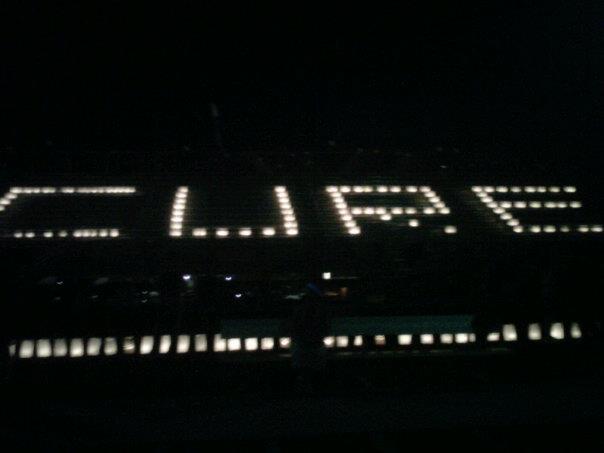 them.
them.
I’ll probably never know his name, but I want to thank him for his reminder yesterday.
I’ve been stressed out for several weeks now about things over which I have no control and things which involve other people over which I have no control. And amid all that stress, I lost some perspective.
There were multiple incidents at yesterday’s Relay for Life that helped me put my life back into focus, but his words were the ones that made everything crystal clear.
Life isn’t about waiting for those few moments when everything falls into place and goes smoothly. If it were, we’d never be happy or grateful.
Life is about appreciating rich experiences made possible by people who are willing to share their limited hours with us. It’s about appreciating everyone who makes us smile and laugh, who lends us a helping hand and who trusts we will do the same for them.
I was surrounded by such people yesterday.
Relay for Life is intended to be a fundraiser for cancer research, and that’s what many people consider it. But to me, it’s not really about the money at all.
It’s about seeing diverse people join together for a common cause rather than tear each other up over political or other differences. It’s about spending hours on a track talking with friends and, even more importantly, talking with my daughter when there is absolutely no “to do” list to distract us. And it’s about remembering all those we’ve lost to cancer and honoring all those who have battled and survived it.
Most of all, it’s about life – embracing it, enjoying it and remembering what it’s all about. And that, as the man in the Nationals shirt reminded me, is simply about helping each other.
The Cost of My Opinion
The bloodiest single-day battle in American history occurred approximately 15 miles from my house. Nearly 23,000 soldiers died, were wounded or went missing after twelve hours of combat on September 17, 1862 at the Battle of Antietam during the Civil War. The lingering echoes and impact of that battle are still felt more than 150 years later.
Both the Union and the Confederacy experienced devastating losses, and historians have never declared a true winner. But for me, my family won. My great, great-grandfather James F. Bartlett (his biography and obituary are on this website right below Edward Bartlett’s) fought with the Massachusetts Infantry and survived. although he did sustain injuries on May 6, 1864, at the Battle of the Wilderness.

John Snyder gravestone Elmwood Cemetery
Ironically, my husband’s great, great-grandfather, John Snyder, died in June 1864 of wounds he sustained at the Battle of the Wilderness while fighting with the Stonewall Brigade.
Years ago, a local historian gave my husband and me a tour of John Snyder’s town and legacy. The tour ended at Elmwood Cemetery in Shepherdstown, where he is buried.
Newly married, I was actually interested in John Snyder until our volunteer tour guide pulled out a Confederate flag for my husband to place on his great, great-grandfather’s grave.
I loudly proclaimed that the Confederate flag had a very specific meaning, and my husband was not allowed to touch it. He tried to explain the flag was meant to honor his great, great grandfather, but I declared that the Confederate flag had nothing to do with honoring anyone. My husband placed the flag on the grave anyway.
Years later, I recognize my words were nothing but rude, and I had absolutely no right to be indignant.
I’ve never put my life on the line for my beliefs, and I have no right to judge those who did. All I can be is thankful.
The passage of time can change perspective and opinion about what is best and sometimes even what is moral, but it will never change what is honorable.
My children carry the blood of two honorable men who fought for what they believed during a time when our nation was completely divided. They also carry the last name of a man who lost his life fighting for what he thought would be a better life for them.
On Memorial Day, I have no right to argue about putting a Confederate flag on a soldier’s grave. Instead, I should simply be grateful that I have the freedom to make those arguments.
That freedom didn’t come without a price, and today we honor those who paid it.
The Graduation Speech I’ll Never Give
 This upcoming week, my husband is scheduled to be the graduation speaker at his high school alma mater. Even though he makes his living talking to millions of people, he actually hates speaking in public.
Because of that, he’s not particularly happy that I encouraged him to go outside of his comfort zone. He thinks I don’t understand his apprehension because I actually enjoy public speaking.
What he doesn’t understand is that I’m simply jealous of the opportunity, and I’m living vicariously through him.
It’s not the spotlight or the attention that make me wish I could stand in his shoes. It’s the privilege of encouraging young people as they take that final step out of childhood and into adulthood.
Ironically, I don’t even remember who spoke at my high school graduation other than it was a white, male politician. Despite that, I still believe that the right words can make a big difference.
If I didn’t, I wouldn’t write.
But since I do write, I’m going to use this space to share my own words with the Class of 2013. What follows are highlights of the commencement speech I’ll never give:
1. As you get older, you will discover that high school wasn’t just a finite period of your life. It was a series of good and bad relationships and events that served as a platform from which you chose to stand still, dive or climb. My advice is to climb. Take the stairs. Rise above the need to be defined by others or the simple accomplishments of youth and discover who you really are. You’ll probably surprise yourself and all the people with whom you once shared the platform.
2. Don’t ever believe that your greatest moments are behind you. There are always opportunities to create more great moments, but they require moving on and doing something different. Many people are uncomfortable with change and will want to force the status quo on you. Don’t let them.
3. Never apologize for your opinions. Ever. Opinions aren’t facts, so you can never be wrong, and you can always change them as circumstances change. But opinions are valuable because they define the essence of who you are. Like any other valuable possession, people will try to take them from you by any means necessary. Don’t ever let them use religion or profits or cultural norms to buy your silence.
4. You’ve probably been told all of your life not to worry about what other people think about you, and in most circumstances, that’s true. But you should worry about what “the future you” will think about you. You are the only person who has to live with you your entire life. You can walk away from other people, but you will still be with yourself. Make sure you are a good companion. Treat yourself with the respect, care and love needed in any long-term relationship.
5. Before you get out of bed each day, think about the calendar. The day you are about to begin is absolutely unique, and in a few short hours it will simply be another day in history. Make sure that day counts in your own life history. Despite the obstacles you may be facing or the hurt you may be feeling, make sure you do something that makes that day memorable and meaningful. If you are stuck in a routine, break it just a little. Eat something unusual. Read something new. Talk to a stranger. Practice a random act of kindness. Your ultimate goal in life is to make every day count, but that sometimes requires a bit of work. Do the work anyway.
A Letter to Abercrombie & Fitch CEO Mike Jeffries
Dear Mr. Jeffries,
Congratulations on recently making headlines with your strategy of only selling clothes to those whom you define as cool, pretty and thin: http://www.businessinsider.com/abercrombie-wants-thin-customers-2013-5#ixzz2SoRlwYlN.
You’ve certainly grabbed a lot of attention and clearly made your point.
As you said, “In every school there are the cool and popular kids, and then there are the not-so-cool kids. Candidly, we go after the cool kids. We go after the attractive all-American kid with a great attitude and a lot of friends. A lot of people don’t belong [in our clothes], and they can’t belong. Are we exclusionary? Absolutely.”
You have every right to your opinion and your business strategy. But here’s what you apparently don’t get: most of us (people who will never set foot in your store) don’t really care whom you define as cool, and we don’t care that you won’t sell us your over-priced clothes. We see you in the same light that we saw the “cool kids” in high school.
We didn’t actually think they were all that cool. Instead, we thought they were self-absorbed and incredibly superficial.
You (as they did) base coolness on appearance, access to money and whom you associate with. Ironically, the only people who hang out with your are also people who only care about superficial appearances.
There’s no depth. There’s no empathy or compassion for others. And there’s no understanding that life is so much bigger than your very small and limited materialistic world.
In the real world, where everyone else lives, life is so much more than what size you wear, how much you paid for your clothes or all the places where your wealth will take you.
It’s about knowing that you can never count on your looks for anything and building upon your other strengths instead.
It’s about walking into a room and being appreciated for what you can contribute to the conversation rather than for what clothes you wear.
And it’s about supporting others rather than rubbing disadvantages in their faces.
Enjoy your fortune while it lasts, Mr. Jeffries, but be warned.
I’ve got two children who won’t ever buy clothes in your store.
I know their current buying habits are of no interest to you (because neither fits your definition of cool), but I think you should know who they are.
They are both very smart and don’t care whether you or anyone else thinks they are popular or cool. They just care that they are happy and making the world a better place.
Such aspirations have never required buying and wearing a certain brand of clothes.
So watch out, Mr. Jeffries. My children represent the next generation of consumers, and they have loud voices.
Sincerely,
Trina Bartlett
Small Moments, Big Reminders
 In the grand scheme of life, this past week was rather uneventful. Yet, small reminders of how to live were wrapped up in my mundane, everyday activities.
On Saturday, I was the local grocery store when I thought I passed someone I knew. Instead of turning around, I glanced into the side view mirror of my shopping cart.
I know . . . shopping carts don’t have side view mirrors, rear view mirrors or any other mirrors. But, I’ve been spending a lot of time on my bike recently, and I’m constantly checking for cars in the side mirror attached to my handlebars. Apparently, the muscle memory of steering a bike is similar to pushing a grocery cart.
My action was ridiculous, and even though no one else would have even noticed the quick glance into nothing, my behavior kept me from actually turning around to see the person. Instead, I put my head down and hurriedly pushed the cart forward.
Saturday’s reminder: Never be so focused on moving away from our mistakes or missteps that we fail to turn around and face the current situation.
Sunday during church, the choir sang a particularly uplifting song, and as members finished singing, a little boy in the pew behind us started clapping. This was followed by his father’s hushed but angry voice saying “you don’t clap in church!”
The father’s reaction to his son’s joy and celebration reminded me how often we let society dictate how we express our feelings. I wish I had turned around and said, “What better place is there to clap than in church?” But I didn’t.
Sunday’s reminder: Don’t let anyone prevent you from expressing joy and happiness.
I was sitting at my desk at work on Monday, when my cell phone rang. Even though I didn’t recognize the number, I answered anyway. The call was from a former neighbor currently living in the Ukraine. As she recited all the countries her children have visited as part of their education and all the trips she is constantly making, I started feeling as though my life is dull and unremarkable. Then she told me her family is coming home after two years, and she was looking for advice regarding schools.
Since I rarely go through a day when someone doesn’t ask me for advice, I didn’t initially think much about her questions. But later, I realized she had given me a compliment.
Monday’s reminder: Being asked for an opinion is a sign of trust, and having someone’s trust is a remarkable gift.
Last month, my colleagues and I moved from our offices to a building that had previously served as a doctors’ office. Despite the large sign out front that says “research center” and the paper sign we put on the front door with the doctors’ new address, patients still come through our doors.
On Tuesday, a woman came walking down the hall yelling loudly, “Where’s my cancer doctor?” I politely told her the doctor had moved and that the address was posted on our front door. The look she gave me indicated she needed more instruction, so I walked her to the door and read her the sign. She repeated the address as she walked to her car.
Tuesday’s reminder: Being able to read is something many of us take for granted, and making assumptions that everyone can get the message through the written word is presumptuous.
My daughter just got braces, and she isn’t bothered at all by them. In fact, she loves the color (aqua) and the attention she’s getting. On Wednesday, she took her customary place in the passenger seat of my Jeep, pulled down the visor, flipped open the mirror and admired her mouth. Then she turned to me and said, “You know, I’m not the one who has to get used to the braces, since I don’t look at myself all the time. Everyone else has to get used to them.”
Wednesdays reminder: Perspective really is everything.
Thursday after work I hurried home so I could get in a bike ride before I had to transport my daughter to evening activities. One of my older neighbors was outside with her dog, so I stopped to talk. Oak catkins were spread all over her lawn and driveway, and she apologized for the mess. Since I was focused on her and her dog, I hadn’t even noticed until she drew attention to them.
Thursday’s reminder: Don’t apologize to others for living your life the way you want. If people judge how you spend your time, they aren’t worth making time for.
On Friday, I was riding my bike on the bridge over the interstate near my house. I could see that traffic on the exit was backed up almost to the highway, and my first reaction was that there must have been another accident on Interstate 81. (Such accidents have become almost daily events.) But traffic on the interstate was moving smoothly.
As I rode through the light at the exit, I noticed the first vehicle in line was about a car’s length back from the white line that distinguishes the exit from the road. It also marks a trigger linked to the stop light. Despite the long line of cars and the red light that wasn’t changing, the first vehicle didn’t move. I imagine eventually something prompted the driver to move forward, but I was glad I wasn’t stuck behind him.
Friday’s reminder: Sometimes we can’t wait for something to happen, we have to make it happen ourselves.
This may not have been a week of earth shattering events or life-changing moments, but it was definitely a week to remember.
Swimming in a Dress

Victoria swim wear – http://www.fashion-era.com/images/SocialHistory/swimpad500.jpg
This week, I had two conversations that morphed into one question about how we live our lives.
The first conversation was with a friend who told me about home-schooled children who were on a field trip at the Shepherd University pool. They were affiliated with a religious group that prohibits females from wearing pants, and, apparently prohibits swimming suits as well. My friend’s son watched astounded as the girls jumped into the pool still in their dresses.
The second conversation occurred on the phone with my mother, who wanted to know if my son had received his birthday check. After telling her yes, I added, “I know, he hasn’t sent a thank you note to acknowledge it. I’m a bad mom.”
My mother disagreed. “No, you aren’t. You are a much better mom than I was.”
Her comment shocked me, because I’m not even close to the type of mother she was.
My mom always made sure we sent thank you notes immediately. She planned menus that met every dietary guideline. And she ensured we did our Saturday chores, our beds were always made and that our laundry was always put away.
Not only do I fail to do all of those things on a regular basis. but my life is a chaotic mess compared to the structure in which I grew up. I told this to my mother in fewer words, but she responded, “You have fun with your kids. You know how to relax and just enjoy them. I never did.”
Not to belabor the point, but she WAS always wound quite tightly, and I’m generally not wound nearly that tight.
But getting unwound wasn’t easy. As I recently told a friend, “I spent the first 15 years of my life being a nerd trying to follow all the rules, and I spent the next 15 years trying to prove I was a rebel. Then I became a mom and had to find a happy medium.”

swimsuits in 1919 – http://old-photos.blogspot.com/2008_01_01_archive.html
In short, I had to break free of restrictive expectations and learn balance so I could enjoy life.
Which brings me back to the girls who jumped into the swimming pool in their dresses and to my question.
“Can anyone really enjoy life fully when they are restricted by a rigid belief system?”
Being in a pool with a dress is probably more fun than not being the pool at all, but I can’t imagine it was all that enjoyable. The water-logged clothing had to make movement difficult and exhausting.
I have absolutely no right to question or judge the beliefs and choices of the girls or their families. If they choose to swim in a dress, they have every right to do so.
But I have every right to question my own choices and the self-imposed restraints I’ve often put on myself – those that prohibit me from enjoying life. Sometimes these have been thinking a work deadline is more important than a few hours with my children. Sometimes they have been my obsession with gaining weight. And sometimes they’ve been my concerns that I will fail when I try something new.
I’ve definitely done my share of swimming in a dress.
But both times and people evolve, and as I’ve aged, I’ve become better and better at shedding my dress. That doesn’t mean I’m going out in public in a string bikini, but it does mean I can enjoy a good swim in a modest tankini.
Shame is Not a Form of Birth Control
I had to double-check my calendar this morning to assure myself that it was actually 2013 and I hadn’t been sucked into a time warp.
I hadn’t been.
Instead, I was sucked into reading news articles about a school assembly featuring an abstinence-only proponent whose only educational credential is a Psychology Degree from Jerry Falwell’s Liberty University.
See: http://www.dailymail.com/News/201304110267 and http://www.wvgazette.com/News/201304110229 .
I can’t emphasize enough how inappropriate the assembly was.
Almost 20 years ago, when I was working in the field of sex education, experts had already proven that abstinence-only and shame-based tactics don’t work. And promoting a particular religious philosophy in a public school is simply prohibited.
But self-righteous people, who believe they actually know what God is thinking, seem to find a way around these issues.
The speaker, Pam Stenzel, and her sponsors, a religious group called Believe in West Virginia, say her speech wasn’t faith-based. Instead they say it was just a warning about the dangers of sex before marriage.
Those few words should have been enough to keep this woman out of the public schools.
A real sex educator doesn’t pretend that a wedding ring can protect people from a sexually transmitted disease, an unplanned pregnancy or heartache.
A real sex educator doesn’t outright dismiss homosexuals, who are still fighting for the right to even be married.
And a real sex educator doesn’t condemn, judge or shame.
Instead, a real sex educator gives facts – not statistics that have been manipulated to fit a certain dogma.
A real sex educator will agree that sex is the only human behavior that has the potential to create life or to threaten a life. The educator’s job is to help individuals make decisions to prevent unwanted consequences.
And a real sex educator will spend time talking about healthy relationships and about treating others with respect – not condemnation.
Years ago, I was that person, and I will never forget making a presentation about AIDS and HIV in a middle school classroom. As I interacted with the students, the teacher, who was obviously not happy I was there, took out his Bible and placed it open on his desk. He pretended to read, and I pretended to ignore him.
A year later, I had the same assignment and found myself in the same classroom. But instead of taking out his Bible, the teacher made a point of welcoming me and telling his students they should listen. He then privately told me that “a really good person” from his church had been diagnosed with AIDS. Instead of noting that a lot of “really good people” had been diagnosed with AIDS, I was just grateful that he had become a bit more open and less judgmental.
Now, I am hoping the same for all those involved in permitting the recent school assembly at George Washington High School.
The Permanent Mark of Bad Behavior
 There are times I feel as though mean and difficult people are the masterminds behind a sinister plot to take over the world. They know they’ll eventually just wear out the rest of us with their rude comments and insensitive behavior.
But then I come to my senses and realize if they were actually smart enough to carry out such a plot, they’d have more sense than a second grader. That’s when you learn some of life’s most important lessons. For example, I learned that a poor decision or a mean word will stay on your permanent record card forever, and a blemish on that card is never going to help you succeed.
Of course, I learned that lesson the hard way. I got the first black mark on my permanent record card when I was in second grade. I’ve had countless since then, but that’s the one that taught me about consequences and guilt.
The exact details of my crime are rather fuzzy, but the guilt is forever etched in my conscience.
The problems started because I was a bus rider.
In second grade, we didn’t have cliques, but there were two distinct groups: bus riders and walkers. (In those days, only the children of teachers came to school in cars.)
I perceived the walkers as privileged. They didn’t have to wait for anyone or abide by any schedule other than the ring of the bell. They didn’t have to arrive at school until the very last minute, and they could leave as soon as the bell rang at the end of the day.
I was jealous.
Those of us who rode the bus were just stuck. Since my bus ran earlier than others, there was a group of us who arrived at school much earlier than we actually needed to be there. In order for school officials to maintain order, they required us to immediately go to the cafeteria and sit quietly until given permission to go to our classrooms.
The wait was long and boring, especially since we were always being told to “quiet down.” Even now, almost 40 years later, I find that difficult. In second grade, it seemed impossible.
I don’t remember who came up with the scheme or how we executed it, but a group of friends and I decided we were going to escape the prison in the cafeteria. We didn’t make it far and were soon discovered hiding in the bathroom. After yelling at us, a teacher escorted my fellow criminals and me to the principal’s office.
The only thing I knew about the principal’s office was that it was where the really bad kids went. I was pretty sure there was a jail cell in there, where we would be handcuffed and chained to the bars as punishment for our crime. My worries grew as we were told to sit outside Mr. Mitchell’s office and “think about what we had done.”
By the time Mr. Mitchell opened his door and told us to come in, I was shaking.
Mr. Mitchell sat behind the desk and lectured us and lectured us and lectured us. As he talked, his face got redder and redder and redder. The only words I remember were “your permanent record card.”
I gulped.
I was supposed to go to college and get a job. I had no idea how I was going to tell my parents that all their hopes and dreams for me had been erased with one stupid decision. (Yes, I really did worry about such things as a young child.)
For years, I worried about my permanent record card and that time in the principal’s office. Many nights, I would lie in bed thinking about the implications. My concerns finally began to fade when I was an adolescent and transferred to a different school district. As my records were being reviewed, no one mentioned my criminal past.
I had been granted a pardon, and I was grateful. But, now, I find myself getting tired of passing on the gift of a pardon to others.
This week I am especially tired. I wrote in another blog about the death of a young West Virginian. While most of the feedback was positive, there were also individuals who left comments that belittled the individual and his way of life. The comments were hurtful and rude and pointless.
They were also permanent. Even if they are deleted, others have already read them, including friends and family members.
The situation bothered me to the point I couldn’t sleep at night worrying whether or not I should even have written about the young man’s death.
But then I remembered another important lesson from second grade: most people are mean to others because they don’t feel good about themselves, so you should try to be nice to them anyway.
I guess I’ll keep trying. Even though the marks made by negative behavior (by both me and by other people) may be permanent, marks for positive behaviors can be permanent too. I just have to keep reminding myself of that.
A Poor Perspective on Poverty
When I was in elementary school, my mom made most of my clothes. As a child, I loved picking out the patterns and fabric to help design something uniquely for me. And when I outgrew those clothes, we donated them to what my parents called “the needy.”
I had a vague understanding of who “the needy” were. They were the kids who came to school dirty and sometimes smelly. They were the kids whose parents didn’t socialize with our parents. They were the kids that lived in neighborhoods where we were told not to go.
I thought that giving my clothes to “the needy” was some kind of measure of moral superiority.
Then one day, a girl in my class came to school wearing one of the outfits my mother had made.
I was shocked.
She was needy? I talked to her. I played with her at recess. I even sat with her at lunch sometimes.
I was even more shocked when someone asked her about her new clothes, and she described a shopping trip she’d made to Portland with her mother. At that age, I was just as unfamiliar with lying as I was with “the needy.”
I made the mistake of calling her out on her lie, but she didn’t relent and insisted she had bought the outfit at a store in Portland.
After that, I didn’t talk to her, play with her at recess or sit with her at lunch. I started equating “being needy” with being a liar.
Decades later, I still feel guilty about calling the girl out. I wish I could go back in time and go along with her fantasy about clothes shopping at fancy stores. She simply wanted to fit in, and I understand that now.
We live in a society that equates products with social status and success. Just carrying an off-brand purse gets me looks from women who pride themselves on carrying name brands.
And the extent to which our children are buying into that materialistic culture even surprises me. I’m usually not at a loss for words, but there is an exception to everything.
My exception came in the form of a ten-year old boy who lives in a house much larger than mine. His parents drive newer and more expensive cars than my husband and I do. His family seems to be on vacation every time school is out while my family rules the staycation. In other words, I think of his family as being “well-off.”
The boy, however, told me his family is poor.
I didn’t know what to say. Even with money out of the picture, I can’t begin to describe his family as poor.
His parents are attentive and loving to each other and their children, who are involved in numerous extracurricular activities. The family worships together and is actively engaged in community service. Simply put, the family lacks for nothing.
The boy, however, was adamant that his family is of limited means. He was sure because he has friends who not only live in a bigger houses but also have beach houses. Their cars are even more expensive, and their vacations even more extravagant. In his eyes, his family really doesn’t have enough.
I understand how this boy reached his conclusion. It’s called perspective. But that’s not an excuse for him or for all the adults who look into that same short lens that distorts everything.
Recently, a local official asked me why the percentage of children living in poverty had grown while the median household income in his county grew by more than $18,000 during the same ten-year period. Before I could answer, his colleague responded.
“There are more poor people, because the poverty level goes up every year. A family can make more money and still be considered poor.”
I was proud of my reaction. I was appropriate, and I didn’t even make a face. Instead, I noted that the local numbers simply reflect national data that show a growing income gap between the rich and the poor. Then I asked, “have you actually looked at the poverty level?”
When I didn’t get a response, I added, “This year, the poverty level for a family of four is $23,500. Personally, I don’t know how I could live within that.”
The topic quickly changed, and I’m not sure if the discussion had really ended or if a genuine conversation about poverty was just too uncomfortable, as it often is. Instead, we misdirect by categorizing the poor as deserving or undeserving. We dress up and attend charity events that make us feel good about helping. And we pride ourselves in giving to “the needy.”
But there are times when I try to change my perspective and look at how we treat the poor from the eyes of my former classmate. I’m pretty sure she’d tell us to stop pretending that poverty is something that happens to other people. I also think she’d say that we should stop pretending that name brand clothes or a big house reflect on our character or our importance. And I’m positive she’d say that we shouldn’t pretend that charitable giving is more meaningful than really listening to someone who is struggling.
And in return for her opinion, I’d tell her that I think she’s right.
Slaying the Lizard of Oz
 When my daughter was in preschool, she discovered The Wizard of Oz, and even though she absolutely loved the story, she just couldn’t get the title quite right. She called the classic story “The Lizard of Oz.”
Initially, my husband and I tried to correct her, but nothing worked.
My son, on other hand, never even attempted to point out that a lizard is very different from a wizard. He simply chose to make fun of his sister, and since she didn’t understand his ridicule, she wasn’t really bothered.
Trying to teach my daughter the difference seemed futile. Instead, we decided that allowing her to happily promote the concept of a giant lizard ruling over the Land of Oz made our lives more peaceful.
At least, it was more peaceful until that day she came home dismayed that her parents made her look foolish by allowing her to publicly talk about “The Lizard of Oz.”
I can’t tell this story without thinking of all the adults who also believe in the Lizard of Oz.
These are people who make up their minds about something and only listen to those who validate their beliefs: the politicians who believe that they speak for “all Americans” or the old white guys with money who only listen to other old white guys with money (or to those who pander to them). They, like the Scarecrow in the Wizard of Oz, could easily gain wisdom. All they’d have to do is listen to people who better understand the real issues.
These are the people who only make decisions based on their own paradigm. They ignore that the world is changing, which means their way of doing things should change too. Instead, they, like the Tin Man, appear heartless because of their refusal to adapt with little regard for others.
These are the people who are self-absorbed. Like the Wicked Witch of the East, they believe those seeking help are the problem, and they care more about feeding their own egos than feeding the hungry.
But no matter how hurtful or destructive these people are, they get away with their behavior because there are even more of us who enable it. We act like the Cowardly Lion, who is afraid of everything. We fear calling out those who are wrong. We fear making ourselves look bad. We fear causing too many problems. We fear repercussions. And we fear failure.
But being the Cowardly Lion is outside of my comfort zone. I’m not the type to sit back because trying to change misperceptions and outright mistakes is too difficult.
I’m off to slay the lizard, the problematic Lizard of Oz.


 Just So You Know