Category Archives: Family
2 and 1/2 Foolish Wishes
 If I had a genie that granted three wishes, I would have almost wasted them this past week.
Instead I only hypothetically wasted two and came very close to wasting the third.
My preoccupation with genies and wishes began when my daughter told me about a recent in-class writing assignment. She and her fellow sixth grade students were given the scenario that they’d released a genie from a lamp and had three wishes to use in a week.
“The only rule,” my daughter explained as I was driving to her dance class, “was that we couldn’t wish for more wishes.”
“What about wishing for magical powers?” I asked.
She thought for a minute then said, “It depends on what kind of magic.” She didn’t elaborate, so we sat in silence for a few minutes.
Then I had to ask, “Well, what were your wishes?”
She turned and gave me an exasperated look. “You’re not going to write about this are you?” she asked.
I didn’t think I would, so I didn’t really lie. “Of course not,” I said.
“I wished for a rainbow-colored unicorn, a black Pegasus like Blackjack from the Percy Jackson books and telepathy,” she said.
At the time, I was simply amused by her choices, but then my imagination took hold and I began to pretend that I too had found a magic lamp with a genie who granted three wishes. I was sure my wishes would be much more meaningful and beneficial to society.
I was wrong. Despite what I thought were good intentions, my wishes were probably more foolish than my daughter’s.
My first was for everyone to see the true colors of a person I’m pretty sure has narcissistic personality disorder. Granted, my clinical training is limited to a few classes in graduate school, but he has most of the of the classic characteristics. He not only lies but also he believes his own lies. He manipulates yet does his best to convey that others are the ones being manipulative. He expects everyone else to go along with his plans, doesn’t listen to anyone he doesn’t deem worthy, takes advantage of others and exaggerates his skills and talents. This week, when I realized how many people either don’t recognize or don’t want to recognize this, I’d had enough. I wished everyone else could see through the bravado. But if that happened, I later realized, his gigantic ego would be injured but he’d still carry on with his life. Others could be hurt much more, and then I’d be as selfish as he is. That was an incredibly foolish wish.
My second wish came after looking at a Facebook news feed and witnessing what I deemed some incredibly stupid posts. Some people were sharing inappropriate details about their personal life and health. Others were posting photos of themselves that screamed “pay attention to me.” And then there were the completely inaccurate and misleading political posts. I wished that Facebook had an automatic editor that screened inane and inaccurate posts then provided genuine feedback as to why the edits were made. I smiled at the thought of opening up Facebook to a much more rationale, intelligent and genuinely humorous news feed. But then I realized what a damaging and self-righteous wish that was. What I was really asking for was a limit on free speech. And no matter how inaccurate, hurtful or stupid the information is that people are now putting on the internet, many Americans fought and even lost their lives for their right to do so. I had wasted another wish.
That’s why my third wish came very close to being a wish to get rid of mirrors.
Mirrors generally don’t benefit society. They either encourage vanity or dissatisfaction. After my first two wishes, I didn’t want to look in the mirror anyway. My avoidance of a mirror had nothing to do with my outward appearance and everything to with lifelong aversion to self-absorbed and self-righteous people. If I looked into the mirror after my first two wishes, I would have been face-to-face with just such a person. But maybe that’s why I wanted mirrors eliminated.
I was on the verge of making the mirror wish when I received an email that jerked me back to reality. The son of a friend had been very seriously injured, and all anyone could do is pray. In comparison, all my wishes seemed trivial and ridiculous. I realized we are all on this planet together and finding fault with each other really doesn’t do us any good in the end. Neither does thinking that we know better than others.
I’m still in the process of learning that lesson the hard way, but I also have one imaginary wish left. If it were real, I’d use it to wish we all had just a bit more patience and understanding. No matter how I look at it, I don’t see how this is foolish. It doesn’t break the rule of wanting more wishes, but it could be magical and transform humanity.

A Leap From The Top Step
On May 14, 1972, I got my first real lesson in fear.
That’s the day my uncle, my mother’s only sibling, was killed in a plane crash.
That’s also the day I stopped leaping from the top step.
Before that day, I loved jumping off the front steps of our small rental house on the Indian Reservation where my father worked. The joy of the  jump was partly due to a sense of flying and partly due to the risk I was taking. More often than not, instead of landing on my feet, I’d land on my hands and knees. But the scraped knees and elbows were a small price to pay for bragging rights.
According to my brother and his friends, walking down the steps was a sign of weakness. Jumping was the only acceptable means of getting off the porch, and the jump had to be from the top step. Even jumping from one step down was considered cheating and a more egregious offense than forgetting to jump at all.
So, every time I walked out the front door, I would hurl my short, five-year old legs over five steps and land in various positions on the sidewalk. Then, I’d brush myself off and walk away with a sense of pride.
That all changed when my uncle crashed his twin-engine plane.
That Mother’s Day started in an ominous way. It began when my dad and mom, a burgeoning journalist, woke up my brother and me before dawn and bundled us into the back of our red, Ford pickup. There had been a train wreck, and we were going to the site. My dad, brother and I stayed in the truck while my mom, notepad in hand and camera around her neck, wandered off to interview people. Sitting in the truck, my imagination ran wild with thoughts of who and what Mom was encountering.
Hours after we had returned, the phone ran, and my mother disappeared for a long, long time, When she finally returned to our living room, she told us “Uncle Lowell was in a plane crash.”
My imagination, already quite stirred up from the morning’s adventure, envisioned all of the injuries he could have sustained. For some reason, I became fixed on the idea that he had, at a minimum, broken his leg. The possibility that he’d died never crossed my mind, and I don’t even remember how or when my mother finally told us. I do know that by the time she did, I’d so worked myself up about the horrors of broken bones that dying seemed like a great alternative.
I’d also decided that, based on my lack of coordination, the next time I jumped off the top step, I would most certainly break my leg.
That fear ate at me, and the next time I had to go down the steps, I couldn’t jump. I was frozen, and the ground seemed to be a long, long, long way down. I eventually jumped from the second step from the top, but I would never leap from that from the top step again.
Now, forty years later, a five year-old’s leap, or lack of a leap, seems insignificant. But it’s not.
That experience taught me about regret and about how inane decisions are made out of fear, limited information or both. It’s also taught me that sometimes we get so wrapped up in an imaginary fear that we are blinded from seeing the genuine and more critical facts.
I still fall into the trap of letting unfounded fear affect my decisions. But more often than not, I remind myself of the joy that comes from leaping off the top step and the pride that comes from going outside my comfort zone.
And then I jump.
My Lifetime Battle with the Big, Yellow School Bus
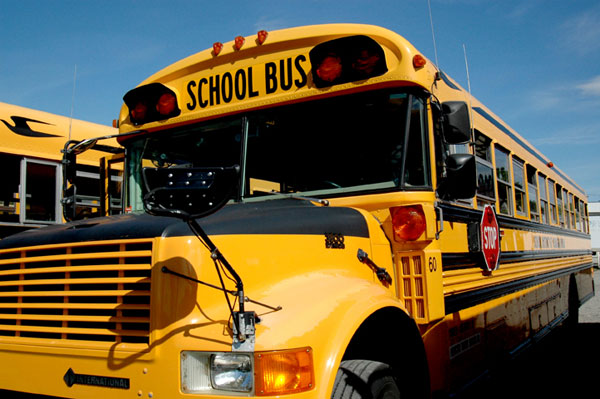 This Monday, my son starts high school and my daughter starts middle school.
I could grieve how quickly the years have flown. I could pull out baby pictures and wallow in nostalgia. I could reminisce about how, just yesterday, my son was starting kindergarten.
Or I could celebrate that, because both of my children are attending school out of district, my epic battle with the big, yellow school bus may just finally be over — permanently.
The battle began when I was in first grade. Having spent kindergarten walking to school, I was ecstatic that we had moved to a house that required riding a school bus.
My enthusiasm didn’t last long.
The problems started on the first day of school when I thought I could handle the bus ride all by myself. And I did. Going to school was simple. The bus picked me up in front of my house and dropped me off at school. My biggest challenge was getting to my classroom.
Going home proved a bit more difficult. I got on bus number 25, rode it to my street and rode it to my house. I then rode it past my house because my timid calls to stop weren’t heard over the din of bus chatter. Even though the bus failed to stop at my house, it did seem to stop at almost every other house in the county. When her route finally ended, the bus driver turned around, gave me a pointed look and asked me where I lived.
I proudly declared my well-memorized address “1910 Bean Drive.”
The bus driver did not look happy. “We went right past there. Why didn’t you get off?”
“Because you didn’t stop,” I replied.
Without a legitimate comeback, the bus driver had to make a decision. She’d take me home on her next run. Surrounded by kids two or three times my age and size, I finally made it home to an almost hysterical mother.
I wasn’t used to my mother being so worried. I was used to my mother being in control of every aspect of my life… including what I ate. And while I pined to have a lunch box with a bologna sandwich on white bread and ding dongs like all the other kids, my mom packed a very different lunch. Ever day I carried a brown bag (that she ask I bring home to be recycled) with a peanut butter (no added sugar) and honey sandwich on home-made wheat bread, carrot sticks, an apple and powdered milk in a square container with a lid (no thermos for me).
I hated that milk. I never drank that milk. But day after day, my mom packed it in a brown paper bag and day after day I carried the brown bag and the container still full of milk home from school.
Then, the inevitable happened, and I dropped the bag onto the floor of the school bus. The milk, which was already at room temperature, spilled everywhere. The bus driver was not at all pleased with me, so I should have known the situation would get even worse. And it did.
Only weeks later, my mother put her car in the shop near my school and needed a ride home. Being practical, she arrived at my school just as classes were ending and climbed onto bus number 25 with the first and second graders. At least she tried to climb on the bus, but the driver wouldn’t let her.
My mother insisted that there was plenty of room and the bus was going right to our house anyway. The driver told her no. After what seemed like the longest argument (and one of the most embarrassing moments of my life), the principal finally came over to settle the matter.
My mother had to find her own way home.
I’m pretty sure that was the day my name was officially added the national school bus “beware of this student” watch list. (That’s the list distributed nationwide to every single school bus driver.)
The list is the only explanation as to why, even after I moved across the country, the new school bus driver didn’t like me either.
In that case, the feeling was mutual. I had no respect for a woman who, instead of looking at the road, was constantly looking in the mirror to see what the kids were doing. After a few very close and dangerous calls on winding, West Virginia roads, my friend and I decided we’d had enough and organized a protest. We told everyone on the bus to duck down below the backs of the seats. The next time the driver looked in the mirror, her bus appeared empty.
We though this was hilarious. Our bus driver didn’t. In fact, she was so angry, she stopped the bus and marched up and down the aisle taking names and phone numbers Once she got mine, she seemed satisfied in learning that the girl on the national watch list was the culprit. What she didn’t expect was that my parents sided with me. They didn’t, however, think the incident warranted a life-time pass from riding the school bus, and I was still forced to ride for a couple more years.
But now, my days on the bus have come to an end, and, except for a few field trips, they have ended for my children as well.
Like so many other parts of childhood, all that is left are the memories and the lessons learned. Now it’s time to make more memories and learn something new. I’m just glad that neither is likely to involve a big, yellow school bus.
Collecting Tiny Pieces of the Soul
 One of the best things about having children is the privilege of serving as a sounding board for the ideas that are constantly bouncing around in their heads.
One of the worst things about having children is being forced to think about the ideas that are constantly bouncing around in their heads.
The other day my daughter said something I simply haven’t been able to shake.
‘Mom,” she said, “I’m worried about the future. What if teleportation actually becomes a reality?”
“Why is that a problem?” I asked.
“In order for teleportation to work, your body gets broken into tiny little pieces that have to be re-assembled perfectly again.” she explained. “If a lot of people are being teleported at the same time, what will prevent the pieces from getting all mixed up?” She sighed, “I don’t want pieces of me mixed up with pieces of someone else!”
Initially, I had visions of my mid-section being swapped with Jennifer Anniston’s. While I’d be delighted, I’m sure Jennifer would be horrified. My daughter interrupted those daydreams. “What if pieces are left behind?”
That was a good question from an almost 11-year old, and it’s come to haunt me over the past week: a week when I know too many people who have lost someone they care about deeply. A week when, for whatever reason, people who should be in the prime of their life are suddenly gone. A week when the power of medicine failed to make all the pieces of a person’s body work correctly. A week when so much has been lost, and yet so much has been left behind.
And some people leave many, many pieces of themselves behind. Those pieces aren’t intended to be re-assembled but to be shared.
I believe that every laugh, every kind thought and every good deed is a tiny piece of our soul that we give away forever with no expectation that it should remain part of us. These are the pieces that shine in our eyes when we smile and that warm our hearts when we hug. These are the pieces we send with our children each time they walk out the door and the pieces we lose when we share a secret.
These are pieces that do get mixed up with the tiny little pieces of others. And then, other people continue to pass them on all mixed up with their own tiny pieces. These are the pieces we collect when we need to paint a picture or compose a song or write a beautiful story. And they are the pieces we collect so we know how to love and embrace all that is beautiful in the world.
I understand why my daughter is worried about her tiny little pieces. I just hope I have collected enough tiny little pieces from others that I have plenty to share with her. And I hope she, in turn, is collecting tiny little pieces that can also pass on.
The Insanity of All This Violence is Driving Me Crazy
Just over two weeks ago, while families gathered to watch Fourth of July fireworks at a park less than a mile from my home, a gun was fired. In addition to shooting the intended victim, the gunman also shot and injured an eight year-old girl.
Just two days ago, a man opened fire in a crowded movie theater in Aurora, Colorado, He killed 12 people and injured dozens more.
While one incident was right down the street and the other was across the country, my initial reaction to both was the same. I wanted to hug my children and thank God they were safe. And then I wanted to scream about the insanity of it all: “Why does such senseless violence keep occurring and, even worse, why is it creeping into my world?”
In “my world,” the only violence we ever witness is in the form of entertainment: on television, in the movies and in video games. It’s not a place where people have to fear actual violence.
In “my world,” safe neighborhoods are easily defined, and we avoid violence by avoiding unsafe locations. It’s not a place where my daughter’s friends tell her “that shooting at the park was in my backyard.”
In “my world,” guns are used for hunting animals and shooting targets – not for shooting people. It’s not a place where people use violence to resolve a dispute or share their rage with the world.
In “my world,” when a horrible crime does occur, we rally around and pray for the victims and their families. It’s not a place where, only hours after a shooting, we try to turn a tragic event into a political advantage.
But I’ve come to realize that “my world” is a complete fantasy, but it’s a fantasy I also want my children to believe.
On July 5, I was driving by the park where the shooting had occurred only hours before. My daughter, sitting in the passenger seat, noticed all the people picnicking and swimming and asked “why are those people even at that park? Don’t they know it’s dangerous.?”
She was talking about a park that she has walked to and played in hundreds of times: a park where I walk my dog every day: a park that is the gathering place for most community events in my town.
And so, I told her that the shooting was an isolated incident and she shouldn’t worry or avoid the park.
What I didn’t tell her was that if we tried to avoid every place where there’s been gun violence, our options would be very limited. At the time, movie theaters weren’t even on my radar.
But theaters are creeping onto my worry list now.
Just last night, while my daughter was performing in a local production of “The Wizard of Oz,” the alarms in the theater unexpectedly went off.
No one in the audience moved, and the youth on the stage continued to perform. We were probably all hoping the same thing: that the smoke on the stage had tripped a fire alarm. We were also probably all just a little worried about the same thing: that someone with a gun had entered the building.
The alarm was turned off, my concerns ebbed and I went back to the fantasy of “my world.” It’s actually a very nice place, and I like living there. If I didn’t, I’d go crazy with worry.
Sadly, I’m having to leave it more and more often. And until we stop arguing about solutions and actually start working together, “my world” never will be a reality.
The Dog, the Derecho and Me

The fence around the pool where we had been swimming minutes before the derecho hit. It literally looks like a whole section was just lifted up.
Living in West Virginia, I’ve been fortunate to escape dealing with any significant natural disaster. That’s probably because floods are the most common disasters in the Mountain State, and since I’ve never lived in a floodplain, I’ve never had to experience one.
But over the past few years, I’ve had warning signs that my time was up.
In 2010, about four feet of snow fell in four days. I spent that week shoveling snow while my husband spent that week in a hotel in D.C. at the courtesy of his employer.
Last October, we were hit with an abnormal autumn snow that knocked down 2 1/2 trees in my yard. While I was listening to the cracking of limbs and the thump of trees, my husband was in D.C. working.
With these warning signs, you’d think I’d have been preparing to handle a real disaster on my own. Instead, I chose to ignore the signs. That’s probably because I’m a complete wimp when it comes to any kind of danger I can’t control. At such times, I always grab my dog and hold on tight.
Last Friday night, I almost suffocated my poor dog.
My neighbors had gone out for the evening, so I was at their house keeping an eye on our ten year-old daughters and our dogs… my German Shepherd and their Golden Retriever. Since it was extremely hot, all of us spent at least some time in their pool.

My neighbor is worried about letting her dog run in the backyard since there is now a big hole in her fence.
At some point, I commented that the sky had gotten unusually dark. I probably shouldn’t have listened to a ten year-old who told me that was normal, but I hadn’t heard that we were in for any severe weather.
So, when lightning began to flash in the distance, all activities moved to the “pool room.” I worked on my blog, the girls flipped through television channels, the dogs romped and the wind blew. And then the rain came and the wind blew harder… a lot harder. Then it began to howl.
Being a weather geek, I checked the radar and saw a dark red mass moving towards my town. Being a naive weather geek, I didn’t get too concerned since I hadn’t heard any sirens or warnings.
My warning came with a roar when the wind blew open the pool room door and raged around the room. The next few minutes are a blur. I remember telling the girls to move into the hall. I remember trying to shut the door. I remember grabbing my laptop, and I remember grabbing both the dogs.
And then the power flickered and went out.
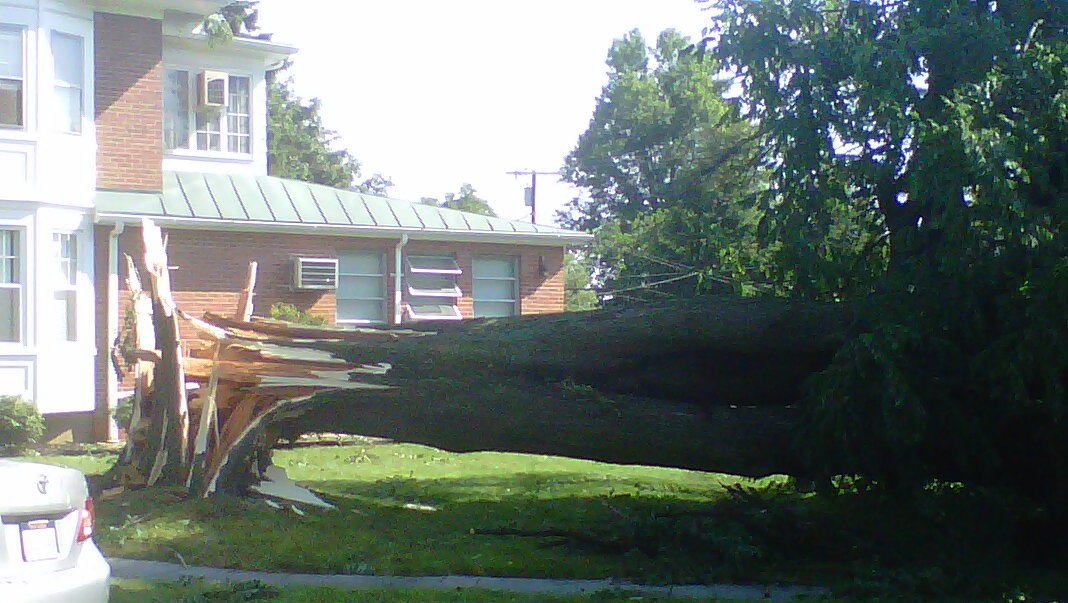
I was surprised at how many trees missed houses and cars… but many landed on roads and utility lines.
We sought refuge in the room of a ten-year old girl. And while I did worry about the girls, I have to say it was the dogs that I held fast. The neighbors’ dog sat in my lap, and my dog stood guard. The girls screamed, lightning flashed and the storm raged. And then, my neighbors’ son and his friend came home. Ever protective, my German Shepherd decided that his barking would be a great addition to Mother Nature’s latest composition.
It wasn’t.
I eventually convinced my daughter that we could dash across the yard to go home, and we spent the remainder of our night in the basement.
By the time my husband went to work shortly after midnight, all the remained of the derecho (also known as a land hurricane) were downed trees, downed power lines and a woman who wouldn’t sleep for days.

This car was entirely covered….
The next morning, my dog and I took our normal walk. Neighbors were already up removing debris from their yards and their roofs.
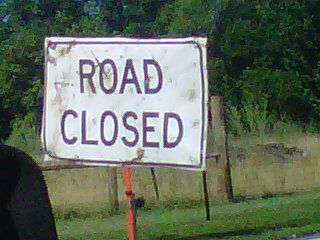
A common site for the first couple days.
Highway workers had already blocked roads, and Potomac Edison crews were already out trying to repair the damage. And the homeless guy at the park was eating his breakfast in his normal spot.
But nothing seemed normal to me except that my favorite dog was on the end of his leash walking happily over broken branches. He was even willing to pause while I used my Blackberry to document the impact of the derecho on my little corner of the world. He obliged for the next couple days as well.
In retrospect, we were lucky. We were only without power for a couple of days. My parents, who live nearly six hours away but experienced the same storm, still don’t have power. And, even with all the damage, what I’ve noted most is how many tall trees are still standing. For every tree that went down, hundreds more didn’t. To me, that’s nature’s way of reminding us all of how resilient we can be.
And, for the most part, I know I am. As long as I have my dog by my side.

My giant German Shepherd, Rodney, looked so small compared to some of the downed trees.
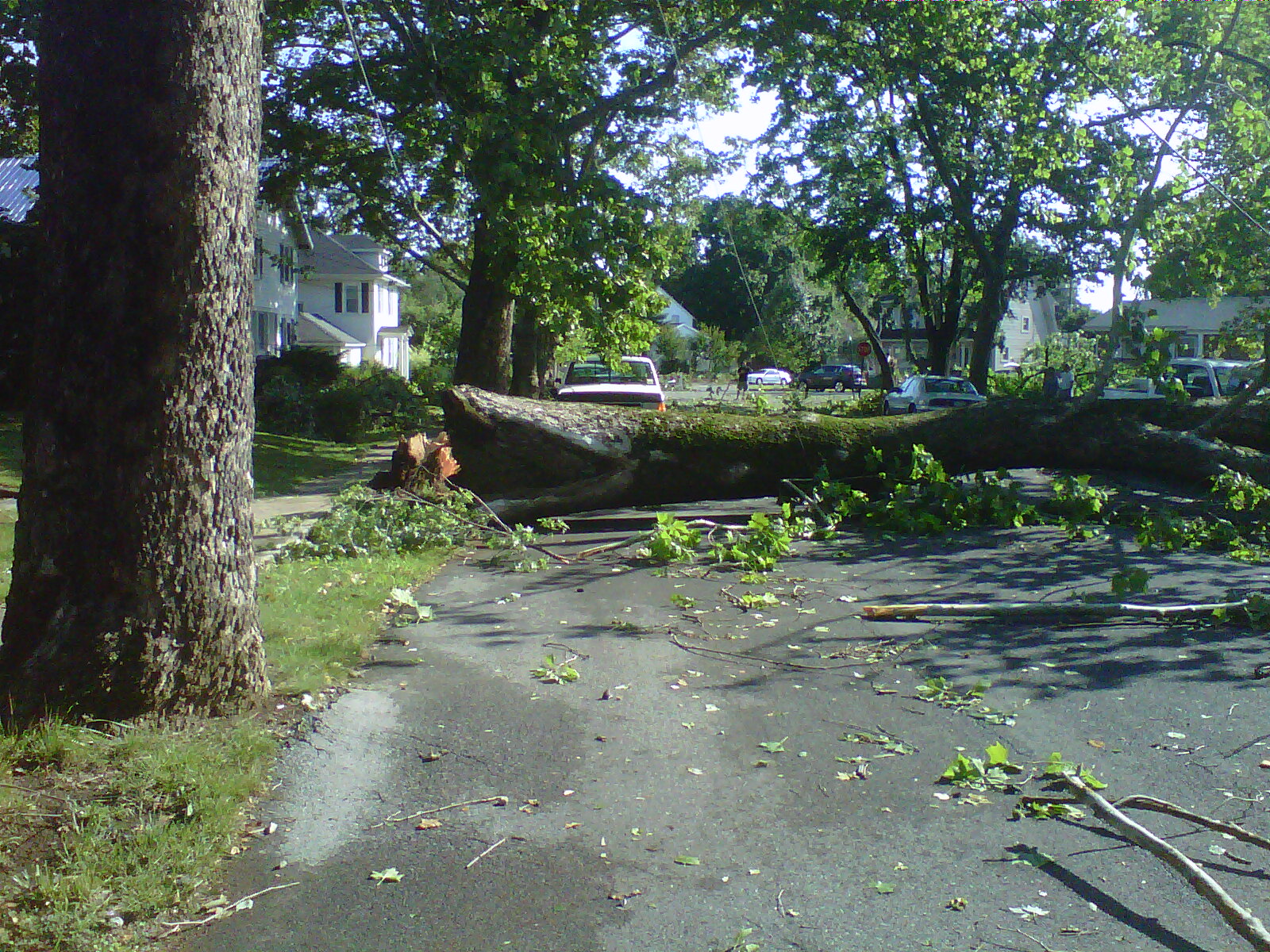
One of many beautiful trees the derecho claimed as victims.
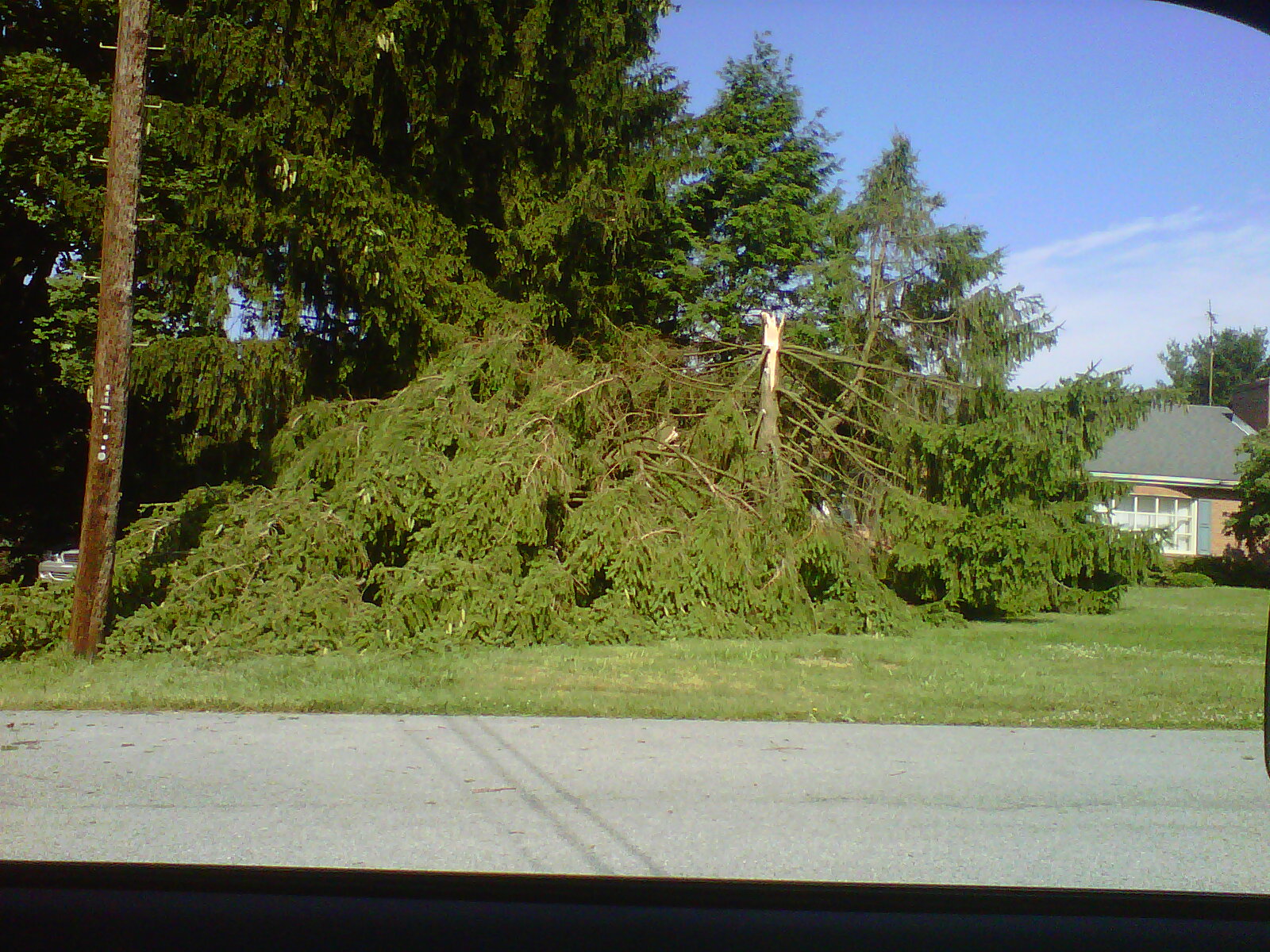
This once beautiful Pine has now been entirely removed from the neighborhood.

The City of Martinsburg is helping out by collecting all the debris residents drag to the curb. Here, Rodney surveys one street in our neighborhood.
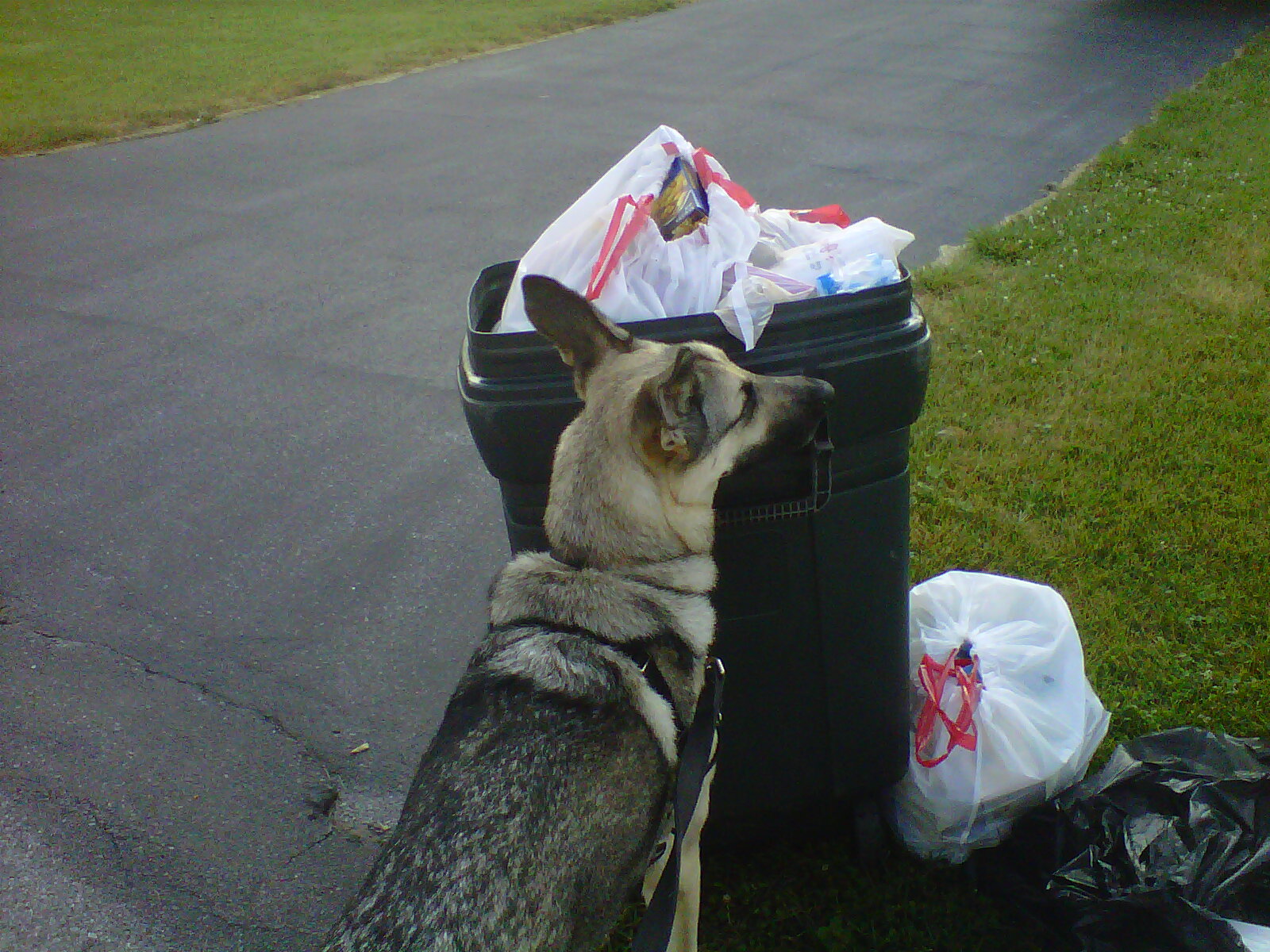
Everyone I know was very appreciative of how hard Potomac Edison worked to restore power. The biggest complaint I heard was how much we all lost when we had to throw away the contents of our freezers and refrigerators.

Rodney was very happy when power and air conditioning were restored. He took a break from all the walking around the neighborhood to sleep on the cool vent.
Five Words I’d Like to Ban From Any Political Discussion
This week, Michigan State Representative Lisa Brown was banned from the House floor for uttering the name of a body part.
She, unlike her male colleagues, actually has that body part.
Personally, I’ve said the word countless times. I’ve taught my kids that it’s an appropriate word, unlike the slang terms that are often used. I’ve even attended a play that features the word in the title and in the script.
But I don’t want to get banned from writing or labeled an extremist, so I’m not going to actually include it here.
I know that’s sad.
But sadder still is that, in 2012, a woman was reprimanded for saying it.
I shouldn’t be surprised. This has been an especially bad year for women.
Access to birth control has been threatened. Equal pay for equal work is being discounted. Ridiculous and invasive medical procedures (procedures that actually include the banned word) have been considered for legislation.
And women who stand up for their rights have been called sluts (because that is apparently not as offensive as a the name of a body part) on a nationally syndicated radio show.
I’m not just feeling belittled and a bit angry, I’m feeling frustrated.
I thought women were making progress. I thought the country was making progress. I thought individuals were important regardless of how much money they make, where they were born, what their sexual orientation is or, most important to me, what sex organs they were born with.
Silly me.
But since we are now engaged in a debate about what words are and are not appropriate to say during a political debate, I’d like to propose five that shouldn’t be part of any discussion.
1. Socialism. In recent years, this term has been used to perpetuate divisiveness and bitterness. It is being used to suggest that it is not American to believe those who have more resources have a responsibility to help those who are struggling.
2. Obamacare. I don’t believe that access to health care should be the responsibility (or fault) of one particular party or individual. It’s about all of us. Health care reform is complicated and hard to understand. But quality, affordable health care is also critical (and currently not accessible) to too many Americans. I have family and friends who have had cancer, high blood pressure and chronic sinus conditions. These are all pre-existing conditions that can drive personal health-care costs sky high. Most of my professional life I’ve been in jobs that either didn’t offer health insurance or offered it at an incredibly high price. I’m a very hard-working person, and I take extreme offense at being told that I don’t deserve the same access to health care as some one who has a different employer. Let’s be rational and talk about the issue rather than about specific politicians and leaders.
3. Christian. Anyone who knows me, knows that I have the greatest respect for God, religion and faith. But America was established on religious freedom, and we are going backward when we make any one religion the basis for laws. Of course our laws should be based on moral and ethical principles, but most religions are based on strong values. Let’s not marginalize people of different faith by holding up Christians as the only religion that counts.
4. Undeserving. This word makes my heart hurt. By using it to broadly describe any group of people is unfair and incredibly biased. It is also very effective. It allows some people to pat themselves on the back for being deserving while belittling people who are different. People hit hard times for a wide variety of reasons, many of which are beyond their control or rooted in a childhood that never gave them a chance. I’m not saying that we shouldn’t set expectations for people or encourage them to take care of their own needs. But lets provide them with skills and opportunities rather than blame and labels.
5. Penis. If vagina isn’t allowed, then we shouldn’t be allowed to say penis either.
Whoops. Did I just say vagina? There go any hopes of a political career.
Hopefully, I will still be allowed to share my thoughts and opinions. And hopefully this post doesn’t get deleted as a result of actually naming a body part.
The Reason I Never Forgot Eddie Pee Pants
 On a beautiful spring day several weeks ago, my kids and I were heading to lunch a few blocks from my husband’s office on the crowded streets of Washington D.C . Dressed in only shorts and t-shirts, we didn’t really fit in with the men and women in business attire who were walking with a great deal more purpose.
But we had one thing in common: we all pretended we didn’t see the homeless person still wrapped in a blanket and sleeping in a doorway on a busy sidewalk.
I saw both of my kids glance over at him, but neither said anything. I didn’t either. Soon, the homeless person was forgotten.
Almost.
Because somewhere in the back of my mind, he stayed with me.
He’s still there.
It’s not that I’ve never seen homeless people before. I see them every day. I even have a semi-relationship with the guy who hangs out at the park where I walk my dog. If I don’t at least wave at him, he coughs or makes some other noise until I acknowledge him.
But the homeless guy sleeping on the steps was different, because he might as well have been invisible. Everyone, including me, blatantly ignored his existence.
I understand why the business people ignored him: they probably see him everyday. He’s as much a part of their daily landscape as the traffic lights, the street signs and the blur of faces they regularly encounter.
But I didn’t have any excuse, and I couldn’t figure out why I didn’t even talk to my kids about him. That’s just not like me at all. If anything, I usually talk way too much about such things.
The only explanation I could find is one I don’t like: I was going along with the crowd. It was just easier.
It’s not the first time I’ve had to make that admission.
When I was in elementary school, I didn’t even know the full name of the boy who rode the school bus. I just knew everyone called him Eddie Pee Pants. You don’t need to be a genius to figure out how he got the name.
I don’t remember calling him that to his face, but that’s the name I used when my peers and I were discussing how to avoid him. No one wanted to have to sit with Eddie Pee Pants on the bus. If you did, you’d not only have to smell him, but you would get “Eddie Pee Pants germs.”
I knew what we were doing was wrong, but I justified my behavior by telling myself that I was never actually mean to his face. But the guilt got worse when Eddie’s life got worse.
One Saturday morning, I joined my dad at the top of our driveway to watch the drama unfold on a hill about a mile from our house. A dilapidated mobile home was on fire. Flames were shooting out the roof, and smoke was turning the sky black.
“That’s a total loss,” my dad commented.
I didn’t know until Monday that the old, junky trailor everyone said was an eyesore was Eddie’s house.
I have no recollection of what happened to him after his house burned. I just know he never rode the bus again, and I don’t remember ever seeing him at school again. I don’t even remember if there were any injuries or fatalities in that fire.
What I do remember is wondering why I wasn’t nicer to Eddie and feeling horrible that I’d never have an opportunity to undo my misdeeds.
Eddie isn’t the only person I’ve ever discounted or belittled. But he’s the first person who taught me three essential life lessons:
1. Treating someone poorly never makes you feel better about yourself.
2. Sometimes you don’t get a second chance to do the right thing.
3. Issues such as poverty, child abuse and homelessness are actually about individuals — people who, regardless of the reason for their circumstances, still have value.
I’ve taken that third lesson to heart. Eddie, like the homeless person in the doorway, gave me something priceless. They taught me to look beyond the unkempt appearances, poor hygiene or odd behavior. They’ve taught me that sometimes the person who needs to change their attitude or perception is me. And they’ve taught me that speaking up feels a lot better than putting someone down.
They were priceless gifts in my life, and I hope I can pass their lessons on to my children. And that, if nothing else, is what makes their lives so valuable to me.
There’s a Reason This Mom’s Brain is a Hot Mess

There’s no doubt I love my children.
But at times, when I’m completely honest with myself, I wonder what the heck I was thinking when I decided to become a mom.
It’s not because I regret having children. Not for a minute.
And it’s not because I think my life would be more interesting or exciting if motherhood didn’t require I put their needs above mine. Being a parent puts a whole new spin on interesting or exciting.
And it’s certainly not out of guilt that as a girl, teenager and even as a young woman, being a mom wasn’t on my list of life goals. Having children helped me recognize what’s really important in life.
It’s because there are times when I think my kids could have done better with another mother – a mom who isn’t as emotional or head strong or outspoken as the one they got. A mom who never purposefully ignores parenting magazines, workshops or other sources of standard parenting advice. A mom who always enjoys her children’s activities instead of attending out of a sense of obligation.
And just when I’ve convinced myself that my kids would be better off with any mom but me, I come face to face with parents who don’t understand what an incredible gift – and responsibility –being a parent is. I witness moms behaving as though they are still adolescents with all the same drama and self-absorption. I have to listen to parents who always blame someone else when their child behaves poorly, gets a bad grade or is fighting with other children. Worst of all, I know of parents who put their children’s welfare and safety in jeopardy.
I may be imperfect, but those situations make me feel better about my own parenting skills. At least for a little while… until my kids do or say something embarrassing or completely inappropriate. Then I’m back to thinking that if they had a different mother, their behavior would be stellar.
Such thoughts bounce around in my brain on a daily basis… sometimes at such incredible speed that I fear an impending brain explosion.
The requirements of my profession haven’t helped.
Because I have a social work license, I’m required to take continuing education. Usually, I seek work-related education. Because I recently changed jobs, I’ve been seeking education that is more closely aligned with parenting issues, which I usually avoid.
I’m not sure the plan has worked for me.
In a workshop on bullying, the presenter disparaged parents who tell their daughters that, when a boy teases her, he actually likes her. According to the presenter, that’s putting her on the path to domestic violence. Having said those exact words to my daughter, I was convinced that, at worst, I was creating a victim. At a minimum, I was teaching her that abusive behavior is a sign of affection.
I was back to being a horrible mom.
But then, a couple of weeks later I attended a workshop on child abuse. The workshop emphasized the need for children to feel comfortable questioning and saying no to adults. Now that is something my children have NO problem doing. Could it actually be good that my children are following in their mother’s footsteps by requiring more than just a command as a reason to follow orders?
My internal confusion isn’t necessarily a bad thing, but it does highlight the reason I’ve avoided reading all those articles about parenting. Once my children started developing their unique personalities, I had to treat them uniquely. And no expert could tell me how to do that.
So while no parenting magazine will ever put me on its cover, that’s not important to me.
What is important is that someday in the distance future, when I’m not the complete embarrassment or the clueless person that my children currently think I am, I will be featured in their life scrapbook .
I don’t even expect to make the cover, but I do want to be featured.
I’m pretty sure I can fill that role quite well… a long as my brain doesn’t explode in the meantime.
Remember When Mother’s Day Was Considered a “Gay” Holiday? Maybe It Still Is.
 As a child, I adored Mother’s Day. Just like Halloween and Christmas, it held the purposiveness of preparation and the excitement of anticipation.
I was incredibly intent the year I had to make a corsage for my mom out of tissue paper. While my fellow students curled the colorful paper around their pencil erasers then glued it to cardboard to resemble bright flowers, I felt the need to put order to chaos. The result was a smiling face that, in retrospect, bore a striking likeness to the Wal-Mart smiley face.
My mother never hesitated to wear the hideous yellow corsage. In fact, she wore it all day on Mother’s Day, even though it thoroughly clashed with her dress.
I was incredibly proud the year I played Mary Poppins in the Mother’s Day program. Families were required to provide the props, and because my frugal family didn’t have a normal umbrella, I twirled a hideous clear, plastic one shaped like a mushroom as I danced through boxes painted like chimneys. I resembled Mary Poppins about as much as I resembled Grace Kelly.
I was incredibly naive when I bought my mother a card that described Mother’s Day as a “gay” holiday.
I’m a lot older now, and I’m a lot less naive.
But I still don’t have a problem describing Mother’s Day as a gay holiday, especially this year.
That’s because, as I’ve aged, Mother’s Day has come to mean more than simply honoring and thanking my own mom. It’s also become a day to reflect on what being a good mother is.
While my experience is limited to 14 years, I’ve come to recognize three primary truths about being a parent:
1. A mother’s primary responsibility is to ensure that her children grow up to be responsible adults;
2. Every child is different, so there is no “right” way to be a parent;
3. Teaching our children to defend and stand up for those who are different is much more important than teaching them how to be popular or stylish.
This week, our President served as a parent to our entire nation when he publicly declared his support of gay marriage. I know the motivations behind his statements can be disputed, but I choose to believe that he was guided by his sense of morality and his need to set an example for all of us.
I heard his message loud and clear; if we tolerate hate and intolerance wrapped in religion then we are acting in direct opposition to the principles on which our country was established: a country in which all people are supposed to be treated equally.
So, while I seriously doubt my children will ever used their hard-earned allowance to buy a card that describes Mother’s Day as gay, I know that if they do, I would be honored to receive it. After all, it might be describing a holiday that looks beyond stereotypes and bias and unites us with a purpose of increasing tolerance for the next generation.
I can certainly hope.


 Just So You Know