Category Archives: current affairs
Buck Wild in a Beauty Salon
 If you’ve ever lived in West Virginia, you know all about MTV’s newest “reality show” premiering this Thursday night in the spot previously filled by Jersey Shore.
If you’ve never lived in West Virginia, all the drama surrounding Buckwild has probably either escaped you and/or seemed relatively unimportant. But here in the Mountain State, there is a great deal of concern about how the show will perpetuate negative stereotypes about those of us who live here.
When the first promos began airing last month, there were newspaper articles, editorials and online petitions criticizing Buckwild. Even our junior U.S. Senator and former Governor, Joe Manchin, wrote a letter to MTV asking that the show not be aired. Many argued that his subsequent appearances on national news and talk shows simply provided unpaid advertising.
To me, the show just looks stupid. I never watched Jersey Shore, and I have no plans to watch Buckwild. And yes, I even signed one of the online petitions asking that it not to be aired. But my reasons have nothing to do with how people might perceive West Virginians. There will always be those who believe stereotypes regardless of what they watch, hear or read.
To me, the show is actually more of a reflection on the entire nation than it is of West Virginia anyway. And while I deplore the concept of encouraging young people to do really stupid (and yes, mostly scripted) things for others’ entertainment, what I deplore even more is that there is obviously a large market for such shows. And yes, I know there are many who will tune it to watch Buckwild out of initial curiosity, but that’s not my issue. My issue is with people who watch this type of show for entertainment and for more people to ridicule. This includes television viewers such as the guy who was having his hair cut during my last hair appointment.
Until a few years ago, I never understood why any man would go to a beauty shop, but that was before I discovered the salon where I now go.
The place is more entertaining than anything on television because the people, the conversations and the emotions are genuine. I never complain that my appointments usually last more than two hours, because that time is more compelling than any reality show, particularly those featuring half-dressed young women and cocky young men whose vocabulary is rooted in George Carlin’s monologue about seven dirty words. And, when I think about it, I don’t recall hearing much, if any, cussing in the beauty salon.
Instead, I hear and participate in conversations about real people and real struggles that somehow turn into laughter and hope. The conversations range from cancer, to drug addiction to cross-country motorcycle rides. Everyone in town seems to know the owner and her husband, so there is a constant stream of local characters who come through her doors with their own dramas and issues. Discussions can turn from politics to childhood memories in a matter of seconds. And all of this occurs to some music soundtrack that almost always becomes part of the conversation.
The owner, and my stylist, strives to play just the right music, but she also always has technological difficulties. During my last appointment, she finally gave up when her latest gadget stopped working, and she was forced to turn on the radio to a classic rock station. Of course, the music brought back more memories and more stories.
And then, Manfred Mann’s Earth Band’s “Blinded by the Light” came on, and we all sang along. Sort of. The lyrics have always been unclear, so we all sang a different variations of “revved up like a deuce another runner in the night.” Some bordered on completely inappropriate. In order to resolve the debate, I took out my phone to search for accurate lyrics.
By the time I’d found them, the conversation had already moved on to Buckwild, and everyone was expressing an opinion. That’s when the clean-cut gentleman who had been sitting quietly while his hair was being trimmed said, “I think it looks entertaining, and I’m looking forward to watching it.”
For the first time, the shop went quiet except for Led Zeppelin playing in the background. Everything just seemed to stop. And then, just as quickly, the conversation resumed. Only no one said anything about Buckwild, instead the owner started telling a story about the recent Eddie Money concert.
No one acknowledged the man’s comment, and I don’t know whether he was oblivious to the slight or if he even cared. What I do know that everyone else’s reaction spoke volumes. And I don’t think the silence was so much an indictment on his opinion as it reflected a deep sadness that someone, surrounded by real characters, real conversation and an ongoing celebration of the reality of day-to-day life, would admit he wanted to simply observe the exact opposite.
Hours later, when I was thinking about the incident, I realized how we often lose sight of all that is meaningful around us because the media is trying to sell us a completely different definition of what makes life interesting.
I’m just glad there are people who still don’t buy that, and instead enjoy the simple pleasures of going a bit crazy, or buck wild, in a beauty salon.
The Rapist with the Great Reputation
 During my freshman year of college, female students were on high alert. A predator had taken advantage of unlocked doors to rape at least two co-eds in their own dorm rooms. Flyers with a composite drawing of the suspect along with warnings and safety reminders were hung up all over campus.
I think the guy was eventually caught, but I honestly don’t remember.
What I do remember is that, for a while, most female students were careful about locking their doors and not walking alone after dark. While those precautions should have been and should continue to be common practice, our fears were somewhat misplaced.
Instead of worrying about a stranger jumping out of the shadows to attack us, we should have been alert to those we already knew.
No one ever taught me that, but I learned the lesson anyway. Unfortunately, I learned it too late.
I was already a college graduate when I was invited to a law school party that started like any other. That didn’t last long.
At other parties, I didn’t fall down after one beer. At other parties, male acquaintances with whom I had absolutely no romantic interest didn’t complain, “that’s not how it was supposed to work” when I talked to other male party goers. And at other parties, I didn’t leave with huge chunks of time missing even though very little alcohol was consumed.
I will never know exactly what happened that night. I’ve gotten bits and pieces from friends but, to be honest, I never really wanted to know. For a long time, I was ashamed and believed that I had done something wrong.
Only years later, when I learned about Rohypnol and other date rape drugs, did I piece together what probably happened. And even then, I had no proof that anything happened at all.
Statistics show that such an incident isn’t uncommon. The National Institute of Justice (NIJ) estimates that about 85 to 90 percent of sexual assaults reported by college women are perpetrated by someone the victims knows. Half of all victims do not define the incident as rape because ” there is no obvious physical injury and alcohol was involved.” The NIJ also reports that “approximately 27.5% of college women reported experiences that met the legal criteria for rape.”
What they usually don’t do is report these incidents as crimes.
That’s because rape often doesn’t look like the crime many of us were taught to avoid.
Rape is not just a crime of violent sex offenders who stalk women in dark alleys. It is not just a crime of deranged individuals who can’t control their violent urges and express them through rape. Instead, it is often a crime committed by men or boys with great reputations who, for whatever reason, are seeking to meet their needs by controlling women. And because these men are often respected professionals, athletes or students, they often get away with their behavior.
A former emergency room nurse told me a story about caring for a young woman who had been raped on campus by a student athlete. The university offered to pay the victim’s tuition if she didn’t press charges or go public. She never pursued the crime, but she never went back to school either.
A social worker tells the story of a woman who drank too much and was picked up by a police officer, who, instead of giving her a ticket, chose to rape her instead. She never pressed charges for obvious reasons.
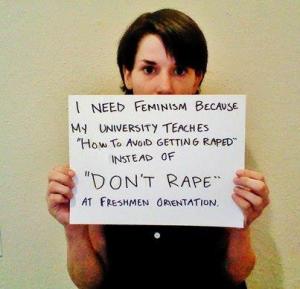
This week, a colleague showed me the photo of a young woman holding a sign that says ” I need feminism because my university teaches how to avoid getting raped rather than don’t rape.” I posted the photo on Facebook, and it immediately got reaction, including those who wanted to emphasize that young women should be taught to take safety precautions.
I couldn’t agree more. But I can’t say that putting all the responsibility on women is fair or appropriate. Universities, and society as a whole, must send a constant and consistent message about the definition of rape and that it is a crime regardless of the circumstances and people involved.
That’s not happening. Instead, the message seems to be that these things sometimes happen when alcohol is involved or when women lead a man on. The message also seems to be that some men are just too important to hold accountable.
And so, I agree with the young woman in the photo.
There will always be individuals who push the limits. The rest of us have the responsibility to push back.
Another Excuse for Bigotry
Over the past couple years, I’ve been doing my best to hold my tongue and tolerate people who use social networking sites to post rude and mean-spirited comments about specific groups of people. But this week, I finally snapped.
I’m calling out these people for what they are: bigots.
According to the dictionary, a bigot is someone who is obstinately or intolerantly devoted to his or her own opinions and prejudices, especially in regards to members of a group.
As America grows more and more diverse, such attitudes against people of different colors or nationalities has become less and less acceptable.
But bigots are haters and, as my kids tell me on a regular basis, haters hate.
So, the haters have set their sights on poor people, particularly those who have had to depend on government assistance when they face tough times.
I’m not the only person whose been noticing this trend.
This week, a colleague stepped into my office, and during a casual conversation, broke into tears.
“I’m sorry,” she said. “I’m just so angry. I had a relative post the meanest thing on Facebook.”

The post she was referring to was a meme that compared people on welfare to a dog: lazy, unemployed, with no known father.
“I wanted to give her the facts,” she said, “but I know that won’t matter. She just won’t listen.”
I know how she feels. For years, I’ve been trying to share the facts with those who demonize people “on welfare.”
In July 2011, I tried to educate them: my rant about people who rant about welfare. People continued to make judgmental comments.
Last Thanksgiving, when people bragged that they never asked for handouts and didn’t want their tax dollars going to those who aren’t willing to help themselves, I tried to explain that very few people succeed on their own: I’m thankful for the handouts I’ve received. The people who should have read that blog obviously didn’t.
Over time, I’ve come to believe that efforts to educate people who wrap themselves in indignation and self-righteousness are simply ineffective.
And yet I still try.
So, for all those people who continue to point fingers and won’t listen to facts, at least listen to this:
When you are making judgmental comments about any group, you are actually referring to individuals who comprise that group. Unlike skin color and despite your preconceived notions about how people on welfare look, you don’t always know who is part of that group. Some of your friends and acquaintances may have, at some point in their life, depended on social services.
These individuals have feelings. When you laugh at people on welfare, you are doing absolutely nothing to encourage them. When you blame them for taking your hard-earned money, you are doing nothing to help them succeed. And when you call them lazy, you are questioning their integrity and intentions. You are simply making them feel worse than they probably already do.
I am under no illusion that people will change their political opinions or their values based on what I write. But what I am asking is for more kindness and understanding. I’m also making a final plea that people get the facts before they make comments about anyone.
I know there’s a platitude that ignorance is bliss, but given the ignorance I’ve observed recently, I disagree. Instead, I think ignorance is just another excuse for bigotry. And that’s just not acceptable.
Fear and Self Doubt at the End of a Pointed Finger
 A few months after I moved to West Virginia from Oregon, a girl in my junior high gym class pushed me into a dark corner of an unused shower, got in my face and screamed at me for being too smart. As she pointed her finger into my chest, she told me that I had better stop acting like I was better than everyone else. She was joined by two other girls whose spittle sprayed across my face as they railed at me – screaming that every time I got a high score on a test or assignment, I ruined the curve for everyone else. They also told me that I talked funny, should accept I was in West Virginia and needed to start acting like it.
Even though the incident probably lasted only a few minutes, the repercussions have lasted my entire life. Yet I never told anyone about what happened, and, up until now, it’s been a secret between me and the three others involved.
But this week, with all of the negative comments and finger-pointing after the presidential election, the memory has come flooding back.
After the incident in the shower, I hated myself and believed I was somehow to blame for the situation. While I never purposely got a bad grade, I was still bullied into submission. I spent years locked in the prison of being a follower rather than an individual. Throughout my adolescence, most of the opinions or beliefs I espoused weren’t really my own. Instead, I was simply parroting what I had heard and what I thought would help me fit in.
Even worse, I was full of self-doubt about who I was and what I believed.
Thankfully, I grew up and I grew strong. I grew to be an independent woman who could think for herself, believe in her own intelligence and develop a conscience that extends far beyond her own wants and needs. I also grew into a woman who isn’t tolerant when people make judgments about or reject someone who acts or thinks differently than they do. I know all too well what that feels like.
That’s why some of the harsh comments and reactions to this week’s election took me right back to the shower where I was being bullied.
I understand why some people are angry and frustrated. I felt the same way after the 2000 and 2004 elections. But I didn’t to purposely make others feel bad about their beliefs and opinions. Yet that’s what I’ve been witnessing, and to me, the reactions mirror how the girls in the shower treated me.
People are angry at the election results and are trying to find someone else to blame. The girls were angry about their own grades and had to find a scapegoat, which was me.
Romney supporters are screaming that those who voted for Obama are idiots, morons, traitors and worse. The girls didn’t question my intelligence, but they did question my standards and integrity.
Some extremists are complaining that Obama rallied minorities and people on welfare to vote for him and, in those complaints, they are insinuating that these individuals don’t have the same status as “real” Americans. The girls complained that I, a newcomer to a community where they had lived their entire lives, should be conforming to their definition of normal.
The main difference between now and when I was a teenager is that I am not going to be quiet when I hear or witness such behavior. It’s wrong and people should be told it’s wrong. Neither do I feel bad about myself or my beliefs. I now recognize that anyone who points a finger is simply trying to transfer their own fear and self-doubt to someone else.
Instead of pointing fingers we should be joining hands so together we can tackle some of the tough issues we face. After, all, it’s’ hard to be angry, fearful or full of doubt when your fingers are touching someone else’s.
My File Cabinets Full of Men
 I completely appreciate why the internet is buzzing about Governor Romney’s claim during Tuesday’s presidential debate that he had “binders full of women.” But there’s also a part of me that identifies with his statement.
I, after all, have file cabinets full of men.
While Romney said he used the binders to identify qualified candidates for key positions in state government, my file cabinets serve an entirely different purpose.
I use them to store reminders of all the men that are NOT qualified to be in any part of my life.
I started my first file when I was a young girl and a boy told me that men were more important than women because they got to keep their last names when they got married. I was devastated, but I was also angry. As a result, that boy had the honor of being the first male I ever put in a file cabinet.
Over the decades, I’ve filled several file cabinets with men. Some of the most memorable include:
* The minister who insisted my friend keep the word “obey” in her wedding vows.
* The agency director who tried to prevent me from getting a management position because I breastfed my baby during a meeting that I graciously attended while on maternity leave.
* The community leader who always referred to me by using my husband’s last name, even though he knew I had never changed mine.
* The manager who issued a dress code that all female employees must wear pantyhose with skirts or dresses. (For the record, the dress code was issued during the summer when I was eight months pregnant.)
* The nonprofit executive who, with a staff of all women, refused to let mothers take sick leave when a child was ill or had a doctor’s appointment. At that time, we were all granted a set number of days for both vacation and sick leave, but vacation was much more limited. The director’s exact words were, “letting mothers take sick leave for their children isn’t fair to the employees who don’t have children.”
* The supervisor who blatantly promoted young, attractive females over more qualified, middle-aged women.
I’ve recently been considering adding another man to my file cabinets. While this man claims to support women, he’s never demonstrated any real understanding of the often life-long battle many of us have faced. He’s skirted around the issues of equal pay for equal work and reproductive rights. And even when he tries to express his appreciation about the need for equality in the workplace, he falls short by indicating that women don’t want to work long hours because they have to go home and fix dinner.
Yes, this week I’m definitely thinking about adding that man to my file cabinets. I’m just not sure if his binders will fit too.

Will You Sound Bite This?
Being married to a national journalist has its advantages. For example, when I’m feeling completely uninformed or confused about national or international events, I have a readily available source to answer my questions.
There are also disadvantages. The news never takes a vacation, so my husband works weekends and odd hours. He can’t express any public opinions about politics (really, he’s not allowed), and even though he and his co-workers are held to very high standards, when people criticize the media as an industry, they are also criticizing his professional integrity.
Regardless, I credit broadcast journalism for giving me a great life. It’s how I met my husband, it pays the bills and it’s how I started my career.
And while my career in broadcast journalism was extremely short-lived, the lessons it taught me have served me well over the past couple  decades. For example:
1) There will always be people who lie or mislead in order to protect their own self-interest. Being able to separate fact from fiction, determine what’s relevant and ensure the truth prevails requires perseverance and a Teflon shield.
2) Well-known people in the public eye generally aren’t making the biggest difference in the lives of others. There are always exceptions, but many are more intent on advancing their own agenda than they are with furthering the common good. Most often, the people behind the scenes are the ones who do the work and really know what’s happening.
3) There are always two sides to every sound bite.
From most people’s perspective, a sound bite is simply a very short clip of a much larger conversation. But for people on both sides of the microphone, it is much, much more.
A simple statement can inspire, inform or be blown completely out of proportion when taken out of context. A few words are often louder than the most heartfelt speech.
Just ask Mitt Romney or President Obama. During this campaign season, Romney’s comment “I like being able to fire people” wasn’t referring to his record at Bain Capital, but his opponents seized the opportunity to use those words against him. A few months later, President Obama had a similar experience when he said, “You didn’t build that.”
You would think both men would more carefully choose the exact words and phrases that come out of their mouths, but they are human. And a good sound bite is irresistible to a reporter. I should know.
I’ve been on both sides of the microphone many times, and I thought I had the sound bite mastered. And then I fell into the trap myself.
My daughter was just under a year old when I took her and her four-year old brother to a public pool. My mother had joined us, and we were enjoying a sunny, summer Saturday afternoon when a muffled announcement came over the speakers: “We apologize for the inconvenience, but the pool will be closing for the rest of the day. Please exit the pool area immediately.”
Since there wasn’t a cloud in the sky, the announcement made no sense. Fortunately, one of the teenager lifeguards was my neighbor, so I asked her what was happening.
Apparently, there was a dispute between management and the lifeguards. The lifeguards were insisting that the chemical levels in the pool weren’t safe, and they were walking off the job. With no lifeguards, the pool had to close. As other people packed up their towels and exited in mass, my mother and I decided there was no hurry and waited by the baby pool until the crowd cleared.
Just as we were finally leaving, a news van pulled into the parking lot. Since very few swimmers were left and I had a cute baby in my arms, the female reporter immediately zeroed in on me.
“Can I ask you a few questions?” she inquired breathlessly as she shoved a microphone in my face.
I agreed, and she began peppering me with questions about unsafe chemicals in the pool. Since I wasn’t really concerned and saw no reason to panic, I carefully avoided her efforts to bait me into saying anything that blew the situation out of proportion. She was obviously getting frustrated that my answers weren’t heightening the drama. Finally, she asked, “Aren’t you concerned about the health of your baby?”
I stepped into her trap when I answered, “Of course I’m concerned about the health of my baby, I just don’t think this particular situation is going to harm her.”
 A few hours later, I turned on the television news to see a lead story about how panicked parents evacuated a local pool. The story featured a carefully edited clip of me holding my daughter and saying, “I’m concerned about the health of my baby.”
I was mortified.
For the rest of the weekend, the clip played over and over again during news promos and broadcasts. My embarrassment grew when further investigation revealed that the chemical levels were fine, and that the situation had been overblown by a handful of teenage lifeguards.
For days, I was teased, even though I tried to explain that I had NOT panicked.
Years later, this story is rather funny, but it is also a cautionary tale.
Drama and conflict can be used as marketing tools and political weapons. And yes, some reporters take words out of context to create the story they want. This is especially true during an election year. No one should accept a few words at face value. We all need to do our research, determine what message was actually intended and take time to learn all the facts before making judgments and leaping to conclusions.
Take the paragraph above. Someone could easily turn it into a sound bite: Trina Bartlett says “reporters take words out of context to create the story they want.” That would likely stir up trouble with my husband of 19 years as well as my friends in the news industry, who all do their best to maintain journalistic integrity.
The problem is too many people prefer hearing words that support their own beliefs rather than knowing the truth, and many media sources have lost the once distinct line between news and opinion. Unfortunately, many people can’t tell the difference.
Every time someone spreads false information or shares quotes that have been taken out of context, the collective integrity and intelligence of our country drops.
And yes, I would love for someone to sound bite that.
How I’d Shake Up the Presidential Debates
 This Wednesday, when President Barack Obama and former Massachusetts Governor Mitt Romney square off in the first in a series of three debates, I’ll be watching for entertainment purposes only.
Despite all the hype, I have absolutely no expectation that anything either candidate says will sway my opinion. They will both be so scripted, so practiced and so focused on performing that their potential to impact my life will seem irrelevant. And even after they stop talking, the pundits will step in to add their spin.
The debates, like so many other events that used to be newsworthy, have become staged productions with limited genuine content.
What I need is honesty. I don’t need platitudes or great sound bites. I need heartfelt discussion and genuine opinions.
If only I were in charge of the debates.
If I were, both candidates would be injected with truth serum before they could answer even one question. I’d also be asking my own questions. I already have a list:
1. If your household income were $50,502 (the median household income in the United States in 2011), describe how you would budget your money to pay for housing and health care, ensure your children received an excellence education and save for emergencies.
2. Describe a situation when you “pulled yourself up by your bootstraps” when the odds were against you, if anyone helped you and what resources you used.
3. Who really influences your political decisions?
4. Do you think there are deserving and undeserving people? If you think there are undeserving people, who are they?
5. What is the biggest lie you or your party has told about the other candidate?
6. What do you think are the biggest differences between men and women? (The ability to give birth doesn’t count.)
7. How would you ensure that every child in America actually received a comparable education?
8. Describe what’s wrong with Congress and how you would attempt to fix it.
9. Describe your understanding of a typical week for an average American.
10. Why do you really want to be President of the United States?
I realize that my questions aren’t particularly politically savvy or intellectually stimulating, but when answered truthfully, they would definitely shine light on which candidate could best lead America.

People Are Not Measuring Devices
I’ve been feeling rather sorry for Condoleezza Rice lately, and my sympathy has nothing to do with the fact that she will be forever associated with the George W. Bush administration.
I feel sorry for her because so many people want to turn her into a measuring device.
 After her speech this past Wednesday at the Republican National Convention, the rhetoric started:
“How can the Democrats claim there is a war on women? Condoleezza Rice proves that’s just propaganda manufactured by liberals who are pandering for women’s votes.”
“Condoleezza Rice demonstrates that any woman can succeed if, instead of relying on the government, she just applies herself.”
While I take issue with those statements, I have no problem with the woman who inspired them. I admire Condoleezza Rice. She’s a smart, accomplished and successful woman. Even though I may not always agree with her politics, I do believe she is a fantastic role model for young woman across our nation.
I just don’t believe that she’s a yardstick .
 The notion that all women should measure themselves against Condoleezza Rice, or any other woman, is ridiculous and damaging.
I’ve spent most of my life trying to break my innate tendency to compare myself to other women. I’ve compared my looks, my body, my talents, my personality, my lifestyle and my parenting skills to others. Instead of embracing my unique blend of strengths, weaknesses, quirks and experiences, I simply saw my flaws and failures. I don’t want that for my daughter or for any other female. And I don’t want them to judge women who don’t possess the talent, intelligence or opportunities to achieve what others may define as success.
Yet they are hearing that, because some women have reached the top, all others have to do is simply “try harder.”
That was certainly the message from those who opposed the Lilly Ledbetter Fair Pay Act.
If only working hard were a guarantee of an adequate paycheck and the appropriate recognition. In reality, the workplace is a harsh and very unfair place. I’ve worked hard only to watch those who didn’t zoom right by me. I’ve seen pretty women take advantage of their assets and maneuver their way past others into better jobs and higher paychecks. And I’ve seen the “good old boy” network benefit those who already had the advantage.
While great strides have been made for women in the workplace, the dollars still tell the story. In 2010, the U.S. Census American Factfinder indicates that 17.9% of families with children were living below the poverty level. That number jumped to 39.6 for families with a female head of household. Despite the increase in the number of men who are taking on active parenting and caregiving roles, nothing will ever change the fact that women are the ones who get pregnant and give birth. And now, their ability to even make decisions about that has been under fire by people such as Missouri Congressman Todd Akin, who doesn’t even understand the biology of conception.
Condoleezza Rice has never married nor had children. I have no idea–nor is it any of my business– whether this was a conscious decision or just the result of the many choices she made throughout her life. I do know that she never had to make arrangements for child care, leave work early to pick up her child at school or miss important meetings when a child was sick.
And I’ve never heard anyone claim that she was an underachiever or compare her to women who have careers and children.
But maybe that’s because some yardsticks are defective and only measure what the user wants them to show.


 Just So You Know