Blog Archives
2 and 1/2 Foolish Wishes
 If I had a genie that granted three wishes, I would have almost wasted them this past week.
Instead I only hypothetically wasted two and came very close to wasting the third.
My preoccupation with genies and wishes began when my daughter told me about a recent in-class writing assignment. She and her fellow sixth grade students were given the scenario that they’d released a genie from a lamp and had three wishes to use in a week.
“The only rule,” my daughter explained as I was driving to her dance class, “was that we couldn’t wish for more wishes.”
“What about wishing for magical powers?” I asked.
She thought for a minute then said, “It depends on what kind of magic.” She didn’t elaborate, so we sat in silence for a few minutes.
Then I had to ask, “Well, what were your wishes?”
She turned and gave me an exasperated look. “You’re not going to write about this are you?” she asked.
I didn’t think I would, so I didn’t really lie. “Of course not,” I said.
“I wished for a rainbow-colored unicorn, a black Pegasus like Blackjack from the Percy Jackson books and telepathy,” she said.
At the time, I was simply amused by her choices, but then my imagination took hold and I began to pretend that I too had found a magic lamp with a genie who granted three wishes. I was sure my wishes would be much more meaningful and beneficial to society.
I was wrong. Despite what I thought were good intentions, my wishes were probably more foolish than my daughter’s.
My first was for everyone to see the true colors of a person I’m pretty sure has narcissistic personality disorder. Granted, my clinical training is limited to a few classes in graduate school, but he has most of the of the classic characteristics. He not only lies but also he believes his own lies. He manipulates yet does his best to convey that others are the ones being manipulative. He expects everyone else to go along with his plans, doesn’t listen to anyone he doesn’t deem worthy, takes advantage of others and exaggerates his skills and talents. This week, when I realized how many people either don’t recognize or don’t want to recognize this, I’d had enough. I wished everyone else could see through the bravado. But if that happened, I later realized, his gigantic ego would be injured but he’d still carry on with his life. Others could be hurt much more, and then I’d be as selfish as he is. That was an incredibly foolish wish.
My second wish came after looking at a Facebook news feed and witnessing what I deemed some incredibly stupid posts. Some people were sharing inappropriate details about their personal life and health. Others were posting photos of themselves that screamed “pay attention to me.” And then there were the completely inaccurate and misleading political posts. I wished that Facebook had an automatic editor that screened inane and inaccurate posts then provided genuine feedback as to why the edits were made. I smiled at the thought of opening up Facebook to a much more rationale, intelligent and genuinely humorous news feed. But then I realized what a damaging and self-righteous wish that was. What I was really asking for was a limit on free speech. And no matter how inaccurate, hurtful or stupid the information is that people are now putting on the internet, many Americans fought and even lost their lives for their right to do so. I had wasted another wish.
That’s why my third wish came very close to being a wish to get rid of mirrors.
Mirrors generally don’t benefit society. They either encourage vanity or dissatisfaction. After my first two wishes, I didn’t want to look in the mirror anyway. My avoidance of a mirror had nothing to do with my outward appearance and everything to with lifelong aversion to self-absorbed and self-righteous people. If I looked into the mirror after my first two wishes, I would have been face-to-face with just such a person. But maybe that’s why I wanted mirrors eliminated.
I was on the verge of making the mirror wish when I received an email that jerked me back to reality. The son of a friend had been very seriously injured, and all anyone could do is pray. In comparison, all my wishes seemed trivial and ridiculous. I realized we are all on this planet together and finding fault with each other really doesn’t do us any good in the end. Neither does thinking that we know better than others.
I’m still in the process of learning that lesson the hard way, but I also have one imaginary wish left. If it were real, I’d use it to wish we all had just a bit more patience and understanding. No matter how I look at it, I don’t see how this is foolish. It doesn’t break the rule of wanting more wishes, but it could be magical and transform humanity.

Will You Sound Bite This?
Being married to a national journalist has its advantages. For example, when I’m feeling completely uninformed or confused about national or international events, I have a readily available source to answer my questions.
There are also disadvantages. The news never takes a vacation, so my husband works weekends and odd hours. He can’t express any public opinions about politics (really, he’s not allowed), and even though he and his co-workers are held to very high standards, when people criticize the media as an industry, they are also criticizing his professional integrity.
Regardless, I credit broadcast journalism for giving me a great life. It’s how I met my husband, it pays the bills and it’s how I started my career.
And while my career in broadcast journalism was extremely short-lived, the lessons it taught me have served me well over the past couple  decades. For example:
1) There will always be people who lie or mislead in order to protect their own self-interest. Being able to separate fact from fiction, determine what’s relevant and ensure the truth prevails requires perseverance and a Teflon shield.
2) Well-known people in the public eye generally aren’t making the biggest difference in the lives of others. There are always exceptions, but many are more intent on advancing their own agenda than they are with furthering the common good. Most often, the people behind the scenes are the ones who do the work and really know what’s happening.
3) There are always two sides to every sound bite.
From most people’s perspective, a sound bite is simply a very short clip of a much larger conversation. But for people on both sides of the microphone, it is much, much more.
A simple statement can inspire, inform or be blown completely out of proportion when taken out of context. A few words are often louder than the most heartfelt speech.
Just ask Mitt Romney or President Obama. During this campaign season, Romney’s comment “I like being able to fire people” wasn’t referring to his record at Bain Capital, but his opponents seized the opportunity to use those words against him. A few months later, President Obama had a similar experience when he said, “You didn’t build that.”
You would think both men would more carefully choose the exact words and phrases that come out of their mouths, but they are human. And a good sound bite is irresistible to a reporter. I should know.
I’ve been on both sides of the microphone many times, and I thought I had the sound bite mastered. And then I fell into the trap myself.
My daughter was just under a year old when I took her and her four-year old brother to a public pool. My mother had joined us, and we were enjoying a sunny, summer Saturday afternoon when a muffled announcement came over the speakers: “We apologize for the inconvenience, but the pool will be closing for the rest of the day. Please exit the pool area immediately.”
Since there wasn’t a cloud in the sky, the announcement made no sense. Fortunately, one of the teenager lifeguards was my neighbor, so I asked her what was happening.
Apparently, there was a dispute between management and the lifeguards. The lifeguards were insisting that the chemical levels in the pool weren’t safe, and they were walking off the job. With no lifeguards, the pool had to close. As other people packed up their towels and exited in mass, my mother and I decided there was no hurry and waited by the baby pool until the crowd cleared.
Just as we were finally leaving, a news van pulled into the parking lot. Since very few swimmers were left and I had a cute baby in my arms, the female reporter immediately zeroed in on me.
“Can I ask you a few questions?” she inquired breathlessly as she shoved a microphone in my face.
I agreed, and she began peppering me with questions about unsafe chemicals in the pool. Since I wasn’t really concerned and saw no reason to panic, I carefully avoided her efforts to bait me into saying anything that blew the situation out of proportion. She was obviously getting frustrated that my answers weren’t heightening the drama. Finally, she asked, “Aren’t you concerned about the health of your baby?”
I stepped into her trap when I answered, “Of course I’m concerned about the health of my baby, I just don’t think this particular situation is going to harm her.”
 A few hours later, I turned on the television news to see a lead story about how panicked parents evacuated a local pool. The story featured a carefully edited clip of me holding my daughter and saying, “I’m concerned about the health of my baby.”
I was mortified.
For the rest of the weekend, the clip played over and over again during news promos and broadcasts. My embarrassment grew when further investigation revealed that the chemical levels were fine, and that the situation had been overblown by a handful of teenage lifeguards.
For days, I was teased, even though I tried to explain that I had NOT panicked.
Years later, this story is rather funny, but it is also a cautionary tale.
Drama and conflict can be used as marketing tools and political weapons. And yes, some reporters take words out of context to create the story they want. This is especially true during an election year. No one should accept a few words at face value. We all need to do our research, determine what message was actually intended and take time to learn all the facts before making judgments and leaping to conclusions.
Take the paragraph above. Someone could easily turn it into a sound bite: Trina Bartlett says “reporters take words out of context to create the story they want.” That would likely stir up trouble with my husband of 19 years as well as my friends in the news industry, who all do their best to maintain journalistic integrity.
The problem is too many people prefer hearing words that support their own beliefs rather than knowing the truth, and many media sources have lost the once distinct line between news and opinion. Unfortunately, many people can’t tell the difference.
Every time someone spreads false information or shares quotes that have been taken out of context, the collective integrity and intelligence of our country drops.
And yes, I would love for someone to sound bite that.

My Brief Encounter With the Perfect Imperfection of Maya Angelou
I am an incredibly imperfect woman living in a society of people who hide their imperfections much better than I do.
Some are better able to hold their tongues. Others have achieved such brilliant success that it hides any inadequacies. And then there are the people who spend a great deal of time and energy covering up any deficiencies.
Since my tongue often seems to engage before my brain, my successes are nothing out of the ordinary and I choose to spend my time and energy just being me, I don’t mind that people know I’m far from perfect.
Despite that, I’m always striving to become a better person. For that, I need inspiration, which most often comes from other admittedly imperfect women.
These are the women who make me believe.
They make me believe that even those of us who are flawed can accomplish great things. They make me believe that past mistakes and missteps are the fundamental ingredients for a rich life. And they make me believe that, despite injustice and unfair odds, believing in possibilities can only result in magic.
My inspiration comes from women who have overcome barriers and have an honest compassion for those who are still struggling.
And, of course, my inspiration comes from women who can express all this in writing — women like Maya Angelou.
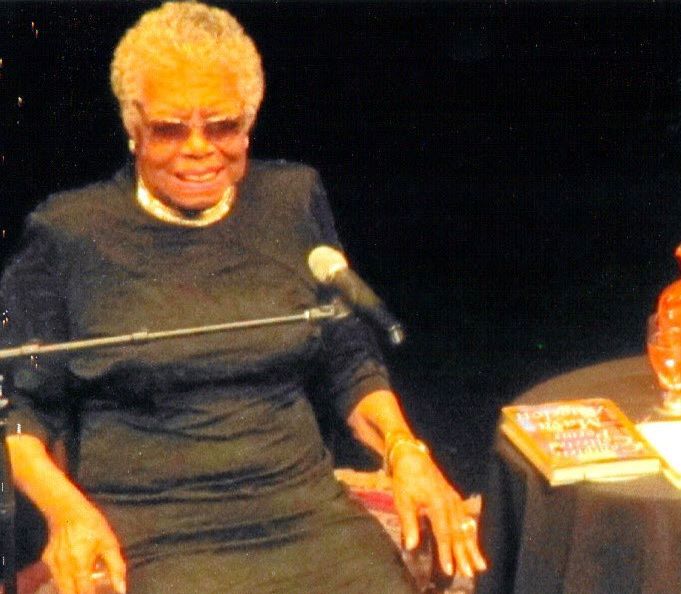
Despite her splendid poetry and prose, her insightful observations of human behavior and the reverence she must encounter everywhere she goes, Maya Angelou doesn’t deny who she is: an imperfect woman who has struggled but, through the support and encouragement of others, done the most she can with the gifts bestowed upon her.
Last week, she shared both her humility and her humor with an audience in Charleston, West Virginia at an event celebrating the 100th anniversary of the YWCA. Thanks to an invitation from a friend, I was fortunate to be in the audience as she poked fun at herself, challenged all of us to empathize with those who are different and encouraged us to think of possibilities.
She talked about her years of silence following the conviction and murder or the man who raped her as a young girl and how poetry freed her. She encouraged us to always find something to make us smile and, when we can’t, to write about something that does. And, she lectured about not blaming others for past injustices but rather thanking those who endured them and taking responsibility for future generations.
In short, she was amazing. I was either laughing or crying the entire time she was speaking.
And then she read her poem “A Brave and Startling Truth,” which she wrote in honor of the 50th anniversary of the United Nations. About halfway into the poem, she lost her place. She faltered, fumbled then regained her composure as she finished.
I know during those moments of silence while she searched for her place, all of us seated at the Clay Center for the Arts and Sciences were holding our breath. She had earlier reminded us that she is 84 years old, and that fact sunk into our brains and into our souls.
The moment was brief, and it passed. But it had still occurred.
Yet, at the end of the evening, Dr. Angelou held her head high, showed appreciation for the applause and ended her talk with dignity.
Some might think she was trying to cover her mistake, but I know she was simply demonstrating why she is so great. Instead of being defined by her mistakes and struggles, she soars through self acceptance and overcoming challenges.
If that’s not inspiration, I don’t know what is.
Writing is a Very Dirty Habit
 Some days, writing simply serves as my own muddled version of confession.
I wish I always came to the keyboard with the honorable intention of making people really think.
But more often than not, I write when people disappoint, frustrate or simply anger me.
Fortunately for others, I don’t usually share those thoughts publicly in writing. I do, however, write about them. I’ve always just been compelled to transfer most of my emotions and all of my opinions into the written word.
I scribble them in the margins of meeting agendas when the person speaking is a blowhard. I jot them on notepads when I’m on the phone with someone who is obviously making excuses. And I type pages and pages when I’m forced to sit on the sidelines while someone blatantly lies, manipulates and abuses his position.
I admit there are times when I’m able to quietly call out these people by surreptitiously weaving them into my blog. But, for the most part, I simply let my written words and the space they occupy clutter my desk, my computer, my brain and my life.
And if that clutter weren’t enough, the time I spend writing far exceeds the time I spend cleaning up those or any other messes.
For the record, I do clean. I simply do just enough to ensure my house will never be featured on an episode of Hoarders or that my family isn’t forced to wear dirty and stained clothes.
To me, the task of cleaning is comparable to cooking. While some people take pride in their spotless homes and fabulous meals (as they should), I only see a lot of time spent doing something that won’t last. Clean houses always require more cleaning, and meals that take hours to prepare can be gone in minutes.
Writing can last forever…or at least as long as someone is willing to read what you wrote (even when the reader and the writer are one in the same.)
I know my life would be less messy if I spent more time cleaning and less time writing. It just wouldn’t be as memorable.
I have a box full of diaries dating back to second grade. The spelling is sometimes amusing, but the narrative is always entertaining. The diaries chronicle my life from the first entry (a meeting with Senator Bob Packwood that ended with a reprimand from my mother for offering him my left hand to shake) to the angst of adolescence and the wonder of emerging adulthood.
I have drawers full of cards and letters sent in a time before emails.
And I have bags of notes that were passed between friends and classes in high school. These notes could be an exhibit about an art form that was lost forever with the advent of text messaging.
These items take up space.
Writing takes up time.
And life takes up emotional and physical energy.
We are all defined by how we spend those resources.
Recently, a friend was recalling an obituary published in the Washington Post several years ago. The name in the obituary had been forgotten, but a description of the deceased was seared in my friend’s memory: “She loved to vacuum.”
This statement and the obituary struck a chord in my friend. “Will people remember me because I vacuum or will people remember me for being passionate about something?” she asked.
For me, I hope the answer is easy. I’d rather be remembered for my passions – and even all the emotions they elicited – than to be remembered for whether or note there were dust bunnies under the beds.
Writing, after all, can be a very dirty habit.
My Lifetime Battle with the Big, Yellow School Bus
 This Monday, my son starts high school and my daughter starts middle school.
I could grieve how quickly the years have flown. I could pull out baby pictures and wallow in nostalgia. I could reminisce about how, just yesterday, my son was starting kindergarten.
Or I could celebrate that, because both of my children are attending school out of district, my epic battle with the big, yellow school bus may just finally be over — permanently.
The battle began when I was in first grade. Having spent kindergarten walking to school, I was ecstatic that we had moved to a house that required riding a school bus.
My enthusiasm didn’t last long.
The problems started on the first day of school when I thought I could handle the bus ride all by myself. And I did. Going to school was simple. The bus picked me up in front of my house and dropped me off at school. My biggest challenge was getting to my classroom.
Going home proved a bit more difficult. I got on bus number 25, rode it to my street and rode it to my house. I then rode it past my house because my timid calls to stop weren’t heard over the din of bus chatter. Even though the bus failed to stop at my house, it did seem to stop at almost every other house in the county. When her route finally ended, the bus driver turned around, gave me a pointed look and asked me where I lived.
I proudly declared my well-memorized address “1910 Bean Drive.”
The bus driver did not look happy. “We went right past there. Why didn’t you get off?”
“Because you didn’t stop,” I replied.
Without a legitimate comeback, the bus driver had to make a decision. She’d take me home on her next run. Surrounded by kids two or three times my age and size, I finally made it home to an almost hysterical mother.
I wasn’t used to my mother being so worried. I was used to my mother being in control of every aspect of my life… including what I ate. And while I pined to have a lunch box with a bologna sandwich on white bread and ding dongs like all the other kids, my mom packed a very different lunch. Ever day I carried a brown bag (that she ask I bring home to be recycled) with a peanut butter (no added sugar) and honey sandwich on home-made wheat bread, carrot sticks, an apple and powdered milk in a square container with a lid (no thermos for me).
I hated that milk. I never drank that milk. But day after day, my mom packed it in a brown paper bag and day after day I carried the brown bag and the container still full of milk home from school.
Then, the inevitable happened, and I dropped the bag onto the floor of the school bus. The milk, which was already at room temperature, spilled everywhere. The bus driver was not at all pleased with me, so I should have known the situation would get even worse. And it did.
Only weeks later, my mother put her car in the shop near my school and needed a ride home. Being practical, she arrived at my school just as classes were ending and climbed onto bus number 25 with the first and second graders. At least she tried to climb on the bus, but the driver wouldn’t let her.
My mother insisted that there was plenty of room and the bus was going right to our house anyway. The driver told her no. After what seemed like the longest argument (and one of the most embarrassing moments of my life), the principal finally came over to settle the matter.
My mother had to find her own way home.
I’m pretty sure that was the day my name was officially added the national school bus “beware of this student” watch list. (That’s the list distributed nationwide to every single school bus driver.)
The list is the only explanation as to why, even after I moved across the country, the new school bus driver didn’t like me either.
In that case, the feeling was mutual. I had no respect for a woman who, instead of looking at the road, was constantly looking in the mirror to see what the kids were doing. After a few very close and dangerous calls on winding, West Virginia roads, my friend and I decided we’d had enough and organized a protest. We told everyone on the bus to duck down below the backs of the seats. The next time the driver looked in the mirror, her bus appeared empty.
We though this was hilarious. Our bus driver didn’t. In fact, she was so angry, she stopped the bus and marched up and down the aisle taking names and phone numbers Once she got mine, she seemed satisfied in learning that the girl on the national watch list was the culprit. What she didn’t expect was that my parents sided with me. They didn’t, however, think the incident warranted a life-time pass from riding the school bus, and I was still forced to ride for a couple more years.
But now, my days on the bus have come to an end, and, except for a few field trips, they have ended for my children as well.
Like so many other parts of childhood, all that is left are the memories and the lessons learned. Now it’s time to make more memories and learn something new. I’m just glad that neither is likely to involve a big, yellow school bus.
Fools On An Artificial Ladder
 Even though I like to consider myself an open-minded and fairly accepting individual, I haven’t always behaved in a manner that demonstrates this. In fact, there are times when I’ve acted foolishly and treated people horribly.
One of my worst infractions occurred when I was a teenager in a place that was supposed to promote love and acceptance: church.
At the time, our church was predominantly middle class. Parishioners were well-groomed, nicely dressed and carefully coiffed when they arrived on Sunday morning. Most were neighbors or co-workers who socialized with the same general crowd and who shoveled their dirty laundry into the closet to either hide it or pretend it didn’t exist.
Their equilibrium was disrupted one Sunday when a family from a nearby trailer park came to church and then began attending services on a regular basis. The parents and children were certainly wearing their Sunday finest, but they were anything but well-groomed and carefully coiffed. I remember the other adults at church were a bit patronizing but outwardly nice. The kids weren’t. We did our best to exclude the children, and we made fun of them behind their backs.
Eventually, the family stopped coming to church, and until recently, I had forgotten about them.
But I was reminded of them again a couple of weeks ago when a young woman who works at a local restaurant told me about her Sunday regulars. Her customers’ routine is to go out to eat after Sunday service, but the dish they enjoy most isn’t on the menu. Instead, they loudly and openly share what everyone else did wrong during the church service. They complain about children who misbehaved, and they make fun of the appearance of some of the adults. Apparently, they are too busy judging others to hear the sermon.
What I can’t fathom is why, as older adults, they feel the need to act this way.
As an adolescent, I know my behavior was contrary to the way I was raised. But, I was insecure and believed that I wouldn’t be at the bottom of the social ladder if someone else were there instead. As an adult, I realize how inconsequential, meaningless and ridiculous that social construct is. I also realize that there are a lot of adults who still buy into it. They falsely believe some people are superior to others and that asserting their superiority will ensure their place on their senseless social ladder.
For the most part, their behavior isn’t nearly as blatant as the hypocritical, church-going restaurant patrons, but it is still based on their need to affirm their status. Take, for example, a local non-profit leader who complained about business people being asked to attend community meetings at the local Department of Health and Human Resources office. This individual, who also lays claim to being a good Christian, said that community and business leaders shouldn’t have to be in the waiting room with the people asking for help/welfare.
Not to be presumptuous, but I’m pretty sure Jesus would point out that the people in the waiting room are the same people the community leaders see every day at school functions, churches and grocery stores and that the people on the presumed top of the social ladder are no closer to God than the people on the bottom. That’s assuming he would even acknowledge such a foolish concept to begin with.
Revelations from a Former Republican
 During a recent conversation, I shocked a friend when I mentioned that, when I turned 18, I had registered to vote as a Republican.
“You were NOT a Republican,” she stated. “There is just no way.”
“Not just a Republican,” I replied. “I was actually heartbroken that, because of my age, I missed voting for Ronald Reagan by only three months in the 1984 election.”
Since I was talking to my friend on the phone, I can’t confirm that her mouth was actually hanging open, but I’m pretty sure it was.
“What happened?” she finally asked.
“I don’t know exactly,” I replied. “But by the time I graduated from college, I’d changed political parties.”
In all honesty, I do know what happened. I’d identified the core values that would guide the rest of my life, and they simply just didn’t align with the Republican Party.
I don’t think my friend, or anyone else, really cares about how I arrived at my decision. And, until this past week, I didn’t feel any need to explain.
But after witnessing one too many debates about how people who receive SNAP (more commonly known as food stamps) may be eligible for additional benefits if they were affected by the derecho (http://www.catholiccharitieswv.org/index.php?option=com_content&view=article&id=300%3Awv-long-term-disaster-recovery-derecho-storm-a-power-outage-disaster&catid=45%3Aannouncements&limitstart=1), I felt the need to say something.
On the surface, the gist of the conservatives’ argument against the additional benefits was that the government was once again frivolously spending taxpayers dollars.
But, as the arguments continued, a different, more self-centered concern actually emerged. Several people were turning the discussion into a conversation about fairness, or more particularly unfairness, in regards to their own lives: ” I lost all my food when the power went out, and no one is paying me to replace it.” “I have a lot of health care bills, and the government isn’t stepping in to help me.” “Basically, I’m being punished for having a job. ”
Sadly, I could relate to their complaints. That kind of thinking was the reason I had originally registered a Republican.
At the age of 18, I really did believe that everyone had an equal opportunity in this country, and if a person worked hard and persevered, they should be able to meet their own needs. If they couldn’t make ends meet, they needed to work harder or get a better education to get a better job. I believed in responsibility: if people made bad decisions then they, not I, should have to pay for those decisions. And I believed that our leaders had our, not their own, best interests at heart.
I held onto those beliefs because I was surrounded by people who believed the same thing. Then I went to college, and I was surrounded by people who didn’t.
I met too many people who had been denied equal opportunity through no fault of their own. I met too many people who had made poor decision after poor decision only to be bailed out by family while others fell into bad luck and had no one who could help. I learned more and more about greed, inequality and political corruption. And I learned more about myself.
At some point, I was confronted with the ultimate question: is life about what I can do for myself or is it about providing unconditional support for others, even when it sometimes costs me?
I chose the latter.
Don’t get me wrong. I can be very self-centered, and I know a lot of Republicans who are anything but selfish.
I just don’t think the core of my political beliefs should be about what makes my, or my family’s, life better or easier. I think public policy should be about ensuring the safety and well-being of all Americans, particularly those who haven’t had the same privileges that I’ve had: good parents, a good education, a decent I.Q. and a lack of any significant health problems.
When I look back on 18-year-old me, I still understand where I was coming from.
I still think people should do their best and be responsible for their behavior. I also think corporations and millionaires should do the same.
I still believe in hard work and self discipline. I also believe that too many people work very hard and still don’t get paid a fair wage so they can’t make ends meet.
I still wish life were fair. I also realize that making life more fair for everyone requires public policies that provide additional support for those who need it.
The difference between 18 year-old me and 45 year-old me is I don’t think the world owes me anything. Instead, I think I owe the world. The difference is I know some people put their own interests above the interests of others, even when it comes to the environment or safety or health. And I know that the most effective way to ensure such people do minimal damage is to implement and enforce regulation.The difference is that even though I don’t agree with wasteful spending, the wasteful spending I’ve seen isn’t for the programs intended to make the lives of most Americans better.
The difference is that I have enough life experience to know that life isn’t about being fair.
And that’s why I got so frustrated with the debate about additional SNAP/food stamp assistance. The debate wasn’t about whether people needed the assistance. Instead, it was a debate about fairness. I’m pretty sure if you asked the majority of people who were eligible to receive the help, they would be the first to tell you life isn’t fair. If it were, they’d be fortunate enough to afford to replace their own groceries while complaining about those who couldn’t.
Five Words I’d Like to Ban From Any Political Discussion
This week, Michigan State Representative Lisa Brown was banned from the House floor for uttering the name of a body part.
She, unlike her male colleagues, actually has that body part.
Personally, I’ve said the word countless times. I’ve taught my kids that it’s an appropriate word, unlike the slang terms that are often used. I’ve even attended a play that features the word in the title and in the script.
But I don’t want to get banned from writing or labeled an extremist, so I’m not going to actually include it here.
I know that’s sad.
But sadder still is that, in 2012, a woman was reprimanded for saying it.
I shouldn’t be surprised. This has been an especially bad year for women.
Access to birth control has been threatened. Equal pay for equal work is being discounted. Ridiculous and invasive medical procedures (procedures that actually include the banned word) have been considered for legislation.
And women who stand up for their rights have been called sluts (because that is apparently not as offensive as a the name of a body part) on a nationally syndicated radio show.
I’m not just feeling belittled and a bit angry, I’m feeling frustrated.
I thought women were making progress. I thought the country was making progress. I thought individuals were important regardless of how much money they make, where they were born, what their sexual orientation is or, most important to me, what sex organs they were born with.
Silly me.
But since we are now engaged in a debate about what words are and are not appropriate to say during a political debate, I’d like to propose five that shouldn’t be part of any discussion.
1. Socialism. In recent years, this term has been used to perpetuate divisiveness and bitterness. It is being used to suggest that it is not American to believe those who have more resources have a responsibility to help those who are struggling.
2. Obamacare. I don’t believe that access to health care should be the responsibility (or fault) of one particular party or individual. It’s about all of us. Health care reform is complicated and hard to understand. But quality, affordable health care is also critical (and currently not accessible) to too many Americans. I have family and friends who have had cancer, high blood pressure and chronic sinus conditions. These are all pre-existing conditions that can drive personal health-care costs sky high. Most of my professional life I’ve been in jobs that either didn’t offer health insurance or offered it at an incredibly high price. I’m a very hard-working person, and I take extreme offense at being told that I don’t deserve the same access to health care as some one who has a different employer. Let’s be rational and talk about the issue rather than about specific politicians and leaders.
3. Christian. Anyone who knows me, knows that I have the greatest respect for God, religion and faith. But America was established on religious freedom, and we are going backward when we make any one religion the basis for laws. Of course our laws should be based on moral and ethical principles, but most religions are based on strong values. Let’s not marginalize people of different faith by holding up Christians as the only religion that counts.
4. Undeserving. This word makes my heart hurt. By using it to broadly describe any group of people is unfair and incredibly biased. It is also very effective. It allows some people to pat themselves on the back for being deserving while belittling people who are different. People hit hard times for a wide variety of reasons, many of which are beyond their control or rooted in a childhood that never gave them a chance. I’m not saying that we shouldn’t set expectations for people or encourage them to take care of their own needs. But lets provide them with skills and opportunities rather than blame and labels.
5. Penis. If vagina isn’t allowed, then we shouldn’t be allowed to say penis either.
Whoops. Did I just say vagina? There go any hopes of a political career.
Hopefully, I will still be allowed to share my thoughts and opinions. And hopefully this post doesn’t get deleted as a result of actually naming a body part.
The Reason I Never Forgot Eddie Pee Pants
 On a beautiful spring day several weeks ago, my kids and I were heading to lunch a few blocks from my husband’s office on the crowded streets of Washington D.C . Dressed in only shorts and t-shirts, we didn’t really fit in with the men and women in business attire who were walking with a great deal more purpose.
But we had one thing in common: we all pretended we didn’t see the homeless person still wrapped in a blanket and sleeping in a doorway on a busy sidewalk.
I saw both of my kids glance over at him, but neither said anything. I didn’t either. Soon, the homeless person was forgotten.
Almost.
Because somewhere in the back of my mind, he stayed with me.
He’s still there.
It’s not that I’ve never seen homeless people before. I see them every day. I even have a semi-relationship with the guy who hangs out at the park where I walk my dog. If I don’t at least wave at him, he coughs or makes some other noise until I acknowledge him.
But the homeless guy sleeping on the steps was different, because he might as well have been invisible. Everyone, including me, blatantly ignored his existence.
I understand why the business people ignored him: they probably see him everyday. He’s as much a part of their daily landscape as the traffic lights, the street signs and the blur of faces they regularly encounter.
But I didn’t have any excuse, and I couldn’t figure out why I didn’t even talk to my kids about him. That’s just not like me at all. If anything, I usually talk way too much about such things.
The only explanation I could find is one I don’t like: I was going along with the crowd. It was just easier.
It’s not the first time I’ve had to make that admission.
When I was in elementary school, I didn’t even know the full name of the boy who rode the school bus. I just knew everyone called him Eddie Pee Pants. You don’t need to be a genius to figure out how he got the name.
I don’t remember calling him that to his face, but that’s the name I used when my peers and I were discussing how to avoid him. No one wanted to have to sit with Eddie Pee Pants on the bus. If you did, you’d not only have to smell him, but you would get “Eddie Pee Pants germs.”
I knew what we were doing was wrong, but I justified my behavior by telling myself that I was never actually mean to his face. But the guilt got worse when Eddie’s life got worse.
One Saturday morning, I joined my dad at the top of our driveway to watch the drama unfold on a hill about a mile from our house. A dilapidated mobile home was on fire. Flames were shooting out the roof, and smoke was turning the sky black.
“That’s a total loss,” my dad commented.
I didn’t know until Monday that the old, junky trailor everyone said was an eyesore was Eddie’s house.
I have no recollection of what happened to him after his house burned. I just know he never rode the bus again, and I don’t remember ever seeing him at school again. I don’t even remember if there were any injuries or fatalities in that fire.
What I do remember is wondering why I wasn’t nicer to Eddie and feeling horrible that I’d never have an opportunity to undo my misdeeds.
Eddie isn’t the only person I’ve ever discounted or belittled. But he’s the first person who taught me three essential life lessons:
1. Treating someone poorly never makes you feel better about yourself.
2. Sometimes you don’t get a second chance to do the right thing.
3. Issues such as poverty, child abuse and homelessness are actually about individuals — people who, regardless of the reason for their circumstances, still have value.
I’ve taken that third lesson to heart. Eddie, like the homeless person in the doorway, gave me something priceless. They taught me to look beyond the unkempt appearances, poor hygiene or odd behavior. They’ve taught me that sometimes the person who needs to change their attitude or perception is me. And they’ve taught me that speaking up feels a lot better than putting someone down.
They were priceless gifts in my life, and I hope I can pass their lessons on to my children. And that, if nothing else, is what makes their lives so valuable to me.
It’s Hard to Get Respect When Your Shoes Are Worn Out

I love shoes.
Unfortunately, I wear out shoes quickly. Very quickly. And, I’ve found that when my shoes are worn out, I have to fight even harder to get respect.
I’m not sure that people who work in the for-profit world will understand, but anyone who works for a community-based nonprofit organization will – especially those who work for social service agencies. Our shoes , just like us, are often worked and worn to the bone.
We are a unique breed that must band together. Our biggest battles aren’t necessarily a result of working directly with the people who need help or of the perception that they are undeserving, lazy or simply crazy.
Sometimes, our biggest battles are with people who support our organization, a cause or a specific project.
I should know.
For almost twenty years, I’ve worked for community-based nonprofit organizations. And while the work is exhausting, it’s also meaningful and educational.
But now, my career path is about to change slightly, so before I leave my comrades, I feel the need to share a few words of wisdom with our board members, our volunteers and our donors:
1. We greatly appreciate you. We know the work we do wouldn’t be possible without you. We know you care, and we know you are compassionate.
2. Your compassion doesn’t mean you are qualified to do our jobs.
3. We do our jobs because we are both compassionate AND skilled.
4. Your bank account doesn’t mean that you know more about the issues than we do. Not only do we have the training and the work experience, many of us work in the trenches because we have ” been there.” Sometimes, because of our salaries, we are still there. Please listen to us.
5. Don’t assume you are more educated than we are. Most nonprofit and social services jobs require, at a minimum, a bachelor’s degree for a position that often doesn’t pay as much as an entry-level, administrative assistant job in the business world.
6. Don’t assume that our ONLY motivation is helping people. That’s a primary motivation, but we still need to pay the bills. Keeping agency administrative costs low is important, but keeping them too low may be hurting the people who are trying to do the most good. It may also limit your pool for people who can fill key leadership positions.
7. Don’t assume that staff doesn’t care about salary and benefits (or lack thereof) because we have spouses/partners who, in your eyes, have”a real job.” The work we do is “ a real job.” Many of our jobs require a license. The helping profession is bound by ethical, legal and professional practices that have been put in place for a reason.
8. Don’t assume that just because we don’t get personally involved with clients that we don’t care. We probably care more than you will ever know. But because we are educated in our field and because we often hold a license, we have to behave in a professional manner that will limit liability while improving outcomes for the client.
9. We know that when you work with our organizations you are volunteering, and we appreciate your time more than you will ever know. But don’t assume we are lazy or not committed to the cause because, at the end of the work day, we don’t have the energy to volunteer to do the same thing we do day in and day out.
10. Disregarding staff in times of key leadership decisions only leads to poor morale. When a key staff person is leaving, other staff members should be consulted as to what skills and leadership style would fit with the team before the selection process even begins. Staff should even be consulted about their interest in a leadership position.
11. The nonprofit and social service sector is composed primarily of females. Falling back on the “good old boys” network for leadership is taking a step backwards, not forwards. It doesn’t sit well with female staff, donors or volunteers.
12. Board members have to play an active role and not simply serve as a rubber stamp for decisions that may have been presented by someone with an agenda. You can always go back to the drawing board – don’t feel like your options are limited to what is presented to you at a board meeting.
These words of advice are based on my long-term work for community nonprofits. That work will end when I walk out the door of my current employer this Friday and into the door of my new employer the following Monday.
As would be expected, my departure has led to an appreciation I never knew existed (see suggestions Number 10 and 11).
So for all the people who, over the past few weeks, have told me that I’m leaving some really big shoes to fill, I apologize if I haven’t accepted the compliment with grace.
It’s not that I don’t appreciate the sentiments. I just know my shoes are really worn out.
Whoever takes my job not only needs to put on their own pair of shoes, they also have the opportunity to point those shoes in their own direction.
And I’m sure that direction will lead to a lot of great accomplishments.


 Just So You Know