Category Archives: writing
There Is No Fear in My Anger
Today, I am stepping out of my comfort zone and attempting a different type of blog.
Since I recently saw Maya Angelou, I’m writing poetry for the first time since adolescence (for the record, that’s about 30 years ago).
This challenge requires taking a deep breath and jumping in.
Here… I… go…

There Is No Fear in My Anger
The workshop leader told us
That anger is always rooted in fear.
That helping people address their anger
Always requires helping them confront their fears.
I, the student, told myself
That my anger is never rooted in fear.
That dealing with my anger
Always requires confronting the source.
There is no fear in my anger.
My anger is rooted in a sense of fairness.
When people are treated differently because of the way they look or because of their perceived social status
Then I am red, hot angry.
But I am not fearful.
My anger is rooted in a desire for benevolence.
When a person with money or connections is regarded more highly than a knowledgeable person
Then I am rebelliously angry.
But I am not fearful.
My anger is rooted in a hard-earned sense of self-worth.
When I am ignored because someone wants to build his own ego on a false sense of self-importance
Then I am howling with anger.
But I am not fearful.
My anger is rooted in a cry for compassion.
When I hear people ridicule those who have less
Then I am sadly angry.
But I am not fearful.
My anger is rooted in respect.
When people spend years building a strong foundation and it is destroyed by those who want to build an empire
Then I am frustrated with anger.
But I am not fearful.
And when I am told that I am fearful rather than angry
I am full of fighting words and the need to persevere and speak the truth.
But I am not fearful.
For there is simply no fear in my anger.
(Wow.. that WAS like jumping into a cold pool and enjoying a great swim… invigorating. I had forgotten why I wrote poetry as a teen. I may now write more!)

My Brief Encounter With the Perfect Imperfection of Maya Angelou
I am an incredibly imperfect woman living in a society of people who hide their imperfections much better than I do.
Some are better able to hold their tongues. Others have achieved such brilliant success that it hides any inadequacies. And then there are the people who spend a great deal of time and energy covering up any deficiencies.
Since my tongue often seems to engage before my brain, my successes are nothing out of the ordinary and I choose to spend my time and energy just being me, I don’t mind that people know I’m far from perfect.
Despite that, I’m always striving to become a better person. For that, I need inspiration, which most often comes from other admittedly imperfect women.
These are the women who make me believe.
They make me believe that even those of us who are flawed can accomplish great things. They make me believe that past mistakes and missteps are the fundamental ingredients for a rich life. And they make me believe that, despite injustice and unfair odds, believing in possibilities can only result in magic.
My inspiration comes from women who have overcome barriers and have an honest compassion for those who are still struggling.
And, of course, my inspiration comes from women who can express all this in writing — women like Maya Angelou.
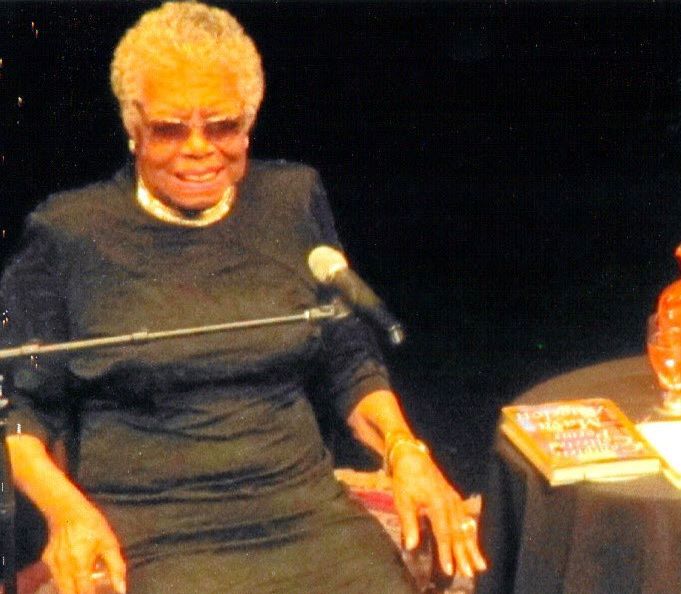
Despite her splendid poetry and prose, her insightful observations of human behavior and the reverence she must encounter everywhere she goes, Maya Angelou doesn’t deny who she is: an imperfect woman who has struggled but, through the support and encouragement of others, done the most she can with the gifts bestowed upon her.
Last week, she shared both her humility and her humor with an audience in Charleston, West Virginia at an event celebrating the 100th anniversary of the YWCA. Thanks to an invitation from a friend, I was fortunate to be in the audience as she poked fun at herself, challenged all of us to empathize with those who are different and encouraged us to think of possibilities.
She talked about her years of silence following the conviction and murder or the man who raped her as a young girl and how poetry freed her. She encouraged us to always find something to make us smile and, when we can’t, to write about something that does. And, she lectured about not blaming others for past injustices but rather thanking those who endured them and taking responsibility for future generations.
In short, she was amazing. I was either laughing or crying the entire time she was speaking.
And then she read her poem “A Brave and Startling Truth,” which she wrote in honor of the 50th anniversary of the United Nations. About halfway into the poem, she lost her place. She faltered, fumbled then regained her composure as she finished.
I know during those moments of silence while she searched for her place, all of us seated at the Clay Center for the Arts and Sciences were holding our breath. She had earlier reminded us that she is 84 years old, and that fact sunk into our brains and into our souls.
The moment was brief, and it passed. But it had still occurred.
Yet, at the end of the evening, Dr. Angelou held her head high, showed appreciation for the applause and ended her talk with dignity.
Some might think she was trying to cover her mistake, but I know she was simply demonstrating why she is so great. Instead of being defined by her mistakes and struggles, she soars through self acceptance and overcoming challenges.
If that’s not inspiration, I don’t know what is.
Writing is a Very Dirty Habit
 Some days, writing simply serves as my own muddled version of confession.
I wish I always came to the keyboard with the honorable intention of making people really think.
But more often than not, I write when people disappoint, frustrate or simply anger me.
Fortunately for others, I don’t usually share those thoughts publicly in writing. I do, however, write about them. I’ve always just been compelled to transfer most of my emotions and all of my opinions into the written word.
I scribble them in the margins of meeting agendas when the person speaking is a blowhard. I jot them on notepads when I’m on the phone with someone who is obviously making excuses. And I type pages and pages when I’m forced to sit on the sidelines while someone blatantly lies, manipulates and abuses his position.
I admit there are times when I’m able to quietly call out these people by surreptitiously weaving them into my blog. But, for the most part, I simply let my written words and the space they occupy clutter my desk, my computer, my brain and my life.
And if that clutter weren’t enough, the time I spend writing far exceeds the time I spend cleaning up those or any other messes.
For the record, I do clean. I simply do just enough to ensure my house will never be featured on an episode of Hoarders or that my family isn’t forced to wear dirty and stained clothes.
To me, the task of cleaning is comparable to cooking. While some people take pride in their spotless homes and fabulous meals (as they should), I only see a lot of time spent doing something that won’t last. Clean houses always require more cleaning, and meals that take hours to prepare can be gone in minutes.
Writing can last forever…or at least as long as someone is willing to read what you wrote (even when the reader and the writer are one in the same.)
I know my life would be less messy if I spent more time cleaning and less time writing. It just wouldn’t be as memorable.
I have a box full of diaries dating back to second grade. The spelling is sometimes amusing, but the narrative is always entertaining. The diaries chronicle my life from the first entry (a meeting with Senator Bob Packwood that ended with a reprimand from my mother for offering him my left hand to shake) to the angst of adolescence and the wonder of emerging adulthood.
I have drawers full of cards and letters sent in a time before emails.
And I have bags of notes that were passed between friends and classes in high school. These notes could be an exhibit about an art form that was lost forever with the advent of text messaging.
These items take up space.
Writing takes up time.
And life takes up emotional and physical energy.
We are all defined by how we spend those resources.
Recently, a friend was recalling an obituary published in the Washington Post several years ago. The name in the obituary had been forgotten, but a description of the deceased was seared in my friend’s memory: “She loved to vacuum.”
This statement and the obituary struck a chord in my friend. “Will people remember me because I vacuum or will people remember me for being passionate about something?” she asked.
For me, I hope the answer is easy. I’d rather be remembered for my passions – and even all the emotions they elicited – than to be remembered for whether or note there were dust bunnies under the beds.
Writing, after all, can be a very dirty habit.


 Just So You Know