Blog Archives
Five Words I’d Like to Ban From Any Political Discussion
This week, Michigan State Representative Lisa Brown was banned from the House floor for uttering the name of a body part.
She, unlike her male colleagues, actually has that body part.
Personally, I’ve said the word countless times. I’ve taught my kids that it’s an appropriate word, unlike the slang terms that are often used. I’ve even attended a play that features the word in the title and in the script.
But I don’t want to get banned from writing or labeled an extremist, so I’m not going to actually include it here.
I know that’s sad.
But sadder still is that, in 2012, a woman was reprimanded for saying it.
I shouldn’t be surprised. This has been an especially bad year for women.
Access to birth control has been threatened. Equal pay for equal work is being discounted. Ridiculous and invasive medical procedures (procedures that actually include the banned word) have been considered for legislation.
And women who stand up for their rights have been called sluts (because that is apparently not as offensive as a the name of a body part) on a nationally syndicated radio show.
I’m not just feeling belittled and a bit angry, I’m feeling frustrated.
I thought women were making progress. I thought the country was making progress. I thought individuals were important regardless of how much money they make, where they were born, what their sexual orientation is or, most important to me, what sex organs they were born with.
Silly me.
But since we are now engaged in a debate about what words are and are not appropriate to say during a political debate, I’d like to propose five that shouldn’t be part of any discussion.
1. Socialism. In recent years, this term has been used to perpetuate divisiveness and bitterness. It is being used to suggest that it is not American to believe those who have more resources have a responsibility to help those who are struggling.
2. Obamacare. I don’t believe that access to health care should be the responsibility (or fault) of one particular party or individual. It’s about all of us. Health care reform is complicated and hard to understand. But quality, affordable health care is also critical (and currently not accessible) to too many Americans. I have family and friends who have had cancer, high blood pressure and chronic sinus conditions. These are all pre-existing conditions that can drive personal health-care costs sky high. Most of my professional life I’ve been in jobs that either didn’t offer health insurance or offered it at an incredibly high price. I’m a very hard-working person, and I take extreme offense at being told that I don’t deserve the same access to health care as some one who has a different employer. Let’s be rational and talk about the issue rather than about specific politicians and leaders.
3. Christian. Anyone who knows me, knows that I have the greatest respect for God, religion and faith. But America was established on religious freedom, and we are going backward when we make any one religion the basis for laws. Of course our laws should be based on moral and ethical principles, but most religions are based on strong values. Let’s not marginalize people of different faith by holding up Christians as the only religion that counts.
4. Undeserving. This word makes my heart hurt. By using it to broadly describe any group of people is unfair and incredibly biased. It is also very effective. It allows some people to pat themselves on the back for being deserving while belittling people who are different. People hit hard times for a wide variety of reasons, many of which are beyond their control or rooted in a childhood that never gave them a chance. I’m not saying that we shouldn’t set expectations for people or encourage them to take care of their own needs. But lets provide them with skills and opportunities rather than blame and labels.
5. Penis. If vagina isn’t allowed, then we shouldn’t be allowed to say penis either.
Whoops. Did I just say vagina? There go any hopes of a political career.
Hopefully, I will still be allowed to share my thoughts and opinions. And hopefully this post doesn’t get deleted as a result of actually naming a body part.
A Letter to Rush Limbaugh (Even Though I Know He Won’t Read It)
“Our purpose in this life is to help others. And if you can’t help them, at least don’t hurt them.” Dalai Lama |
Monday, March 5, 2012
Mr. Limbaugh
Like many Americans (and I hope most Americans), I was appalled when you turned a national debate on religious-affiliated institutions and contraception coverage into a personal attack on Sandra Fluke. Not only did you call the Georgetown law student a slut, but you went so far as to request sex tapes and claim that she was basically asking the government to pay for her to have sex.
Umm, no, Mr. Limbaugh, government coverage of birth control was not being discussed. The topic was actually about what can, or should, be required health-care coverage by religious institutions… not the government.
But that didn’t matter to you, did it?
And why should it?
Your job isn’t to provide accurate information or to engage the public in genuine debate about how to make life better for most Americans.
Instead, your job is to do the exact opposite. You don’t care about helping anyone but yourself. Your primary concern is about getting higher ratings and more money. And every time you say something controversial, you get more attention, which is all you really want.
You figured out the formula years ago and have been perfecting it ever since. You divide people by ridiculing others, tearing down anyone who thinks differently than your audience and twisting what liberals believe, think and do.
The problem is, your attitude and behavior are contagious, and other news media and internet sites have followed your lead. Attacking people has now become more common than engaging in real, intellectual debate about tough issues that have no easy, and sometimes no right, answer.
Because of this, a lot of people now find it acceptable to demonize others because of religious beliefs. Those who have fallen on hard times and need financial assistance are defined as lazy and undeserving. And lately, our country seems to be going backwards when it comes to women’s issues.
The American public now views politics as a matter of us-versus-them and is more interested in which side can score the most points than what will benefit our country. Attacking others is more important than considering possible solutions and compromise.
Worst of all, we’ve become a country where many think only of their own personal gain rather than about the greater good.
But like I said before, that’s not your concern. Your concern is about getting ratings, and you’ve accomplished that by making every political issue about personal behaviors and beliefs.
But I’m not going to call you out on your own personal behaviors, because that would be stooping to your level.
Instead, I simply want you to think about the real purpose of life. Is it to make as much money as possible while hurting a lot of people in the process? Or is it to make the lives of others better while building people up in the process.
I believe in the latter. I hope someday, you do too.
Sincerely,
Trina Bartlett
There’s Going to Be Trouble When You Live in a Bubble
 Keeping an eye on politics this week has been as compelling as anything the best Hollywood writers could make up. Mitt Romney, the front-runner for the Republican nomination for President of the United States, actually said that he cares about Americans but that he isn’t concerned about the very poor because they have a safety net.
That’s precisely what he said. In that exact order. What happened next, while predictable, was still extremely entertaining.
Some political pundits latched onto the concept that Romney didn’t care about the poor and (gasp) he didn’t even consider them Americans.
Others suggested that he was supporting the notion that government should help the poor indefinitely without encouraging them improve their situations.
And others, particularly those in the Republican party, despaired that Romney is a bad politician who blunders when he doesn’t have a teleprompter.
I have to agree with the latter. When Romney opens his mouth without a script, his comments seem unsympathetic to the average American. His latest remarks about the poor just add to the growing concern.
The doubts have been building with every questionable statement: his spontaneous offer to bet Rick Perry $10,000 (a very sizable amount of money to the average American); his remark that he is also unemployed (not funny to the millions without a job or a daily income like he has) and his insensitive language about liking to fire people. All of these feed into the perception that Romney has no clue about the daily struggles many Americans face.
And there may be something to that. He has, after all, lived in a bubble his entire life.
He grew up in a bubble and doesn’t appear to have left it. That bubble has protected him from worrying about which bills he could afford to pay or whether his children would be able to go to college. I’m pretty sure that there’s never been any coupon clipping, layaways or bargain hunting in the Romney bubble.
But apparently the barrier between Romney’s bubble and the rest of the world isn’t impenetrable. Rumblings of discontent about the disparity between the very rich and the rest of the country actually seem to be reaching Romney’s ears. But the layers of film between us are distorting the message, and he just isn’t hearing it correctly.
But Romney’s not alone.
Because of religion, socio-economic status and even our appearances, many of us live in a bubble and generally associate with, relate to and hear the opinions of people who are very similar to us. And while some people step outside of their bubbles, others never do.
The problem with staying in your own bubble is that you generally don’t hear or understand the plight of those outside the bubble. I’ve bumped into a lot of those people as they float through life. It’s not that people who stay in their own bubbles are bad people. Bubbles simply distort how they see things, so their view of the world just isn’t accurate.
But who can blame them? Living in a bubble can be deceptively comfortable.
Unfortunately, people who are floating around in their own bubbles are still part of the real world: a world where poverty is not a moral issue, where people still face discrimination and where money is a driving force in determining who has power.
If you are floating around in a bubble, your hands may never get dirty, your heart may never fully empathize and your head may never understand.
And that’s the problem with Mitt Romney. It’s hard to understand something you’ve never felt or experienced. And it’s even worse if you don’t recognize the fact that you’re living in a bubble.
On the bright side, most everyone likes watching bubbles float away and eventually pop. Even as a child, I found the sight highly entertaining. I’m pretty sure I still do.
My “Liberal” Brain May Not Believe What You Think It Does

I’m getting very tired of being told what I think. Partly because I already know, and partly because what other people say is often not accurate.
But that doesn’t seem to matter to a lot of people, especially in today’s political environment. Sound bites, snarky comments and misinformation appear to be the norm when it comes to influencing opinion.
And sadly, many people prefer to make generalizations rather than to look at the complexities of almost every issue.
In other words, clarifying what my “liberal” beliefs are won’t matter to those who prefer spoon-fed ideology that paints everything in black and white terms.
Despite the fact that people who should hear what I really believe won’t bother to read this, I’m sharing anyway:
1. I believe in personal responsibility and hard work. I can’t stand laziness and I don’t think it’s the taxpayers responsibility to support people who abuse the system. I also know that the majority of people seeking help have fallen on hard times, are not lazy and/or have a legitimate need. Most have children, who will suffer if their needs aren’t met. I also know that only about 10% of those receiving help also attempt to abuse the system. I know that charitable giving doesn’t begin to cover the need, that the implications of not helping those in need are severe and that funding social services is an essential use of taxpayer dollars.
2. I believe that people who receive assistance from social services should be held accountable for what they receive by taking steps to help themselves. Apparently, a lot of other “liberals” believe the same thing, which is why most social workers and social service providers spend most of their time helping people build skills to improve their circumstances … not “handing out” money. I also believe that people can change, which is why they need others to support and encourage them rather than to criticize and judge. And I believe that people who complain about lazy people on welfare don’t know the basic facts about eligibility requirements, what people actually receive and what is required of them. I know the majority of people who point fingers really don’t want to learn more anyway, because if they did, they wouldn’t be so judgmental in the first place.
3. I believe in the Constitution and its Amendments, particularly the First Amendment and Freedom of Speech. I also believe that these rights should equally apply to all Americans, not just those who have more money or connections. When you have more resources, you have greater opportunity to use and abuse these rights. Ensuring equal access is important. I don’t believe that microphones only belong in the hands of the elected, and I don’t believe Constitution was written with the concept that corporations are people.
4. I believe in freedom of religion and the power of prayer. I also believe that religion is personal and shouldn’t be used to further a political or any other agenda. Historically, people have abused religion to gain power and influence and to promote their own causes. The results can be extremely harmful.
5. I believe in one nation under God, but I don’t believe in a nation of only one religion. I don’t believe that people of one faith are any more moral than people of any other faith or even people of no faith.
6. I believe that people who want to own a gun should have the right to do so. I also believe that the use of guns should be regulated and monitored, just like the use and operation of a motor vehicle. The primary purpose of a gun is to harm another living being, and I believe everyone who picks one up should fully understand and consider that potential. I don’t understand why any private citizen needs to own a semi-automatic weapon, and I know when that happens, there is always the potential that a criminal will steal or gain access to it. I also know the gun industry wants to sell as many guns as they can because their goal is to make a big profit, not to protect anyone. That’s why it spends spend big bucks on propaganda to make the issue black and white.
7. I believe in fairness, just as one of the most revered Republicans ever, Abraham Lincoln, did when he proclaimed, “These men ask for just the same thing, fairness, and fairness only. This, so far as in my power, they, and all others, shall have” I also realize, that since his time, we recognize that inequality exists beyond just race. I believe that love is love, and if you want to commit your life to someone else, the sex of that other person shouldn’t matter. I believe that race, income and religion shouldn’t predict your outcomes in life. And I believe that people who discriminate, judge or make harsh comments on the basis of race, religion, socio-economic status or sexual orientation are either fearful or selfish.
8. I believe that having money is a good thing, but I also believe that there is something wrong with a country when the distribution of wealth and power is so unequal. I know that this unequal distribution is NOT a result of some people working harder than others. I also know that raising this issue threatens people who are happy with the status quo, with their bank accounts and with the power that gives them. And I know that people who are threatened tend to point fingers and find fault with others so they deflect attention from the real issues. Whenever issues of inequality become part of the political landscape, people who have nothing to lose may not fight for the rights of those who have everything to gain. But when they do? The country benefits.
9. I believe that people CAN “pull them up from the bootstraps,” and I’m privileged to know people who have accomplished just that. I also know that the odds are against this. When your parent abuse drugs, when they don’t value education and when they don’t encourage hard work, you already have three strikes against you. And when you’re low-income, the chances are that you aren’t attending the best schools. Low-income children should have the best teachers and the best schools. But they can’t pay for them, so middle and upper class children get the educational benefits and the advantage in life instead. Children are our future, and we have to invest in them… all of them. Early education provided through Head Start and other programs is essential.
10. I believe people are more important than money. There’s no other way to say it. I believe that worshiping money and power more than God violates the First Commandment. I believe that our current political system allows people, and corporations, to buy politicians and policies that in turn allows them to buy more power and money. I believe something has to change, and if it doesn’t, the majority of Americans will suffer.
I also believe that everyone has the right to his/her own opinion, and I’m grateful to have the opportunity to express mine on Martin Luther King Jr. Day. As the great man said, “Our lives begin to end the day we become silent about things that matter.”
No Mitt Romney, It’s Not Envy That’s Making Me Green
I was getting ready for work yesterday morning, when my stomach started churning.
No, it wasn’t morning sickness. At least, not the typical type of morning sickness.
My nausea was the result of listening to Matt Lauer interview Mitt Romney after his decisive win in the New Hampshire Presidential Primary.
Let me restate that.
I was nauseous listening to Mitt Romney respond to Matt Lauer.
Lauer had asked the heir apparent to the Republican throne if it was fair to characterize questions about income inequality and Wall Street greed as “politics of envy.”
Personally, I thought this was a great question, because issues of income inequality are important to me. How politicians understand and care about the less fortunate is just as critical.
Then Mitt Romney opened his mouth.
“I think it’s about envy. I think it’s about class warfare,” Romney said. ” … you’ve opened up a whole new wave of approach in this country which is entirely inconsistent with the concept of ‘one nation under God.'”
Envy? Class Warfare? God? Obviously, Romney’s comments were simple pandering: throwing out key words that his handlers had identified as appealing to potential voters.
Raising the issue of economic inequality has nothing to do with envy. In fact, it’s just the opposite. It reflects compassion and caring for all Americans, not just a few privileged individuals.
All political candidates, regardless of party affiliation, have more dollars flowing into their campaign coffers than make sense for a nation with a struggling economy and where children are going to bed cold and hungry. So I definitely think we should all be asking questions.
Besides, addressing issues of inequality isn’t anything new. I thought it was what this country was all about. Up until the last few years, if America was in a beauty contest, equality would have been her platform.
But there IS something wrong in America. And it’s not just one or two individuals who can be blamed. It’s the system.
Report after report shows that income inequality is growing while at the same time, the amount of money flowing into politics is greatly influencing policy. Those with money are controlling policies, and policies drive how money flows. Most Americans are finding it difficult to break into that exclusive circle. So if you don’t have money, your influence is very limited.
Needless to say, I wasn’t impressed with Romney’s reaction. Then he said something even worse.
“I think it’s fine to talk about those things in quiet rooms and discussions about tax policy and the like,” Romney said. “But the president has made this part of his campaign rally. Everywhere he goes we hear him talking about millionaires and billionaires and executives and Wall Street. It’s a very envy-oriented, attack-oriented approach and I think it’ll fail.”
Forget his comments about Obama. My mind was stuck on the fact that he thought issues of inequality should occur in quiet rooms.
I was dumbstruck. Then I got nauseous.
The issues of unequal distribution of money and the unequal distribution of power shouldn’t be raised during political campaigns? They shouldn’t be the subject of public debate? Did he really say that?
Isn’t that what some people used to think of racism? of women’s rights? about gay rights? About all the critical issues that ultimately helped define, and are still defining America? Does Romney really think those issues should also be discussed in quiet rooms?
With my stomach still rolling, I had to ask myself if he doesn’t want them discussed publicly because the current system suits his need and he sees no need for change. Or does he really just think that people with less money, less education or fewer connections really shouldn’t have an equal voice or opportunity to express their opinions publicly? Or is it both?
With a face green with nausea, not envy, I turned the television off and left for work.
On my agenda for the morning? Giving a presentation on “the Dimensions of Poverty.” The presentation went well. The 50 or so people from various business and social sectors really wanted to talk about the issue. And the room wasn’t even close to quiet.
I Can Suggest Where to Stick Your Labels
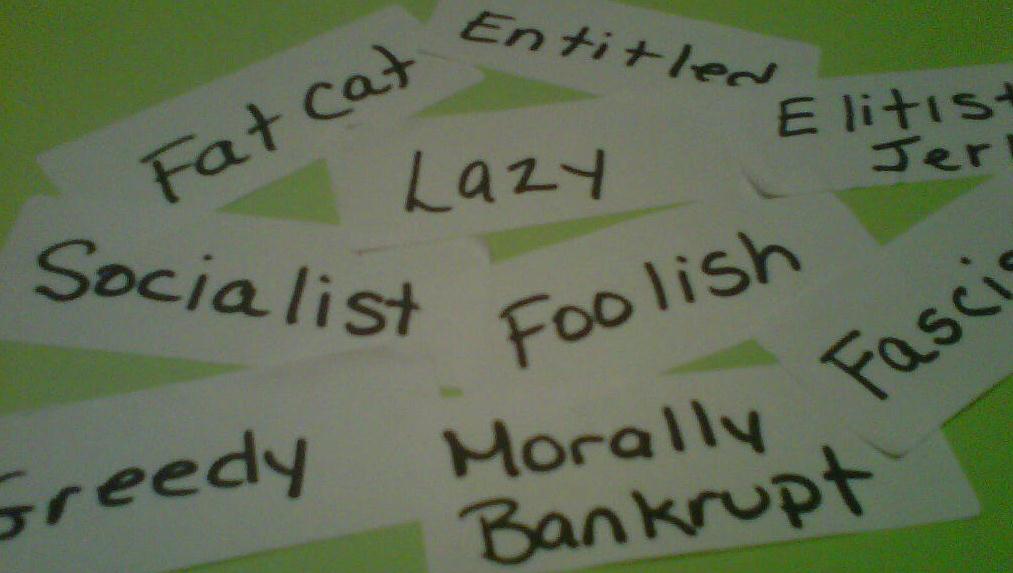 While in the car the other day, I was randomly scanning radio stations when I inadvertently heard a guy who, in my opinion, was giving questionable advice about how to wipe out bullying.
I didn’t give much credence to his advice for three reasons. First, I found him really annoying. That in and of itself really shouldn’t reflect on the validity of his advice – – but it did reflect on my opinion of him and everything he said. Secondly, he was talking in sound bites, and I’ve come to believe sound bites are specifically designed to prevent people from having to think. It allows them to repeat something they’ve heard as an absolute truth without knowing all the facts or putting it into context.
And the third reason?
His simple solution was aimed at changing the behavior of young people without addressing the bigger issue: the adults – – the people who are supposed to be the role models – – who are actually the worst perpetrators. We just don’t call it bullying.
Sometimes we call it politics. Sometimes we call it religion. And sometimes we call it patriotism.
But no matter what we call it, we are simply using acceptable terms to hide the fact that we are practicing the same behaviors as bullies: using labels to belittle those who threaten our beliefs and/or our lifestyle while using other labels to build ourselves up.
I know. I’ve been there. On both sides of that label making frenzy.
I’ve sometimes deemed people who consider themselves conservatives as being self-centered and dogmatic individuals who care more about their own bank accounts than they do about the welfare of others, especially those who are different or less fortunate. I’ve characterized them as people who frame every issue within the lens of their own life circumstances, struggles and successes rather than considering a broad range of factors.
That’s not always accurate or fair. But even though I know a lot of very intelligent, kind-hearted and well-intentioned conservatives, those labels are still there, niggling at the back of my mind and sometimes escaping my lips.
But then, I got labeled. I was told that liberals don’t believe in personal responsibility or living within their means and we don’t like rich people just because they are rich.
For me, nothing can be further from the truth.
But when it comes to labels, the truth doesn’t seem to matter all that much. What matters is they are having a very negative impact on our lives.
For those who want to control our votes, labels make a great tool for dividing us, swaying public opinion and preventing people from digging deeper into the real issues. When we are busy pointing fingers or ridiculing others as being wrong or misguided based on their label, we aren’t engaging in genuine discussions or discovering areas of mutual agreement and understanding. We are simply falling into a trap that’s been set out for us.
Lately, I’ve been trying to avoid that trap for very personal reasons.
I can’t tell my children that name calling and bullying are wrong if I’m not setting a good example. That doesn’t t mean I can’t still be opinionated or call out actions and behaviors that are wrong or against my beliefs. But that’s very different from labeling a person or a group of people with broad generalizations.
It’s not easy, but it just may be worth the effort. If nothing else, I feel like it’s helping me become a more patient person.
And that’s a label I’m willing to stick with.
Tattered Flags
 Like many Americans, I’ve been reflecting about the events that shook our nation ten years ago today.
And, even though my memories of the following days aren’t nearly as vivid, I remember one thing very clearly.
There were American flags everywhere.
They were flying on private homes. They adorned t-shirts and other articles of clothing. And they were fluttering on moving vehicles.
I found this fascinating. Not just because I’d never before seen American flags flying on automobiles as though they were paraphernalia for a sports team, but because the flags were so easily damaged, which seemed to defeat the purpose of flying them.
As a child in Girl Scouts, I remember being taught all the rules about how to handle and treat a flag. As a young adult, I remembered the national debate over the issue of defacing and even burning flags as a sign of protest.
And yet, in the days after 911, people were damaging their flags in the name of patriotism.
At the time, I wasn’t particularly upset by this phenomena; I simply found it interesting. But now, ten years later, the tattered flags represent something much greater to me: while America initially came together after 9 11, we’ve since been tearing apart – kind of like those flags waving on the cars.
I think that’s because some people equate patriotism with pride, pride with winning and winning with defeating an enemy.
There have been and always will be plenty of enemies to our country, we don’t need to be creating them.
But some people seem intent on doing so by pointing fingers at immigrants, people with different religious beliefs, people with different political ideas, people who are poor, etc. The list goes on and on.
Each time fingers point, I hear the American flag rip a bit more. That’s because our flag represents a country that was founded by immigrants. A country that welcomed people who didn’t have the same religious beliefs as the establishment. A country that encouraged diverse ways of thinking. A country that has a rich tradition of helping those who are down on their luck.
Rip.
Rip.
Rip.
Rip.
As the tenth anniversary of September 11 draws to a close, I hope that people focus not only on all the lives that were lost on that horrible day but also on the possibilities that we initially found that day.
The possibility that we could come together as a country to help each other.
The possibility that we were better united than we are divided.
The possibility that we use our diverse strengths to support each other rather than to tear each other down.
The possibility that we live can live up to ideals represented by our flag: a flag that may be a bit torn and ripped but still stands for a compassionate, caring and idealistic country.
A flag we can all fly with pride.
Please Don’t Feed the Drama Queen
 My house was invaded by bees this month. Well, according to my husband, they are yellow jackets. But to me? Anything that has stripes, wings and a stinger is a bee.
But regardless of their taxonomy, they invaded my basement and my life.
We eventually got rid of them thanks to our hero, Gary the Exterminator Guy. But, in the meantime, they created a bit of drama in the house.
I should have expected that. I live with a drama queen. The invasion of the stinging beasts simply emphasized that fact.
I warned my kids that the bees, make that yellow jackets, dying in the basement could still sting. My son, per normal, didn’t listen. Instead, he went barefoot into the Kid Cave, stepped on a yellow jacket and got stung. He then calmly came upstairs to tell me he’d been stung and his foot hurt. That was it. The incident was over, and he never mentioned it again.
My daughter, on the other hand, over reacted as usual.
She was already perturbed that I didn’t share her belief that the start of school also marks the beginning of Halloween season. She was insistent that the time to decorate had come. When I didn’t respond to her demands to bring up the tub of Halloween decorations up from the basement, she took matters into her own hands.
But, a dying yellow jacket had found the tub first. Keep in mind, it had died. It could have been easily flicked away. But, that would have been under normal circumstances when a drama queen wasn’t involved.
A drama queen changes everything.
My daughter ALMOST touched the yellow jacket, and the subsequent scream traveled farther than the recent earthquake that shook the East Coast.
I absolutely love my daughter, but about eight years ago I came to the inevitable conclusion that Shakespeare knew a girl just like her when he said “all the world’s a stage.”
On the positive side, there are benefits to being the mother of a drama queen. It not only helps you to be less reactive, it also helps you to completely ignore it.
Which is a good thing considering what’s going on in our country right now. We’ve got a lot of drama queens and people who encourage them. I’m not sure which is worse.
Anyone who has lived or worked with a drama queen, knows this is someone who blows things way out of proportion. A drama queen often views the world in absolutes. In short, drama queens are all about creating crisis out of any situation. And the more people pay attention, the more drama ensues.
If you pay any attention to the news, you probably think the world is being taken over by drama queens. If the invasion of the yellow jackets had made the news? I’m pretty sure there would be a world-wide scare and a call to exterminate every flying insect.
Sadly, I’m pretty sure that a lot of people pay more attention to drama queens than they are to the facts.
I’m not saying our country is perfect or that changes don’t need to be made.
But I am saying that using fear or emotional blackmail to drive the political process is completely ridiculous. Very few matters or situations are black and white, but drama queens love black and white.
They thrive on it.
But, as the mom of a drama queen , I’ve learned that one of the best way to deal with faux drama is to simply complicate matters. Add facts, variables and diverse opinions. Instead of creating drama, create genuine discussion.
And if the drama continues anyway? Simply do what I do with my daughter – ignore it.
I’m pretty sure it works with most drama queens.
I’d like to create some more buzz about the issue. But, the moment, I’ve had enough of both buzz and drama.
A Bit of a Rant About People Who Rant About “Welfare”
I am all for letting people have their own opinions.
I better be, especially since I have a lot of them myself. And I’m also all for letting people express their opinions, because I’m pretty sure I’d explode if I couldn’t express mine once in a while.
But here’s the thing.
I don’t pretend I know about everything. In fact, I’ll be the first to admit that I don’t know much at all.
The recent debate over the national debt? While I have an opinion about how our “leaders” behaved, I certainly never thought I had the answer. That’s because math, finance and anything to do with numbers was never my thing. Same with legal issues. While I can give a small amount of advice to nonprofits about issues they should consider, I would certainly never try to pretend I actually understand the legalities involved. And when it comes to anything medical, technical or mechanical? Forget it. I can’t contribute anything.
But I do know a thing about social services and about issues facing people in poverty. Which is why my blood starts boiling when I hear people ranting about the “welfare” system, the” lazy people who use it” and how people who “get welfare” should be drug tested. I’m pretty sure I’ve seen these topics come up on Facebook at least once a week for the past couple years.
I sometimes wonder if people who make these comments really understand the issues at all. Or if they realize that some of “those people” might be people they sit next to in church, or who care for their children or who are members of the PTA. I also wonder if they’ve ever considered that any of us, through some series of unfortunate circumstances, could have been – or still could become-one of “those people.”
I’m not going to use this space to elaborate on the multitude of reasons, some of them societal, that people end up “on welfare.” What I really want to do is set people straight about what “welfare” actually is. However, I do spend a lot of time at our local Department of Health and Human Resources (DHHR), often called the “welfare office,” and I highly recommend that everyone spend some time there. It’s very enlightening.
It’s also not a happy place to be.
First, the waiting room is always crammed full of people who are down on their luck. Secondly, because people often have to wait all day just to see a worker, many arrive before 7:30 in the morning so they don’t have to come back the next day and wait again. And third, there is no specific profile for people who need assistance. When I’ve seen people I know in the waiting room, I’m generally surprised and they are they are generally embarrassed.
With that said, I’ll be the first to admit that there will always be people who want something for nothing. And there are always be people who try to work the system. But, in my experience, about 90% of the people seeking assistance are honest and have simply fallen on hard times. Those people “driving cars nicer than yours?” That car might be the last asset they are holding on to after losing everything else, including a good paying job. They may have gone through their savings and exhausted all help from relatives only to be in a place they never imagined. That woman with three young kids? She may have just escaped a domestic violence situation in which the controlling husband or boyfriend didn’t allow her to work. Now that she’s finally left him, she’s left with nothing. And then there are those people who’ve never had any support or resources their entire life.
Based on what I know, I wouldn’t say these individuals are taking the easy way out. But a lot of people seem to think that. I recently had a friend call and ask me what to tell a family member who told her son, “There’s no reason you should go to college or worry about getting a job. You can just go to the welfare office and the taxpayers will support you. You’ll get a free place to live, a free car and a free phone.” The family member wasn’t actually encouraging this. They were simply complaining about how their tax dollars are supporting people who can live a good life without working.
Not true.
Just for the record, there is no actual assistance called welfare any more. What used to be called welfare is now Temporary Assistance to Needy Families, or TANF. TANF is a federal program and is only available for families with children. Single people or childless couples cannot receive TANF, because the purpose of it is not to help people live comfortably but rather to ensure that the children in those families have their basic needs met. It also intended help recipients become more employable. If you actually look at how much money TANF recipients receive, I can’t imagine how you think they can live comfortably.
Also, TANF recipients don’t get something for nothing. Anyone who receives TANF must participate in some kind of job training and work activity. If they can’t find a job, they have to volunteer. If they don’t participate in these activities, they are sanctioned.
And TANF isn’t a lifetime deal. A person can only receive a LIFETIME maximum of 60 months of assistance. And because TANF is a federal program, they can’t get assistance in WV then move to Maryland and start over. The assistance they received in WV is counted toward the 60 months. Many, many, many TANF recipients never even reach 60 months, because they are able to get back on their feet months, and sometimes even years, before their benefits run out.
As for the free housing? Free car? Free phone? First of all, housing is a completely different program than TANF and has its own set of guidelines. In West Virginia’s Eastern Panhandle, where the cost of housing is much, much higher than the rest of the state, there is virtually no public housing available. Last I heard, the two-year waiting list was closed because of high demand and limited resources.
There is a non-profit program that provides donated cars to TANF recipients, but the purpose of these vehicles is to provide a way for people to get to the work they are required to do while receiving assistance. There’s not much public transportation in rural West Virginia, and without a car, they can’t get to work. Also, the availability of these cars if very limited. These are donated, used cars. If people don’t donate, there are no cars. The cell phones are provided by a private company, and there are no taxpayer dollars involved.
I’m sure by now, someone who is reading this is thinking, “I know someone who doesn’t have children, and they still got welfare.” Granted, there are other financial assistance programs out there. Some serve people with disabilities, and many disabilities aren’t obvious. Also, West Virginia has a program called Emergency Assistance that low-income individuals can receive during a one-month period only once a year. And when I say low-income, I mean really low-income. The income eligibility guidelines haven’t changed since the early 1980’s. Which basically means the limited financial assistance is like putting a band-aid on a wound that requires surgery.
I also know there are people who feel that churches and charities should be providing the bulk of the charitable support. I think that would be great if only it were actually feasible. But, it’s not. I encourage you to 1)take a look at the budgets or nonprofit organizations that serve low-income individuals and families, and 2) review the amount of assistance they can actually provide. Most only provide a very small amount of assistance and limit assistance to once a year. There are simply more people who are hurting than there are dollars or donations to help. And most organizations have criteria for assistance, just as DHHR does.
Which brings me to the issue of drug testing those who receive “welfare.” To be honest, I really don’t have a strong opinion when it comes to the issue of civil rights and drug testing. As I said before, I’m not a lawyer and I would never pretend to be.
But, as my husband is constantly pointing out, I’m a very practical person. And drug testing individuals who receive TANF… or Emergency Assistance or whatever people consider welfare… just isn’t practical. First, DHHR officials report that they just don’t see much evidence of drug use among the economic services or “welfare” clients. (They do, however, see a lot of evidence of it with families who are involved with Child Protective Services). Secondly, drug testing requires resources: every drug test costs money. It has to be administered, it has to analyzed, and the reports have to be given to the clients. I doubt DHHR workers could provide the results because of a conflict of interest. If there were a positive test, I’m sure there would also be a complaint that “DHHR told me I tested positive so they wouldn’t have to give me money.” So in addition to personnel costs, there might also be legal costs.
I’m not sure where the money for drug testing would come from. For those of you who say it could come from the TANF dollars that the clients would receive if they didn’t test positive? I refer you again to my first point… there’s no evidence indicating that the majority of individuals who receive economic assistance use drugs. I’m just not sure the dollars would be there – even if they could even be used for that purpose.
And, let’s say I’m wrong and a lot of people did have positive results. What then? These are low-income individuals to begin with. Should they just be left to fend for themselves or would treatment be provided? If treatment is provided, where would the money for that come from? Treatment services are already very under-funded and have long wait lists.
Finally, since helping individuals develop the skills, knowledge and habits to gain and maintain employment is one of the primary purposes of TANF programs, I don’t understand why we would put up barriers to participating. Don’t we want to help people improve their situation?
So I rant. And I am sure there are those who are going to disagree with everything I say. Feel free. As I said before, I think everyone is required to an opinion.
I just don’t think those opinions should involve blaming or marginalizing any segment of our population. And I don’t understand why people who have more than enough to meet their basic needs– food, housing, clothing, and health care– feel that they are being punished by being asked to help their fellow-man. To me, that’s a privilege. Besides, as the saying goes, you can’t take it with you. But I’m pretty sure good deeds stick with you forever.


 Just So You Know