365 Reasons to Smile – Day 1

If someone were to ask me about my greatest asset or my greatest deficit, I’d give the same answer: my brain. It’s constantly engaged and always working overtime.
It’s probably the reason I worry, get anxious and have trouble sleeping.
It’s also the reason I’m always making lists in my head. I’m not talking about shopping lists or “to do” lists. I’m talking about random lists about anything and everything: eight things I can talk about with a stranger; 12 exercises to do while driving a car (facial exercises count); and 365 reasons to smile.
I started that last list after my experience during November when I joined others in writing daily about something for which I was grateful. That forced me to think of all the good things in my life rather than all my worries. But then, when November ended, so did my daily dose of thankfulness.
That’s when I started my list of 365 reasons to smile.
Today, I’ve decided to start sharing that list.
I know this is just a random day in July instead of January 1 or any other date that marks a significant beginning, but I don’t care.
Being able to write what I want when I want is certainly a reason to smile, but it’s not the my “Day One” reason.
That reason is the Martians on Sesame Street.
As a young child, my parents always limited my television, so watching Sesame Street was a treat. I didn’t realize it was supposed to be educational, I just thought it was fun. And one particular sketch stuck in my mind for years. Even in high school, my friends and I would reenact the scene from Sesame Street when the Martians try to talk to a telephone. We’d move our mouths down and over in a ridiculous parody. And it made me smile.
It still does.
No matter how many times I’ve watched that sketch, it always makes me smile. I hope it makes you smile too:
Where Fear Comes From
As I sat in my driveway Thursday night watching fireworks, I was transported back to a July evening more than 40 years ago.
My family and I were sitting in lawn chairs in front of our small rental house on the Warm Springs Indian Reservation in Oregon watching an amateur fireworks show. As a very young girl, I didn’t know the pyrotechnics were less than impressive. All I knew was that my parents were complaining about the long delays between explosions and that Charlie Brown was scared. And I was worried about Charlie.
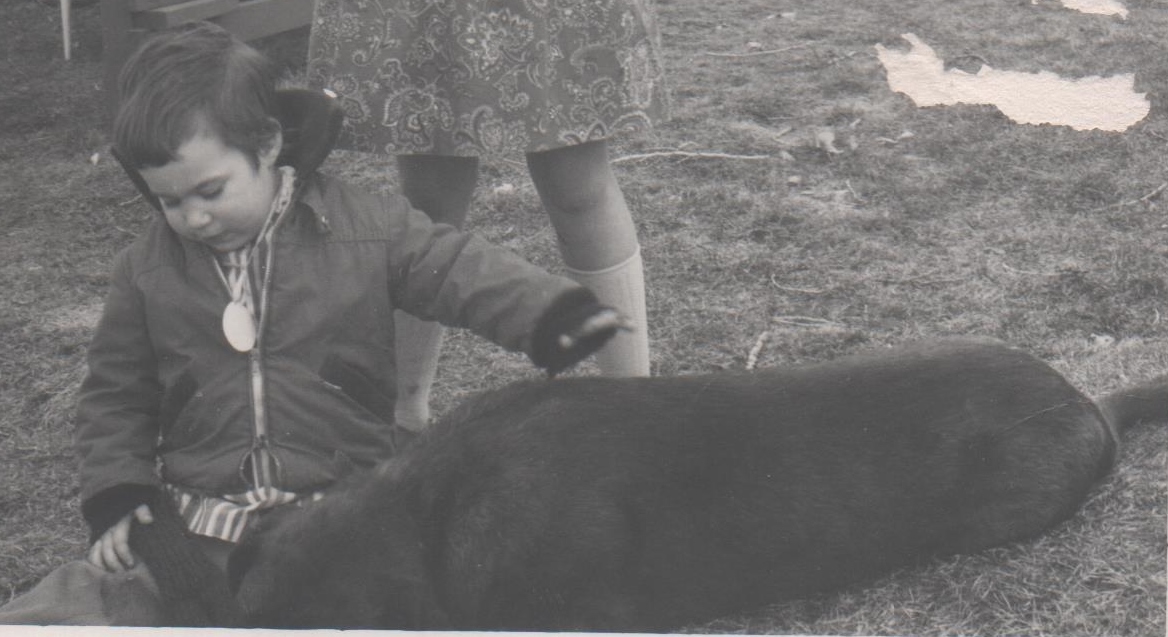
Trina and Charlie Brown 1971
From the day my parents adopted Charlie Brown, they should have known I would fall deeply in love. I was born to be a dog lover the way some people are born to be athletes or musicians. According to my baby book, one of my first words was “doggie,” and, as a toddler, I would search out dog books at the local library.
But until Charlie Brown arrived, my family never had a dog.
Since then, my family has never been complete without a dog.
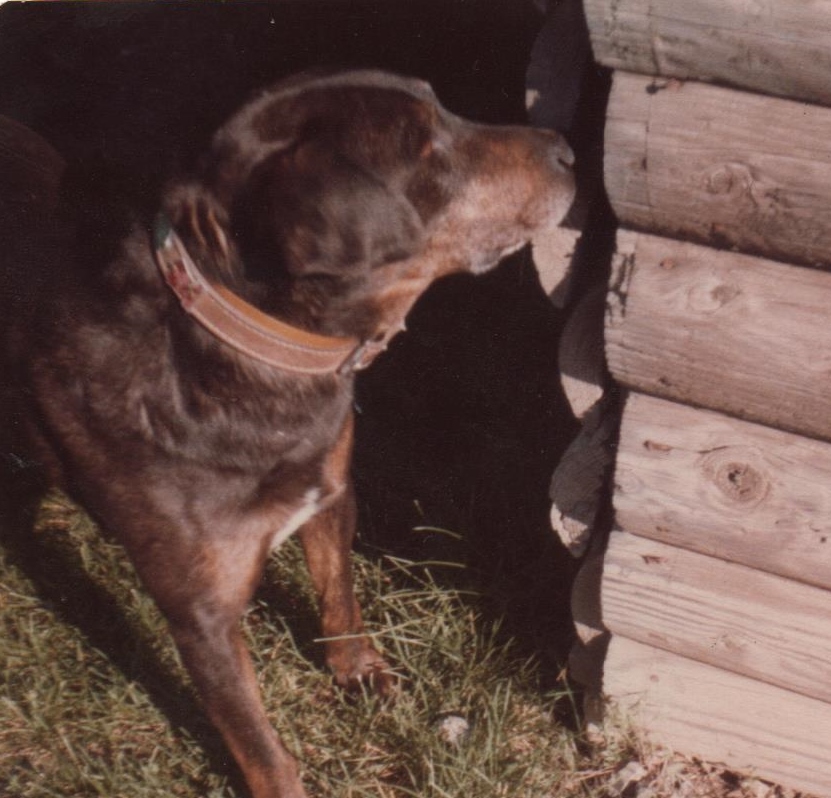
Charlie Brown
And even though we loved Charlie, his early years weren’t easy. He came into our lives at a time when dogs were allowed to roam, and roam he did. When he strayed onto a cattle ranch and started chasing the cows, the rancher shot him. He barely survived, and my parents always blamed his fear of thunder and fireworks on that incident.
Their explanation was reasonable, and I always believed them until I discovered that other dogs, those who have never been shot, also fear thunder and fireworks.
That’s when I began to wonder where the fear comes from. I just couldn’t understand why so many dogs would be afraid of the same thing when their experiences were so varied.
The concept of fear has always fascinated me, especially since I’ve spent my own life overcoming unjustified ones. When I was young, I was afraid to swim in water that was over my head even though I could swim perfectly well when I could touch the bottom. I was afraid to slide down a fireman’s pole, even when all the other kids were expressing sheer joy during the descent. And I’ve always been afraid of rejection and failure to the extent that I avoided potential relationships and challenges.
Then, at one point in my life, I thought I had finally figured out the fear factor.
In college, a Psychology professor discussed the theory of collective memory, and the concept clicked. I might not have experienced an event that would provoke fear, but one of more of my ancestors had. They would have then passed those fears down to me.
That made sense for the dogs as well. They may not have experienced the danger associated with loud noises, but their ancestors had.
For years, as I’ve slowly overcome my fears one by one, I’ve held on to that theory.
Then Rodney entered my life.

Rodney watching the fireworks.
Rodney is the current canine member of my family. He’s a giant German Shepherd with a lot of energy and very little fear. That is, very little fear unless you count his inability to be left alone.
When we first adopted Rodney from a rescue group, he wouldn’t even go into our backyard without someone accompanying him. Over the past three years, he’s improved, but he still hates to be separated from the family, and, yes, particularly from me.
On Thursday night, as the human members of the family sat in the driveway watching fireworks, Rodney sat in the house watching us. He whined, he whimpered and he cried until I brought him out to join us.
And then he was content. While the city fireworks boomed overhead and the neighbors shot off their firecrackers, he simply watched. And my theory about the roots of fear was forgotten.
Because, at that moment, I realized that no matter where fear comes from, there will always be an even greater force.
It’s called love.
The Rainbow Connection
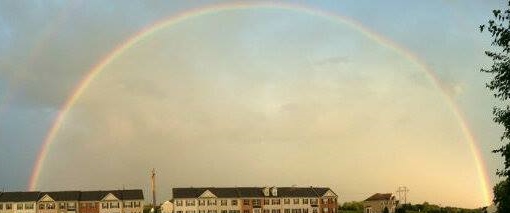
June 29, 2013 Rainbow
Last night, I enjoyed the most beautiful and perfect rainbow I have ever seen.
It arrived exactly on the anniversary of last year’s June 29 derecho, the scariest storm I’ve ever experienced.
Ironically, the events of both evenings were similar.
Last year, I was supervising my daughter and her best friend as they swam. Last night, I was at a pool party where my daughter and her best friend were once again swimming.  And, last night, just like the year before, a sudden and unexpected storm blew in.
Unlike last year’s storm, which brought fallen trees, downed power lines and electrical outages, last night’s storm brought the perfect rainbow, and for a few minutes, a double rainbow.
It also brought a reminder.
Sometimes, the only thing we get from weathering life’s storms is the strength we find in our struggles. But sometimes we get a brief glimpse at all the beauty and hope that the world offers.
Standing in awe of nature last night, I was also reminded that in addition to symbolizing promise, the rainbow also symbolizes diversity and inclusiveness.
Not only did the rainbow shine bright on the anniversary of the derecho, it also served as the ending punctuation mark on a historical week.
On Wednesday, the United States Supreme Court delivered a victory for gay rights. It ruled that married same-sex couples were entitled to federal benefits and effectively allowed same-sex marriages in California.
The fight for equality may not be over, but those decisions, like the rainbows, hold promise.
Thinking of that, a song from my childhood has been stuck in my head all day. Unlike some songs, which can be rather annoying, “The Rainbow Connection” from The Muppet Movie is simply making me smile.
The Rainbow Connection by Paul Williams and Kenny Ascher
Why are there so many songs about rainbows
and what’s on the other side?
Rainbows are visions, but only illusions,
and rainbows have nothing to hide.
So we’ve been told and some choose to believe it.
I know they’re wrong, wait and see.
Someday we’ll find it, the rainbow connection.
The lovers, the dreamers and me.
Who said that every wish would be heard
and answered when wished on the morning star?
Somebody thought of that and someone believed it.
Look what it’s done so far.
What’s so amazing that keeps us star gazing
and what do we think we might see?
Someday we’ll find it, the rainbow connection.
The lovers, the dreamers and me.
All of us under its spell. We know that it’s probably magic.
Have you been half asleep and have you heard voices?
I’ve heard them calling my name.
Is this the sweet sound that called the young sailors.
The voice might be one and the same.
I’ve heard it too many times to ignore it.
It’s something that I’m supposed to be.
Someday we’ll find it, the rainbow connection.
The lovers, the dreamers and me.
Entitled
I’d be lying if I claimed I never stereotype people. But I am being completely truthful when I say I come by those unfair stereotypes honestly.
That is, they aren’t based on propaganda or how I was raised. They are based on experience.
Take, for my example, my instant assumption about women who wear fur coats and multiple diamond rings on their fingers. There’s a reason I automatically label them as being self-centered.
Years ago, on a bitter cold December day when I was in my twenties and living just on the right side of poverty, I spent my entire lunch hour 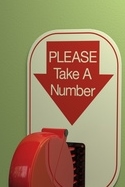 waiting in line at the post office. I was hungry and irritated, which are generally interchangeable for me. I was also uncomfortable and sweating. The temperature in the post office had been bumped up to fight against the frigid temperature outside, but I was wearing my winter coat. I was also carrying numerous packages and simply hoping the line would suddenly advance.
It didn’t. Every customer had multiple packages, and, even though we were smack in the middle of the holiday rush, there were only two clerks working at the counter. As we inched forward, I tried to find ways to amuse myself. Since this was in the days before smart phones, I counted the tiles on the floor and made up stories about the other customers. I even tried to strike up a conversation with the person in front of me, but he was even more irritable than I was.
And then, she arrived.
The woman wearing the fur coat and lots of diamonds swept (yes, she really swept) into the post office with an armful of packages like the rest of us. Only, unlike the rest of us, she took one look at the line and loudly announced, “I don’t have time to wait in line. I have a lunch appointment.” And then she simply walked to the counter and insisted she be served immediately.
She was.
While the rest of us stood with our mouths hanging open, the clerk accepted her demands and began processing her packages. She swept out in a manner similar to the way she had swept in. Only now, unlike the rest of us, she no longer carried packages.
And she never apologized.
From that time on, I labeled women who wore furs and diamonds as entitled.
In years to come, I would hear others use that same word to describe individuals and families who have depended on government assistance. And I would always cringe.
 But this week, I had an eye-opening experience.
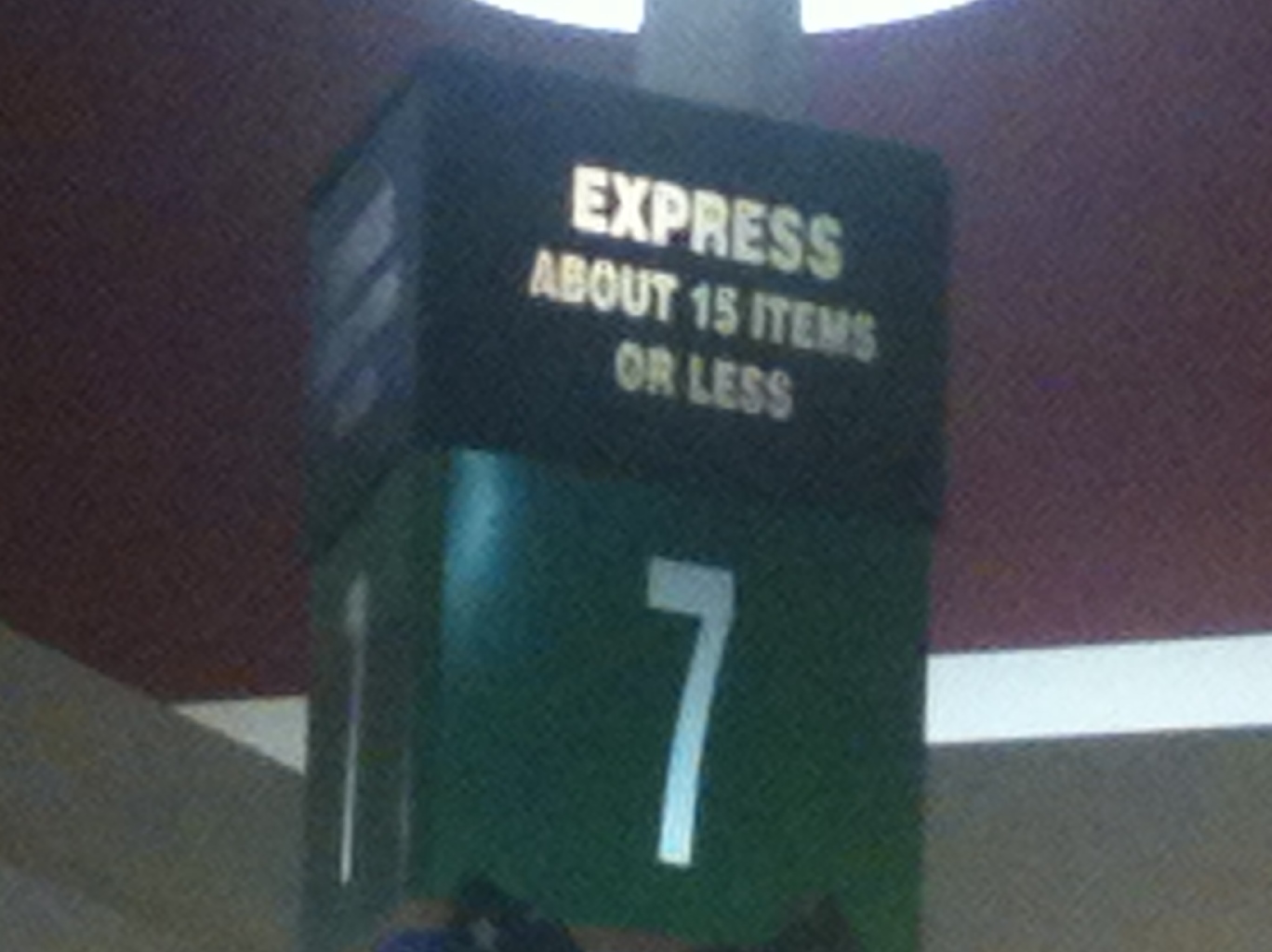
I was picking up a few things at the grocery store and was checking out in the express line with my seven (yes, I counted them) items. As the customer in front of me finished checking out, a women walked in the door of the store.
She had rather straggly hair and was dressed in cheap clothes. The little girl tagging along behind her didn’t look much better.
Instead of getting in line, she glanced at me then entered the check out line where most people exit. She simply walked between me and the man who was checking out. The clerk also glanced at me, as though unsure what to do. But the woman took control of the situation. She ordered three packs of cigarettes and then, when asked if she was using a debit or credit, almost rebelliously said “credit.”
I was disgusted. She had blatantly cut in front of me to charge cigarettes. And she had done it with a child in tow. She behaved as though she were…entitled.
And that’s when I got it. I understood how one experience can easily shape our opinion about all people who look or act in a certain way. And I understood that entitlement has absolutely nothing to do with social or economic class and has everything to do with individuals who think more about themselves than about others.
And neither one is right.
The Bridge that Mrs. Henderson Built
Life speeds by as a changing tide of both small and big events that leaves in its wake only memories and eventual acceptance that nothing ever stays the same.
It also allows us to witness what others will someday study as history.

Mrs. Henderson and Trina 1979
When I was young, I truly believed that the distance between me and any historical events was immense. Even though I loved studying history and was a voracious reader of biographies, I still thought that events simply happened, were over and everyone moved on.
And then I met Mrs. Henderson.
Born on February 5, 1885, Blanche Henderson was literally a pioneer. In 1904, at the age of 19, she graduated from the Oregon Agricultural College (now Oregon State University) with a degree in pharmacy.
A few years later and on her own, she became a homesteader near Madras, Oregon. After she married fellow homesteader, Perry Henderson, she surprised herself by becoming a teacher.
As far as I know, she never had any of her own children, but she obviously loved kids. And she showed that love to me.
By the time I met her, she was a widow living alone in a small, two-bedroom house with minimal furniture. She was also well over 90 years old.
I have absolutely no recollection how our friendship began, although I’m guessing my mother, a journalist, introduced us.
Once those introductions were made, the unlikely relationship began. My mother would take me to visit Mrs. Henderson, and she would always serve me half-melted ice cream from a freezer that wasn’t keeping her food cold enough.
Neither of us cared.
What I did care about was listening to her stories, and what she cared about was sharing them.
As I thumbed through her coffee table book of Norman Rockwell prints, she told me about attending the 1905 World’s Fair in Portland. She even gave me a fan from it, a souvenir she’d kept all those years and that I still treasure.
She told me about witnessing a stagecoach robbery when she was a little girl. “I thought the men had dunce caps on their heads,” she said. “My father had to tell me they were holding their arms about their heads because they were being robbed.”
As Mrs. Henderson talked about her experiences and about how the world had changed, I began to recognize that, what was history to me, was simply life to her. And wanted me to be able to touch it too.
Mrs. Henderson died shortly after my family left Oregon, but the lesson she taught me has stayed with me: each person can be a bridge between the past and 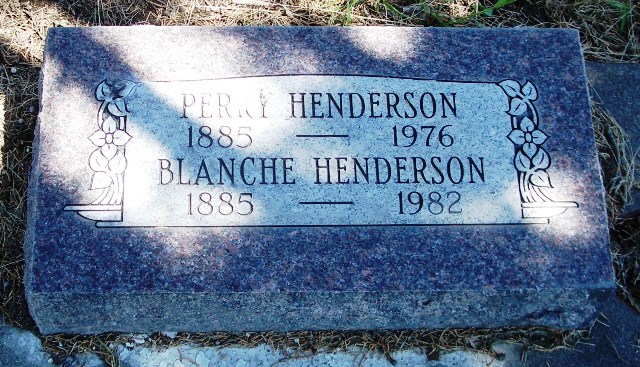 the future. But that only happens when we reach out to future generations and develop relationships with those whom we may think we have little in common.
Thanks to Mrs. Henderson, I’ve actually touched the historical 1800’s. If I stretch myself far enough, I might be able to reach the 2100’s too.
A Piece of Your Dad

Summer 1998
A message to my 15 year-old son:
The moment you were born, your dad grinned wider than I’ve ever seen. Then he said,”This is the best day of my life.”
And he meant it.
While my mind was spinning with worry, and I wasn’t even sure if I was even cut out to be a mother, your dad knew he had arrived at the place he was always meant to be – fatherhood.
Since then, he’s never left that place. Not even once. And that hasn’t always been an easy thing to do.
Not all men have the fortitude to be a father, and, and as you should well know, it is often a thankless job. It’s even harder when you grow up without much of a role model.
But your father has something a lot of men don’t – the ability to put his ego aside and focus on what he believes is most important – always being available for you and your sister.
From the moment you were born, you have been his priority. He’s never stopped believing in you or being your number one champion. Ever.
At those times when I’ve cried over your behavior or questioned what I did wrong, your dad always spoke up for you. And he was always the voice of reason.
On those days when I worried that you weren’t like other boys – that you weren’t particularly interested in playing sports or being overly social – he always praised you for being comfortable in your own skin and being true to yourself. And he was always right.

Summer 2013
And all those times when you were being the total and complete goof you are, he was proud of you and never hid his face in embarrassment.
Well, almost never.
I know we often joke about your blood line and about your genealogy, but, in all honesty, you should be proud of being your father’s son.
You may not have his brown eyes or his poker straight hair, but you have something much more important.
You have pieces of his heart and pieces of his soul.
Treasure them and make good use of them. Your dad sacrificed a great deal so you could have them.
What the Sunrise Says
 The end of the school year marks the beginning of early morning bike rides for me.
For a few weeks during summer months when my children and I don’t have to be ready at 7:00 AM, I can pedal into the dawn on country roads.
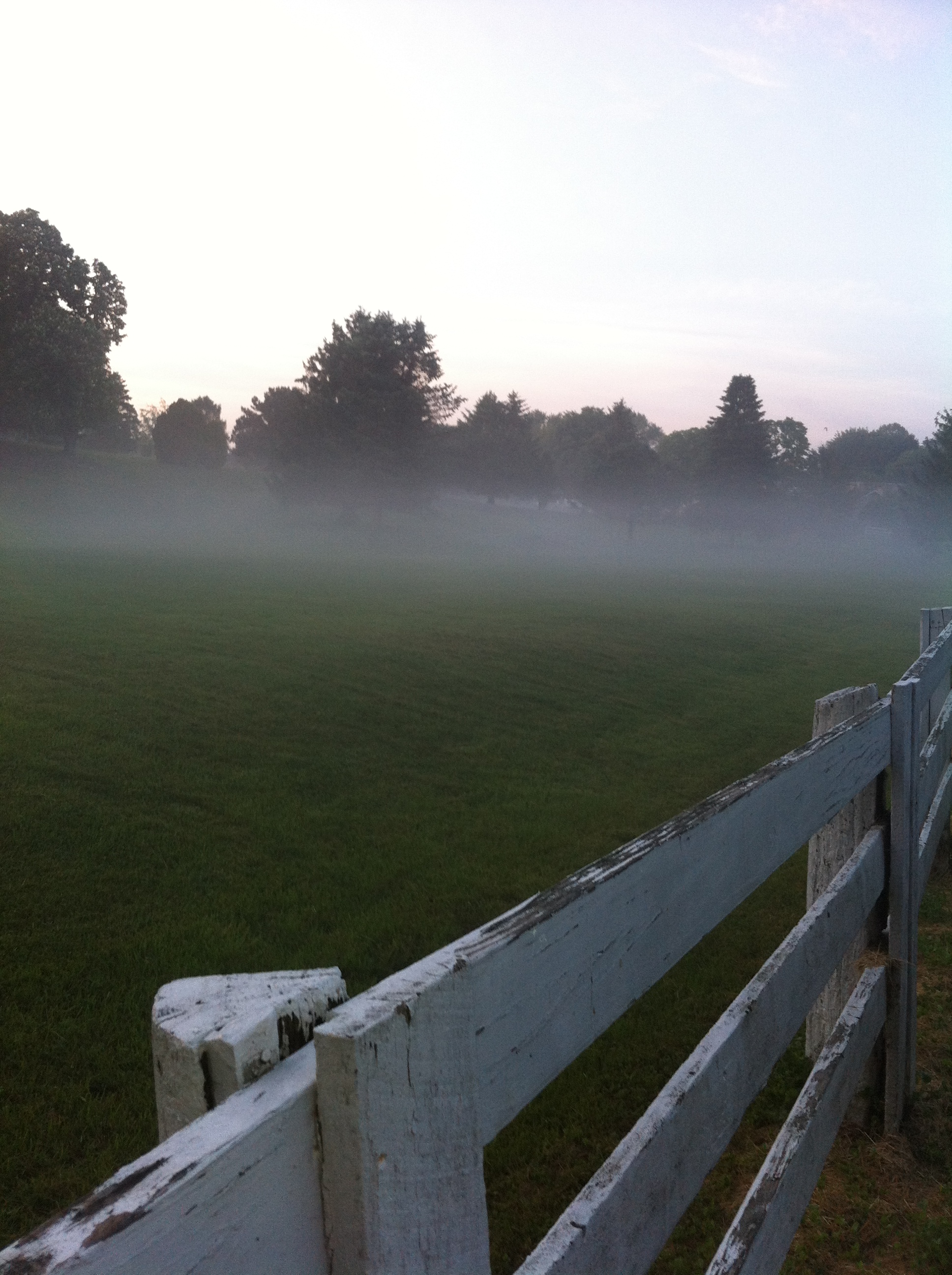
Sometimes, the fog still clings to the fields, and I can almost see the ghosts of Civil War soldiers who once walked the land.
Usually, the deer and rabbits momentarily stop nibbling the leaves and grass to watch me pedal by.
And, during those early morning hours, the songs of the birds can be enjoyed without the roar of traffic and other human noises to dull them.
All of this occurs as the sun is slowing making its daily appearance and providing me with advice.
The sunrise tells me that the beauty of nature is evidence that humankind will never master the paintbrush like God can.
The sunrise whispers the importance of taking time to enjoy the moment instead of constantly anticipating the moments that are yet to come.
The sunrise reminds me that it is simply a reflection of life – constantly changing with time and the vantage point from which we observe it.
The sunrise says that it will never fail me. Even if I can’t see it through the clouds of a dark, gray day, it is still there holding the same promise that it does on a bright, sunny day.
And the sunrise shouts that it will always be a wonderful gift to be treasured.
School may be out for the summer, but the wise sunrise is ensuring the lessons haven’t stopped.
“Isn’t That What We’re All Here For?”
 Yesterday morning, my daughter and I were struggling to carry and drag multiple large objects across a school parking lot when a stranger in a Washington Nationals shirt offered to help.
I gladly accepted his gesture and handed him a folding table.
As we walked, I asked about his shirt, and he broke into a broad grin as he talked about the team enthusiastically. He told me that his son had recently played in a Nationals benefit against cancer.
We continued the small talk until we arrived at my church’s Relay for Life campsite in the middle of the high school football field. As the man put down the table, I thanked him profusely for helping. He merely shrugged and said, “Isn’t that what we’re all here for? To help each other out?”
I nodded in agreement then said goodbye as I turned to help the rest of my team set up for a day in the hot sun. But the man’s words stayed in my head.
About an hour later, the event had begun, and cancer survivors were making the first lap around the high school track while the rest of us clapped and cheered. Since several friends and acquaintances were walking, I don’t know why I was so surprised to see a relative stranger, the man in the Nationals shirt, walking among them.
them.
I’ll probably never know his name, but I want to thank him for his reminder yesterday.
I’ve been stressed out for several weeks now about things over which I have no control and things which involve other people over which I have no control. And amid all that stress, I lost some perspective.
There were multiple incidents at yesterday’s Relay for Life that helped me put my life back into focus, but his words were the ones that made everything crystal clear.
Life isn’t about waiting for those few moments when everything falls into place and goes smoothly. If it were, we’d never be happy or grateful.
Life is about appreciating rich experiences made possible by people who are willing to share their limited hours with us. It’s about appreciating everyone who makes us smile and laugh, who lends us a helping hand and who trusts we will do the same for them.
I was surrounded by such people yesterday.
Relay for Life is intended to be a fundraiser for cancer research, and that’s what many people consider it. But to me, it’s not really about the money at all.
It’s about seeing diverse people join together for a common cause rather than tear each other up over political or other differences. It’s about spending hours on a track talking with friends and, even more importantly, talking with my daughter when there is absolutely no “to do” list to distract us. And it’s about remembering all those we’ve lost to cancer and honoring all those who have battled and survived it.
Most of all, it’s about life – embracing it, enjoying it and remembering what it’s all about. And that, as the man in the Nationals shirt reminded me, is simply about helping each other.
The Cost of My Opinion
The bloodiest single-day battle in American history occurred approximately 15 miles from my house. Nearly 23,000 soldiers died, were wounded or went missing after twelve hours of combat on September 17, 1862 at the Battle of Antietam during the Civil War. The lingering echoes and impact of that battle are still felt more than 150 years later.
Both the Union and the Confederacy experienced devastating losses, and historians have never declared a true winner. But for me, my family won. My great, great-grandfather James F. Bartlett (his biography and obituary are on this website right below Edward Bartlett’s) fought with the Massachusetts Infantry and survived. although he did sustain injuries on May 6, 1864, at the Battle of the Wilderness.

John Snyder gravestone Elmwood Cemetery
Ironically, my husband’s great, great-grandfather, John Snyder, died in June 1864 of wounds he sustained at the Battle of the Wilderness while fighting with the Stonewall Brigade.
Years ago, a local historian gave my husband and me a tour of John Snyder’s town and legacy. The tour ended at Elmwood Cemetery in Shepherdstown, where he is buried.
Newly married, I was actually interested in John Snyder until our volunteer tour guide pulled out a Confederate flag for my husband to place on his great, great-grandfather’s grave.
I loudly proclaimed that the Confederate flag had a very specific meaning, and my husband was not allowed to touch it. He tried to explain the flag was meant to honor his great, great grandfather, but I declared that the Confederate flag had nothing to do with honoring anyone. My husband placed the flag on the grave anyway.
Years later, I recognize my words were nothing but rude, and I had absolutely no right to be indignant.
I’ve never put my life on the line for my beliefs, and I have no right to judge those who did. All I can be is thankful.
The passage of time can change perspective and opinion about what is best and sometimes even what is moral, but it will never change what is honorable.
My children carry the blood of two honorable men who fought for what they believed during a time when our nation was completely divided. They also carry the last name of a man who lost his life fighting for what he thought would be a better life for them.
On Memorial Day, I have no right to argue about putting a Confederate flag on a soldier’s grave. Instead, I should simply be grateful that I have the freedom to make those arguments.
That freedom didn’t come without a price, and today we honor those who paid it.
The Graduation Speech I’ll Never Give
 This upcoming week, my husband is scheduled to be the graduation speaker at his high school alma mater. Even though he makes his living talking to millions of people, he actually hates speaking in public.
Because of that, he’s not particularly happy that I encouraged him to go outside of his comfort zone. He thinks I don’t understand his apprehension because I actually enjoy public speaking.
What he doesn’t understand is that I’m simply jealous of the opportunity, and I’m living vicariously through him.
It’s not the spotlight or the attention that make me wish I could stand in his shoes. It’s the privilege of encouraging young people as they take that final step out of childhood and into adulthood.
Ironically, I don’t even remember who spoke at my high school graduation other than it was a white, male politician. Despite that, I still believe that the right words can make a big difference.
If I didn’t, I wouldn’t write.
But since I do write, I’m going to use this space to share my own words with the Class of 2013. What follows are highlights of the commencement speech I’ll never give:
1. As you get older, you will discover that high school wasn’t just a finite period of your life. It was a series of good and bad relationships and events that served as a platform from which you chose to stand still, dive or climb. My advice is to climb. Take the stairs. Rise above the need to be defined by others or the simple accomplishments of youth and discover who you really are. You’ll probably surprise yourself and all the people with whom you once shared the platform.
2. Don’t ever believe that your greatest moments are behind you. There are always opportunities to create more great moments, but they require moving on and doing something different. Many people are uncomfortable with change and will want to force the status quo on you. Don’t let them.
3. Never apologize for your opinions. Ever. Opinions aren’t facts, so you can never be wrong, and you can always change them as circumstances change. But opinions are valuable because they define the essence of who you are. Like any other valuable possession, people will try to take them from you by any means necessary. Don’t ever let them use religion or profits or cultural norms to buy your silence.
4. You’ve probably been told all of your life not to worry about what other people think about you, and in most circumstances, that’s true. But you should worry about what “the future you” will think about you. You are the only person who has to live with you your entire life. You can walk away from other people, but you will still be with yourself. Make sure you are a good companion. Treat yourself with the respect, care and love needed in any long-term relationship.
5. Before you get out of bed each day, think about the calendar. The day you are about to begin is absolutely unique, and in a few short hours it will simply be another day in history. Make sure that day counts in your own life history. Despite the obstacles you may be facing or the hurt you may be feeling, make sure you do something that makes that day memorable and meaningful. If you are stuck in a routine, break it just a little. Eat something unusual. Read something new. Talk to a stranger. Practice a random act of kindness. Your ultimate goal in life is to make every day count, but that sometimes requires a bit of work. Do the work anyway.


 Just So You Know