Blog Archives
The Misadventures of Mr. Muffet, My Chronically Confused Cat
 Mr. Muffet was never destined for greatness, dignity or even a long life.
Quite the opposite in fact.
The moment he joined our family, his fate was sealed.
I was too young to remember how Mr. Muffet arrived at our house or even when his name changed.
All I know is that Mr. Muffet was Miss Muffet until my cat-loving grandmother from Massachusetts visited our Oregon home. All things considered, my grandmother probably thought my parents were trying to make some kind of statement about gender stereotypes, but she wasn’t going to have any of it. She told them in no uncertain terms that Miss Muffet was just not an appropriate name for a male cat.
My father, who had previously tried unsuccessfully to breed rabbits, (he was unsuccessful because they were all female) heeded her advice, and Mr. Muffet’s name was modified accordingly. But his status as a full-fledged member of the family never changed.
Which, apparently, is why he went with us on a family vacation to the Oregon Coast.
I was recently reminded of the trip during a conversation with a couple of co-workers. Both were discussing the trauma of having to ship their cats overseas.
“I’ve never shipped a cat,” I said. “But I do remember the time my family took our cat to the beach.”
They both looked at me in disbelief.
“Why,” they wanted to know, “would you take your cat to the beach?”
I couldn’t answer their question. But since cats were the topic, curiosity got the best of me. I had to call my mom and ask why.
“I don’t remember,” she told me.
“But we did take the cat to the beach, didn’t we?” I asked.
“Yes, we did,” she answered. “I just don’t remember why. Probably because cats are easy, and we didn’t want to travel an hour to have him boarded.”
I didn’t even ask why a neighbor couldn’t have taken care of Mr. Muffet. Instead, I pressed on with the bigger issue. “And he pooped in the car, right?”
“Yes,” she sighed. “Yes, your memory is correct. He pooped in the car.”
She was obviously done with the conversation, so I didn’t push the issue. But I did tell my co-workers that I wasn’t imagining the trip.
Not only did we take Mr. Muffet on vacation with us, but we didn’t even have a carrier for him. (Were cat carriers even around in the early 1970’s?) Because of that, he was simply free to move around the cabin. But he didn’t. He stayed on the vent behind the back seat where my brother and I were riding.
That was either his favorite spot or he was too terrified to move, even when he had to poop. As a result, he pooped in the vent right behind my head.
There is no way to describe 1) the smell, or 2) how determined my mother was to get the mess cleaned up.
My mom was determined for a long, long time.
The good news for Mr. Muffet was that he soon had a lot more places to poop.
Always an equal member of the Bartlett family, Mr. Muffet accompanied us on our first walk on the beach (a beach comprised mostly of sand dunes.) He probably thought he’d landed in the world’s largest litter box.
He did his best to take advantage of the situation, but after an hour of running through the dunes, scratching in the sand and doing his business, the poor cat was simply exhausted.
Fortunately, our trip home was much less memorable than the one to the coast. Unfortunately, I don’t have many more memories of Mr. Muffet.
He disappeared shortly after the infamous vacation.
For years, I was convinced that a less adventurous family had found and adopted him. I was equally sure that he was quite relieved that he didn’t have to live with my crazy family anymore.
I was well into adulthood before I learned the truth: Mr. Muffet had been hit by a truck on the highway near our home.
I appreciate that my parents tried to protect me from the facts, but I also think they were trying to protect themselves. I’m certain that the adventures with Mr. Muffet had a significant impact on them.
He was, after all, my only cat growing up. After he “disappeared,” we only had dogs. And, I must say, dogs travel a lot better.
The Gift of a Dead Bee
I’ve finally figured out how to deal with the gift of a dead bee.
It’s only taken most of my life, since no one ever told me what to do with one. Or, at least if someone did, per usual I ignored the advice.
Like most of valuable lessons, I’ve had to learn the hard way – through experience. And, to quote Randy Pausch, “Experience is what you get when you didn’t get what you wanted.”
I’m a very experienced woman. And I’ve been given a lot of dead bees.
 I’m not simply referring to the dead bees, or any other small critters, that my cat brings me as gifts. I’m referring to all the times I’ve been given something that was intended to be a gift – a piece of advice, a kind thought or even responsibility – that I didn’t want. Not only did I not want the gift, but I overreacted to it – if not outwardly then inwardly.
Unfortunately, I’ve wasted a lot of time and energy on dead bees.
My mother was a master at giving them. To be fair, just like my cat, she was giving dead bees out of love. But, unlike my cat’s gifts, hers were harder to deal with.
Even before I hit adolescence, I remember her telling me to accept my body type since it wasn’t going to meet society’s standards for the female form. “It’s o.k. to be a big-boned girl,” she told me. ” I always wanted to be small too, but it’s just not how we are built.”
Really? I don’t remember worrying about my body type. I remember complaining that I wasn’t cool, but I didn’t think that had anything to do with my size. In fact, I never thought my 11-year old body was particularly big… kind of dorky, maybe, but not big. But from that moment on, I was sure my hips were going to grow so large that I wouldn’t be able to walk through doors.
I was almost thirty before a doctor finally convinced me I simply didn’t fit the definition of “big-boned.”
But that was nothing compared to the dead bee my mom gave me when I was 16.
The gift came during a conversation in her car. She had been covering something for the newspaper and was all worked up about the unfair treatment of a female official.
“They just won’t listen to her.” she told me. “They won’t take her seriously because she’s attractive.”
And then my mother did something she rarely ever did. She actually turned and looked at me, instead of looking at the road, while she was driving. It was brief, but it was still memorable.
“You are so lucky,” she told me, “that you are smart rather than pretty.”
That bee stung even though it was already dead. Those are just words no 16 year-old girl wants to hear. Not only did they linger when they came out of her mouth, they hung in the air long enough for me to grab hold of them and carry them with me for years.
Since them, I’ve collected hundreds more dead bees from very well-intentioned people. But only recently have I understood that these dead bees were actually gifts.
My mother’s comments about my looks and my body helped shape who I am: someone who recognizes that character is far more important than appearance.
Dead bees also make good stories. And those who know me best know I’m always telling a story – whether the listener cares or not.
Finally, they shine a spotlight on what’s really important: the relationship with the giver.
A few weeks ago I was making the bed when I flipped up a blanket to find a dead bee on the sheet. My cat had brought me another gift. But instead of freaking out over the fact that I’d been sleeping with a bee, I just laughed. You see, Skitty isn’t the most affectionate cat in the world. My husband calls her mean, but I disagree. Every night, after she thinks we’ve all gone to sleep, she jumps onto the bed and curls up next to me. I love the fact she does that, and if it means dealing with a few dead bees in bed, I’ll accept the trade-off.
In fact, I’m getting really good at dealing with dead bees in general. All it takes is focusing on the intent of the giver rather than on the gift itself.
I say this in recognition of the biggest dead bee my mother ever gave me: the tendency to give them myself. I’m pretty sure I’ve exceeded her abilities at giving dead bees, and I’ve already given a lot of them to my own children.
I can only hope I’ve also passed on how to accept and even embrace them.
Not Just Another Walk in the Park
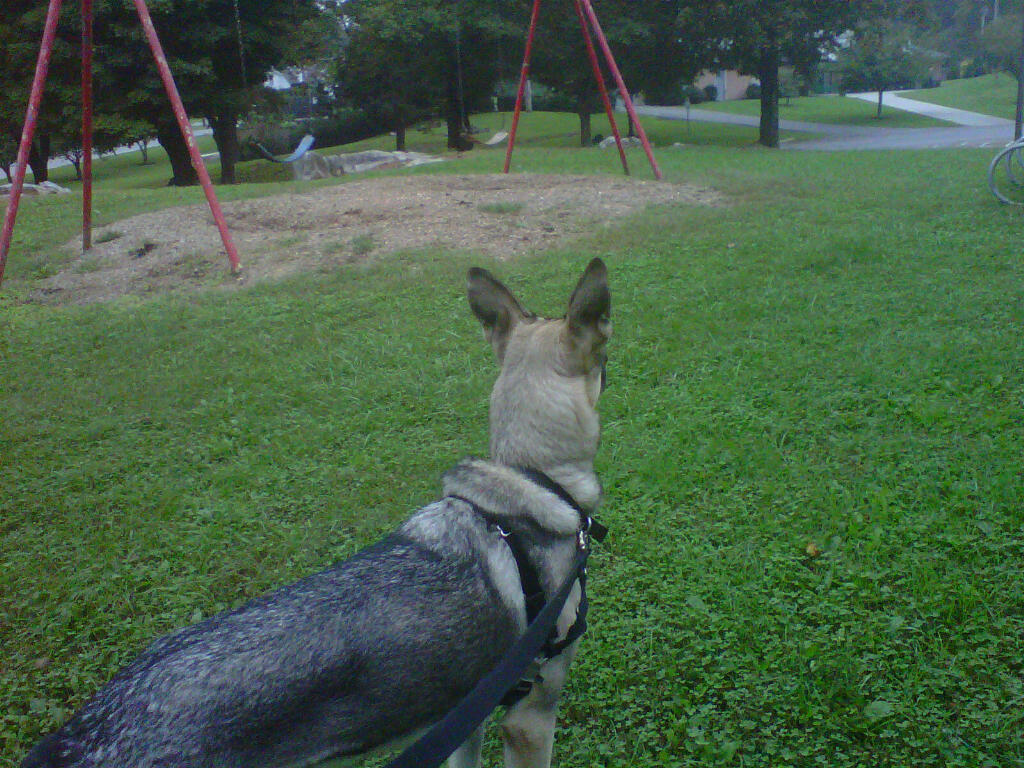
My dog Rodney on a daily walk in the park
I’ve got a habit.
It’s a habit that’s opened my eyes to a side of my town that many people aren’t even aware of. It’s a side of our town that some people look right through – maybe because they don’t want to see it or maybe because they simply don’t know what they are looking at. It’s a side of our town that shows disparity, inequality and absurdity.
But it’s there right out in the open – in the park down the street from my neighborhood. It’s a park where I’ve spent hours and hours of my time.
My husband calls my behavior obsessive. I call it maintaining a routine. But, whatever you call it, I am compelled to take our dog Rodney for a walk in the park at least once, and sometimes twice, a day depending on the weather and how busy my schedule is.
No matter what, we always go in the morning. Always.
On weekdays this means my alarm goes off at 5:00 and we’re in the park by 5:30. On weekends, we’re generally there a bit later.
But no matter the time, those visits to the park provide a glimpse into what’s going on in my town.
This time of year, it’s still dark when I get to the park. But that doesn’t bother me. I’m walking a big German Shepherd, and anyone would be crazy to mess with him. He’s a nice dog, but he isn’t exactly a fan anything, human or otherwise, that he sees moving in the dark.
Besides, just like I have a routine, so do others.
There’s the group of joggers that come running through every other day. There’s the two middle-aged women whose exercise routine is a little less strenuous and who simply walk through the park gossiping. There are always the other dog walkers, although I don’t think they are quite as committed to the whole dog walking thing as I am because they are only there sporadically.
And on Mondays, Wednesdays and Fridays, there’s the group of bankers, accountants, lawyers and others being barked at by an ex-Marine putting them through “boot camp.” I’m always amused by the fact that these professionals pay to have someone tell them to run the bleachers and jump rope at the crack of dawn. But, then, I guess they probably wouldn’t get out of bed for the torture if they weren’t paying for it.
And as the sun begins to rise, I also see what other people have left behind. Clean-up crews haven’t arrived yet, so there’s always quite a bit left from the previous days’ activities and events. There are sweatshirts and shoes; I don’t understand how anyone can leave the park without shoes, but it happens all the time. There are balls and toys; I imagine some of those the parents were happy to leave some of those toys behind. And worst of all, there is litter – lots and lots of litter. Bottles, cans, cups, fast food wrappers, tin foil and popped balloons often lie on picnic tables and on the ground, usually near one of the dozens of trash cans that dot the park.
And, also as the sun rises, I see a man walking through the park. I never know where he’s spent the night, but I do know it’s not in the comfort of a warm home and bed. He’s always carrying his life on his back and something to read in his hand.
Just like many of us, he has his own morning routine. He settles at his favorite table at the shelter by the creek. He takes a water bottle from his backpack and lays his reading materials out before him. He then heads to the restroom, where I assume he grooms as best he can. And then he goes back to his table and reads. He is usually there for a few hours but is always gone by mid-morning. I don’t know where he goes, although at times I have seen him walking the streets of my town during the day.
I’ve come to think of this man as an acquaintance, even though I don’t know his name or his story. But, like any other acquaintance, we always greet each other. I’ve also come to respect this man – not because he is obviously surviving any way he can, but because he’s earned my respect.
Unlike many other patrons of the park, he alway leaves his space cleaner than when he got there. If that means throwing away his trash as well as the trash of others, he does. I’ve seen him do it many, many times.
It might seem like a simple thing, but it’s not simple at all to me. In fact, it seems very complicated.
Because people who can afford to leave behind shoes and sweatshirts have more than this man… a lot more. At the same time, many people who have sufficient material possessions are quick to judge and label those who don’t as lazy. Yet, to me, someone who throws away trash is NOT lazy, and someone who leaves it behind is.
That’s a puzzle I’ll have to ponder on yet another walk through the park.
My Bookshelf is Going to the Dogs
Despite the image I lamely attempt to portray, I really do care what other people think of me. I care a lot. And there is nothing I hate more than disappointing people who have invested something, whether it’s their time, money or emotion, in me.
Unfortunately one of my greatest talents (or lack of talent depending on how you look at it) is my inability to be fake, or as I’ve been told many, many, many, many, many times (can we say almost on a daily basis?), I’m extremely blunt.
Combine those two personality traits, and you have a recipe for disaster when it comes to any gift-giving occasion.
But here’s the deal. People who know me well enough to give me a gift should also know my quirks. And one of my biggest quirks is an aversion to any book or movie about animals.
Unfortunately, people seem to forget this, because I have enough animal books to fill an entire bookcase. Logically, the gifts make perfect sense. I am passionate about animals, particularly dogs, and I also love to read. So, in a rational world, a book about animals seems ideal.
The problem is I’m not exactly the most rational person in the world, especially when animals are involved.
I think my issues began when I was as a child, and almost every animal story ended with the animal dying. And the movies weren’t any better: Sounder? Where the Red Fern Grows? Old Yeller? The heroes always died in the end. And, simply put, that left me with emotional scars.
My husband has tried for years to get me to watch animal movies. “The animals don’t die anymore,” he’s told me. “They almost always have happy endings now.”
I just can’t bring myself to believe him. I simply don’t trust Hollywood. And for good reason.
While I never read Marley and Me (although I have a hardback copy that was a gift from my mother if anyone ever wants to borrow it), I refused to see the movie because I was
pretty sure it would end with tears. I’ve been told that it does. I’ve also been told the book is better than the movie,and I should read it anyway.
But despite that, I don’t care because I’m pretty sure the dog still dies. And I refuse to have to deal with the grief issues.
I’ve had to deal with my own dogs dying. I think that’s enough. I really don’t need to grieve for a dog I’ve never met.
My husband doesn’t understand why I’m so adamant about the whole “animal movie/book” thing. After all, I read mysteries, and people always die in those books. The same is true with the television shows and the movies I like.
I try to explain to him the difference between animals and people dying, but he just doesn’t get it. He simply fast forwards to his own death and tells me that I probably won’t grieve for him like I’ve grieved for our pets. He even thinks that, at his funeral, I’ll be preoccupied worrying about how I’ll fit walking the dog into the chaos his death has created.
He’s probably got a point there.
But his accusations have got me thinking. Maybe I should address my aversion to the animal movies and books. My concerns are limiting my entertainment options. Also, my behavior reminds me a bit of my former neighbor, Jimmy.
Jimmy absolutely adored my dogs and welcomed them into his home. But Jimmy also refused to get his own dog because he’d had one once, and it died. He simply didn’t want to have to go through that grief again. I was always sad at how much love and joy Jimmy was missing for fear of heartache.

- Gusty 1994 – August 2010. I still miss him.

While I completely understand how difficult losing a canine family member is, their deaths are a small price to pay for all the pleasure they bring to a home. Maybe the books and movies are the same. Maybe the sad endings are worth it.
So I am now re-considering the whole issue, and I may even pick up one of those many unread books on my bookshelf. Maybe. But it’s going to take some time to get up my nerve.
In the meantime, if you are thinking of sending me a gift, just remember that you can never go wrong with jewelry.


 Just So You Know