Blog Archives
Everything I Need to Know About Valentine’s Day, I learned in First Grade
 I always liked school, but I absolutely hated first grade. That’s because I had a very, very, very mean teacher.
Even forty years later, I’m still traumatized by memories of Mrs. Gladwill.
Normally, I’d feel really guilty calling someone out by name but 1) I’m not the only who has scars inflicted by Mrs. Gladwill and, 2) She’s dead. She died in 2008 at the age of 94. I know this because my mother sent me a link to her obituary. My mother, who is a very wise woman, knew I needed closure.
There’s no need to go into all the details of why first grade was difficult. There are just too many of those details, such as:
Watching fellow students have their ears twisted;
Sitting in class in fear of having “accidents” because, instead of giving permission to use the bathroom, Mrs. Gladwill gave lectures about “not planning accordingly”;
Having my desk put in the corner of the room so others couldn’t cheat from my papers.
But my worst memory, by far, is Valentine’s Day.
Back in the early 1970’s, before there were strict dietary guidelines in schools, Valentine’s Day parties were one of the celebrated days of the school year. Preparation began well before the actual day. By the beginning of February, letters were sent home with both the names of classmates and a list of snacks, such as cookies, cupcakes and candy, that parents were asked to contribute. We used that list of names to painstakingly address a card for every single classmate – whether we liked the person or not. But we did pick out “the best” cards and candy (every card had to have candy) for our friends.
In school, we decorated mailboxes (shoeboxes covered with construction paper) in which our Valentine’s Day cards were to be delivered. The actual celebration was to be a festival of sugar and giggles.
The day before the big Valentine’s Day party, I could no longer hide the fact I couldn’t swallow. I’d begun to worry the day before at school when eating lunch was a painful challenge. At breakfast, while I was trying to somehow swallow a spoonful of Cheerios, my mother took one look at me, told me I looked like a chipmunk and declared I had the mumps.
I wasn’t just devastated. I was horrified.
Mrs. Gladwill simply did not tolerate illness. Every day, after she took attendance, she would take a piece of chalk and scrawl the names of the absent on the blackboard. In the eyes of first graders, having your name on the blackboard was equivalent to the adult version of being forced to wear a scarlet letter. Walking into the classroom and seeing your name on the blackboard was the ultimate walk of shame.
Being diagnosed with mumps was not only a sentence to take that walk of shame, but it also meant I was going to miss the Valentine’s Day party. In the eyes of a six-year-old, life couldn’t have been much worse.
That Valentine’s Day was probably one of the longest days of my life as I spent every minute imagining all I was missing. Finally, sometime after 3:00, I heard the squeal of the school bus’ brakes as it stopped in front of my house. When my brother came into the house, he didn’t call me chipmunk or tease me for missing all the festivities. Instead, he handed me the shoebox I had so painstakingly decorated only a few days earlier. But now, it was full of Valentine’s and candy. I spent hours reading and treasuring all of the cards, even the ones I knew weren’t heartfelt.
A few days later when I returned to class, my name was one of many written in dark chalk on the blackboard. Apparently, some nameless person (me?) had come to school with the mumps and shared the virus with everyone else.
Eventually, attendance went back up and our class returned to the same, miserable status quo. But I didn’t. That Valentine’s Day taught me a lot about love:
1. Love is about the memories we treasure because, even though they sometimes grow out of difficult situations, they remind us of people and challenges we’ve overcome.
2.Love is about finding a song that will mean something to you at any age. For me, the Rolling Stones got it exactly right. “You can’t always get what you want, but if you try sometimes, well you just might find, you get what you need.”
3. Love is about having a family whose support will always make the worst day a little bit brighter.
4. Love is learning to treasure all the small gifts, even ones from people who may not realize that they were giving anything of importance.
5. Love is about taking care yourself, even when others will try to make you feel as though their needs should come first.
Most of all, I learned that Valentine’s Day is much more complicated than cards, or candy or having just one special person in your life. It’s about recognizing and acknowledge everything that makes you happy.
And, over the past 40 years, I’ve been immensely blessed with people, memories and circumstances that make me happy.
Which, is why, even though I may not entirely succumb to the sappiness of Valentine’s Day, I certainly embrace the sentiments, and the lessons, it’s taught me.
60 Years, 3 Couples, 1 Anniversary and Immeasurable Memories
 From the diary of Letha Bates Smith: “Nov. 29, 1933 Wed. Finished cleaning at the house this morning. Met Sylvia at 3:25. Morden, she & I met Martin in E. Lansing and had the knot tied at 8:30. Home then to Vilas and Evelyn’s for the nite.”
That’s how my grandmother described the day she married my grandfather, Morden, in the chapel at the People’s Church in East Lansing, Michigan with her sister Sylvia and her brothers Martin and Vilas in attendance.
Exactly 30 years later, my mother married my father in the same chapel. Unlike my grandmother, she didn’t keep a diary, but, just like my grandmother, she had a very practical wedding.
Exactly thirty years after that, at age 26, I was a completely different person than both these women. I was definitely less conservative and more reckless. Yet all three of us would be forever connected not just by blood but by our sensibilities and our belief that a strong marriage, just like a strong woman, is defined by substance not glamour.
And so, on November 29, 1993, my grandparents celebrated their 60th anniversary and my parents celebrated their 30th by attending my wedding.
 Letha and Morden
My grandparents met on a blind date while they were both students at Michigan State College (later University) during the Great Depression. My grandmother was one of four children from a farming family in Quincy Michigan who were all determined to go to college. Despite the odds and through their own perseverance, all four obtained college degrees.
My grandfather, the youngest of seven children, grew up in a family that had an uneven financial history – sometimes they had a lot, sometimes they didn’t. My grandfather’s older brother, Carl, had died when he contracted smallpox working in a lab while in medical school. The money from his insurance policy allowed my grandfather to pursue a degree in electrical engineering.
I know little about my grandparents’ college romance. My grandmother wasn’t a talkative or an emotional woman. But for decades, she documented her life in diaries. The one or two sentence entries she diligently recorded provide some insight into the often hidden thoughts of a woman who, on the surface, was practical to the bone. The grandmother I knew had one dress that she wore to every special occasion (including my wedding) for decades. But, that didn’t mean she never cared about a new dress.
“Oct. 30, 1932 Sunday. My sweetheart down today. And what did he bring me – Um does it sparkle? Simply gorgeous delightful! The dear boy.”
“Nov. 1, 1932 Tuesday Met Sylvia downtown this P.M. spent the nite with me. The ring fixed – lovely now – more thrilled than ever. A new dress.”
Even after my grandmother died, we never found picture of her wedding or her wedding dress. At the time of their marriage, my grandfather was a relatively new employee at Citizens Gas Fuel Company. My grandparents chose to get married the evening before Thanksgiving because my grandfather would have a four-day weekend.
My grandparents’ marriage ended when my grandfather died in 1998, just shy of their 65th wedding anniversary. My grandmother would live for another seven years.
The words in her diary will be passed on to future generations.
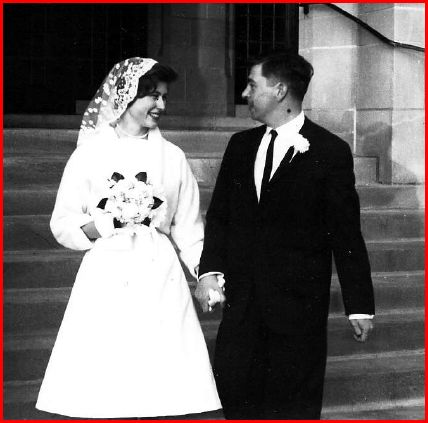
Evadna and Ken
Following in the footsteps of her parents and her older brother, my mother attended Michigan State University. After graduation, she moved to Manistee, Michigan, but neither her job nor her location were exotic or adventurous enough for her. She wanted to see the world and submitted an application to join the newly established Peace Corps.
After he graduated from Idaho State University, my dad, a Massachusetts native who had already seen a great deal of the world while in the Navy, also applied to join the Peace Corps.
They were among the first individuals ever selected and were in the third group deployed. Before they left for Chile, my parents attended training at Notre Dame University, where they spent days in Spanish class. My father excelled with his ability to speak the words perfectly in his loud, booming voice while my mother shot him dirty looks while she struggled.
Her irritation didn’t last long. Before they returned to the United States, my parents were engaged. Instead of a diamond, my mother wore a simple gold band on her right hand that she would transfer to her left hand when she was married. The only diamond I’ve ever seen my mother wear is her mother’s engagement ring, the one that sparkled so brilliantly in 1932.
After returning to the United States, my father, a forester, got a job in Montana. He hadn’t accumulated any leave, but he was allowed to take a few days for Thanksgiving. And so, a wedding the day after Thanksgiving made sense, and my parents spent their honeymoon driving west to their new home.
They’ve spent the rest of their lives sharing stories of their adventures with their children and grandchildren.
Trina and Giles
Ironically, I met my husband on a November night.
On November 8, 1988, I was a college intern helping cover election results in the newsroom at West Virginia Public Radio. Giles was reporting for his first night of work. He thought I had an attitude, and I thought I had work to do. No sparks flew, and I didn’t give him a second thought.
But after I graduated from Ohio University, our paths continued to cross and our circle of friends became one in the same. Over time and shots of Jagermeister, we eventually ended up together.
Our relationship was nothing like I imagined everlasting love was supposed to be and everything my mother had told me it would be. (She’d told me on multiple occasions that common values and compromise, not romance, were the key to a successful relationship.)
In the beginning, our schedules were very different, and we accommodated. Our schedules are still very different, and we still accommodate. In the beginning, we watched a lot of Star Trek. Giles still watches a lot of Star Trek, and sometimes our kids even watch with him. And in the beginning, we laughed at my intensity and his lack of it. Now, we work around our differences… and we still laugh a lot.
Giles and I didn’t get engaged out of some romantic notion of marriage. We got engaged because his roommate bought a house, and logistically, our moving in together just made sense. And when we realized the significance of the year, we picked a very significant wedding date.
Unlike the two couples before us, we didn’t marry over Thanksgiving weekend nor did we get married in Michigan, Instead, our ceremony took place the Monday after Thanksgiving in Charleston, WV. And yes, our wedding was also simple and practical (my mother made my dress), but it was also a bit quirky. We received gifts of Star Trek dinnerware and had Star Trek action figures on top of our cake.
Our children look at the photographs and simply roll their eyes.
The Present
This Thursday marks my 19th wedding anniversary and my parent’s 49th. If they were still alive, my grandparents would be celebrating their 79th.
Those aren’t generally noteworthy numbers, but they are to me. Life and marriage are both fragile, and every day, month and year of marriage should be treasured.
I am under no illusions that future generations will marry on November 29. But I do hope that the stories from all three couples will serve as a reminder that weddings are not about a fancy show or an exotic honeymoon. They are about two people deciding to move forward together and create memories that can bond families together for generations.
A Tale of Two Teachers and Blank Sheets of Paper
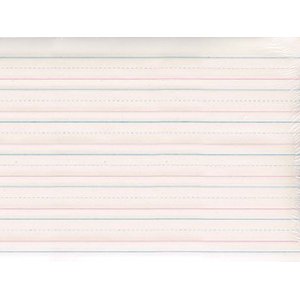
With the current year fading fast and all of the potential of a new year on the horizon, I’d like to suggest a resolution for everyone: don’t write on someone else’s blank sheet of paper.
Whether or not you let someone write on YOUR paper is up to you, but please don’t write on someone else’s.
Personally, I’m resolving to avoid both. For such an outwardly head strong, opinionated person, you might think the first will be more difficult. But, for the unsure, worried and perpetually questioning me inside, the second will be just as challenging.
For years, I’ve let way too many people write on my paper. . . altering my story with their advice, opinions and standards. And the difference between someone who writes on your paper and someone who cheers as you write is long-lasting.
I learned this from two teachers and the blank sheets of paper they expected their students to fill.
I absolutely loved those blank sheets of paper. I loved the smell. I loved the look. And I loved the endless possibilities.
During my grade school years, the paper wasn’t white. It was an indescribable shade of grey and tan with space for a picture above and a combination of dotted and solid lines below. The purpose of the lines was to ensure appropriate hand-writing form.
I never worried about my handwriting (and was generally graded down accordingly). I was much more worried about content. I was fascinated by how I could string words together to say something that nobody else had ever said. I adored the feeling of putting pencil to paper and creating something. And I loved being able to express myself.
What I didn’t love was having parameters placed on me.
And those parameters were set forth quite firmly by my first grade teacher, Mrs. Gladwill. Unfortunately, I can’t really say anything nice about the woman. I could write pages about the horrors of that school year –about the times I was stuck in the corner so other students wouldn’t cheat off me; about how needing to go to the bathroom was a nightmare because it was prohibited during class time (Mrs. Gladwill’s theory was that if you didn’t have the sense to go during recess or lunch, then you should wait); about how Mrs. Gladwill liberally used harsh words and a ruler on knuckles; and, most of all, about how Mrs. Gladwill required conformity.
For a “spirited” child, there’s no wonder that I didn’t thrive in first grade. I simply survived. And was beholden to a series of lessons that led me to believe that sometimes it’s easier to just let others control what goes on your blank sheet of paper.
That became evident when Mrs. Gladwill gave all of her students the assignment of writing (and drawing) an answer to the question “what do you want to be when you grow up?”
At first, I was very excited about the assignment. With Mrs. Gladwill as a teacher, I should have known better.
I wanted to write about becoming a trapeze artist. My father had built and hung a trapeze from a juniper tree in our backyard, and I was already practicing my act.
The problem was, I didn’t know how to spell trapeze.
When I asked Mrs. Gladwill, her only advice was to look it up in the “book of careers” she had provided us.
Needless to say, trapeze artist wasn’t listed.
So I had to ask Mrs. Gladwill again.
Instead of helping me spell out my dream, she advised me to write about something “normal”, like becoming a nurse.
I had no desire to be nurse, but I recognized the authority she had. So, I reluctantly looked up nurse in the career book and wrote about how I wanted to be one. I even remember drawing the picture with particularly harsh strokes: I was angry that Mrs. Gladwill had taken control of MY piece of paper. At the same time, I did not want to be in trouble. So my blank sheet of paper became a full sheet of paper that was a lie.
Turning in that paper marked the end of my dreams of becoming a trapeze artist. Mrs. Gladwill had made it clear: if it wasn’t in the book about careers, there was no sense in pursuing it.
By second grade, my dreams had evolved anyway. My new ambition was to become a writer.
Much to my surprise, my teacher, Mrs. Roth, never told me to look up writer in the “career book.” In fact, she didn’t even have a career book. She simply encouraged me to write stories whenever I had extra time. She even taped my stories on the outside of her classroom door where others could read them. And they did.
I remember swelling with pride when fourth graders stopped by our classroom to read my stories.
Since then, that dream of being a writer has never died. I can’t say I’ve fully achieved that goal, but I never gave it up. It’s hard to give up something when others, particular teachers, believe in you.
So as 2012 approaches, I’m raising a glass to toast the blank sheets of paper everyone will receive in the new year. And I’m toasting the opportunity we all have to continue writing our own unique story without being told what the plot should be. I’m also raising a glass to how we can all cheer each other on. And most of all, I’m raising a glass to the great teachers who lead the way. Not only do they encourage so many of us, but they also serve as examples for other teachers by acknowledging that sometimes the most meaningful lessons aren’t the ones that are taught but are the ones that are observed.
Here’s to that! Cheers!
Ghosts of Christmas Past
Halloween may be the most ghostly holiday, but like Ebenezer Scrooge, I have always found Christmas to be more haunting. 
And just as with Scrooge, my Christmas ghosts remind me of what used to be and what I still hold dear.
Unlike Scrooge, my ghosts don’t necessarily encourage me to reconsider my life path. They are simply reminders about change, about being a parent and about how the best Christmas gifts often go unopened for years and sometimes even decades.
And every holiday season, my ghosts remind me of when I was an adolescent and received gifts that I didn’t unwrap or appreciate until years later.
They were given to me when I was struggling with the usual angst and therefore oblivious to anything my parents were dealing with.
And they were dealing with a lot.
My dad was unhappy with his current employment and seeking a new job. My mom was happy and fulfilled with her role in the community, but supportive of my dad. Therefore, the needs of my dad, the family breadwinner, won out and he accepted a job almost all the way across the country from our Oregon home.
Shortly after accepting the new job, he packed up his Ford truck and our family dog and drove cross-country to West Virginia. And my mother, my brother and I were left behind.
He made the move in early fall, and even through my self-absorbed haze, I knew much my mom didn’t want to move.
She even insisted that no one was going to buy our house anytime soon. But it sold almost immediately, and plans were made for the rest of the family to move to West Virginia over the Christmas holiday.
I continued my life as usual, pretending the change wouldn’t occur. My mother appeared to do the same. And with the holidays approaching, she made sure all the family traditions were kept. We decorated the house and the tree. We participated in holiday events. And we baked Christmas cookies and breads. Our house was warm, festive and inviting. In fact, there were very few indications that our life would soon be disrupted in ways that would take me years to understand.
But that Christmas WAS different.
My dad wasn’t around, and my mom’s eyes would tear up every time ‘”I’ll be Home For Christmas” came on the radio.
Too soon, school was out for winter break, my dad came home to help with the move, we hurriedly celebrated Christmas and just as quickly packed the house. Then we left. Forever.
Initially, I thought I would never adapt to my new life. Everything was different – the way people talked, how they viewed the world and what their priorities were. But I was young, and I eventually adjusted. But because I was young, I was also self-absorbed. So, the fact that my mother was facing the same issues at the “real-world” level didn’t seem important.
I knew she was unhappy. I knew that she went from being a community leader to being someone fairly unknown. And I knew that she just couldn’t conform to the suburban culture that we suddenly found ourselves in.
But I also thought she was “old” and just wasn’t affected by things the way I was. Or at least she knew how to deal with everything better.
I’m now even older than she was at that time, and I know we “old” people don’t always know how to deal. At least I don’t. And I don’t always hide my frustrations and imperfections… not even from my children. And during the holidays, I sometimes simply choke.
But my mom never choked. Even when she was going through one of the hardest times of her life, she never put her own issues, concerns and needs before those of her kids. She pretended that whatever her children were going through was a much greater priority. And she knew the importance of making us feel like we were home, even if she didn’t feel like she was.
That’s why, the Christmas after “the big move” felt just like every other Christmas. We decorated the house with the same decorations that we’d put out in years past. We baked the same cookies and breads that we baked in the past. And we listened to Christmas carols on the scratchy records we’d always listened to. It felt like we were home for Christmas.
I actually received several unwrapped gifts those two Christmas holidays. I received the gift of learning to move forward with my life while still embracing the past. I received the gift of understanding the importance of traditions at Christmas. And I received the gift of a role model who gave of herself at a time when there was often little left to give.
I unwrapped those gifts years ago, but I’ve held onto them. Every year when we hang the decorations on the tree… some which go back to my childhood…these Ghosts of Christmas Past come back to haunt me. And they remind me that life is constantly changing: new people arrive while others leave. Circumstances sometimes improve and sometimes get worse. And sometimes, even the entire culture seems to dramatically shift. But amid these changes, we can still appreciate the Ghosts of Christmas Past, celebrate the Ghosts of Christmas Present and hope that the Ghost of Christmas Yet To Come provide opportunities for our children to open the unwrapped gifts we’ve given them. And that they too are haunted by Ghosts of Christmas Past.


 Just So You Know