Category Archives: Uncategorized
Veterans Day, a Wounded Marine, and the Other Side of the Door
On Monday, October 31, 2011, I left work earlier than usual because it was Halloween and I had important issues to deal with. At least, they seemed important at the time. I needed to make sure my daughter was dressed in her costume, that the jack-o-lanterns were lit and appropriately placed and that we had a plan to ensure the dog behaved himself during trick-or-treat activities.
On that same day, Marine Lance Corporal Brian Felber, was severely wounded in Afghanistan when he stepped on an IED and lost both his legs.
My concerns on Halloween seem unimportant in comparison. But, like most Americans, I was oblivious to the events that changed his and his family’s life forever. I was absorbed in the trivial details of my own life.
But the next day, I was sitting in my office when Jan Callen’s cell phone rang. Like everyone else in the office, I knew the call was from his wife Susie since she has her own ring tone. What we didn’t know was that she was calling to tell Jan about Brian, the husband of their 22 year-old niece.
As a retired Army Colonel, Jan reacted in true military fashion. He adjusted his plans accordingly and took the most appropriate course of action: instead of going to Nashville for the week, he and Susie would go to the Walter Reed in Bethesda to do what they could for Brian and the rest of his family.
In the meantime, I did what I thought was appropriate. I took Jan’s suggestion and liked a Facebook page supporting Brian: https://www.facebook.com/pages/Support-Combat-Wounded-Marine-Brian-Felber/281745445190900.
I admit, at first I did this because it was just what I thought was expected of me in such a situation. I’d never met Brian and didn’t really relate his situation to my own life.
But then I looked at the Facebook page and the photos.
He appears to be a guy I would genuinely like. In one photo, he has his arm around his young wife. In another, he has his arm around a dog. And in yet another, he’s playing with a band.
Dogs and music? Brian seems like my kind of guy.
That Facebook page made him more than just another news story or statistic. He’s become real to me. He is a person with a family and a life outside the military. Yet his service in the military will shape the rest of his life: a life that’s changed forever.
For most of us, our lives are going on as they always do. We pay attention to those things we think directly affect us with very little consideration to those that don’t.
As Jan said when reflecting about the time he spent with Brian and his family this past weekend, “When we were at the hospital, we saw all these young guys with lost limbs and young wives by their side. We saw an entire floor of a parking garage for handicapped parking. And then we went home, and the world goes on like nothing happened.”
His words remind me of lyrics from the Cat Stevens song “Sitting.” They are lyrics I’ve always loved. “Life is like a maze of doors, and they all open from the side you’re on. Just keep on pushing hard boy, try as you may you’re going to wind up where you started from. ”
The meaning of those lyrics can be debated, but to me, they’ve always meant that to move forward, we not only have to think beyond our own circumstances, but we also need to approach life from a perspective other than our own. We need to turn around and walk through the doors from the other direction.
When we do this, we just might actually see and appreciate all the people we never met who have been helping hold doors open for us: people who are contributing to our lives. As someone who didn’t grow up with close family or friends in the military, I’ve too often failed to recognize how members of the military help hold my doors open.
I hope Brian knows that his circumstances have served as a reminder to me. A couple of years ago, my son, Shepherd, also reminded me.
My husband and I were in a parent-teacher conference when Shepherd’s teacher told us she was very impressed with his thoughtful writing. We were surprised and asked what she meant. Apparently, he’d been charged with writing an essay in answer to the question “If you could change places with anyone for one day, who would it be?”
My son had answered a soldier. His reasoning was that, while he never wanted to be a soldier, as an American, he needed to understand what they are going through.
Wise words from a sixth grader and words to think about on this Veteran’s Day.
I hope we all take time think about the side of the door that our active troops and our veterans are facing. Members of our military do what they are asked, and they respond to some horrendous situations. And, most importantly, they do their duty out of love for our country.
On this Veterans Day, we should all consider what we can do to help hold THEIR doors open.
The Gift of a Dead Bee
I’ve finally figured out how to deal with the gift of a dead bee.
It’s only taken most of my life, since no one ever told me what to do with one. Or, at least if someone did, per usual I ignored the advice.
Like most of valuable lessons, I’ve had to learn the hard way – through experience. And, to quote Randy Pausch, “Experience is what you get when you didn’t get what you wanted.”
I’m a very experienced woman. And I’ve been given a lot of dead bees.
 I’m not simply referring to the dead bees, or any other small critters, that my cat brings me as gifts. I’m referring to all the times I’ve been given something that was intended to be a gift – a piece of advice, a kind thought or even responsibility – that I didn’t want. Not only did I not want the gift, but I overreacted to it – if not outwardly then inwardly.
Unfortunately, I’ve wasted a lot of time and energy on dead bees.
My mother was a master at giving them. To be fair, just like my cat, she was giving dead bees out of love. But, unlike my cat’s gifts, hers were harder to deal with.
Even before I hit adolescence, I remember her telling me to accept my body type since it wasn’t going to meet society’s standards for the female form. “It’s o.k. to be a big-boned girl,” she told me. ” I always wanted to be small too, but it’s just not how we are built.”
Really? I don’t remember worrying about my body type. I remember complaining that I wasn’t cool, but I didn’t think that had anything to do with my size. In fact, I never thought my 11-year old body was particularly big… kind of dorky, maybe, but not big. But from that moment on, I was sure my hips were going to grow so large that I wouldn’t be able to walk through doors.
I was almost thirty before a doctor finally convinced me I simply didn’t fit the definition of “big-boned.”
But that was nothing compared to the dead bee my mom gave me when I was 16.
The gift came during a conversation in her car. She had been covering something for the newspaper and was all worked up about the unfair treatment of a female official.
“They just won’t listen to her.” she told me. “They won’t take her seriously because she’s attractive.”
And then my mother did something she rarely ever did. She actually turned and looked at me, instead of looking at the road, while she was driving. It was brief, but it was still memorable.
“You are so lucky,” she told me, “that you are smart rather than pretty.”
That bee stung even though it was already dead. Those are just words no 16 year-old girl wants to hear. Not only did they linger when they came out of her mouth, they hung in the air long enough for me to grab hold of them and carry them with me for years.
Since them, I’ve collected hundreds more dead bees from very well-intentioned people. But only recently have I understood that these dead bees were actually gifts.
My mother’s comments about my looks and my body helped shape who I am: someone who recognizes that character is far more important than appearance.
Dead bees also make good stories. And those who know me best know I’m always telling a story – whether the listener cares or not.
Finally, they shine a spotlight on what’s really important: the relationship with the giver.
A few weeks ago I was making the bed when I flipped up a blanket to find a dead bee on the sheet. My cat had brought me another gift. But instead of freaking out over the fact that I’d been sleeping with a bee, I just laughed. You see, Skitty isn’t the most affectionate cat in the world. My husband calls her mean, but I disagree. Every night, after she thinks we’ve all gone to sleep, she jumps onto the bed and curls up next to me. I love the fact she does that, and if it means dealing with a few dead bees in bed, I’ll accept the trade-off.
In fact, I’m getting really good at dealing with dead bees in general. All it takes is focusing on the intent of the giver rather than on the gift itself.
I say this in recognition of the biggest dead bee my mother ever gave me: the tendency to give them myself. I’m pretty sure I’ve exceeded her abilities at giving dead bees, and I’ve already given a lot of them to my own children.
I can only hope I’ve also passed on how to accept and even embrace them.
Reality Shows, Sports Competitions and Really Confused “Christians”
Either I’m really confused, or a lot of other people are really confused.
Not surprisingly, my sensibilities and my ego lean toward the latter.
Because even though I’m far from being a Biblical scholar, I consider myself a fairly intelligent person. And based on everything I’ve read and been taught, being a Christian means believing and following the teachings of Christ.
Period.
But there seem to be a lot of people who think that being a Christian doesn’t have as much to do with what you do, but instead has everything to do with what you profess to believe. On top of that, these same people seem to think that calling themselves Christian means God will give them what they want based on this “badge of honor” they proudly wear.
While this seems completely off base to me, there are a lot of people who believe the concept.
Just watch reality TV or sports competitions.
I’m not particularly proud of the fact, but being the dork that I am, I’m a fan of the television shows “Survivor” and “The Amazing Race.”
(As a disclaimer, I watch these shows because I’m fascinated by the personal dynamics and contestant interactions. In other words I’m simply doing research for the book I’m going to write someday. At least that’s my story and I’m sticking to it.)
But in watching these shows, I’ve also noticed a trend: every season, there are contestants who not only proclaim that they are Christian, but believe that because of this, they’ve got some kind of upper hand in the competition. In subsequent episodes, they continue to pray and claim that God is on their side and, therefore, they have the advantage.
Call me a cynic, but I’m pretty sure God’s top priorities have nothing to do with who wins a reality TV show.
I’m beginning to wonder if I’m in the minority, though, since a lot of people are buying into this whole “Christians have the upper hand in pretty much pointless competitions” theory.
I’ve seen it time and time again in sports. Athletes describe themselves as “a Christian,” and because of that, they claim God is on their side.
Really?
For some reason, I seriously doubt that God is spending precious time ensuring that the team that prays the most or has the most self-proclaimed Christians is THE team that wins a championship.
Instead, I’m thinking that God’s top priorities have something to do with how we treat and care for each other.
But then again, maybe I’m interpreting Jesus’ message differently. Because I completely buy into the simplified version shared by a friend the other day: “Love God and love each other.”
I don’t think that winning a competition for money or fame falls under either of these commands. I also don’t think prayers are intended to be wish lists for everything we want in life.
As my mother once told me “Don’t pray for what you want. Pray that God gives you the strength, the skills and the direction to deal with the situations you are handed.”
Makes perfect sense to me.
But then, I’m not trying to win a reality TV show or a major sports competition.
I’m just stumbling through life trying to figure out how to spend less time irritated with people and more time doing what I think Jesus meant by “being Christian.”
It’s hard, but on those days when I feel like I’ve made a bit of progress, I feel like a winner.
And that’s the kind of winner I think God is hoping we strive to be.
I Can Suggest Where to Stick Your Labels
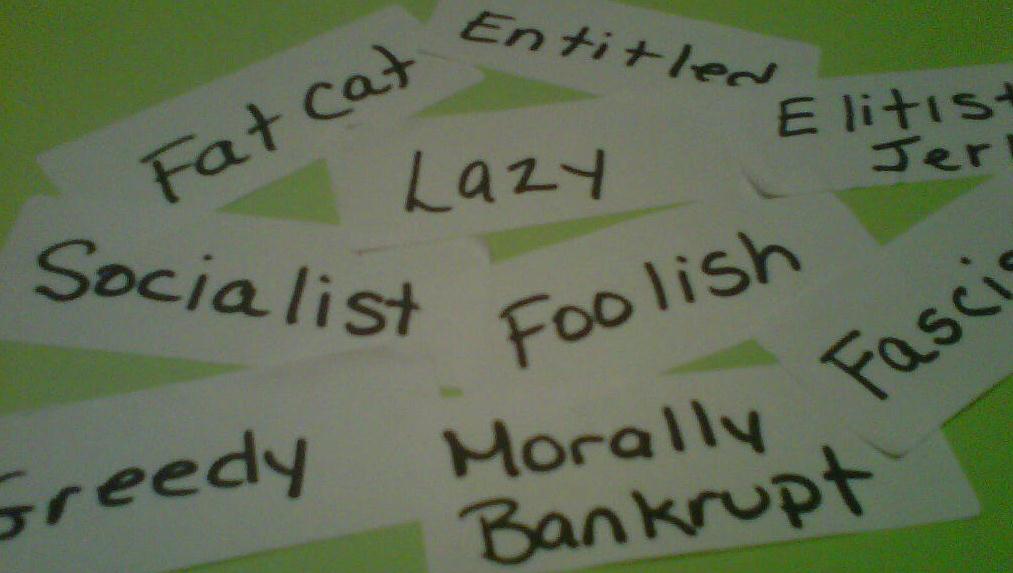 While in the car the other day, I was randomly scanning radio stations when I inadvertently heard a guy who, in my opinion, was giving questionable advice about how to wipe out bullying.
I didn’t give much credence to his advice for three reasons. First, I found him really annoying. That in and of itself really shouldn’t reflect on the validity of his advice – – but it did reflect on my opinion of him and everything he said. Secondly, he was talking in sound bites, and I’ve come to believe sound bites are specifically designed to prevent people from having to think. It allows them to repeat something they’ve heard as an absolute truth without knowing all the facts or putting it into context.
And the third reason?
His simple solution was aimed at changing the behavior of young people without addressing the bigger issue: the adults – – the people who are supposed to be the role models – – who are actually the worst perpetrators. We just don’t call it bullying.
Sometimes we call it politics. Sometimes we call it religion. And sometimes we call it patriotism.
But no matter what we call it, we are simply using acceptable terms to hide the fact that we are practicing the same behaviors as bullies: using labels to belittle those who threaten our beliefs and/or our lifestyle while using other labels to build ourselves up.
I know. I’ve been there. On both sides of that label making frenzy.
I’ve sometimes deemed people who consider themselves conservatives as being self-centered and dogmatic individuals who care more about their own bank accounts than they do about the welfare of others, especially those who are different or less fortunate. I’ve characterized them as people who frame every issue within the lens of their own life circumstances, struggles and successes rather than considering a broad range of factors.
That’s not always accurate or fair. But even though I know a lot of very intelligent, kind-hearted and well-intentioned conservatives, those labels are still there, niggling at the back of my mind and sometimes escaping my lips.
But then, I got labeled. I was told that liberals don’t believe in personal responsibility or living within their means and we don’t like rich people just because they are rich.
For me, nothing can be further from the truth.
But when it comes to labels, the truth doesn’t seem to matter all that much. What matters is they are having a very negative impact on our lives.
For those who want to control our votes, labels make a great tool for dividing us, swaying public opinion and preventing people from digging deeper into the real issues. When we are busy pointing fingers or ridiculing others as being wrong or misguided based on their label, we aren’t engaging in genuine discussions or discovering areas of mutual agreement and understanding. We are simply falling into a trap that’s been set out for us.
Lately, I’ve been trying to avoid that trap for very personal reasons.
I can’t tell my children that name calling and bullying are wrong if I’m not setting a good example. That doesn’t t mean I can’t still be opinionated or call out actions and behaviors that are wrong or against my beliefs. But that’s very different from labeling a person or a group of people with broad generalizations.
It’s not easy, but it just may be worth the effort. If nothing else, I feel like it’s helping me become a more patient person.
And that’s a label I’m willing to stick with.
Lesbian Is Not a Dirty Word
 Relationships with other parents were so much simpler when my children were little. That’s primarily because we all had the same rules for our children: share with each other, don’t hit when you get mad and don’t throw temper tantrums, especially not in public.
But as our children get older, the issues become more complicated. And so do the relationships with other parents. Because the tougher the issues are, the more likely the adults are to have different values and opinions.
Take the issue of love and relationships.
My husband and I have always believed in tolerance and love. It doesn’t matter who you love. What matters is that you do love and, hopefully, are loved back. The power of love is so much greater than bigotry and hate, and we’ve tried to pass down that value to our children.
But not everyone shares that value. There are those people who believe that there is a right kind of love and a wrong kind of love. And they pass that value down to their children.
Unfortunately in that process, they try to pass their values down to other children too.
Take a recent incident in the neighborhood. Like so much neighborhood drama, it started on the school bus.
A neighbor boy called my daughter and her BFF lesbians.
My daughter was completely unaffected by the comment. She probably would have forgotten about it if her best friend hadn’t told her father, who completely freaked out. In fact, I wouldn’t have even know about the incident if the BFF’s parents hadn’t felt the need to include me in on their concerns.
“They were called a name,” the frantic father told me.
“What name?” I asked.
“I can’t say it in front of the girls,” he said. “When they are older and learn what it means, it will scar them.”
This seemed ridiculous to me since his daughter had obviously heard “the name” and had repeated it to him. But, my daughter, who never misses anything, reinforced the concept.
“I already know what ‘it’ means,” she said.
At this point, I was still completely unaware of what “it” was, but my daughter caught my confusion. “Lesbian,” she whispered.
The BFF’s father looked a bit confused then muttered, “Well my daughter doesn’t know what it means.”
Being raised not to think any of this was a big deal, my daughter immediately chimed in, “Yes she does. I told her.”
Here’s the deal. If my son or daughter even mentions an issue related to sex or sexuality, I make sure to contribute to the conversation. I want to ensure they get the facts. I’ve seen the research that shows the more accurate information youth have, the more likely they are to make safe choices when the time comes. Which means there are a lot of interesting, and honest, conversations in my house.
Apparently, those conversations aren’t happening in the home of my daughter’s BFF. Instead, she’s getting her sex education on the school bus.
After getting over his initial shock that my ten-year old daughter had told his ten-year old daughter what a lesbian is, the BFF’s father ranted on.
I only heard a small part of what he was saying. First, I knew I didn’t agree with his concerns. My only concern was that any of the children would use lesbian as a derogatory term. Of course, in the world of ten-year-olds, it was intended to be an insult to two girls who don’t yet shave their legs (which is apparently what the conversation was about). Secondly, I was thinking there are a lot worse names my daughter could have been called.
Regardless of my attention to his rant, my daughter WAS listening because she later wanted to know if lesbian is a dirty word. (My daughter’s new obsession is dirty words, and she’s hyper-vigilant as to anything that even has the appearance of being one.) And even though I reassured her that it wasn’t, she still seems very concerned. Over the last week, I feel like I’ve spent more time undoing the negative influence of the BFF’s father than I ever had to spend on conveying that love is ALWAYS a good thing.
“No,” I told her. “Lesbian is not a dirty word. Prejudice is a dirty word. Bigotry is a dirty word. Hate is a dirty word. But not lesbian. It’s a clean word.”
She seems a bit confused that none of the words I recited were on her list of dirty words, but I know that, through my persistence, they’ll land on her list eventually.
After all, I know a dirty word when I hear one.
It’s Not an Afternoon, or a Morning or Any Other Delight
I’ve never considered myself a snob. Not an “I want to feel more important than someone else” snob, or a food snob or a music snob.
Especially not a music snob. How could I be when you can find me listening to just about anything on my Ipod? And when I say anything, I really do mean anything. The music on my beloved Ipod ranges from musical theater to punk and just about everything in between.
But even I, the person who knows all the lyrics to every song in the musical “Oklahoma,” have my limits.
And they were reached this week at the local Sheetz station.
I admit that I generally enjoy the music playing over the speakers while I pump gas. It tends to be fairly retro, so I can happily sing along to the Eagles or Lynard Skynard or Bob Segar while ignoring the dollar amounts flying by on the gas pump.
I used to think it was a great marketing strategy dreamed up by someone half my age: “Play old-time music, and those middle-aged people with their gas-guzzling SUV’s will be so distracted they won’t care about the cost of gas. They might even buy a made-to-order food item because they aren’t paying attention to the cost.”
I was wrong. Either that, or someone who developed the playlist for Sheetz had absolutely no clue what they were doing.
Because this time, as I swiped my debit card, I heard the strains of a song that took me back – but not in a good way. Instead, it was more like a fingernails scraping on a blackboard way. (For those of you who don’t know what a blackboard is – it’s the prehistoric version of a smart board.)
At first, I couldn’t believe I was actually hearing it. “Gonna f ind my baby gonna hold her tight. Gonna grab some afternoon delight. My motto has always been when it’s right it right. Why wait until the middle of the cold dark night.”
Really? It was only 7:30 in the morning and I was taking my 13-year old son to school.
Instead of putting me in a good mood, the song was irritating me. Really irritating me. Because, even though I don’t like the song, I know the words. So when I went inside to buy a coffee, I actually found myself singing along.
Singing along to one of the most obnoxious songs in history.
I tried voicing my complaint about the music selection to the clerk, but she gave me a completely blank stare, ignored my complaint and asked if I needed anything else. When I told her that what I really needed was for her to change the music, I got another blank stare.
So I reverted to my only other option.
I posted my complaint about the music on Facebook.
By the time I got to the office, there were several comments about my Facebook post, including one trying to convince me the song was actually about the menu at a restaurant and not about an afternoon tryst. But others were eager to set that person straight. And while I appreciated the support, none of the comments were helping get the song out of my head. It was just there.. repeating over and over again.
And since I was suffering, I felt the need to make others suffer. So, I brought the song up on an office computer and made my co-worker listen to it.
Not only was she not happy, but my boss, who had been in an executive committee meeting, took that exact moment to leave the meeting and come into our office. He sauntered over to the computer and asked what I was doing.
What could I say? There, in all its glory was the Starland Vocal Band, singing about rubbing sticks and stones together and making sparks ignite. If the lyrics weren’t bad enough, the band members’ horrible hair and the bell-bottoms were.
My boss glanced at my computer and said, “Hey, I remember that kind of music,” then walked away.
I decided Facebook was safer. I clicked off the video and back onto Facebook. I decided to “like” the comment from the person who said she thought she saw a blog coming on.
And, to her credit, there was.
Not Just Another Walk in the Park
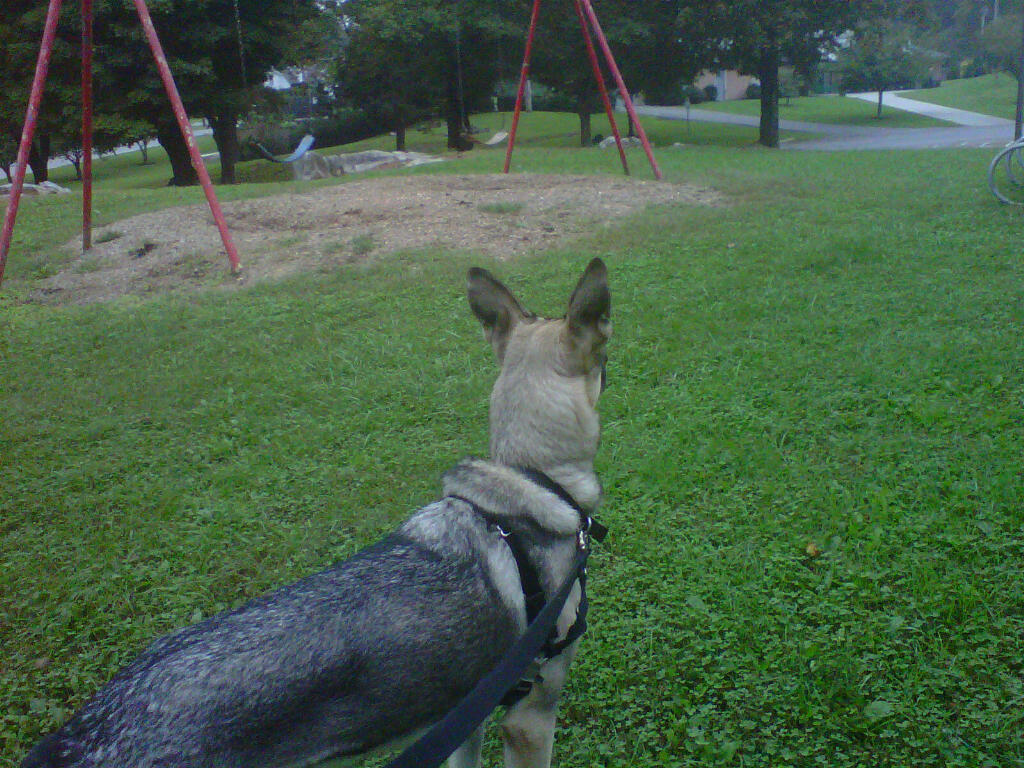
My dog Rodney on a daily walk in the park
I’ve got a habit.
It’s a habit that’s opened my eyes to a side of my town that many people aren’t even aware of. It’s a side of our town that some people look right through – maybe because they don’t want to see it or maybe because they simply don’t know what they are looking at. It’s a side of our town that shows disparity, inequality and absurdity.
But it’s there right out in the open – in the park down the street from my neighborhood. It’s a park where I’ve spent hours and hours of my time.
My husband calls my behavior obsessive. I call it maintaining a routine. But, whatever you call it, I am compelled to take our dog Rodney for a walk in the park at least once, and sometimes twice, a day depending on the weather and how busy my schedule is.
No matter what, we always go in the morning. Always.
On weekdays this means my alarm goes off at 5:00 and we’re in the park by 5:30. On weekends, we’re generally there a bit later.
But no matter the time, those visits to the park provide a glimpse into what’s going on in my town.
This time of year, it’s still dark when I get to the park. But that doesn’t bother me. I’m walking a big German Shepherd, and anyone would be crazy to mess with him. He’s a nice dog, but he isn’t exactly a fan anything, human or otherwise, that he sees moving in the dark.
Besides, just like I have a routine, so do others.
There’s the group of joggers that come running through every other day. There’s the two middle-aged women whose exercise routine is a little less strenuous and who simply walk through the park gossiping. There are always the other dog walkers, although I don’t think they are quite as committed to the whole dog walking thing as I am because they are only there sporadically.
And on Mondays, Wednesdays and Fridays, there’s the group of bankers, accountants, lawyers and others being barked at by an ex-Marine putting them through “boot camp.” I’m always amused by the fact that these professionals pay to have someone tell them to run the bleachers and jump rope at the crack of dawn. But, then, I guess they probably wouldn’t get out of bed for the torture if they weren’t paying for it.
And as the sun begins to rise, I also see what other people have left behind. Clean-up crews haven’t arrived yet, so there’s always quite a bit left from the previous days’ activities and events. There are sweatshirts and shoes; I don’t understand how anyone can leave the park without shoes, but it happens all the time. There are balls and toys; I imagine some of those the parents were happy to leave some of those toys behind. And worst of all, there is litter – lots and lots of litter. Bottles, cans, cups, fast food wrappers, tin foil and popped balloons often lie on picnic tables and on the ground, usually near one of the dozens of trash cans that dot the park.
And, also as the sun rises, I see a man walking through the park. I never know where he’s spent the night, but I do know it’s not in the comfort of a warm home and bed. He’s always carrying his life on his back and something to read in his hand.
Just like many of us, he has his own morning routine. He settles at his favorite table at the shelter by the creek. He takes a water bottle from his backpack and lays his reading materials out before him. He then heads to the restroom, where I assume he grooms as best he can. And then he goes back to his table and reads. He is usually there for a few hours but is always gone by mid-morning. I don’t know where he goes, although at times I have seen him walking the streets of my town during the day.
I’ve come to think of this man as an acquaintance, even though I don’t know his name or his story. But, like any other acquaintance, we always greet each other. I’ve also come to respect this man – not because he is obviously surviving any way he can, but because he’s earned my respect.
Unlike many other patrons of the park, he alway leaves his space cleaner than when he got there. If that means throwing away his trash as well as the trash of others, he does. I’ve seen him do it many, many times.
It might seem like a simple thing, but it’s not simple at all to me. In fact, it seems very complicated.
Because people who can afford to leave behind shoes and sweatshirts have more than this man… a lot more. At the same time, many people who have sufficient material possessions are quick to judge and label those who don’t as lazy. Yet, to me, someone who throws away trash is NOT lazy, and someone who leaves it behind is.
That’s a puzzle I’ll have to ponder on yet another walk through the park.
Tattered Flags
 Like many Americans, I’ve been reflecting about the events that shook our nation ten years ago today.
And, even though my memories of the following days aren’t nearly as vivid, I remember one thing very clearly.
There were American flags everywhere.
They were flying on private homes. They adorned t-shirts and other articles of clothing. And they were fluttering on moving vehicles.
I found this fascinating. Not just because I’d never before seen American flags flying on automobiles as though they were paraphernalia for a sports team, but because the flags were so easily damaged, which seemed to defeat the purpose of flying them.
As a child in Girl Scouts, I remember being taught all the rules about how to handle and treat a flag. As a young adult, I remembered the national debate over the issue of defacing and even burning flags as a sign of protest.
And yet, in the days after 911, people were damaging their flags in the name of patriotism.
At the time, I wasn’t particularly upset by this phenomena; I simply found it interesting. But now, ten years later, the tattered flags represent something much greater to me: while America initially came together after 9 11, we’ve since been tearing apart – kind of like those flags waving on the cars.
I think that’s because some people equate patriotism with pride, pride with winning and winning with defeating an enemy.
There have been and always will be plenty of enemies to our country, we don’t need to be creating them.
But some people seem intent on doing so by pointing fingers at immigrants, people with different religious beliefs, people with different political ideas, people who are poor, etc. The list goes on and on.
Each time fingers point, I hear the American flag rip a bit more. That’s because our flag represents a country that was founded by immigrants. A country that welcomed people who didn’t have the same religious beliefs as the establishment. A country that encouraged diverse ways of thinking. A country that has a rich tradition of helping those who are down on their luck.
Rip.
Rip.
Rip.
Rip.
As the tenth anniversary of September 11 draws to a close, I hope that people focus not only on all the lives that were lost on that horrible day but also on the possibilities that we initially found that day.
The possibility that we could come together as a country to help each other.
The possibility that we were better united than we are divided.
The possibility that we use our diverse strengths to support each other rather than to tear each other down.
The possibility that we live can live up to ideals represented by our flag: a flag that may be a bit torn and ripped but still stands for a compassionate, caring and idealistic country.
A flag we can all fly with pride.
Say Anything… Except…
I’ve never been good at hiding my thoughts and feelings.
NEVER.
When I was a child my mother used to call me Poker Face. Not because I had one but because I didn’t.
If I didn’t like someone or something, everyone knew it.
Not much has changed in the past few decades.
I’ve tried pretending. I’ve tried changing the subject. I’ve even tried wearing sunglasses during meetings so people couldn’t see my eyes roll.
But regardless, in the end I feel compelled to be genuine. In other words, eventually I always end up letting people know what I REALLY think.
Not that I’m trying to be mean. I generally trying to be helpful by being truthful.
The problem is, a lot of people don’t appreciate it.
I used to worry about that, but, like with so many other things that come with age, I’m over it.
Maybe that’s because I’ve had friends tell that they always know where they stand with me. And if they don’t want to know? Than they probably aren’t really my friend anyway.
Maybe it’s because when I give a compliment, it comes from the heart. It isn’t intended just to ingratiate myself to others.
Or maybe it’s because I’m afraid if I hold my true thoughts in, I’ll eventually implode. At least it feels that way.
But just because I’m o.k. with how I am, that doesn’t mean it’s easy to be who I am.
I’m constantly battling to survive in a world where appearances are often appreciated more than reality. Where people ask for feedback when all they really want is a compliment. And where people prefer to complain behind someone’s back while pretending everything is fine to their face.
But I understand you can’t change people or systems overnight. So all I can do is encourage people to at least be honest with me. Since I’m so blunt, I expect others to be the same.
If I ask for feedback, I want genuine feedback.. not just approval. If I say or do something ridiculous? Let me know. And if I ask if my outfit makes me look fat? Consult with my husband.
He’ll tell you the truth about how well I do when people are brutally honest with me.


 Just So You Know