Blog Archives
The Gift of a Dead Bee
I’ve finally figured out how to deal with the gift of a dead bee.
It’s only taken most of my life, since no one ever told me what to do with one. Or, at least if someone did, per usual I ignored the advice.
Like most of valuable lessons, I’ve had to learn the hard way – through experience. And, to quote Randy Pausch, “Experience is what you get when you didn’t get what you wanted.”
I’m a very experienced woman. And I’ve been given a lot of dead bees.
 I’m not simply referring to the dead bees, or any other small critters, that my cat brings me as gifts. I’m referring to all the times I’ve been given something that was intended to be a gift – a piece of advice, a kind thought or even responsibility – that I didn’t want. Not only did I not want the gift, but I overreacted to it – if not outwardly then inwardly.
Unfortunately, I’ve wasted a lot of time and energy on dead bees.
My mother was a master at giving them. To be fair, just like my cat, she was giving dead bees out of love. But, unlike my cat’s gifts, hers were harder to deal with.
Even before I hit adolescence, I remember her telling me to accept my body type since it wasn’t going to meet society’s standards for the female form. “It’s o.k. to be a big-boned girl,” she told me. ” I always wanted to be small too, but it’s just not how we are built.”
Really? I don’t remember worrying about my body type. I remember complaining that I wasn’t cool, but I didn’t think that had anything to do with my size. In fact, I never thought my 11-year old body was particularly big… kind of dorky, maybe, but not big. But from that moment on, I was sure my hips were going to grow so large that I wouldn’t be able to walk through doors.
I was almost thirty before a doctor finally convinced me I simply didn’t fit the definition of “big-boned.”
But that was nothing compared to the dead bee my mom gave me when I was 16.
The gift came during a conversation in her car. She had been covering something for the newspaper and was all worked up about the unfair treatment of a female official.
“They just won’t listen to her.” she told me. “They won’t take her seriously because she’s attractive.”
And then my mother did something she rarely ever did. She actually turned and looked at me, instead of looking at the road, while she was driving. It was brief, but it was still memorable.
“You are so lucky,” she told me, “that you are smart rather than pretty.”
That bee stung even though it was already dead. Those are just words no 16 year-old girl wants to hear. Not only did they linger when they came out of her mouth, they hung in the air long enough for me to grab hold of them and carry them with me for years.
Since them, I’ve collected hundreds more dead bees from very well-intentioned people. But only recently have I understood that these dead bees were actually gifts.
My mother’s comments about my looks and my body helped shape who I am: someone who recognizes that character is far more important than appearance.
Dead bees also make good stories. And those who know me best know I’m always telling a story – whether the listener cares or not.
Finally, they shine a spotlight on what’s really important: the relationship with the giver.
A few weeks ago I was making the bed when I flipped up a blanket to find a dead bee on the sheet. My cat had brought me another gift. But instead of freaking out over the fact that I’d been sleeping with a bee, I just laughed. You see, Skitty isn’t the most affectionate cat in the world. My husband calls her mean, but I disagree. Every night, after she thinks we’ve all gone to sleep, she jumps onto the bed and curls up next to me. I love the fact she does that, and if it means dealing with a few dead bees in bed, I’ll accept the trade-off.
In fact, I’m getting really good at dealing with dead bees in general. All it takes is focusing on the intent of the giver rather than on the gift itself.
I say this in recognition of the biggest dead bee my mother ever gave me: the tendency to give them myself. I’m pretty sure I’ve exceeded her abilities at giving dead bees, and I’ve already given a lot of them to my own children.
I can only hope I’ve also passed on how to accept and even embrace them.
I Can Suggest Where to Stick Your Labels
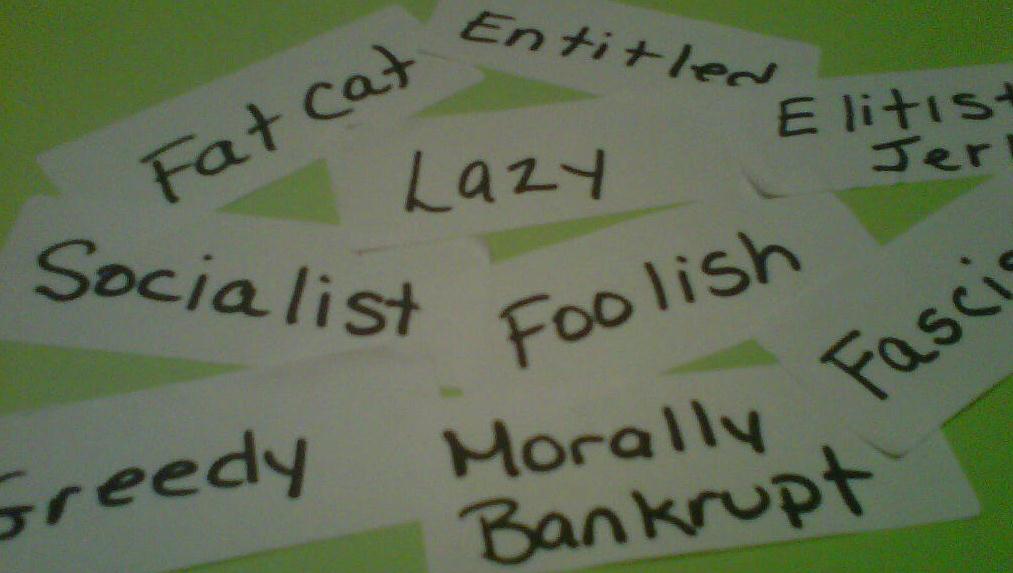 While in the car the other day, I was randomly scanning radio stations when I inadvertently heard a guy who, in my opinion, was giving questionable advice about how to wipe out bullying.
I didn’t give much credence to his advice for three reasons. First, I found him really annoying. That in and of itself really shouldn’t reflect on the validity of his advice – – but it did reflect on my opinion of him and everything he said. Secondly, he was talking in sound bites, and I’ve come to believe sound bites are specifically designed to prevent people from having to think. It allows them to repeat something they’ve heard as an absolute truth without knowing all the facts or putting it into context.
And the third reason?
His simple solution was aimed at changing the behavior of young people without addressing the bigger issue: the adults – – the people who are supposed to be the role models – – who are actually the worst perpetrators. We just don’t call it bullying.
Sometimes we call it politics. Sometimes we call it religion. And sometimes we call it patriotism.
But no matter what we call it, we are simply using acceptable terms to hide the fact that we are practicing the same behaviors as bullies: using labels to belittle those who threaten our beliefs and/or our lifestyle while using other labels to build ourselves up.
I know. I’ve been there. On both sides of that label making frenzy.
I’ve sometimes deemed people who consider themselves conservatives as being self-centered and dogmatic individuals who care more about their own bank accounts than they do about the welfare of others, especially those who are different or less fortunate. I’ve characterized them as people who frame every issue within the lens of their own life circumstances, struggles and successes rather than considering a broad range of factors.
That’s not always accurate or fair. But even though I know a lot of very intelligent, kind-hearted and well-intentioned conservatives, those labels are still there, niggling at the back of my mind and sometimes escaping my lips.
But then, I got labeled. I was told that liberals don’t believe in personal responsibility or living within their means and we don’t like rich people just because they are rich.
For me, nothing can be further from the truth.
But when it comes to labels, the truth doesn’t seem to matter all that much. What matters is they are having a very negative impact on our lives.
For those who want to control our votes, labels make a great tool for dividing us, swaying public opinion and preventing people from digging deeper into the real issues. When we are busy pointing fingers or ridiculing others as being wrong or misguided based on their label, we aren’t engaging in genuine discussions or discovering areas of mutual agreement and understanding. We are simply falling into a trap that’s been set out for us.
Lately, I’ve been trying to avoid that trap for very personal reasons.
I can’t tell my children that name calling and bullying are wrong if I’m not setting a good example. That doesn’t t mean I can’t still be opinionated or call out actions and behaviors that are wrong or against my beliefs. But that’s very different from labeling a person or a group of people with broad generalizations.
It’s not easy, but it just may be worth the effort. If nothing else, I feel like it’s helping me become a more patient person.
And that’s a label I’m willing to stick with.
Lesbian Is Not a Dirty Word
 Relationships with other parents were so much simpler when my children were little. That’s primarily because we all had the same rules for our children: share with each other, don’t hit when you get mad and don’t throw temper tantrums, especially not in public.
But as our children get older, the issues become more complicated. And so do the relationships with other parents. Because the tougher the issues are, the more likely the adults are to have different values and opinions.
Take the issue of love and relationships.
My husband and I have always believed in tolerance and love. It doesn’t matter who you love. What matters is that you do love and, hopefully, are loved back. The power of love is so much greater than bigotry and hate, and we’ve tried to pass down that value to our children.
But not everyone shares that value. There are those people who believe that there is a right kind of love and a wrong kind of love. And they pass that value down to their children.
Unfortunately in that process, they try to pass their values down to other children too.
Take a recent incident in the neighborhood. Like so much neighborhood drama, it started on the school bus.
A neighbor boy called my daughter and her BFF lesbians.
My daughter was completely unaffected by the comment. She probably would have forgotten about it if her best friend hadn’t told her father, who completely freaked out. In fact, I wouldn’t have even know about the incident if the BFF’s parents hadn’t felt the need to include me in on their concerns.
“They were called a name,” the frantic father told me.
“What name?” I asked.
“I can’t say it in front of the girls,” he said. “When they are older and learn what it means, it will scar them.”
This seemed ridiculous to me since his daughter had obviously heard “the name” and had repeated it to him. But, my daughter, who never misses anything, reinforced the concept.
“I already know what ‘it’ means,” she said.
At this point, I was still completely unaware of what “it” was, but my daughter caught my confusion. “Lesbian,” she whispered.
The BFF’s father looked a bit confused then muttered, “Well my daughter doesn’t know what it means.”
Being raised not to think any of this was a big deal, my daughter immediately chimed in, “Yes she does. I told her.”
Here’s the deal. If my son or daughter even mentions an issue related to sex or sexuality, I make sure to contribute to the conversation. I want to ensure they get the facts. I’ve seen the research that shows the more accurate information youth have, the more likely they are to make safe choices when the time comes. Which means there are a lot of interesting, and honest, conversations in my house.
Apparently, those conversations aren’t happening in the home of my daughter’s BFF. Instead, she’s getting her sex education on the school bus.
After getting over his initial shock that my ten-year old daughter had told his ten-year old daughter what a lesbian is, the BFF’s father ranted on.
I only heard a small part of what he was saying. First, I knew I didn’t agree with his concerns. My only concern was that any of the children would use lesbian as a derogatory term. Of course, in the world of ten-year-olds, it was intended to be an insult to two girls who don’t yet shave their legs (which is apparently what the conversation was about). Secondly, I was thinking there are a lot worse names my daughter could have been called.
Regardless of my attention to his rant, my daughter WAS listening because she later wanted to know if lesbian is a dirty word. (My daughter’s new obsession is dirty words, and she’s hyper-vigilant as to anything that even has the appearance of being one.) And even though I reassured her that it wasn’t, she still seems very concerned. Over the last week, I feel like I’ve spent more time undoing the negative influence of the BFF’s father than I ever had to spend on conveying that love is ALWAYS a good thing.
“No,” I told her. “Lesbian is not a dirty word. Prejudice is a dirty word. Bigotry is a dirty word. Hate is a dirty word. But not lesbian. It’s a clean word.”
She seems a bit confused that none of the words I recited were on her list of dirty words, but I know that, through my persistence, they’ll land on her list eventually.
After all, I know a dirty word when I hear one.
Please Don’t Feed the Drama Queen
 My house was invaded by bees this month. Well, according to my husband, they are yellow jackets. But to me? Anything that has stripes, wings and a stinger is a bee.
But regardless of their taxonomy, they invaded my basement and my life.
We eventually got rid of them thanks to our hero, Gary the Exterminator Guy. But, in the meantime, they created a bit of drama in the house.
I should have expected that. I live with a drama queen. The invasion of the stinging beasts simply emphasized that fact.
I warned my kids that the bees, make that yellow jackets, dying in the basement could still sting. My son, per normal, didn’t listen. Instead, he went barefoot into the Kid Cave, stepped on a yellow jacket and got stung. He then calmly came upstairs to tell me he’d been stung and his foot hurt. That was it. The incident was over, and he never mentioned it again.
My daughter, on the other hand, over reacted as usual.
She was already perturbed that I didn’t share her belief that the start of school also marks the beginning of Halloween season. She was insistent that the time to decorate had come. When I didn’t respond to her demands to bring up the tub of Halloween decorations up from the basement, she took matters into her own hands.
But, a dying yellow jacket had found the tub first. Keep in mind, it had died. It could have been easily flicked away. But, that would have been under normal circumstances when a drama queen wasn’t involved.
A drama queen changes everything.
My daughter ALMOST touched the yellow jacket, and the subsequent scream traveled farther than the recent earthquake that shook the East Coast.
I absolutely love my daughter, but about eight years ago I came to the inevitable conclusion that Shakespeare knew a girl just like her when he said “all the world’s a stage.”
On the positive side, there are benefits to being the mother of a drama queen. It not only helps you to be less reactive, it also helps you to completely ignore it.
Which is a good thing considering what’s going on in our country right now. We’ve got a lot of drama queens and people who encourage them. I’m not sure which is worse.
Anyone who has lived or worked with a drama queen, knows this is someone who blows things way out of proportion. A drama queen often views the world in absolutes. In short, drama queens are all about creating crisis out of any situation. And the more people pay attention, the more drama ensues.
If you pay any attention to the news, you probably think the world is being taken over by drama queens. If the invasion of the yellow jackets had made the news? I’m pretty sure there would be a world-wide scare and a call to exterminate every flying insect.
Sadly, I’m pretty sure that a lot of people pay more attention to drama queens than they are to the facts.
I’m not saying our country is perfect or that changes don’t need to be made.
But I am saying that using fear or emotional blackmail to drive the political process is completely ridiculous. Very few matters or situations are black and white, but drama queens love black and white.
They thrive on it.
But, as the mom of a drama queen , I’ve learned that one of the best way to deal with faux drama is to simply complicate matters. Add facts, variables and diverse opinions. Instead of creating drama, create genuine discussion.
And if the drama continues anyway? Simply do what I do with my daughter – ignore it.
I’m pretty sure it works with most drama queens.
I’d like to create some more buzz about the issue. But, the moment, I’ve had enough of both buzz and drama.
For my mom on Mother’s Day
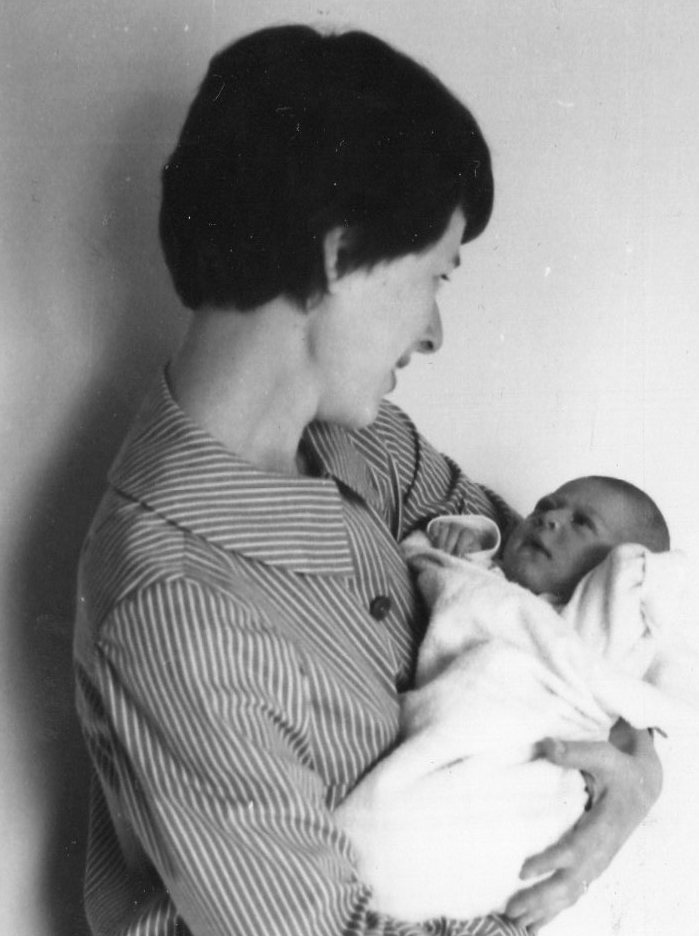
Evadna and Trina February 1967
As Mother’s Day drew near, I once again found myself shopping for the perfect card for my mother.
Shopping for my mother is never an easy task, but card shopping for her is next to impossible.
I just can’t equate any of the flowery, sappy cards with my mother.
Granted, I’m not the flowery, sappy type myself, but compared to her? I’m a sentimental fool. I would be kidding myself and others if I claimed I had never wished my mother was the warm fuzzy type. Or that I didn’t find her a bit too serious and intense. Or that on more than one occasion (count hundreds in my teen years), I’d wished she was more like other mothers.
But I’d also be kidding myself if I didn’t recognize that if it weren’t for my mom, I wouldn’t be me. And, although it’s taken way too many years for me to publicly admit the fact, I really do like myself. So thanks Mom.
Thanks for living your life on your own terms and not bending to societal pressures. And thanks for expecting that I do the same.
Thanks for having the fortitude to speak out for what you believe, even when everyone else is keeping quiet. And thanks for expecting I do the same.
Thanks for taking on stereotypical male roles and responsibilities. And thanks for expecting I do the same.
Thanks for living a life that demonstrates what you do for others is more important than accumulating material possessions. And thanks for expecting I do the same.
Thanks for taking time to pursue your own dreams and passions while still ensuring your children get everything they need. And thanks for expecting I do the same.
And while I am grateful for everything my mom is and did, I’ve never have found the perfect Mother’s Day card to share that message. This year, I settled on one that simply said “You are special.” But I wish I could find the perfect card for her.
It would be a card that tells her to relax. She did her job as mother, and she did it brilliantly. It would tell her that she needs to stop worrying about her perceived missteps and focus on the facts: both of her kids turned out just fine. We never went to jail and we never made headlines for our bad behavior (at least I never made headlines for my bad behavior, I’m not sure my brother even participated in bad behavior.)
It would tell her she helped stack the odds in our favor so that we could live happy, productive lives. We are both well-educated, we are both responsible for ourselves and our own families and we are both parents who greatly appreciate that we had positive role models in our parents.
Most importantly, the card would tell her that she gave her children the best gift of all: the gift of knowing we are accepted and appreciated for being who we are with all our own flaws and quirks.
So instead of providing her with the perfect card, the best I can do is write my thoughts and share them with anyone who is willing to read them.
Happy Mother’s Day Mom.
I love you!


 Just So You Know